
How champagne bubbles form: the science explained
Champagne effervescence is defined as the release of dissolved carbon dioxide gas from wine after the bottle is opened, triggered by a pressure drop and microscopic nucleation sites on the glass surface. Understanding how champagne bubbles form reveals a process far more intricate than simple carbonation. The bubbles you see rising in a flute are the visible result of secondary fermentation, dissolved gas physics, and the unique chemistry of wine. Each element shapes the character, aroma, and mouthfeel of what is arguably the world’s most celebrated sparkling wine.
What is secondary fermentation and how does it create CO2 in champagne?
Secondary fermentation, known in French Champagne production as prise de mousse, is the process that creates the dissolved carbon dioxide responsible for champagne’s effervescence. Winemakers add a precise mixture of yeast and sugar, called the liqueur de tirage, to the base wine before sealing the bottle. The yeast then consumes approximately 4 g/L of sugar, converting it to alcohol and CO2 under pressure, reaching around 5–6 atmospheres inside the sealed bottle.
That pressure is roughly three times the pressure inside a standard car tyre. At that level, CO2 remains fully dissolved in the wine. No bubbles are visible at this stage because the gas has nowhere to go. The wine simply holds it in solution, waiting for the moment the cork is drawn.
Temperature and fermentation speed during this stage have a direct bearing on bubble quality. Slow, cool secondary fermentation produces smaller, finely persistent bubbles that contribute to a smoother mouthfeel, whereas faster fermentation at higher temperatures generates larger, harsher bubbles. This is why Champagne producers cellar their bottles at carefully controlled temperatures, often between 10°C and 12°C, for months or years.
Aging on lees, the spent yeast cells left in the bottle after fermentation, further refines the mousse. Compounds released during autolysis, the breakdown of yeast cells, act as natural surfactants that later stabilise bubble chains during serving. The longer a champagne ages on lees, the finer and more persistent its effervescence tends to be.
Pro Tip: When selecting a champagne for a special occasion, look for extended lees aging on the label. Non-vintage Champagnes aged for 15 months or more on lees, and vintage cuvées aged for three years or longer, typically deliver noticeably finer and more persistent bubbles.
How does bubble formation begin when the bottle is opened?
Bubble formation begins the instant the cork leaves the bottle. The pressure inside drops from around 5–6 atmospheres to standard atmospheric pressure, and the wine instantly becomes supersaturated with CO2. This means the wine holds far more dissolved gas than it can stably contain at the new, lower pressure. The gas must escape, and it does so through a process called nucleation.
The sequence of champagne bubble formation follows a clear physical logic:
- Nucleation initiation. CO2 escapes from solution at specific microscopic sites on the glass surface, including glass imperfections and micro-particles such as tiny fibres or scratches. These sites trap stable pockets of gas that serve as the starting point for each bubble.
- Bubble growth. Once a gas pocket forms at a nucleation site, dissolved CO2 diffuses into it continuously. The bubble grows larger as more gas joins the pocket, driven by the principle described by Henry’s law: CO2 solubility decreases as pressure drops, so the gas actively seeks to leave the liquid.
- Ascent. When the bubble reaches sufficient size, buoyancy overcomes surface tension and the bubble detaches from the nucleation site. It rises through the wine, collecting more CO2 as it ascends, growing slightly larger along the way.
- Surface rupture. At the surface, the bubble bursts, releasing a fine spray of aromatic droplets into the air above the glass.
Bubbles do not appear randomly across the glass surface. They form at consistent, predictable spots wherever nucleation sites exist. This is why you often see a steady stream of bubbles rising from the same point at the base or side of a flute, rather than appearing uniformly throughout the wine.
Pro Tip: A glass that appears visually clean may still carry invisible fibres from a cloth or dishwasher residue. These act as nucleation sites and can dramatically increase bubble activity. For the finest effervescence, rinse glasses with still water and allow them to air dry before pouring.
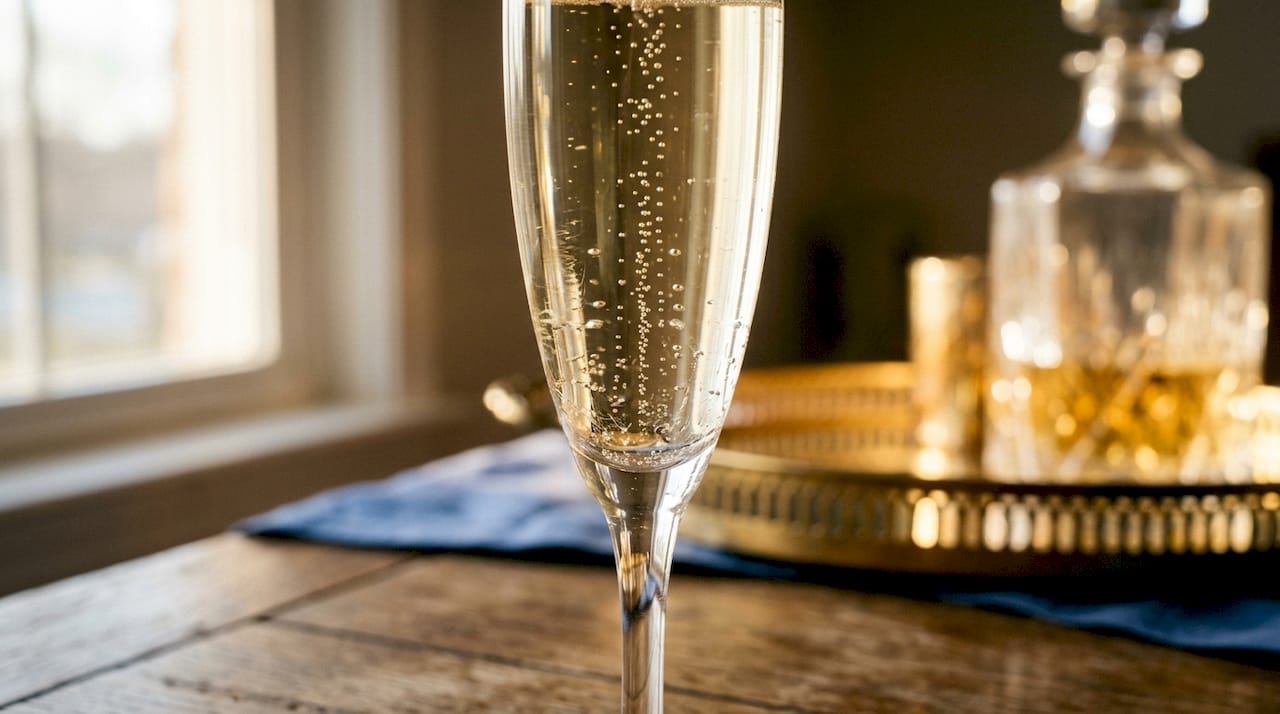
Why do champagne bubbles rise in tidy, single-file chains?
Champagne bubbles rise in stable vertical chains, and this behaviour is not shared by soda water or beer. The reason lies in champagne’s unique chemical composition. Champagne contains more surfactant-like compounds than soda or beer, and these compounds alter the fluid dynamics around each rising bubble.
In a glass of soda water, bubbles wobble and drift sideways as they rise because the liquid behind each bubble creates turbulent wake currents. In champagne, surfactants coat the surface of each bubble and dampen that turbulence. The wake behind a rising champagne bubble remains stable and narrow, which guides the next bubble forming at the nucleation site directly upward into the same path. The result is the elegant, single-file column that defines champagne’s visual character.
This matters beyond aesthetics. Stable bubble chains mean each bubble travels a longer, more controlled path to the surface. The bubble has more time to grow and collect CO2 during its ascent. A larger, well-formed bubble carries more dissolved aromatic compounds to the surface, where it bursts and releases them as aerosols toward the nose. The surfactant chemistry that creates the visual elegance of champagne also amplifies its aromatic delivery.
The contrast with beer is instructive. Beer bubbles form in chaotic clusters, collide, and merge. Champagne bubbles, guided by their surfactant coating, remain discrete and orderly. That distinction is a direct expression of champagne’s complex organic chemistry, built over months of fermentation and lees aging.
How do glass choice and temperature affect champagne bubbles?
Serving conditions shape the entire bubble experience, from the moment the wine is poured to the last sip. Temperature is the first variable. Lower temperatures increase CO2 solubility, meaning the wine holds gas in solution more readily and releases it more slowly. A champagne served at 8°C produces a finer, more restrained effervescence than the same wine served at 16°C, where bubbles form rapidly and dissipate quickly.
Glass shape is equally significant. The table below summarises the key differences between the two most common champagne glass formats.
| Feature | Flute | Tulip |
|---|---|---|
| Bubble column length | Long, concentrated | Moderate, broader |
| Aroma concentration | Limited, narrow opening | Superior, wider bowl traps and releases aromas |
| Nucleation surface area | Minimal | Greater, more bubble streams |
| Visual appeal | Classic, elegant column | Richer effervescence display |
| Recommended use | Toasting, visual presentation | Tasting, appreciating complex cuvées |
The tulip glass, now favoured by many Champagne houses including Laurent-Perrier, allows the wine’s aromatic compounds to collect above the liquid before reaching the nose. The flute, while visually striking, can restrict aroma delivery. For a wine as nuanced as vintage Champagne, the tulip format reveals more of what the winemaker intended.
Glass surface treatment also plays a direct role. Many quality champagne glasses are laser-etched or mechanically scratched at the base to create intentional nucleation points. Optimum bubble size for aroma evaporation is approximately 3.4 mm, and etched glasses reliably produce bubbles within that range by controlling where and how nucleation begins.
Pro Tip: Chill your champagne to between 8°C and 10°C before serving. Pouring at this temperature slows CO2 release, preserves the mousse longer in the glass, and gives you more time to appreciate the full aromatic profile before the effervescence fades.
How many bubbles are in a bottle, and what do they actually do?
A standard 75cl bottle of champagne can theoretically produce around 49 million bubbles during full CO2 release, though the actual number varies considerably with temperature, glass shape, surface roughness, and aging. That figure is not merely a curiosity. It represents the total aromatic delivery mechanism of the wine.
“Each bubble that bursts at the surface of a champagne glass releases a fine aerosol of aromatic droplets, carrying volatile compounds from the wine directly toward the nose. The bubbles are not decoration. They are the primary vehicle for champagne’s aromatic expression.”
The bubble lifecycle follows four stages: nucleation, growth via CO2 diffusion, ascent driven by buoyancy and surfactant effects, and surface rupture releasing aromatic aerosols. Each stage contributes to the tasting experience. Nucleation determines where and how consistently bubbles form. Growth determines their size and CO2 load. Ascent determines how long they travel and how much aromatic material they collect. Rupture delivers that material to the senses.
Bubble count and quality also reflect the wine’s age and production method. A prestige cuvée aged for six or more years on lees will typically produce finer, more persistent bubbles than a young non-vintage release. The extended autolysis of yeast cells deposits additional surfactant compounds into the wine, refining the mousse over time. When you observe the effervescence in a mature vintage champagne, you are seeing the physical expression of years of careful cellaring.
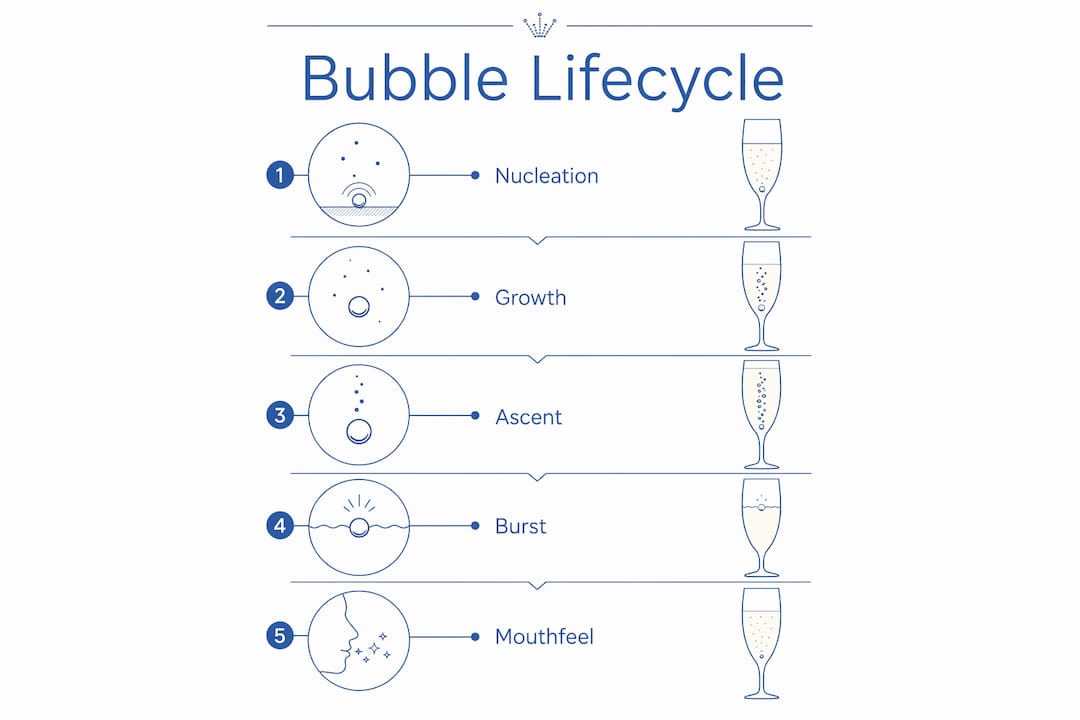
Mouthfeel is the final dimension. Fine, persistent bubbles create a sensation of creaminess and lift on the palate. Coarser bubbles feel aggressive and dissipate quickly, leaving the wine flat before the finish. The difference between a well-made grower Champagne and a poorly produced sparkling wine is often felt in the texture of the mousse as much as it is tasted in the flavour.
Key takeaways
Champagne bubbles form through a precise sequence of secondary fermentation, CO2 supersaturation, nucleation on glass surfaces, and surfactant-guided ascent, with every variable from temperature to glass shape shaping the final sensory experience.
| Point | Details |
|---|---|
| Secondary fermentation creates dissolved CO2 | Yeast converts sugar to CO2 under 5–6 atmospheres of pressure inside the sealed bottle. |
| Nucleation sites trigger bubble birth | Glass imperfections and micro-fibres provide stable gas pockets where bubbles reliably begin. |
| Surfactants create single-file bubble chains | Champagne’s unique chemistry stabilises bubble wakes, producing the characteristic vertical column. |
| Temperature and glass shape control bubble quality | Serving at 8–10°C in a tulip glass preserves mousse and maximises aromatic delivery. |
| Bubbles are the primary aroma vehicle | Each bursting bubble releases aromatic aerosols, making effervescence central to tasting, not merely visual. |
Aptent’s perspective on appreciating champagne effervescence
The science of champagne bubbles is genuinely one of the more elegant intersections of chemistry and sensory pleasure. What strikes Aptent most, having worked closely with grower Champagne houses and prestige cuvées, is how rarely the effervescence itself receives the attention it deserves during tasting. Most people look at the bubbles and move on. The more rewarding approach is to pause and observe the column before the first sip.
A common misconception is that bubbles are created during pouring. They are not. Bubbles form from dissolved CO2 that was already present in the wine, waiting for the pressure drop that opening the bottle provides. The pour simply introduces the wine to a new environment. The nucleation sites on the glass do the rest. Understanding this shifts the way you read a glass. A wine with fine, persistent, single-file chains is telling you something about its fermentation, its aging, and its chemistry.
Aptent’s practical advice: experiment with the same champagne in two different glasses on the same occasion. Pour a flute and a tulip side by side. The difference in aroma concentration and bubble behaviour is immediately apparent, and it reframes how you think about serving champagne at home. The glass is not a passive vessel. It is an active participant in the tasting experience.
— Aptent
Premium champagnes worth experiencing for yourself
Aptent curates a selection of French grower Champagnes sourced directly from boutique houses in the Champagne region, chosen specifically for the finesse of their effervescence and the complexity of their aromatic profiles.
For those who appreciate the full sensory occasion, Aptent’s gourmet champagne collection pairs beautifully with Baeri and Osciètre signature caviars, creating a tasting experience where the aromatic aerosols of fine effervescence meet the briny richness of exceptional roe. Whether you are selecting for a private dinner, a corporate event, or a curated gift, Aptent’s collection reflects the same attention to provenance and quality that the science of champagne bubbles demands.
FAQ
What causes champagne to have bubbles?
Champagne bubbles form because secondary fermentation inside the sealed bottle dissolves CO2 into the wine under high pressure. When the bottle is opened, the pressure drops and the CO2 escapes as bubbles through nucleation sites on the glass.
Why do champagne bubbles rise in a straight line?
Surfactant compounds in champagne stabilise the wake behind each rising bubble, guiding subsequent bubbles into the same vertical path. This behaviour is unique to champagne and does not occur in soda water or beer.
How many bubbles does a bottle of champagne produce?
A standard 75cl bottle can theoretically produce around 49 million bubbles, though the actual count varies with serving temperature, glass surface, and the wine’s age and production method.
Does glass shape affect champagne bubbles?
Glass shape directly affects bubble formation and aroma delivery. A tulip glass produces more nucleation streams and concentrates aromas more effectively than a flute, making it the preferred choice for tasting complex cuvées.
Does serving temperature change champagne effervescence?
Lower temperatures increase CO2 solubility, slowing bubble release and preserving the mousse for longer. Serving champagne at 8°C to 10°C produces finer, more persistent effervescence than serving it warmer.


