
Managing fine wine cellar inventory: the collector's guide
Fine wine cellar inventory management is the practice of systematically tracking, organising, and maintaining every bottle in your collection to protect ageing potential and ensure the right wine reaches the glass at the right moment. A well-run cellar is not simply a storage space. It is a living catalogue of investment, pleasure, and occasion. Tools like InVintory, CellarTracker, and WineBox have made this discipline accessible to serious collectors at every scale, yet the discipline itself demands more than software. It requires deliberate physical organisation, consistent intake habits, and scheduled audit cycles that keep your records as refined as the wines they represent.
What are the ideal storage conditions for fine wine cellars?
Stable temperature between 10–15°C is the single most critical factor in fine wine preservation. Chemical reactions in wine double with every 10°C increase in temperature, which means a cellar running warm accelerates ageing far beyond any winemaker’s intention. Stability matters more than hitting an exact number. A cellar holding a steady 13°C outperforms one swinging between 10°C and 18°C every season.
Relative humidity of 60–70% protects cork-sealed bottles from two opposing threats. Below 50% RH, corks dry out and shrink, allowing oxygen to enter the bottle and oxidise the wine prematurely. Above 80% RH, mould colonises corks and labels, degrading both the wine and its resale presentation. A calibrated hygrometer placed at mid-cellar height gives the most reliable reading.
Light and vibration are less discussed but equally damaging. UV light degrades phenolic compounds in wine, producing what sommeliers call “light strike,” a flat, cardboard-like character that no amount of ageing will correct. Vibration from nearby machinery or foot traffic disturbs sediment and disrupts the slow chemical processes that build complexity over time. Purpose-built wine fridges from brands like EuroCave and Liebherr address all four variables in a single unit, making them the preferred choice for collectors without a dedicated underground cellar.
Pro Tip: Install a data-logging thermometer and hygrometer that records hourly readings. Review the log monthly rather than relying on a single spot-check. Patterns reveal problems that a single reading will miss.
How to set up accurate wine cellar inventory records
Accurate fine wine inventory management begins at the moment a bottle enters the cellar, not after it is already shelved. Treating intake as a formal receiving process prevents the most common source of inventory drift: bottles logged without location, drinking window, or purchase metadata.
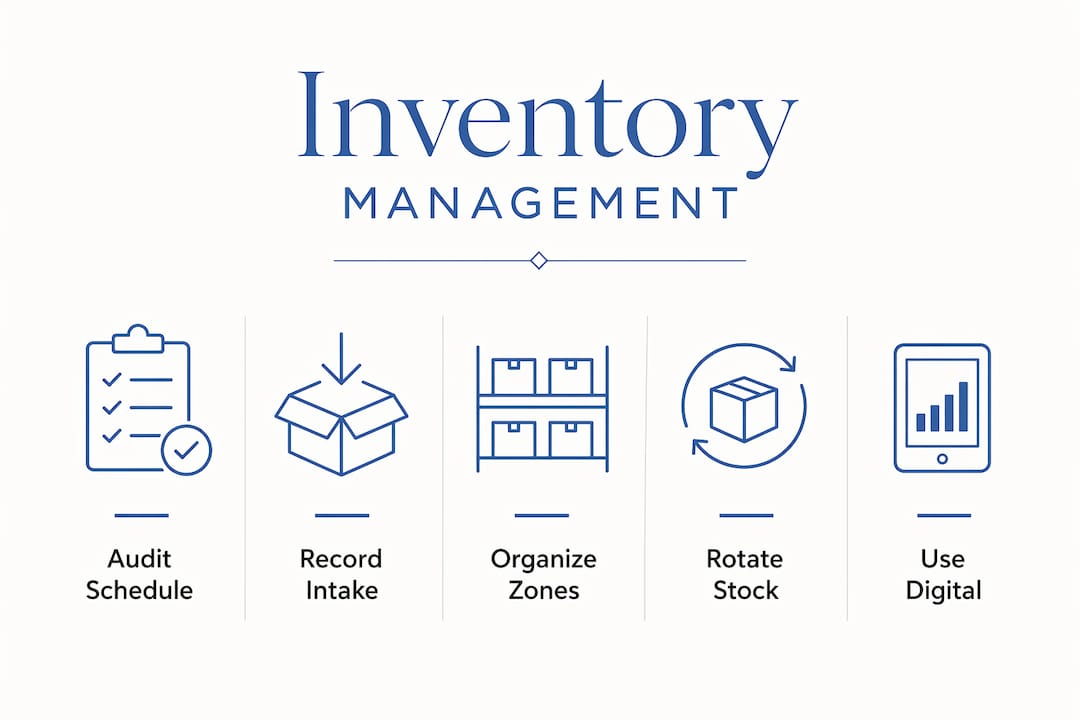
A reliable intake workflow follows four steps.
- Scan the label. Apps like WineBox and InVintory use AI-based metadata extraction to pull producer, vintage, appellation, and critic scores from a single label photograph. This removes manual transcription errors and reduces entry time to under a minute per bottle.
- Assign a physical location. Every bottle receives a rack, row, and slot designation at intake. Vague entries like “back of cellar” are the primary cause of lost bottles in collections exceeding 100 units.
- Record the drinking window. Entering the drinking window at intake converts a static inventory list into an active decision-making tool. Without this field, the inventory cannot tell you what to open tonight.
- Log the purchase price and provenance. For insurance and resale purposes, provenance records tied to individual bottles are far more credible than a general collection valuation.
Quarterly or biannual cycle counts prevent inventory accuracy from decaying over time. Audit effort should concentrate on expensive bottles, low-stock items, and wines approaching their peak drinking window. A full physical count once per year, combined with event-level tracking of every move, pull, and tasting, maintains the operational reliability that serious collectors depend upon.
Pro Tip: Conduct your biannual audit in late march and late september, when cellar temperatures are naturally stable. Avoid auditing in summer or winter when frequent door openings disturb the environment.
What organising strategies best support wine ageing and rotation?
Organisation by maturity horizon is the most effective physical structure for a mixed-vintage collection. Sorting bottles solely by producer or region creates a visually tidy cellar that routinely buries bottles past their peak. A three-zone system solves this problem directly.
The three zones are defined by time horizon. The drinking zone holds bottles ready to open within the next 12–18 months and sits at the most accessible point in the cellar, typically at eye level near the door. The development zone holds wines still building complexity, typically 2–5 years from peak. The long-hold zone stores investment-grade bottles and wines with decade-plus ageing potential, placed in the least-disturbed area of the cellar.
Within each zone, sorting by region or producer adds a secondary layer of organisation that supports wine selection for a collector and makes vertical tastings straightforward to assemble. The key discipline is reclassifying bottles as they move between zones. A Barossa Shiraz purchased in 2020 for a 2030 peak belongs in the development zone today and must migrate to the drinking zone by 2028.
| Rotation method | Best suited to | Key advantage |
|---|---|---|
| First to peak, first to open | Mixed-vintage collections | Prevents bottles passing their prime unnoticed |
| FIFO (first in, first out) | Single-producer, single-vintage lots | Simple to execute with no window tracking required |
| Investment candidate hold | Grand Cru and rare cuvées | Maximises resale value by holding through full maturity |
Rotation based on drinking windows rather than purchase order is the standard recommended by experienced collectors and sommeliers alike. FIFO works for commodity stock management. It does not work for a cellar containing a 2015 Burgundy alongside a 2019 Rhône, where the maturity trajectories diverge by years.
Minimising cellar disturbance through access prioritisation is equally important. Every unnecessary entry into the cellar introduces a temperature fluctuation and a handling risk. Placing drink-soon bottles at the front reduces the number of times older, more fragile bottles are moved to reach them.
Which digital tools best assist with tracking a wine collection?
The best wine inventory software for serious collectors combines label scanning, location mapping, drinking window alerts, and tasting note integration in a single platform. Three tools dominate the category for home and professional use.

Digital tools with AI label scanning, such as WineBox and InVintory, reduce manual entry and improve metadata accuracy across large collections. InVintory adds a visual cellar map that mirrors the physical rack layout, making location assignment intuitive even for cellars with complex configurations. CellarTracker, the longest-established platform in the category, draws its authority from a community-sourced database of tasting notes and drinking window consensus across millions of bottles.
| Tool | Standout feature | Best for |
|---|---|---|
| InVintory | Visual rack mapping and drinking window alerts | Home collectors with structured rack systems |
| CellarTracker | Community tasting notes and vintage consensus data | Collectors researching drinking windows and scores |
| WineBox | AI label scanning and rapid intake workflow | Large collections requiring fast, accurate intake |
For restaurant-scale management, CellarTracker’s export functions and API integrations support connection to point-of-sale systems, making it the preferred choice for beverage directors managing event stock. Home collectors with fewer than 500 bottles typically find InVintory’s visual interface more intuitive and less time-consuming to maintain.
Adding tasting notes and pairing metadata to each inventory record transforms a static list into an active cellar workflow. A record that answers “what does this taste like and what does it pair with?” is far more useful at the moment of selection than one that records only producer and vintage. For collectors who entertain regularly, this metadata layer is what separates a functional cellar from an exceptional one.
Pro Tip: Use your inventory software’s export function to generate a printed cellar card for each rack section. Keep it laminated inside the cellar door. When software access is unavailable during an event, the physical card prevents costly mistakes.
What are the common challenges in fine wine cellar management?
Temperature fluctuations and frequent cellar openings cause cork expansion and contraction cycles that accelerate failure in older bottles. This risk is highest in cellars located in domestic spaces where ambient temperature varies seasonally. The practical solution is a dedicated wine storage appliance with a sealed environment, rather than a converted cupboard or garage space.
Inventory drift, the gradual divergence between physical stock and digital records, is the most common operational failure in private cellars. It begins with a single bottle pulled without being logged and compounds over months until the inventory is unreliable. Recording every operational event, including moves, pulls, and tastings, is the discipline that prevents drift from taking hold.
Sorting only by producer or region risks bottles becoming buried and missed entirely. A collector who stores all their Burgundy together may open a 2018 village-level wine while a 2012 Premier Cru quietly passes its peak three rows back. Maturity horizon organisation eliminates this risk by making the drinking window the primary sorting criterion.
Experienced sommeliers recommend linking every physical location to its digital record with a QR code or barcode label on the rack slot, not the bottle. Bottle labels are fragile and may become unreadable over a decade of cellar humidity. A rack-mounted QR code tied to the slot record remains scannable regardless of what the bottle label looks like after ten years of ageing.
“A cellar without an audit trail is a cellar full of surprises. Most of them are unpleasant.” — cellar management insight from Sommelier Authority
Understanding vintage variation is the final layer of expertise that separates reactive cellar management from genuinely informed stewardship. Two bottles of the same wine from different vintages may have drinking windows that diverge by a decade. Inventory records that capture vintage-specific context, not just producer and appellation, give collectors the information they need to make confident decisions.
Key takeaways
Effective fine wine cellar inventory management requires stable physical conditions, disciplined intake workflows, and regular audit cycles to protect both drinking quality and collection value.
| Point | Details |
|---|---|
| Maintain stable conditions | Hold cellar temperature at 10–15°C and humidity at 60–70% RH to protect corks and ageing potential. |
| Formalise intake at the door | Scan, assign a location, and record the drinking window for every bottle before it reaches the rack. |
| Organise by maturity horizon | Use three zones (drinking, development, long-hold) to prevent bottles passing their peak unnoticed. |
| Audit on a fixed schedule | Conduct cycle counts quarterly or biannually, focusing effort on high-value and near-peak bottles. |
| Choose software that fits your scale | InVintory suits structured home cellars; CellarTracker suits research-heavy collectors and beverage professionals. |
Aptent’s perspective on cellar stewardship
The collectors whose cellars genuinely reward them share one habit that technology alone cannot replicate: they treat intake as a ceremony, not a chore. Every bottle that enters the cellar deserves a location, a drinking window, and a note on why it was acquired. That discipline, practised consistently, is what separates a cellar that delights from one that merely stores.
What Aptent has observed across curated collections is that the most common regret is not buying the wrong wine. It is opening the right wine at the wrong moment because the records were incomplete. A 2009 Pomerol consumed in 2021 because it was “at the front of the rack” is a loss that no software can recover after the fact. The intake workflow is the intervention point.
The temptation to over-rely on digital tools is real, and understandable. Apps like InVintory and CellarTracker are genuinely excellent. But they are only as good as the data entered into them. A collector who scans every bottle but never records a drinking window has built a beautiful catalogue with no practical utility. The metadata is the value, not the interface.
Aptent’s recommendation is to audit the cellar twice per year with the same seriousness applied to a financial portfolio review. Pull the records, walk the racks, reconcile every discrepancy, and reclassify bottles that have moved between maturity zones. That two-hour exercise, repeated consistently, compounds into a cellar that performs at the level of the wines it holds.
— Aptent
Curate your cellar with Aptent’s finest selections
A well-managed cellar is only as distinguished as the wines it holds. Aptent sources its collection from prestigious producers whose bottles reward the patience and discipline that serious cellar management demands.
The Aptent Gourmet collection spans Grand Cru Burgundy, grower Champagne, and refined white wines selected for their ageing credentials and provenance. For collectors building a cellar with genuine long-hold candidates, the Grand Cru and rare cuvées range offers bottles worthy of the development and long-hold zones in any serious collection. Aptent also curates boutique gourmet events for high net worth individuals seeking to experience these wines in a setting as refined as the cellar they come from.
FAQ
What temperature should a fine wine cellar be kept at?
A fine wine cellar should maintain a stable temperature between 10–15°C. Stability matters more than the exact figure, as chemical reactions in wine double with every 10°C rise in temperature.
How often should I audit my wine cellar inventory?
Quarterly or biannual cycle counts are the standard recommendation. Focus audit effort on expensive bottles, low-stock items, and wines approaching their peak drinking window.
What is the best wine inventory software for home collectors?
InVintory is the preferred choice for home collectors with structured rack systems, thanks to its visual cellar map and drinking window alerts. CellarTracker suits collectors who rely heavily on community tasting notes and vintage consensus data.
What does “first to peak, first to open” mean in cellar rotation?
It means prioritising bottles that will reach their peak maturity soonest, regardless of when they were purchased. This approach prevents wines from passing their prime unnoticed in a mixed-vintage collection.
How do I prevent inventory drift in my cellar records?
Log every operational event, including moves, pulls, and tastings, at the time it occurs. Inventory accuracy decays when even a single bottle is pulled without being recorded, and the gap compounds quickly in active cellars.


