
Pairing wine with tasting courses: 2026 guide
Pairing wine with tasting courses is the art of matching a specific wine to each course in a structured meal, with the goal of amplifying the flavours of both the food and the wine. Done well, it transforms a dinner into a considered sensory experience rather than a sequence of dishes. This guide covers the core principles of wine and food interaction, how to select the best wine for tasting menus of three to five courses, and how to troubleshoot the pairings that go wrong. Whether you are attending a food and wine pairing course or hosting your own tasting event, the same principles apply.
What are the core principles of pairing wine with tasting courses?
Wine pairing in the context of tasting menus operates on two fundamental approaches: harmony and contrast. Harmony softens wine with food, creating a balanced, unified experience, while contrast highlights complexity by placing opposing flavours in productive tension. Knowing which approach a chef intends is the single most useful piece of information you can have before selecting a wine.
How acidity, tannins, and flavour profiles drive pairing
Acidity in wine cuts through richness in food. A high-acid Chablis or Vermentino alongside a butter-poached lobster works because the wine’s acidity dissolves the fat coating on the palate, refreshing it for the next bite. Tannins, the grippy compounds found in red wines like Barossa Valley Shiraz or Bordeaux blends, bind to proteins in red meat. This is why a well-structured Cabernet Sauvignon alongside a grass-fed eye fillet feels complete rather than astringent.
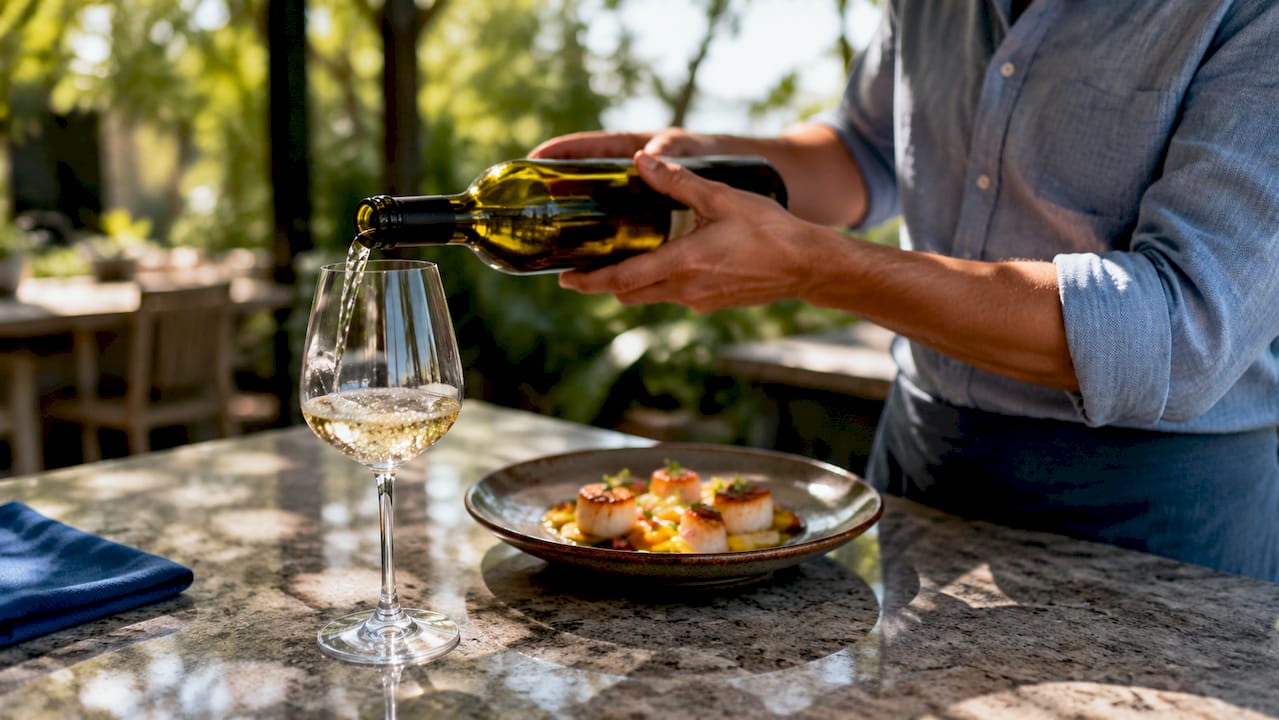
Flavour intensity is the third pillar. A delicate steamed snapper will be overwhelmed by a full-bodied Amarone. The wine’s weight must match the dish’s weight. Sommeliers at institutions like the London Wine Academy teach this as the foundational rule before any other consideration.
Understanding chemical interactions like how fat coats the palate and how tannins bind to protein is more valuable than memorising labels or regions. This is the insight that separates a confident pairer from someone who simply follows a chart.
Pro Tip: When attending a tasting event, ask the sommelier directly: “Is this pairing built on harmony or contrast?” That single question will tell you more about the chef’s intent than any tasting note.
Modern wine styles have shifted in favour of pairings. Current trends favour wines with lush fruit, minerality, balance, and moderate alcohol levels, such as a 12.5% Chablis, over the sharply tart profiles that dominated earlier decades. These balanced wines suit a broader range of tasting courses without dominating any single dish.
How to select the best wines for multi-course tasting menus
A well-structured tasting menu typically moves from lighter to richer dishes. The wine selection must follow the same arc. Starting with a full-bodied red and then serving a delicate seafood course is the equivalent of listening to a symphony in reverse order.
Matching wine style to each course type
The table below outlines reliable pairings for each course type in a standard three to five course tasting menu. These are not rigid rules. They are starting points grounded in the principles of intensity matching and acidity management.
| Course | Dish Style | Recommended Wine Style | Example |
|---|---|---|---|
| Amuse-bouche or canapé | Light, savoury bites | Brut Champagne or Crémant | Tradition Brut, Champagne Symposium |
| Entrée or seafood | Delicate proteins, citrus notes | High-acid white: Chablis, Vermentino | Moreau-Naudet Chablis |
| Main: white meat or pasta | Richer sauces, cream or herb bases | Full white or light red: Chardonnay, Pinot Noir | Burgundy Chardonnay |
| Main: red meat | Grilled or braised proteins | Structured red: Shiraz, Cabernet Sauvignon | Beresford Classic Shiraz |
| Cheese course | Aged or washed-rind cheeses | Off-dry white or aged red | Sauternes, Rioja Reserva |
| Dessert | Sweet, fruit-forward or chocolate | Dessert wine: Sauternes, Muscat | Rutherglen Muscat |
The wine and cheese pairing deserves particular attention. Aged hard cheeses like Parmigiano-Reggiano or Comté pair well with structured reds because the fat and protein in the cheese soften the tannins. Fresh, acidic cheeses like chèvre call for a crisp Sauvignon Blanc or a dry Riesling. The contrast between the cheese’s lactic acidity and the wine’s fruit creates a clean, lively finish.
Award-winning wines are increasingly available at modest prices. The 2023 Beresford Classic Shiraz from McLaren Vale scored 97 points at the 2026 International Wine Challenge and costs approximately $25. That result proves that a compelling tasting menu wine match does not require a premium budget.
Structured wine tasting courses at institutions like the London Wine Academy range from short two-hour sessions to multi-week programmes, covering four to eleven wines per session. These courses cost from £130 for a four-week programme to £229 for a premium day-long session with a multi-course lunch. The investment is worthwhile for anyone who wants to move beyond guesswork.
How do you execute a wine pairing for a tasting menu?
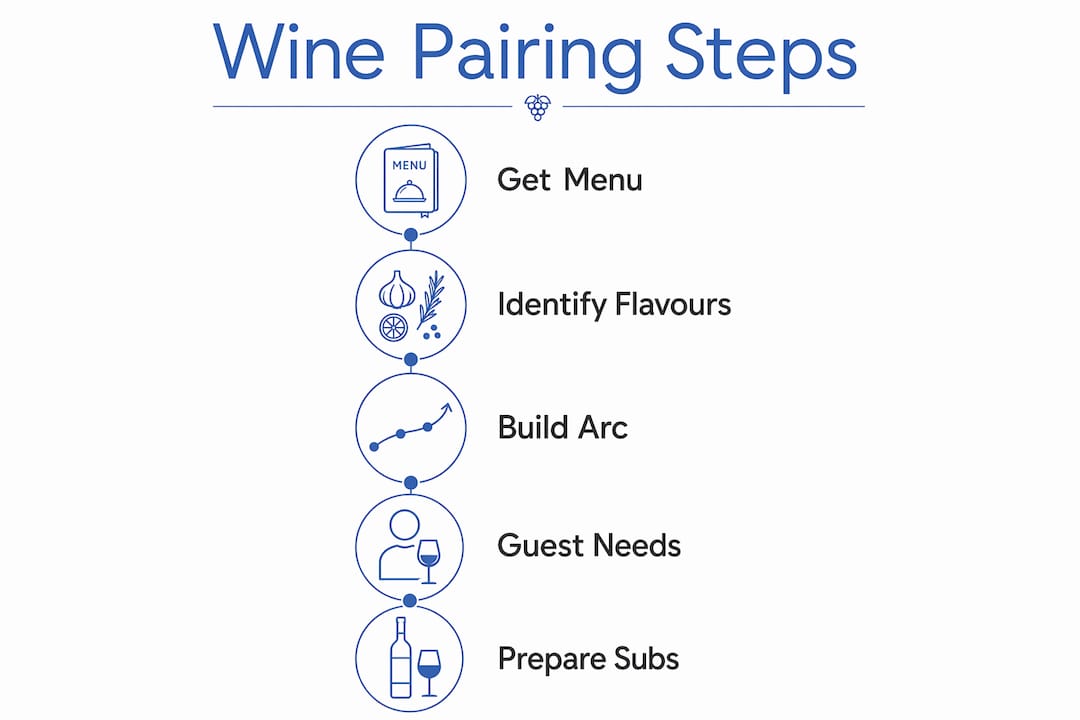
Executing a wine pairing for a tasting menu requires preparation before the first glass is poured. Improvising on the night produces inconsistent results. The following steps build a reliable framework.
Step 1: Obtain the full menu in advance. Contact the chef or restaurant at least two to four weeks before the event. Food and wine pairing experiences typically require this lead time for booking and preparation. Use this window to map each course to a wine style using the intensity and acidity principles above.
Step 2: Identify the dominant flavour in each dish. Is the dish rich, acidic, spicy, sweet, or umami-forward? Each dominant flavour suggests a pairing direction. Spicy dishes, for example, are softened by off-dry whites like a German Spätlese Riesling, where the residual sugar tempers the heat.
Step 3: Build the arc from light to full. Begin with sparkling or high-acid whites, progress through fuller whites and light reds, and finish with structured reds or dessert wines. This arc preserves the palate’s sensitivity across all courses.
Step 4: Consider the guests. Dietary restrictions and personal preferences matter. A vegetarian tasting menu changes the pairing logic significantly. Without red meat proteins to soften tannins, heavy reds can taste harsh. Lighter reds like Pinot Noir or Gamay, or a full-bodied white like an oaked Chardonnay, serve vegetarian courses far better.
Step 5: Prepare substitutions. Wine availability changes. Have a backup for each course that shares the same structural profile. If a specific Chablis is unavailable, a Picpoul de Pinet or an unoaked Sauvignon Blanc from the Adelaide Hills will perform a similar role.
Pro Tip: At a hosted tasting event, brief your guests on the pairing approach before the first course. A single sentence explaining whether the evening follows harmony or contrast gives everyone a framework for what they are tasting, and it transforms passive drinking into active appreciation.
Knowing whether a tasting event is experience-led or a technical masterclass shapes how you engage with the pairings. Masterclasses focus on blind tasting and technical knowledge. Pairing experiences prioritise flavour harmony and cultural immersion. Both are valuable, but they require different preparation and deliver different outcomes.
What to do when a wine pairing goes wrong
Even experienced sommeliers encounter pairings that clash. The most common failure is a wine that overpowers the dish. This happens when the wine’s alcohol, tannin, or oak intensity exceeds the dish’s weight. The solution is to move one step lighter in the wine selection and reassess.
Handling complex, spicy, or umami-rich courses
Spicy food amplifies the perception of alcohol and tannin in wine. A high-alcohol Shiraz alongside a Sichuan-spiced dish will taste fiery and bitter. The correct adjustment is to select a wine with lower alcohol, higher acidity, and some residual sweetness. A Gewürztraminer or an off-dry Riesling from the Clare Valley provides the necessary counterbalance.
Umami-rich dishes, such as aged parmesan, mushroom risotto, or miso-glazed proteins, intensify the bitterness of tannins. With these courses, harmony and contrast as distinct approaches become especially relevant. A harmonious pairing uses an earthy, low-tannin red like a Burgundy Pinot Noir to echo the umami notes. A contrasting pairing uses a bright, high-acid white to cut through the richness entirely.
Vegan and vegetarian tasting menus require a full rethink of the red wine strategy. Without animal proteins to bind tannins, structured reds can dominate. Opt for Gamay, Pinot Noir, or a chilled Grenache. For white courses, a skin-contact orange wine from producers like Delinquente Wine Co. in the Riverland adds textural interest without overwhelming plant-based dishes.
When a specific wine is unavailable, match the structural profile rather than the label. A wine’s acidity, tannin level, sweetness, and body are the variables that matter. The grape variety and region are secondary to these structural characteristics when substituting at short notice.
Key takeaways
Pairing wine with tasting courses succeeds when wine selection follows the arc of the menu, matching intensity, acidity, and structure to each dish in sequence.
| Point | Details |
|---|---|
| Harmony vs contrast | Identify the chef’s intent before selecting wine to align the pairing approach. |
| Intensity matching | Match the wine’s weight to the dish’s richness to avoid one overpowering the other. |
| Acidity and tannins | Use high-acid wines to cut through fat; use tannic reds alongside protein-rich mains. |
| Build the arc | Progress from sparkling or light whites through to structured reds and dessert wines. |
| Accessible quality | Award-winning wines at modest prices, like the Beresford Classic Shiraz at $25, make fine pairings achievable without extravagance. |
Aptent’s view on what actually makes a pairing memorable
The technical framework for wine pairing is learnable in an afternoon. What takes years to develop is the sensory confidence to trust your own palate over a chart. At Aptent, we have observed that the most memorable pairings at our boutique events are rarely the most technically correct ones. They are the ones where a wine reveals something unexpected in a dish, where a glass of aged Champagne alongside a spoonful of Baeri caviar produces a moment of genuine surprise.
The shift toward balanced, fruit-forward wines with moderate alcohol is not simply a trend. It reflects a broader understanding that wine at the table should serve the food, not compete with it. The old prestige hierarchy, where the most expensive or most tannic wine was considered the best choice, has given way to something more nuanced. A well-chosen $25 McLaren Vale Shiraz alongside a grass-fed beef course can outperform a $200 Napa Cabernet if the structural fit is right.
For those serious about developing their pairing knowledge, Aptent recommends attending both a structured wine tasting course and an immersive food and wine pairing experience. The two formats teach different skills. The masterclass builds analytical vocabulary. The pairing experience builds sensory memory. You need both to pair with genuine confidence.
The most underused tool in any pairing is the direct conversation with the sommelier or chef. Ask about the chemical interactions. Ask whether the pairing is built on harmony or contrast. That dialogue transforms a dinner into an education, and it is always available to those who ask.
— Aptent
Discover curated wines for your next tasting experience
Aptent’s collection is assembled with precisely this kind of discerning pairing in mind. Whether you are planning a private tasting dinner, attending a gourmet event, or searching for a considered gift for a culinary enthusiast, the Aptent Gourmet store offers a curated selection of wines sourced from prestigious producers across France, Australia, and beyond.
For those seeking the finest expressions for a tasting menu, the Grand Cru and rare cuvée collection presents wines of exceptional provenance, each selected for its ability to perform alongside fine food. Aptent also offers gourmet gifting options and boutique events for those who wish to experience wine pairing at its most refined. Explore the collection and find the wine that belongs at your table.
FAQ
What is wine pairing in a tasting course context?
Wine pairing in a tasting course is the practice of selecting a specific wine to accompany each course in a structured meal, with the aim of enhancing the flavours of both the food and the wine. The pairing is guided by principles of acidity, tannin, intensity, and the choice between harmony and contrast.
How many wines are typically served in a tasting course?
Structured tasting courses typically include four to eleven wines across a session, with food and wine pairing experiences usually featuring three to five courses with a matched wine for each.
What is the difference between a pairing experience and a wine masterclass?
A pairing experience prioritises flavour harmony, cultural immersion, and the relationship between food and wine, while a wine masterclass focuses on technical knowledge and blind tasting. Pairing experiences are generally longer and more immersive; masterclasses are shorter and more analytical.
Which wines work best for a vegetarian tasting menu?
Lighter reds with low tannin, such as Pinot Noir or Gamay, and full-bodied whites like oaked Chardonnay perform best across vegetarian tasting courses. Heavy tannic reds can taste harsh without animal proteins to soften them.
Do i need to spend a lot to pair wine well with a tasting menu?
Quality pairings are achievable at modest prices. The 2023 Beresford Classic Shiraz scored 97 points at the 2026 International Wine Challenge and retails for approximately $25, demonstrating that structural fit matters far more than price when selecting a tasting menu wine.


