
What is a grand cru? a wine lover's guide
Grand Cru is the highest recognised classification for certain French wines, denoting bottles from elite vineyard sites or villages renowned for exceptional terroir and quality potential. The designation is not a universal quality rating. It is a regional legal designation that means something distinct in Burgundy, Bordeaux, Champagne, and Alsace. Understanding what is a grand cru requires knowing which region you are reading about, because the classification systems differ fundamentally in their logic, scale, and legal requirements. Burgundy counts 33 specific vineyard plots; Champagne designates 17 entire villages. The label on the bottle tells only part of the story.
What is a grand cru in burgundy?
Burgundy is the spiritual home of the grand cru definition, and its model is the most rigorous of all French regions. The entire Burgundy appellation system rests on the concept of terroir, the idea that a specific plot of land, its soil composition, drainage, and microclimate, produces wine of a character no other site can replicate. These plots are called climats, and they form the backbone of Burgundy’s four-tier hierarchy: regional appellations, village wines, Premier Cru, and Grand Cru at the summit.
Burgundy’s 33 Grand Cru vineyards are concentrated along the Côte d’Or, the golden hillside stretching from Dijon to Santenay. They account for less than 2% of total production, which is precisely what makes them so coveted. Names such as Chambertin, Montrachet, Romanée-Conti, and Clos de Vougeot carry a weight that few other wine designations in the world can match.
One of the most telling features of a Burgundy Grand Cru label is what it omits. The village name disappears entirely. A bottle from the Chambertin vineyard simply reads “Chambertin,” with no mention of Gevrey-Chambertin, the village it sits within. This is the inverse of how most wine regions work, and it signals that the vineyard itself is considered the defining authority.
Pro Tip: When you see a Burgundy label with only a single place name and no village, you are almost certainly looking at a Grand Cru. Cross-reference the name against the Burgundy appellations guide to confirm its classification.
How does bordeaux’s grand cru classé system differ?
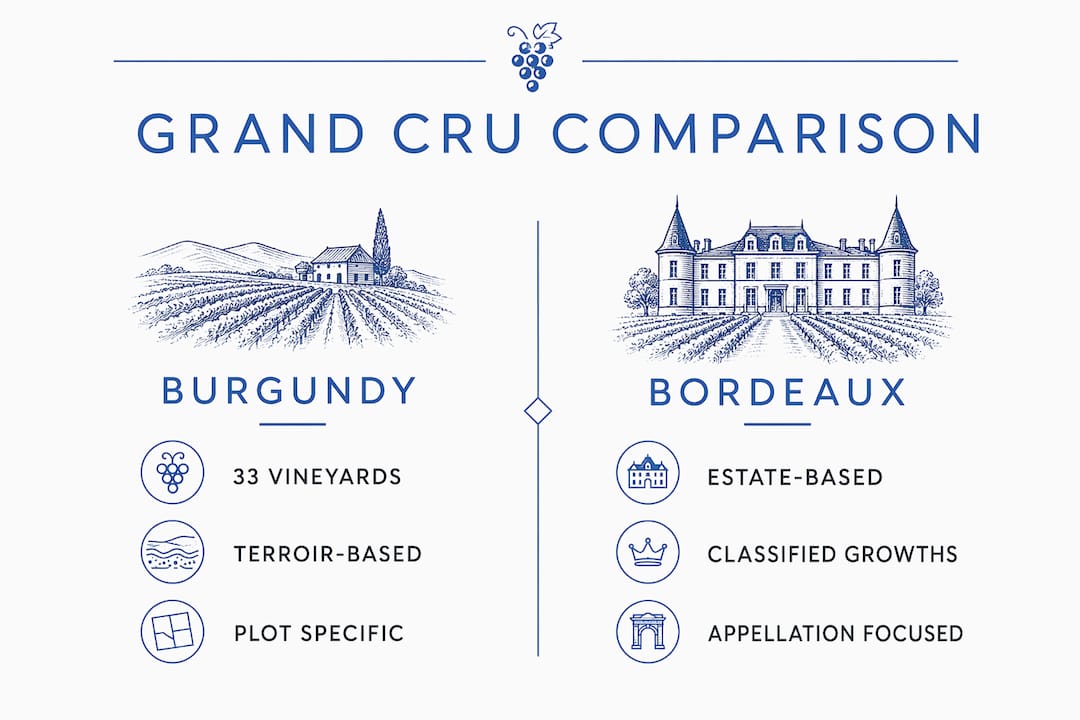
Bordeaux takes a fundamentally different approach, and understanding that difference is central to reading any grand cru wine classification correctly. Where Burgundy classifies individual vineyard plots, Bordeaux ranks estates based on their historical reputation and market value. The famous 1855 classification, commissioned by Napoleon III for the Paris Universal Exhibition, ranked châteaux rather than the land beneath them.
The practical consequence is significant. A Bordeaux estate can sell or acquire vineyard land, and its classification remains tied to the château’s name and track record rather than any specific parcel of soil. This creates a very different consumer expectation. When you purchase a classified Bordeaux, you are buying into the reputation of a producer house, not a particular hillside.
The Bordeaux classification tiers are structured as follows:
- Premier Grand Cru Classé (First Growth): The five most prestigious estates, including Château Pétrus, Château Margaux, and Château Latour.
- Deuxième Grand Cru Classé (Second Growth): Estates such as Château Léoville-Las Cases and Château Cos d’Estournel.
- Troisième, Quatrième, Cinquième Grand Cru Classé (Third, Fourth, Fifth Growths): A broader tier of respected houses whose wines remain highly sought after.
| Feature | Burgundy Grand Cru | Bordeaux Grand Cru Classé |
|---|---|---|
| Classification basis | Specific vineyard plot | Estate reputation and history |
| Origin of system | Terroir-based, evolved over centuries | 1855 classification by market value |
| Label presentation | Vineyard name only | Château name prominent |
| Flexibility | Fixed to the land | Estate can change vineyard holdings |
| Consumer focus | Terroir and vintage | Producer house and prestige |
This contrast explains why the dual traditions of Bordeaux and Burgundy create such different expectations for the same two words on a label. Neither system is superior. They simply reflect different histories and philosophies of what makes a wine great.
How is grand cru defined in champagne and alsace?
Champagne and Alsace each add further layers to the grand cru wine classification picture, and neither follows the Burgundy or Bordeaux model precisely.
In Champagne, the designation operates at the village level. Seventeen villages hold Grand Cru status, including Aÿ, Ambonnay, Bouzy, and Cramant. This system was historically linked to a pricing mechanism called the Échelle des Crus, which assigned percentage ratings to villages and determined what growers were paid for their grapes. The Échelle des Crus was abandoned in 2004, but the village classifications it produced remain in use. For a Champagne to carry the Grand Cru designation on its label, all grapes must be sourced exclusively from those 17 villages.
Alsace operates differently again. The region authorises 51 Grand Cru vineyard sites with strict regulations governing both yield and permitted grape varieties. Maximum yields are capped at 55 hectolitres per hectare, a meaningful constraint that concentrates flavour. The permitted varieties are Riesling, Muscat, Pinot Gris, and Gewürztraminer, with one notable exception: the Zotzenberg vineyard is authorised to produce Grand Cru Sylvaner.
| Region | Grand Cru Scale | Key Regulation |
|---|---|---|
| Burgundy | 33 vineyard plots | Terroir-based, Côte d’Or only |
| Bordeaux | Ranked estates | Historical reputation, 1855 system |
| Champagne | 17 villages | 100% Grand Cru village sourcing required |
| Alsace | 51 vineyard sites | Max 55hl/ha; four permitted varieties |
The contrast between Champagne and Alsace is instructive. Grand Cru in Burgundy attaches to specific plots, while in Champagne it refers to entire villages. Alsace sits closer to the Burgundy model in its vineyard specificity, yet applies its own regulated framework. Across all four regions, the two words “Grand Cru” carry legal weight, but that weight is measured on entirely different scales.
Pro Tip: When selecting a Grand Cru Champagne, look beyond the village designation to the producer’s sourcing notes. A grower Champagne from a single Grand Cru village often reveals more terroir character than a blended house cuvée using the same classification.
Common misconceptions about grand cru wine labels
The most persistent misconception about Grand Cru is that the designation guarantees superior taste. It does not. Grand Cru indicates vineyard pedigree and potential, not the quality of the winemaking decisions made in the cellar. A poorly managed Grand Cru vineyard can produce wine that a skilled producer in a Premier Cru site will surpass with ease.
Experienced collectors understand this distinction well. Producer reputation often matters more than the vineyard classification, because the label tracks land, not the winemaker’s craft. Domaine Leflaive’s Premier Cru Puligny-Montrachet, for instance, commands prices that rival many Grand Cru bottles from lesser producers. The classification is a starting point, not a verdict.
A second misconception involves Premier Cru. Many buyers assume Grand Cru is simply a step above Premier Cru in a universal hierarchy. The reality is more nuanced. A Premier Cru Champagne can be more expensive than a Grand Cru Champagne when brand prestige and placement in luxury channels drive the market. Classification and price do not always move in the same direction.
A third error is comparing Grand Cru to quality designations from other countries. The Spanish Reserva or Italian Riserva labels operate on entirely different logic. Grand Cru tracks terroir; Reserva tracks ageing period. Treating them as equivalent tiers misreads both systems. Comparing wine quality tiers across countries is misleading because each classification addresses different historical and regional factors.
To identify an authentic Grand Cru wine with confidence, consider the following:
- Confirm the region first. A Burgundy Grand Cru will show only the vineyard name. A Champagne Grand Cru will name the village.
- Check the producer’s name against respected references such as the Revue du Vin de France or Wine Advocate.
- For Alsace, look for the specific vineyard site name alongside the permitted variety.
- Explore Premier Cru wines alongside Grand Cru selections to calibrate your own palate rather than relying on classification alone.
Pro Tip: The most reliable way to build Grand Cru literacy is to taste horizontally across producers within the same vineyard. Comparing two or three producers from Chambertin in the same vintage reveals how much the winemaker’s hand shapes the final wine.
Key takeaways
Grand Cru is a regional legal designation tied to specific land or villages, not a universal guarantee of superior wine quality.
| Point | Details |
|---|---|
| Grand Cru is region-specific | The designation means different things in Burgundy, Bordeaux, Champagne, and Alsace. |
| Burgundy’s model is terroir-based | Thirty-three vineyard plots account for less than 2% of total Burgundy production. |
| Bordeaux ranks estates, not land | The 1855 classification elevated châteaux by reputation, not by vineyard quality alone. |
| Producer matters as much as classification | A skilled winemaker in a Premier Cru site can outperform a poorly managed Grand Cru. |
| Cross-country comparisons mislead | Grand Cru tracks terroir; designations like Reserva track ageing, making them incomparable. |
Aptent’s take on what grand cru really tells you
The most liberating shift in wine appreciation occurs when you stop treating Grand Cru as a guarantee and start treating it as a conversation starter. At Aptent, we have spent years sourcing from prestigious producers across Burgundy, Champagne, and Alsace, and the pattern is consistent: the bottles that genuinely move us are rarely chosen on classification alone.
What the Grand Cru designation does well is point you toward land with a proven track record. Romanée-Conti, Chambertin, and Montrachet have centuries of evidence behind them. That history is real and worth respecting. What it cannot tell you is whether the producer harvested too early, used excessive new oak, or simply had an off vintage. Those decisions live outside the classification entirely.
The collectors we work with at Aptent have largely arrived at the same conclusion: the producer’s name on the label carries as much weight as the vineyard name beneath it. We would sooner recommend a bottle from a meticulous grower in a Premier Cru climat than a Grand Cru from a négociant who treats the vineyard as a marketing asset. The classification opens the door. The producer determines what is behind it.
Our honest counsel to any serious enthusiast is to build your knowledge of specific producers within Grand Cru sites rather than collecting the classification itself. Taste Rousseau’s Chambertin alongside a lesser-known producer from the same vineyard. The difference will teach you more about Grand Cru than any classification chart ever could.
— Aptent
Discover aptent’s curated grand cru collection
For those who appreciate the refinement and prestige that Grand Cru wines represent, Aptent has assembled a collection worthy of the designation’s finest traditions.
Aptent’s Grand Cru wine collection brings together red, white, and Champagne selections sourced directly from producers whose commitment to terroir and craft matches the pedigree of their vineyards. Each bottle is chosen with the discerning collector in mind, whether for personal cellaring, a special occasion, or a bespoke gifting experience. For those wishing to explore the full breadth of what Aptent offers, the Aptent Gourmet cellar presents a curated world of fine wine and exceptional produce, where every selection reflects the same standard of authenticity and refinement.
FAQ
What does grand cru mean on a french wine label?
Grand Cru is a legal designation indicating that a wine comes from a top-ranked vineyard site or village within a specific French region. The precise meaning varies by region, covering individual plots in Burgundy and Alsace, entire villages in Champagne, and ranked estates in Bordeaux.
How many grand cru vineyards exist in burgundy?
Burgundy has exactly 33 Grand Cru vineyard sites, all located along the Côte d’Or. These sites represent less than 2% of total Burgundy wine production, which underpins their rarity and prestige.
Is grand cru always better than premier cru?
Not necessarily. Grand Cru designates land quality and potential, not winemaking skill. A Premier Cru Champagne from a prestigious house can command higher prices than a Grand Cru from a lesser producer, depending on brand reputation and market placement.
How do i identify a grand cru wine on the label?
In Burgundy, look for a single vineyard name with no village mentioned. In Champagne, the label will state “Grand Cru” alongside the village name. In Alsace, the specific vineyard site name appears with the permitted grape variety. In Bordeaux, the tier is stated as “Grand Cru Classé” with the château name.
Can grand cru wines from different countries be compared?
Directly comparing Grand Cru to designations like Spanish Reserva or Italian Riserva is misleading. Grand Cru tracks the quality of specific land or estates, while Reserva tracks the duration of ageing. The two systems address entirely different aspects of wine production and cannot be treated as equivalent quality tiers.


