
Types of caviar ranked: from Beluga to Baeri
Caviar is defined as the salt-cured roe of sturgeon, and the four primary varieties rank by rarity, maturation length, and flavour complexity. The types of caviar ranked in this guide are Beluga, Osetra, Sevruga, and Baeri. Each variety occupies a distinct position in the world of fine dining, shaped by biology, scarcity, and taste. Understanding these distinctions transforms caviar from an intimidating luxury into a considered, deeply pleasurable choice.
1. What makes Beluga caviar the highest-ranked variety?
Beluga caviar sits at the pinnacle of every serious caviar valuation guide. Its eggs are the largest of any sturgeon species, ranging from 3 to 4 mm in diameter, and their membrane is so delicate it dissolves almost instantly on the palate. The flavour is very delicate with a soft finish, delivering buttery smoothness and a clean, lingering creaminess that no other variety replicates.
The rarity of Beluga is inseparable from its rank. The Beluga sturgeon requires 15–25 years to mature before it yields roe, and its slow reproduction and longevity make commercial availability extraordinarily limited. That biological reality drives prices to between €3,500 and €10,000 per kilogram, placing it firmly in the category of black gold. For a 30g tin, collectors and connoisseurs expect to pay a significant premium.
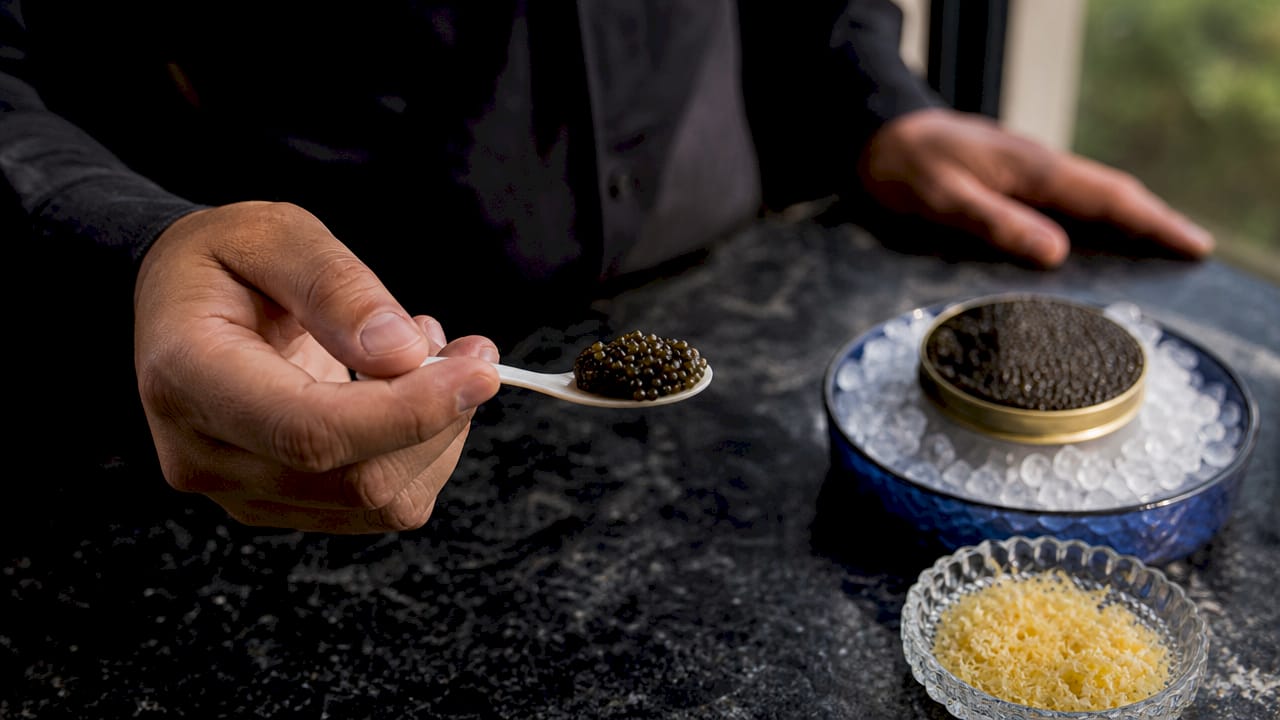
Beluga is best served alone, on a mother-of-pearl spoon, with no accompaniment that might compete with its nuance. Blinis and crème fraîche are acceptable, but purists argue that anything beyond a glass of vintage Champagne is a distraction.
Pro Tip: Serve Beluga at 8–10°C directly from the tin. Metallic spoons oxidise the flavour immediately, so always use mother-of-pearl, bone, or gold-plated serving ware.
2. How does Osetra caviar combine complexity and accessibility?
Osetra is the connoisseur’s working choice. Its eggs are medium-sized, firm, and possess a nutty complexity with marine undertones that reward attentive tasting. Tasting notes include walnut skin, cultured butter, toasted grain, and shellfish. That layered profile is precisely why Osetra is favoured by chefs for fine dining menus and structured pairing courses.
Osetra sturgeon matures in 8–12 years, which is considerably faster than Beluga. That shorter cycle makes Osetra more available without diminishing its prestige. Prices typically sit between €1,500 and €3,500 per kilogram, and a 30g tin of select Osetra can exceed £180. The price-to-quality ratio here is arguably the strongest of any caviar variety.
Osetra pairs exceptionally well with Champagne, particularly blanc de blancs styles, and holds its own alongside lightly dressed seafood. Its flavour is assertive enough to complement food rather than disappear beneath it. For a detailed approach to caviar and Champagne pairings, the interplay between Osetra’s nuttiness and fine bubbles is particularly well documented.
3. Why is Sevruga caviar prized for its intense, briny character?
Sevruga occupies a distinct position in any caviar types comparison. Its eggs are small, typically 1.5–2 mm in diameter, and the flavour is sharp, saline, and pronounced. Where Beluga whispers, Sevruga announces itself. That intensity is its defining quality and the reason it commands a devoted following among those who prefer a bold, oceanic experience.
The Sevruga sturgeon matures in 7–10 years, making it the fastest-maturing of the three traditional Caspian varieties. That shorter cycle keeps prices more moderate than Beluga or Osetra, though Sevruga remains firmly in the luxury tier. Its smaller egg size produces a denser texture, and the roe releases its saline intensity quickly, making it particularly suited to those who want a caviar experience that is immediate and memorable.
Sevruga suits vodka pairings and robust accompaniments such as buckwheat blinis. Its assertive salinity also makes it an excellent choice for those who find Beluga’s delicacy underwhelming. Serve it simply and cold, allowing the brine to speak without interference.
4. What makes Baeri caviar the most accessible ranked type?
Baeri, derived from the Siberian sturgeon, is the most accessible true sturgeon caviar on the market. Its eggs measure 2–2.5 mm and the flavour is mild, clean, and gently nutty. There is no aggressive brine, no overwhelming intensity. Baeri is the variety that introduces discerning newcomers to the pleasure of genuine sturgeon roe without demanding an experienced palate.
Baeri sturgeon matures in 5–9 years, the shortest cycle of the four ranked varieties. That biological efficiency, combined with widespread aquaculture production in France, Spain, and China, keeps prices in the range of €600–€1,500 per kilogram. A 30g tin typically begins at around £40, making it the entry point for those building their caviar knowledge.
The mild, clean flavour profile of Baeri pairs well with light accompaniments: crème fraîche, cucumber, and delicate canapés. It also works beautifully with white Burgundy or a crisp Chablis. Baeri rewards those who approach it with curiosity rather than expectation.
Pro Tip: If you are new to caviar, taste Baeri alone first. Eat a small amount directly from the spoon, let it rest on the tongue, and notice the clean salinity before adding any accompaniment. This trains the palate for more complex varieties.
5. How do caviar flavour profiles compare across all four varieties?
Caviar flavour profiles cluster into four distinct categories: buttery and creamy, nutty and complex, intense and briny, and mild and clean. Each category maps directly to a ranked variety, and understanding this spectrum is the foundation of any serious caviar ratings assessment.
The table below presents a direct caviar types comparison across the four ranked varieties.
| Variety | Egg size | Flavour profile | Maturation | Price per kg (approx.) |
|---|---|---|---|---|
| Beluga | 3–4 mm | Buttery, creamy, delicate | 15–25 years | €3,500–€10,000 |
| Osetra | 2.5–3 mm | Nutty, complex, marine | 8–12 years | €1,500–€3,500 |
| Sevruga | 1.5–2 mm | Intense, briny, sharp | 7–10 years | Moderate luxury |
| Baeri | 2–2.5 mm | Mild, clean, gently nutty | 5–9 years | €600–€1,500 |
Price and flavour complexity increase consistently with rarity and maturation time. This is not coincidence. It reflects the biological cost of producing each variety and the market’s recognition of that scarcity. Beluga commands the highest prices because it is genuinely the rarest. Baeri is affordable because it is the most efficiently farmed.
Texture also varies meaningfully. Beluga’s large, thin-membraned eggs burst with almost no resistance. Osetra’s firmer eggs hold their shape longer, releasing flavour gradually. Sevruga’s small, dense eggs deliver an immediate saline hit. Baeri sits between Sevruga and Osetra in texture, offering a pleasant pop without intensity. Choosing between them is ultimately a matter of occasion and personal taste, not hierarchy alone.
For those building a caviar pairing menu, moving from Baeri through Osetra to Beluga across courses creates a natural crescendo of flavour and opulence.
Key takeaways
The best caviar varieties rank by maturation length, egg size, flavour intensity, and rarity, with Beluga at the top and Baeri as the ideal starting point for those new to sturgeon roe.
| Point | Details |
|---|---|
| Maturation drives rank | Longer maturation produces rarer, more complex caviar and higher market prices. |
| Flavour spans a clear spectrum | Profiles range from Beluga’s buttery creaminess to Sevruga’s sharp brine and Baeri’s mild nuttiness. |
| Price reflects biology | Beluga costs €3,500–€10,000 per kg; Baeri begins at €600, making it the accessible entry point. |
| Osetra offers the best ratio | Osetra delivers the strongest price-to-quality balance and is the chef’s preferred variety. |
| Beginners should start with Baeri | Baeri’s clean, mild flavour trains the palate without overwhelming it. |
Aptent’s perspective on choosing the right caviar for the occasion
The ranking of caviar varieties is useful, but it can mislead. Ranking implies that Beluga is always the correct choice, and that is simply not true. Beluga’s delicacy makes it extraordinary when served alone, but it can disappear entirely in a complex pairing menu. Osetra, by contrast, holds its ground alongside food and wine in a way that Beluga cannot. For a dinner where caviar is one element among many, Osetra is the more intelligent selection.
The mistake Aptent sees most often among those new to caviar is confusing sturgeon roe with salmon or trout roe. True sturgeon caviar offers nuanced, balanced salinity that salmon roe cannot replicate. Salmon roe is bolder, oilier, and far less refined. Tasting them side by side makes the distinction immediately clear, and that comparison is worth doing once.
Aptent also recommends resisting the impulse to begin with Beluga. The palate needs context. Tasting Baeri first, then Osetra, then Beluga across separate occasions builds genuine appreciation. Arriving at Beluga after that progression is a genuinely revelatory experience. Arriving at Beluga first, without reference points, often leaves people uncertain what they are tasting or why it matters.
For special occasions, Aptent’s preferred combination is Osetra alongside a vintage Champagne from a grower house. The nutty backbone of Osetra and the fine autolytic notes of aged Champagne create a pairing that is greater than either component alone. That is the standard worth aspiring to.
— Aptent
Aptent Gourmet’s curated caviar selection
Aptent sources its caviar from prestigious producers who meet exacting standards of quality and authenticity. Whether you are beginning your appreciation with Baeri or seeking the complexity of Oscietre for a formal occasion, the collection is curated to match every palate and setting.
The Baeri Signature Caviar is available in 30g, 50g, and 250g formats, offering flexibility for intimate tastings or larger gatherings. For those ready to move into the premium tier, the Oscietre Signature Caviar delivers the nutty complexity and marine depth that defines the variety. Both are available through Aptent Gourmet, where personalised guidance is available for those planning a special event or curated dining experience.
FAQ
What is the highest-ranked caviar variety?
Beluga caviar ranks highest due to its extraordinary rarity, large egg size, and buttery flavour profile. The Beluga sturgeon requires 15–25 years to mature, making its roe the scarcest and most expensive of all sturgeon varieties.
How do caviar flavour profiles differ between varieties?
Flavour profiles range from Beluga’s buttery creaminess to Osetra’s nutty complexity, Sevruga’s sharp brine, and Baeri’s mild, clean taste. Each profile reflects the species’ biology, maturation period, and egg structure.
Is Baeri caviar considered real caviar?
Baeri is genuine sturgeon caviar, derived from the Siberian sturgeon. It offers mild, clean flavour and is the most accessible true sturgeon variety, making it the recommended starting point for those new to caviar.
Why is Osetra preferred by chefs?
Osetra’s nutty backbone and marine notes allow it to hold flavour in complex pairings, unlike Beluga’s delicate profile which can be overwhelmed by food. Chefs favour it for tasting menus and structured pairing courses.
How should beginners approach tasting caviar for the first time?
Begin with Baeri alone on a mother-of-pearl spoon, without accompaniment, to appreciate its clean salinity. Seek moderate salinity and freshness as hallmarks of quality before progressing to more complex varieties.


