
The role of caviar in fine dining: a culinary guide
Caviar is defined as the salt-cured roe of sturgeon, and its role in fine dining is to deliver unmatched textural complexity, briny depth, and visual opulence that no other ingredient replicates. Chefs at Michelin-starred restaurants from Paris to Sydney treat caviar not merely as a garnish but as the centrepiece of flavour architecture. Modern sustainable aquaculture producers such as Aquatir have reshaped how restaurants source this ingredient, making traceability and ethical provenance as important as taste. The result is a luxury ingredient that carries cultural weight, culinary precision, and an evolving story that resonates with discerning diners and culinary professionals alike.
What is the role of caviar in fine dining?
Caviar functions as a luxury flavour enhancer that simultaneously elevates texture, taste, and visual presentation on the plate. Its signature quality is the “pop” of each pearl against the palate, releasing a wave of oceanic salinity followed by buttery smoothness or nutty richness depending on the variety. No other ingredient delivers this precise sensory sequence, which is why caviar commands its position at the apex of gourmet cuisine. Chefs use it to create contrast: a single spoonful placed atop warm egg custard or chilled seafood tartare transforms a composed dish into a multi-layered tasting experience. The caviar tasting experience is inseparable from the theatre of fine dining itself.
How is caviar traditionally and currently served in fine dining?
Classic caviar service is minimalist by design, focusing on blinis and crème fraîche to keep the roe as the undisputed flavour and texture focal point. This restraint is deliberate. Overpowering accompaniments mask the nuance that makes caviar worth its price. Contemporary fine dining has refined this tradition further, reducing garnishing to near zero and placing all emphasis on temperature precision and plating geometry.
Temperature is the single most critical variable in caviar service. Caviar must be served cold, between 0°C and 4°C, and is never cooked. The ideal serving window sits between 28°F and 32°F to keep each pearl firm, glossy, and flavourful. Warming or partial freezing damages the roe’s texture irreversibly, stripping away the very quality that defines its appeal.
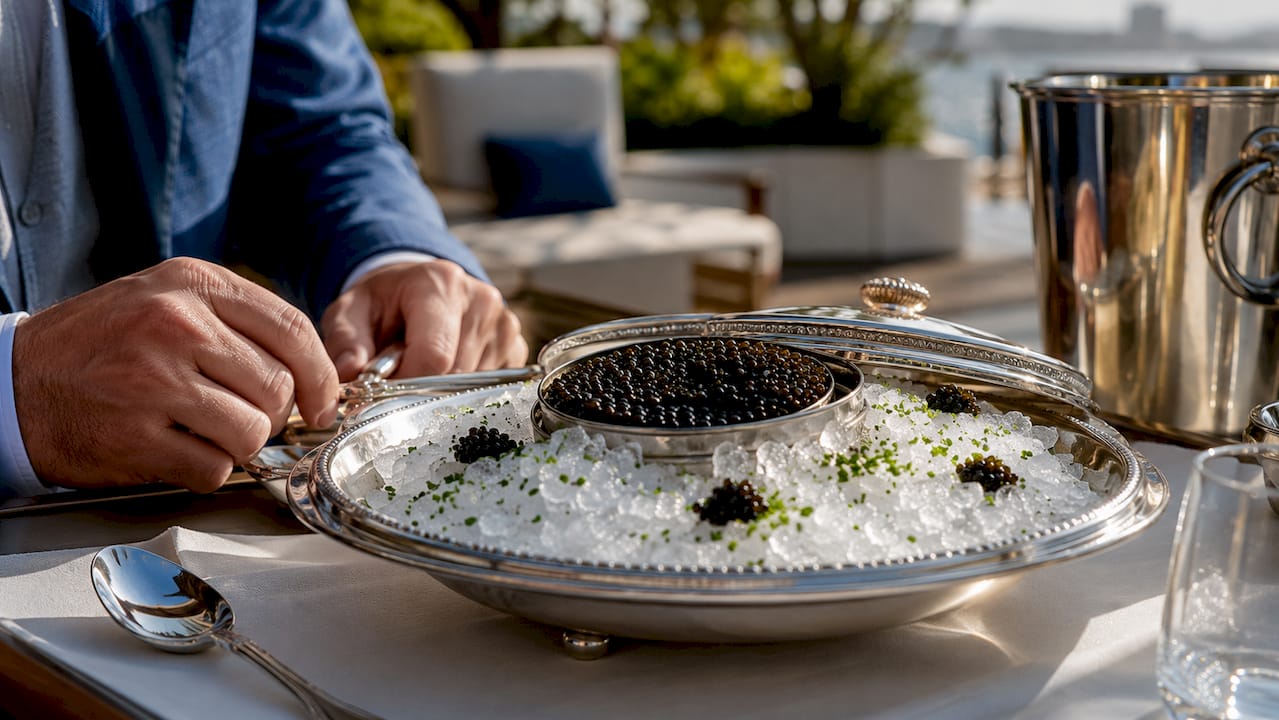
Mother-of-pearl spoons are the standard service tool in upscale dining. Metal spoons react with the roe and introduce a metallic note that corrupts the flavour profile. Bone and horn spoons are also acceptable alternatives. The tin or jar is always presented on a bed of crushed ice, and service is completed swiftly to minimise temperature fluctuation.
The best caviar garnishes in fine dining are those that add contrast without competition. Finely chopped chives, a whisper of lemon zest, or a single quenelle of crème fraîche are the accepted canon. Anything more elaborate shifts attention away from the roe itself.
Pro Tip: Remove caviar from refrigeration no more than five minutes before service. Extended exposure to ambient temperature softens the pearls and dulls the briny complexity that defines the ingredient.
What types of caviar are preferred in luxury dining and how are they selected?
The three varieties that dominate fine dining menus are Beluga, Ossetra, and Baerii, each with a distinct flavour profile and sourcing consideration. Selection depends on the dish, the price point, and the chef’s commitment to traceability.
| Caviar type | Flavour profile | Texture | Primary sourcing |
|---|---|---|---|
| Beluga (Huso huso) | Delicate, creamy, mild brine | Large, soft pearls | Aquaculture, strictly regulated |
| Ossetra (Acipenser gueldenstaedtii) | Nutty, rich, complex | Medium, firm pearls | European and Iranian aquaculture |
| Baerii (Acipenser baerii) | Buttery, clean, lightly briny | Small to medium, firm | Widely farmed, accessible quality |
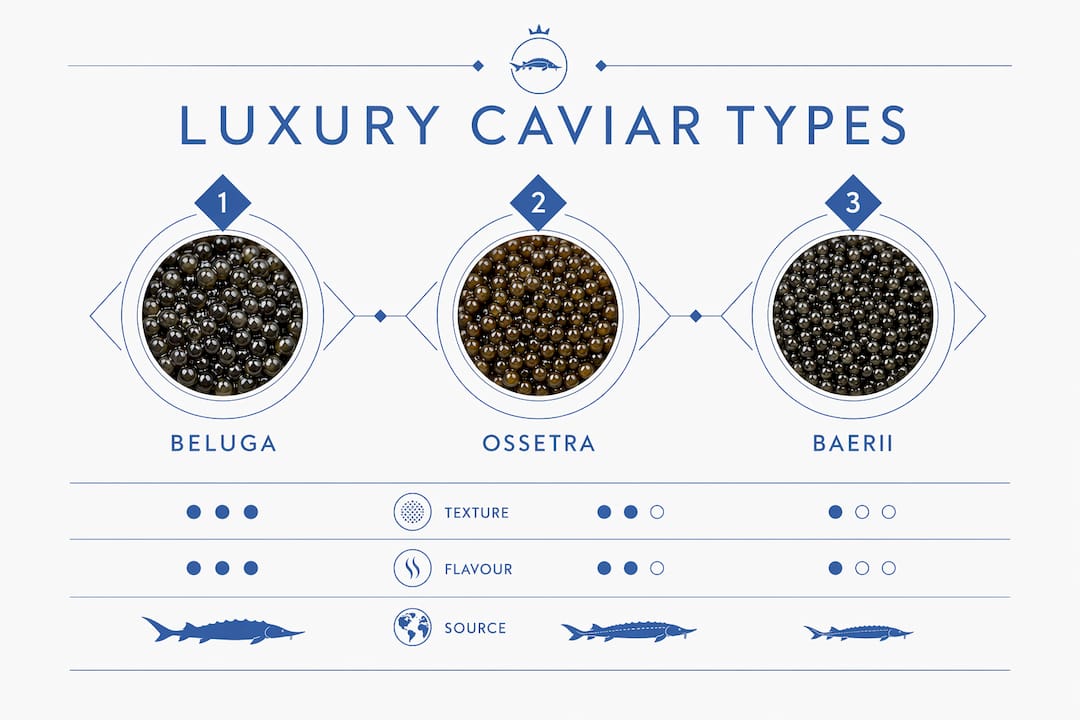
Beluga is the rarest and most prized, producing large, soft pearls with a delicate creaminess that requires almost no accompaniment. Ossetra delivers a more assertive nutty richness, making it the preferred choice for chefs who want caviar to carry a composed dish rather than simply accent it. Baerii has become the workhorse of modern fine dining menus because its consistent quality and accessible price point allow chefs to use it with greater creative freedom.
Sustainable aquaculture underpins virtually all premium caviar production today. Farm-raised sturgeon in controlled environments produce roe with consistent flavour and texture across harvests. This consistency is something wild-caught roe could never guarantee. Global caviar production is now almost entirely farm-based, with Europe alone producing 226 tonnes in 2023. That figure reflects an industry that has fundamentally restructured itself around ethical production rather than extraction.
CITES international regulations require that all commercial caviar shipments carry permits and labelling that identify the species, origin, and harvest year. Restaurants that treat this traceability as a quality standard rather than a compliance burden signal to diners that their sourcing is beyond reproach.
How does caviar contribute to luxury branding and cultural significance?
The role of caviar in luxury branding has shifted decisively from pure opulence to responsible refinement. A decade ago, caviar on a menu was shorthand for extravagance. Today, the most prestigious restaurants use it to communicate a more nuanced story: one of craft, provenance, and ecological stewardship.
Luxury dining is shifting from indulgence to responsibility, with consumers and chefs placing equal value on a caviar’s traceability and the story behind it. This shift matters commercially. Diners who pay premium prices now expect to know where their roe was harvested, which farm raised the sturgeon, and whether the producer operates within CITES compliance. Restaurants that cannot answer these questions lose credibility with exactly the clientele they are trying to attract.
Caviar’s cultural significance also lies in its rarity narrative. Even as aquaculture has made supply more reliable, the years of patient farming required to bring a sturgeon to maturity preserve the sense of scarcity. Chefs who articulate this story at the table, whether through menu notes, sommelier dialogue, or tasting menu narration, transform a single bite into a moment of genuine cultural connection. Traceability labels integrated into luxury standards are not mere paperwork. They are the foundation of the provenance narrative that makes caviar irreplaceable in upscale dining.
What are the best caviar pairings and culinary uses for modern menus?
Chefs use caviar in tasting menus with small, precise portions to highlight texture and briny complexity without overwhelming the palate. The portion discipline is as important as the pairing itself. A generous mound of caviar on a delicate dish crushes the balance; a measured spoonful amplifies it.
Classic pairings remain the benchmark for a reason. Blinis with crème fraîche provide a neutral, slightly tangy base that lets the roe speak. Egg custard, particularly the Japanese-influenced chawanmushi style, creates a silky warmth that contrasts beautifully with cold pearls. Seafood tartare, whether tuna, scallop, or kingfish, shares the oceanic register of caviar without competing for dominance.
Modern menus have pushed caviar into more unexpected territory with compelling results. Wagyu beef, with its intense fat content, provides a richness that mirrors the buttery quality of Ossetra. Sea urchin (uni) and caviar together create a layered oceanic intensity that has become a signature combination at restaurants like Quay in Sydney. Dessert applications, particularly with white chocolate or lightly sweetened crème brûlée, use the salt and brine of caviar as a counterpoint to sweetness.
Beverage pairings follow a clear logic: avoid tannin and oak, prioritise minerality and acidity. Dry Champagne, particularly blanc de blancs, is the canonical match because its fine bubbles and citrus acidity cut through the fat of the roe. Chablis and other unoaked Chardonnays work on the same principle. Sake, particularly junmai daiginjo, offers an elegant alternative for menus with an Asian influence. Mineral-driven white wines from Alsace or the Loire Valley also complement caviar without overwhelming it. A well-curated selection of white wines can anchor a caviar pairing menu with authority.
Pro Tip: Serve caviar as the first course or between courses rather than mid-plate. The palate is freshest at the start of a meal, and caviar’s subtle complexity registers most clearly before richer flavours accumulate.
Key takeaways
Caviar’s role in fine dining is defined by its unique combination of textural precision, flavour complexity, and cultural provenance, making it the preeminent luxury ingredient in gourmet cuisine.
| Point | Details |
|---|---|
| Temperature is non-negotiable | Serve caviar between 0°C and 4°C to preserve texture, gloss, and flavour integrity. |
| Restraint defines great service | Minimalist garnishes like crème fraîche and blinis keep caviar as the flavour centrepiece. |
| Variety selection shapes the dish | Beluga, Ossetra, and Baerii each offer distinct profiles suited to different culinary applications. |
| Provenance is part of the luxury | CITES-compliant traceability and aquaculture sourcing are now core to caviar’s prestige. |
| Pairing logic follows minerality | Dry Champagne, unoaked Chardonnay, and sake complement caviar without competing with it. |
Aptent’s perspective on caviar’s enduring place at the table
What strikes me most about caviar’s position in fine dining is how it has survived every culinary trend of the past three decades without compromise. Molecular gastronomy came and went. Farm-to-table became the dominant philosophy. Plant-forward menus reshaped tasting courses across the world. Through all of it, caviar remained. Not because it is fashionable, but because nothing else does what it does.
The shift toward sustainable aquaculture has actually strengthened caviar’s cultural authority rather than diminishing it. When a chef can name the farm, the species, and the harvest year, caviar becomes a story rather than a status symbol. That shift from opulence to narrative is where the real future of this ingredient lies. The diners who matter most, those who eat at the level where caviar appears, are increasingly motivated by knowledge and ethics alongside pleasure.
My expectation for the coming years is that Baerii and Ossetra will continue to dominate restaurant menus because their aquaculture profiles are most consistent and their flavour versatility is greatest. Beluga will remain the pinnacle for special occasions and tasting menus where provenance is the entire point. The chefs who use caviar most effectively will be those who treat it as a culinary argument, not a decoration.
— Aptent
Aptent Gourmet: premium caviar for fine dining at home and in the kitchen
Aptent curates a collection of premium caviar sourced from producers who meet the highest standards of aquaculture and traceability. The 250g Baeri Signature Caviar delivers buttery smoothness and clean brine, ideal for tasting menus or elevated home dining. The 250g Oscietre Signature Caviar offers the nutty richness that chefs prize for composed dishes.
Aptent also offers a curated selection of Grand Cru wines and boutique Champagnes to complete the pairing experience. For those seeking a complete luxury occasion, Aptent’s gourmet events service delivers bespoke caviar and wine experiences for private and corporate clients. The full range is available at Aptent Gourmet.
FAQ
What is the primary role of caviar in fine dining?
Caviar functions as a luxury flavour and texture enhancer, delivering briny complexity and a distinctive pearl “pop” that no other ingredient replicates. Chefs use it to elevate composed dishes, from egg custard to seafood tartare, with precise small portions.
What temperature should caviar be served at in a restaurant?
Caviar must be served between 0°C and 4°C and is never cooked. Warming or partial freezing damages the roe’s texture and strips its flavour complexity irreversibly.
Which types of caviar are most commonly used in fine dining?
Beluga, Ossetra, and Baerii are the three varieties that dominate upscale dining menus. Ossetra is favoured for its nutty richness in composed dishes, while Baerii is prized for its consistent quality and versatility.
Why does sustainable aquaculture matter for restaurant caviar sourcing?
Global caviar production is now almost entirely farm-based, with Europe producing 226 tonnes in 2023. Aquaculture delivers consistent flavour and texture across harvests while supporting CITES compliance and ethical sourcing standards.
What are the best wine pairings for caviar in a fine dining setting?
Dry Champagne, particularly blanc de blancs, is the canonical pairing because its acidity and fine bubbles cut through the fat of the roe. Unoaked Chardonnay, mineral-driven whites from Alsace, and junmai daiginjo sake are equally effective alternatives.


