
What does vintage mean in wine: a collector's guide
Vintage in wine is defined as the calendar year in which the grapes used to produce that wine were harvested. A 2019 Barolo, for example, tells you the grapes were picked in Piedmont during 2019, not that the wine was bottled or purchased in that year. This distinction matters enormously for collectors and enthusiasts, because the vintage year is a direct record of the growing season’s conditions. Those conditions shape everything from a wine’s aroma and structure to its ageing potential and peak drinking window. Understanding what vintage means in wine is the first step toward making genuinely informed buying, cellaring, and gifting decisions.
What does vintage mean in wine, and why does it matter?
Vintage, in the formal wine sense, refers to the harvest year of the grapes, not the year the wine was released or purchased. This is one of the most common misconceptions among newer collectors. A bottle sitting on a retailer’s shelf in 2026 may carry a 2018 vintage, meaning the fruit was harvested eight years prior and the wine has been ageing since.
The vintage year condenses an entire growing season into a single number on the label. Rainfall, temperature, sunlight hours, and harvest timing all collapse into that figure. For collectors, it functions as a shorthand for quality and character before a single drop is tasted.

In the Southern Hemisphere, including Australia’s premier wine regions such as the Barossa Valley, Clare Valley, and Margaret River, the vintage reflects the harvesting year even though the growing season spans two calendar years. A 2023 Australian Shiraz, for instance, means grapes harvested in the autumn of 2023, after a growing season that began in the spring of 2022. This nuance is worth knowing when reading labels from Australian producers alongside European counterparts.
In the United States, vintage-dated wines must contain at least 95% of wine volume from grapes grown and harvested in the stated year. This regulation protects the integrity of vintage labelling and gives collectors confidence that the year on the bottle genuinely reflects specific growing conditions.
How does vintage shape wine quality and character?
The vintage year is a proxy for the weather and harvest decisions that create noticeable differences in wine character from one year to the next. A cool, wet spring followed by a warm, dry summer produces grapes with different sugar levels, acidity, and phenolic ripeness than a season marked by drought stress or early frost. Those differences translate directly into the glass.
In regions with variable climates, such as Burgundy, the Mosel, and Champagne, vintage has a major impact on ageing potential and overall quality. A celebrated Burgundy vintage like 2015 produced wines of exceptional concentration and longevity, while a difficult year can yield wines that are best consumed young. In warmer, more stable climates like Napa Valley, vintage variation is more modest, though it still influences style and structure.
The practical implication for collectors is clear. Knowing the vintage year tells you whether a wine is likely to reward cellaring or whether it should be opened sooner. A wine from a great vintage in a cool climate region may need a decade or more to reach its peak. A wine from a lesser year in the same region may be at its best within three to five years of harvest.
Vintage also shapes tasting notes in ways that go beyond simple quality ratings. A warm vintage tends to produce wines with riper fruit, higher alcohol, and softer tannins. A cooler vintage often delivers higher acidity, more restrained fruit, and greater ageing capacity. These differences affect food pairing choices and the overall experience at the table.
Pro Tip: When assessing a wine’s drinking window, cross-reference the vintage year with a reputable vintage chart for that specific region. A great vintage in Burgundy does not automatically translate to a great vintage in Barossa, so region-specific guidance is far more reliable than general quality scores.
Vintage vs. non-vintage wine: what is the difference?
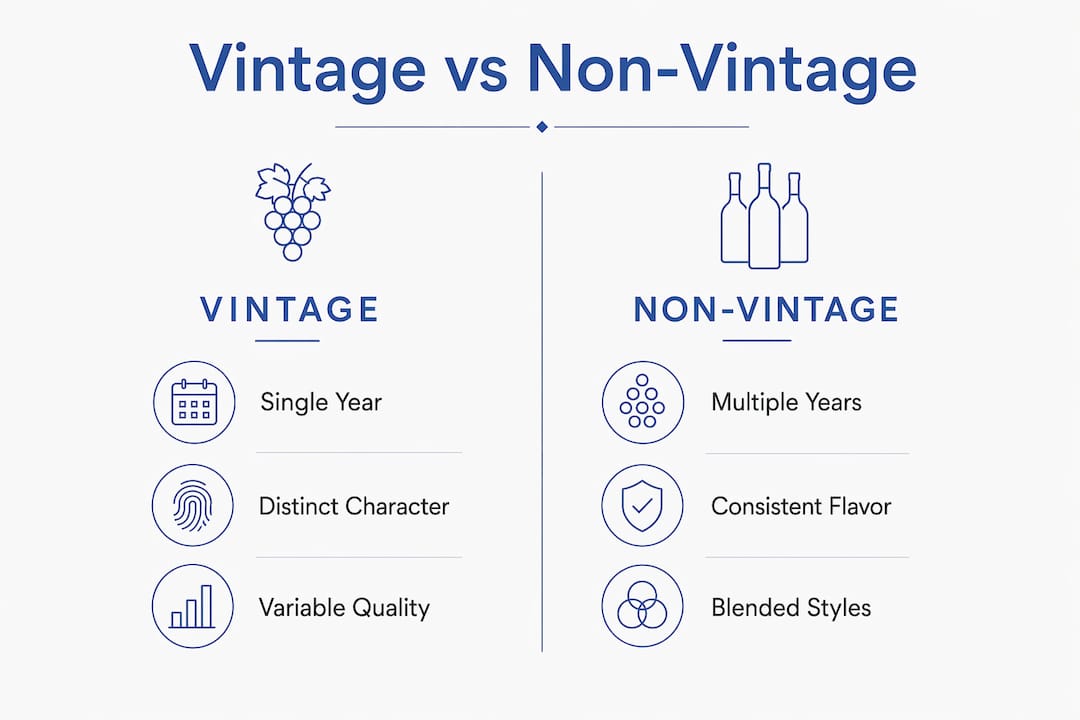
Non-vintage wines, commonly labelled NV, are blends of base wines drawn from multiple harvest years. The winemaker’s goal is flavour consistency rather than the expression of a single season. This approach is standard practice in Champagne, where houses such as Moët and Chandon and Veuve Clicquot blend wines from several years to maintain a recognisable house style regardless of annual variation.
| Feature | Vintage wine | Non-vintage (NV) wine |
|---|---|---|
| Year on label | Single harvest year | No year, or NV designation |
| Primary goal | Express a specific season’s character | Achieve consistent house style |
| Common styles | Still reds, still whites, prestige Champagne | Entry-level Champagne, Prosecco, some rosés |
| Ageing potential | Often higher, especially in great years | Generally lower; designed for early drinking |
| Collector interest | High, particularly for celebrated vintages | Lower, unless a prestige cuvée |
Vintage wines, by contrast, carry the character of a single harvest. They are inherently variable, which is precisely what makes them compelling to serious collectors. A 2010 Château Pétrus and a 2013 Château Pétrus are fundamentally different wines, shaped by two very different growing seasons in Pomerol.
NV sparkling wines are intentionally designed so that vintage differences are less meaningful than for still wines. The blending process smooths out the peaks and troughs of individual years. When a house does release a vintage Champagne, it signals that the year was exceptional enough to stand alone without blending support.
Pro Tip: When choosing between a vintage and NV sparkling wine as a gift, consider the occasion. NV Champagne offers reliability and immediate pleasure. A vintage Champagne from a celebrated year, such as 2008 or 2012, carries a story and a sense of occasion that makes it a far more memorable gift for a discerning recipient.
How to read vintage labels and use vintage charts
The vintage year on a label legally indicates the year the grapes were harvested, not when the wine was made, aged, or released. Reading that number correctly requires knowing the region’s typical production timeline. A Barolo, for example, requires a minimum of 38 months of ageing before release, meaning a 2020 Barolo would not reach shelves until at least late 2023.
Vintage charts summarise wine quality and character from a specific region in a specific year, and they guide collectors on peak drinking times. Wine Spectator publishes one of the most widely referenced vintage charts, covering major regions from Bordeaux and Burgundy to Napa Valley and the Barossa. The chart typically assigns a score and a drinking window, giving collectors a practical framework for deciding when to open a bottle.
Using vintage charts effectively involves four clear steps.
- Identify the wine’s region and style. A vintage chart for Bordeaux does not apply to Rioja, even if the years overlap.
- Locate the specific vintage year on the chart. Note the quality rating and the recommended drinking window.
- Compare the current year against the drinking window. If the wine is not yet in its window, plan to cellar it further.
- Factor in the producer’s reputation. A top producer in a modest vintage often outperforms a lesser producer in a celebrated year.
| Region | Vintage to watch | General drinking window |
|---|---|---|
| Burgundy (red) | 2015 | Now through 2035 |
| Barossa Valley Shiraz | 2019 | 2024 through 2032 |
| Bordeaux (left bank) | 2016 | 2026 through 2040 |
| Mosel Riesling | 2017 | Now through 2030 |
Vintage charts have limitations worth acknowledging. For everyday wines priced under $25, vintage variation rarely justifies detailed research. In warm, consistent climates, the difference between years is often subtle enough that chart guidance adds little practical value. Vintage charts deliver the most value when applied to age-worthy wines from variable-climate regions.
How to choose vintage wines as a collector or enthusiast
Choosing a vintage wine well requires matching the wine’s character to your purpose, whether that is cellaring, gifting, or pairing with a specific meal. The vintage year is one of several factors, alongside producer reputation, appellation, and grape variety.
Regional vintage variability is the first consideration. Burgundy and Champagne reward careful vintage selection because year-to-year differences are significant. Napa Valley Cabernet Sauvignon is more forgiving, with most recent vintages producing wines of reliably high quality. Australian regions such as the Clare Valley and Coonawarra sit closer to the variable end of the spectrum, making vintage knowledge genuinely useful.
Producer consistency matters as much as vintage quality. A great producer in a difficult year often crafts a wine that outperforms the regional average. Domaine de la Romanée-Conti in Burgundy and Penfolds in the Barossa are examples of producers whose winemaking skill narrows the gap between good and great vintages.
Vintage knowledge connects directly to food pairing decisions. A warm vintage Shiraz with ripe, generous fruit pairs differently with a dish than a cooler vintage expression of the same wine. Collectors who understand this nuance can plan cellar selections around their entertaining calendar with genuine precision.
For gifting, the vintage year adds a layer of meaning that elevates the gesture. A wine from the recipient’s birth year, a milestone year, or a celebrated harvest carries a narrative that no generic bottle can replicate. Aptent’s wine gifting guide offers detailed guidance on selecting vintage wines for special occasions, including how to match the wine’s character to the recipient’s palate.
Investment-worthy bottles almost always carry a vintage designation. The secondary market for fine wine is built on vintage specificity. A 2005 Château Lafite Rothschild commands a price that a 2011 from the same estate does not, because the vintage tells the market everything it needs to know about the wine’s potential.
Key takeaways
Vintage in wine is the single most information-dense detail on any label, condensing an entire growing season into one number that shapes quality, character, ageing potential, and value.
| Point | Details |
|---|---|
| Vintage definition | The vintage year is the grape harvest year, not the bottling or purchase date. |
| Climate and quality | Variable climates like Burgundy and Mosel show the greatest vintage-to-vintage differences in quality. |
| NV wines | Non-vintage wines blend multiple harvest years to achieve consistency, not to express a single season. |
| Vintage charts | Use region-specific vintage charts to identify peak drinking windows before opening or buying. |
| Collector value | Investment-grade bottles are almost always vintage-dated, with celebrated years commanding significant price premiums. |
Aptent’s perspective on vintage and the collector’s mindset
The most revealing thing about a wine collector’s cellar is not the labels on the bottles. It is the depth of vintage knowledge behind each selection. Aptent has observed, across years of working with serious collectors and high-net-worth enthusiasts, that the collectors who derive the greatest pleasure from their cellars are those who treat the vintage year as a living piece of information rather than a static number.
The conventional wisdom says to buy great vintages and avoid poor ones. That advice is too blunt to be genuinely useful. A so-called difficult vintage in Burgundy, such as 2007 or 2011, can produce wines of extraordinary elegance and early drinkability. Those wines are often undervalued precisely because the vintage’s reputation overshadows the producer’s skill. Aptent has found that the most rewarding cellar discoveries frequently come from these overlooked years.
Australian collectors sometimes underestimate the significance of local vintage variation. The 2019 vintage across much of South Australia and Victoria was exceptional, producing wines of remarkable depth and longevity. Yet many collectors default to European vintage charts without applying the same rigour to domestic selections. The Barossa, Clare Valley, and Yarra Valley each have their own vintage rhythms, and understanding those rhythms is what separates a thoughtful collection from a random accumulation of bottles.
The advice Aptent offers to collectors at every level is this: learn the vintage story before you buy, not after. A vintage chart takes two minutes to consult. That two minutes can be the difference between opening a wine at its peak and opening it a decade too early.
— Aptent
Fine vintage wines, curated for discerning collectors
Aptent’s curated wine collection is built around the principle that vintage matters. Every bottle in the selection has been chosen with provenance, producer reputation, and vintage character in mind.
The Grand Cru and rare cuvée collection at Aptent includes vintage wines from celebrated producers across Burgundy, Bordeaux, Champagne, and Australia’s finest regions. For collectors seeking a singular expression of a great year, or for those looking to present a vintage wine as a gift of genuine distinction, Aptent’s gifting service offers personalised guidance and presentation to match the occasion. Each selection reflects Aptent’s commitment to authenticity, refinement, and the enduring pleasure of wine chosen with knowledge and care.
FAQ
What does vintage mean on a wine label?
Vintage on a wine label refers to the calendar year in which the grapes were harvested. It is not the year the wine was bottled, aged, or purchased.
What is the difference between vintage and non-vintage wine?
Vintage wine comes from a single harvest year and reflects that season’s specific conditions. Non-vintage wine blends grapes from multiple years to achieve a consistent flavour profile.
Does a better vintage always mean a better wine?
Not necessarily. Producer skill can outperform a modest vintage, and a celebrated vintage does not guarantee quality from every producer in a region.
How do I use a vintage chart to choose wine?
Identify the wine’s region, locate the vintage year on a reputable chart such as Wine Spectator’s, and check the quality rating and recommended drinking window before buying or opening.
Does vintage matter for sparkling wine?
For NV sparkling wines, vintage variation is intentionally minimised through blending. Vintage Champagne and prestige cuvées are the exception, released only in exceptional years and worth seeking out for their singular character.


