
Why caviar is expensive: the real cost explained
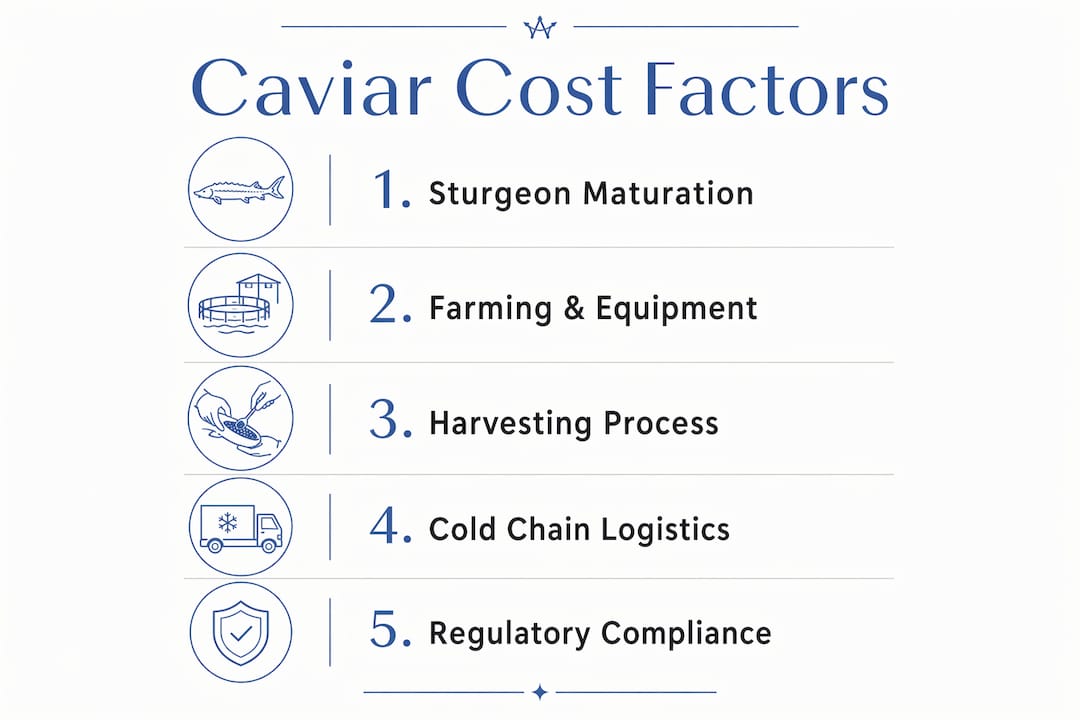
Caviar is defined as the salt-cured roe of sturgeon, and its price reflects genuine biological and production realities rather than marketing mythology. Premium caviar regularly exceeds $250 per ounce because sturgeon require 8 to 20 years of intensive care before producing any roe at all. That timeline alone creates a cost foundation unlike almost any other food product on earth. Add strict international regulations, skilled manual labour, and an unforgiving cold chain, and the price becomes not just understandable but inevitable. Understanding why caviar is expensive means understanding the full weight of that investment.
Why is caviar so expensive? The biology behind the price
Sturgeon are among the oldest fish species alive, and their biology is the single greatest driver of caviar pricing. Most species require between 8 and 20 years to reach sexual maturity. During that entire period, a farm generates zero roe revenue while continuing to pay for feed, water quality management, veterinary oversight, and infrastructure.
The financial exposure is considerable. Farms investing in water filtration, oxygen control, and specialist feed accumulate costs for years before a single tin reaches market. A disease outbreak or water contamination event can wipe out an entire cohort of fish, erasing a decade of investment in a matter of days. That catastrophic risk is priced into every gram sold.
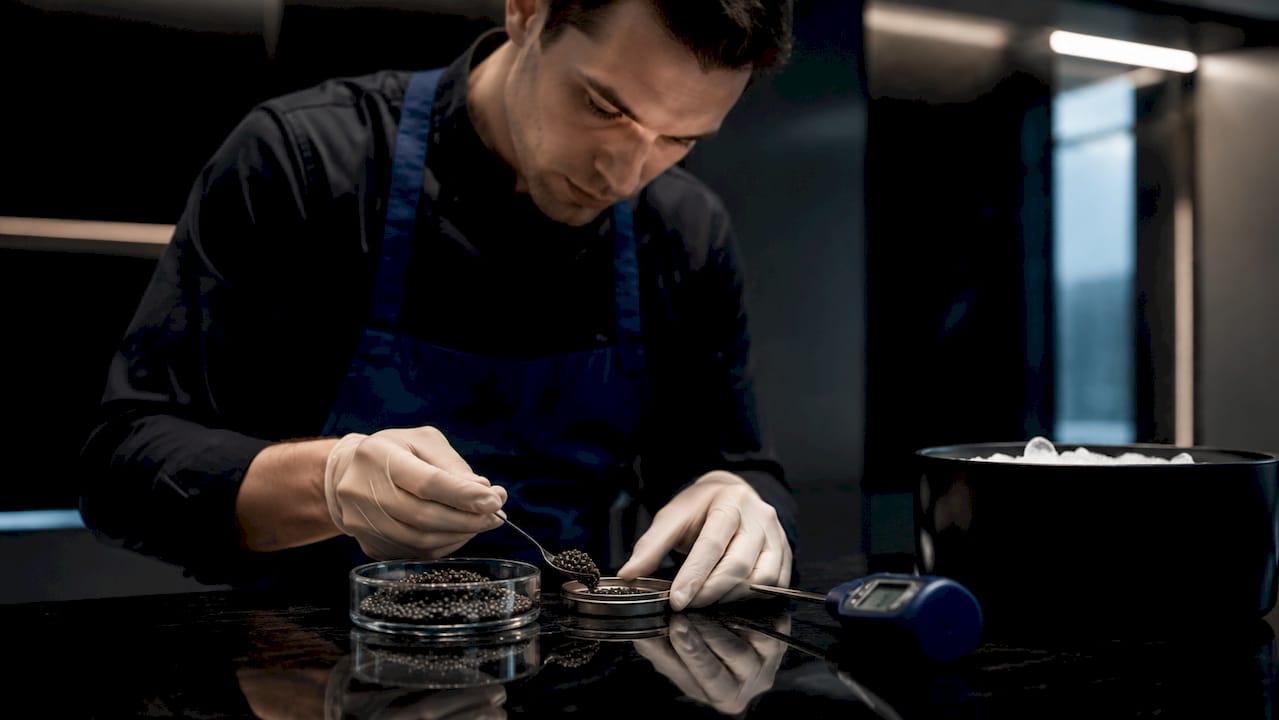
Compare this to salmon, which reaches harvest weight in roughly two years, or oysters, which are ready in three to five years. Sturgeon farming operates on a fundamentally different economic model. The fish are not a crop in any conventional sense. They are a long-term capital commitment with no guarantee of return.
Pro Tip: When comparing caviar prices across producers, ask how long their fish have been in production. A farm with mature, well-established stock typically delivers more consistent roe quality than one working with younger fish.
How wild harvest collapse and regulation drove costs higher
Wild sturgeon populations in the Caspian and Black Seas were commercially devastated by decades of overfishing through the twentieth century. The Convention on International Trade in Endangered Species (CITES) responded by imposing strict protections that effectively ended commercial wild sturgeon harvesting. The result is that modern caviar is almost entirely farm-raised, and aquaculture carries its own substantial cost structure.
Regulatory compliance alone adds significant expense to every legitimate producer. Farms must maintain:
- Species traceability documentation from egg to tin
- Environmental monitoring records for water discharge and habitat impact
- Licensing renewals subject to government inspection
- Certification for export, particularly for markets in the European Union, the United States, and Australia
Each of these requirements demands dedicated staff, record-keeping systems, and periodic audits. There is no low-cost shortcut that preserves legal market access. Producers who cut corners lose their export licences and their customers. That compliance burden is built into the retail price, whether buyers recognise it or not.
The shift to aquaculture has not reduced prices, despite what one might expect from moving production indoors and under controlled conditions. Farmed caviar has maintained or increased prices because the human expertise and fragile production conditions required have not diminished. Regulation replaced scarcity as the primary supply constraint, and the economics remained equally demanding.
Harvesting, processing, and the cold chain that protects every tin
Extracting roe from a mature sturgeon is a skilled procedure that cannot be mechanised without damaging the delicate eggs. Specialist workers assess each fish individually, timing the harvest to the precise moment of roe ripeness. Yield varies considerably between fish of the same species and age, which means not every mature sturgeon produces commercially viable roe in a given season.
Once extracted, the roe moves through a careful sequence of steps:
- Rinsing and sieving to remove membrane and impurities
- Light salting using the malossol technique, which uses minimal salt to preserve natural flavour
- Grading by size, colour, and firmness to separate tins by quality tier
- Packing into airtight tins under refrigeration
- Cold chain transport maintained at near-freezing temperatures from farm to consumer
Malossol caviar commands higher prices than pasteurised alternatives because the light salting preserves texture and flavour at the cost of a much shorter shelf life. Pasteurised caviar lasts longer but loses some of the buttery smoothness and clean brine character that defines premium roe. The choice of preservation method is a direct trade-off between quality and commercial convenience.
The cold chain requirement adds cost at every stage. Any break in refrigeration degrades texture and flavour irreversibly. Specialist couriers, temperature-controlled warehousing, and insulated packaging are not optional extras. They are the minimum standard for delivering a product worth eating. Spoilage risk at any point in the chain is factored into the price from the outset.
Pro Tip: Always check the packing date on a tin before purchasing. Fresh malossol caviar is best consumed within four to six weeks of packing. A tin without a clear packing date is a tin to avoid.
How species, grades, and quality distinctions affect caviar pricing
The species of sturgeon determines the character of the roe and sets the price ceiling for any given product. The three most prized species are Beluga (Huso huso), Osetra (Acipenser gueldenstaedtii), and Sevruga (Acipenser stellatus). Beluga produces the largest eggs with the most delicate flavour and commands the highest prices. Osetra offers a nutty richness and golden to dark brown colour range that many connoisseurs prefer. Sevruga produces smaller, more intensely flavoured eggs at a comparatively lower price point.
Caviar grading is not standardised internationally. Producers use internal house systems with terms like “Imperial,” “Royal,” or “Selection” that reflect their own sorting criteria rather than any universal benchmark. These labels are marketing designations, not regulated quality certificates. A tin labelled “Imperial” from one producer may be equivalent to “Classic” from another.
| Species | Egg size | Flavour profile | Relative price |
|---|---|---|---|
| Beluga | Large | Delicate, creamy, subtle brine | Highest |
| Osetra | Medium | Nutty, rich, complex | High |
| Sevruga | Small | Intense, briny, mineral | Moderate |
| Baeri | Small to medium | Clean, mild, buttery | Accessible |
Educated buyers focus on species, origin, and packing date rather than house grade labels to assess genuine value. The country of origin matters because aquaculture regulations vary significantly. French and Italian farms operate under stringent European Union environmental standards. Chinese farms have expanded production rapidly but face greater scrutiny over consistency. Provenance is not snobbery. It is a practical indicator of production standards.
The distinction between malossol and pasteurised caviar also carries direct pricing implications. Malossol tins carry a premium because they require faster handling, more careful storage, and a shorter retail window. Pasteurised caviar suits longer supply chains and lower price points but does not represent the same sensory experience.
Caviar service formats for events and what they actually cost
Caviar service at events ranges from intimate tasting portions to generous appetiser spreads, and the format chosen determines both the quantity required and the overall budget. A tasting portion runs at roughly 10–15 grams per person, while a proper appetiser service requires 30–50 grams per person to feel generous rather than token.
A high-end Beluga caviar appetiser service for 30 guests can cost between €2,400 and €4,800 depending on service style and sourcing. That figure shifts considerably when Osetra or Sevruga replaces Beluga, or when a caviar pairing menu incorporates blinis, crème fraîche, and matched wines to extend the experience across multiple courses.
Modern event formats have introduced the caviar “bump,” where guests receive a small spoonful of roe served directly on the back of the hand. This experiential format uses less product per person while creating a memorable, tactile moment. It suits corporate events and cocktail receptions where theatre matters as much as quantity.
Purchasing caviar directly from specialist distributors rather than through catering companies can reduce event costs substantially, as catering mark-ups on premium ingredients typically range from 40 to 100 per cent. Selecting Osetra or Baeri over Beluga for larger groups also delivers genuine quality at a more manageable per-head cost. Presentation, including mother-of-pearl spoons, crushed ice, and elegant tins, shapes perceived value as much as the roe itself. Luxury yacht events and private dining experiences increasingly use caviar service as a centrepiece precisely because the visual and sensory impact justifies the investment.
Key takeaways
Caviar pricing is driven by irreplaceable biological timelines, strict regulatory compliance, and skilled production processes that cannot be shortcut without destroying the product’s quality.
| Point | Details |
|---|---|
| Sturgeon maturation timeline | Sturgeon take 8 to 20 years to mature, creating years of cost with no roe revenue. |
| Regulatory compliance costs | CITES protections ended wild harvesting, making costly aquaculture the only legal supply route. |
| Processing and cold chain | Malossol handling and unbroken refrigeration add unavoidable cost at every production stage. |
| Grading labels are not universal | Terms like “Imperial” or “Royal” are internal producer standards, not regulated quality marks. |
| Event sourcing strategy | Buying direct from specialist distributors reduces event caviar costs by avoiding catering mark-ups. |
Aptent’s perspective on reading caviar value honestly
The most common mistake discerning buyers make is paying for a label rather than a product. After years of working with premium caviar producers and curating selections for high-net-worth clients, the pattern is consistent: the buyers who feel most satisfied are those who understand what they are actually purchasing, not those who simply bought the most expensive tin available.
The real cost of caviar lies in the years of patient cultivation, the risk absorbed by producers, and the expertise applied at every stage from harvest to tin. That cost is legitimate and verifiable. What is not legitimate is paying a premium for a house grade term that carries no independent meaning.
For anyone exploring caviar for the first time, start with Osetra or Baeri. Both species offer genuine complexity and quality at a price point that allows you to taste thoughtfully rather than anxiously. Read the label for species, country of origin, and packing date. Ignore the marketing tier name entirely. Freshness and provenance will tell you everything the grade label will not.
Pair your first tin with a lightly buttered blini and a glass of well-made blanc de blancs Champagne. Resist the urge to overwhelm the roe with garnishes. The flavour of genuinely good caviar is its own argument for the price.
— Aptent
Discover Aptent’s curated caviar collection
Aptent sources its caviar directly from prestigious producers, delivering authenticated farm-raised roe to discerning buyers across Australia with full cold chain integrity.
The Baeri Signature Caviar and Oscietre Signature Caviar lines represent Aptent’s commitment to provenance and freshness, with clear species labelling and packing dates on every tin. For events and private dining, Aptent’s gourmet events service provides curated caviar experiences tailored to intimate gatherings and large-scale luxury functions alike. Explore the full caviar collection to find the right selection for your table or occasion.
FAQ
What exactly is caviar?
Caviar is the salt-cured roe of sturgeon, harvested from mature female fish and lightly salted using the malossol technique to preserve flavour. Only roe from sturgeon species qualifies as true caviar under international trade definitions.
What is caviar grading and how does it work?
Caviar grading is not standardised internationally. Producers use internal house systems with terms like “Imperial” or “Royal” that reflect their own sorting criteria, making species, origin, and packing date more reliable quality indicators than grade labels.
Why is farm-raised caviar still so costly?
Farm-raised caviar remains expensive because sturgeon require 8 to 20 years to mature, generating no revenue during that period while farms absorb ongoing costs for feed, water management, veterinary care, and regulatory compliance.
What is a caviar service at an event?
A caviar service at an event is a structured presentation of roe, typically served on blinis, with crème fraîche and matched wines, in portions ranging from 10 grams for a tasting to 50 grams per person for a full appetiser course.
How can I reduce caviar costs for an event?
Purchasing directly from specialist distributors rather than through catering companies avoids mark-ups of 40 to 100 per cent. Choosing Osetra or Baeri over Beluga for larger groups also delivers genuine quality at a more manageable per-head cost.


