
Why wine pairing elevates events: a host's guide
Wine pairing is the deliberate matching of wine and food to enhance an event’s sensory and emotional experience, transforming ordinary gatherings into occasions of genuine distinction. For event hosts and planners, understanding why wine pairing elevates events is the difference between a forgettable dinner and one guests discuss for months. The practice draws on sensory neuroscience, chemistry, and the refined instincts of institutions like the Court of Master Sommeliers to produce harmony between glass and plate. Recent advances in evidence-based pairing protocols are making these principles more accessible and measurable than ever before.
How does wine pairing enhance the sensory experience of an event?
Wine pairing works at a chemical level before it works at an aesthetic one. Tannin-protein binding is the clearest example: a tannic Cabernet Sauvignon that feels austere on its own becomes smooth and generous when served alongside a fatty ribeye, because the tannins bind to the meat’s proteins and reduce astringency. The transformation is immediate and unmistakable. Guests who might have found the wine harsh alone will find it polished and complete at the table.
Acidity performs an equally important role. Wine acidity cuts through fat and salt, refreshing the palate between bites and preventing richness from becoming fatigue. A crisp Sancerre alongside a creamy goat cheese is the textbook illustration of this principle. The Loire Valley’s signature acidity slices through the cheese’s density, leaving the palate clean and ready for the next bite.
The neuroscience behind these interactions is compelling. Sensory researcher Dr Peter Klosse has demonstrated that harmonious pairings trigger pleasurable emotional brain responses, enhancing guest experience well beyond taste alone. When the flavour profiles of wine and dish overlap in the right way, the brain registers a genuinely pleasurable state. This is why a well-paired table feels convivial and warm, not merely well-fed.
The industry is formalising these insights. The shift toward evidence-based physiological pairing using metrics like the Salivary Protein Index to reduce astringency is becoming the standard by which serious hosts and sommeliers now operate. That shift matters for event planners because it means pairing decisions can be validated, not merely guessed at.
Pro Tip: Tell guests that some wines feel firm or sharp on their own but become generous and round with food. This simple piece of storytelling transforms a tasting note into a moment of discovery, and guests remember the experience far longer.
What practical principles should event hosts follow for wine pairing?
The single most common mistake hosts make is selecting wines before they have finalised the menu. Food must lead wine selection, with the dish’s weight, texture, and dominant flavours determining which wine structure will complement rather than clash. A delicate steamed fish calls for a wine with restraint and acidity; a slow-braised lamb shoulder demands something with body and depth.
Once the food is defined, match the wine’s structure to the dish’s character. Acidity, tannin, sweetness, and alcohol each interact differently with food. Sweetness is particularly useful for managing heat: wines with 18–25 g/L residual sugar, at the Spätlese level, measurably reduce the perceived spiciness of capsaicin-forward dishes compared to dry wines. For hosts designing menus with Thai, Sichuan, or Indian-inspired courses, an off-dry German Riesling or Alsatian Gewurztraminer is not merely pleasant. It is functional.
Balance is the governing principle throughout. Sommeliers emphasise balance over perfection: the goal is for neither wine nor food to dominate the pairing. A wine that overpowers a dish is as problematic as one that disappears beneath it. Both components should arrive at the table as equals.
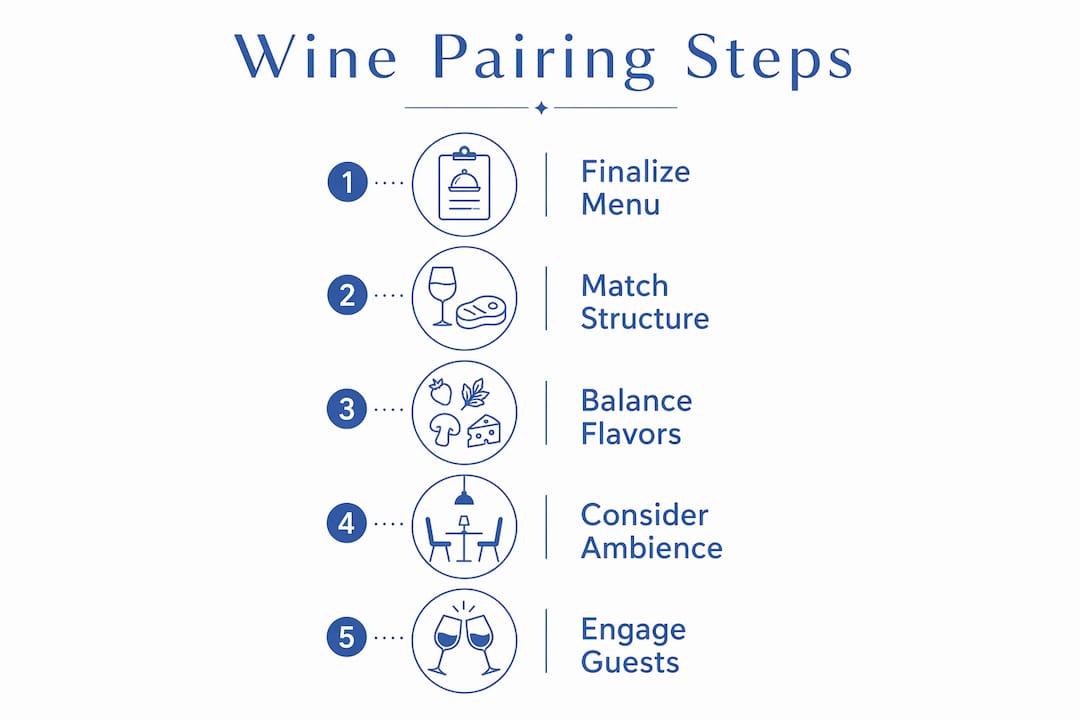
Ambience matters more than most hosts realise. Strong scents like candles or flowers interfere directly with wine’s olfactory perception, negating pairing efforts before the first sip. Fragrance-free table settings, appropriate glassware for each wine style, and correct serving temperatures are not optional refinements. They are the foundation on which pairing success rests.
The table below offers a practical reference for matching wine types to common event menu categories.
| Wine type | Ideal food match | Key structural reason |
|---|---|---|
| Crisp white (Sancerre, Chablis) | Seafood, goat cheese, light salads | High acidity cleanses fat and salt |
| Off-dry white (Riesling Spätlese) | Spicy dishes, Asian cuisine | Residual sugar dampens heat perception |
| Full-bodied red (Cabernet Sauvignon) | Red meat, aged hard cheese | Tannins bind to protein, reducing astringency |
| Sparkling (Champagne, Crémant) | Fried foods, caviar, oysters | Bubbles and acidity cut through richness |
| Dessert wine (Sauternes) | Foie gras, blue cheese, fruit tarts | Sweetness contrasts salt and amplifies fruit |
Pro Tip: Use wine acidity strategically as a palate cleanser between courses. A small pour of a high-acid white between a rich entrée and a delicate fish course resets the palate and sharpens guest attention for what follows.
How does wine pairing impact event success and business outcomes?
The commercial case for wine pairing is well established. Curated wine pairing events boost revenue by an average of 30% while increasing brand loyalty and guest engagement. That figure reflects a straightforward dynamic: guests who feel they have received something considered and expert are more willing to spend, return, and recommend.
Beyond revenue, wine pairing changes the social texture of an event. When guests are guided through a pairing sequence, conversation flows naturally around the wines, the dishes, and the stories behind both. A Burgundy producer’s narrative, a vintage’s particular character, or the origin of a rare caviar all become talking points that guests carry into their own networks. The wine becomes a vehicle for connection, not merely a beverage.
Corporate events and fundraising galas benefit particularly from this dynamic. A structured pairing programme signals investment in guest experience and positions the host as a connoisseur of quality. For high-net-worth audiences, that signal carries genuine weight. Educational wine events, where guests learn the rationale behind each pairing, generate the highest levels of engagement and the strongest post-event recall.
The memorability factor is not incidental. Guests who experience a thoughtfully paired meal associate the quality of the wine with the quality of the host’s judgement. That association builds the kind of loyalty that no promotional material can manufacture.
How can hosts design wine pairing events that fully engage guests?
The most memorable wine pairing events are built around a narrative, not just a list of bottles. Hosts who introduce each wine with a brief account of its region, producer, and the specific reason it was chosen for that course give guests a framework for what they are about to experience. That context transforms passive consumption into active appreciation.
Structure the menu so that wines guide the progression of courses. Begin with lighter, more delicate pairings and build toward richer, more complex combinations. This mirrors the natural arc of a well-composed meal and prevents palate fatigue. A well-sequenced tasting course also creates a sense of occasion, each course arriving as a distinct chapter rather than a series of disconnected plates.
Avoid these common pitfalls when executing a wine pairing event:
- Selecting wines before the menu is finalised, which almost always produces mismatches.
- Ignoring serving temperature: white wines served too warm lose their defining acidity; reds served too cold suppress their fruit and amplify tannin.
- Overlooking glassware: the wrong glass shape mutes aroma and changes the perceived structure of the wine.
- Placing scented candles or floral arrangements near the table, which interfere with olfactory perception.
- Failing to brief service staff on the pairing rationale, leaving guests without the storytelling that makes the experience memorable.
Invite guests to notice how a wine changes with each bite. Ask them to taste the wine alone first, then with the food. This simple act of guided attention turns a dinner into an education and creates the kind of shared discovery that guests associate with exceptional hosting.
Key takeaways
Wine pairing elevates events by creating chemical harmony between food and wine, triggering pleasurable emotional responses, and giving hosts a measurable tool for increasing guest engagement and event revenue.
| Point | Details |
|---|---|
| Food leads wine selection | Always finalise the menu before choosing wines to avoid structural mismatches. |
| Balance governs every pairing | Neither wine nor food should dominate; both must arrive at the table as equals. |
| Residual sugar controls heat | Off-dry wines at Spätlese level measurably reduce spice perception in capsaicin-forward dishes. |
| Ambience affects perception | Remove strong scents from the table setting to protect the wine’s olfactory character. |
| Pairing drives revenue | Curated wine pairing events increase event revenue by an average of 30%. |
Aptent’s perspective on wine pairing and event excellence
The most persistent misconception I encounter is that wine pairing is about finding a perfect match. It is not. It is about finding balance. Hosts who chase perfection tend to over-engineer their selections and lose sight of the guest experience entirely. The wines that generate the most conversation at an event are rarely the most expensive or the most technically correct. They are the ones that surprise, that change visibly with the food, and that give guests something to talk about.
What I have observed across years of working with discerning hosts and luxury event planners is that the emotional dimension of pairing is consistently underestimated. Dr Peter Klosse’s research on harmonious pairings triggering pleasurable brain states is not an abstraction. It describes something guests feel in the room, even when they cannot articulate why the evening felt so right. The science validates what experienced hosts have always known intuitively.
The practical lesson is this: invest in the story as much as the selection. A well-chosen Riesling Spätlese paired with a Sichuan-inspired course is interesting. The same wine, introduced with a brief explanation of why its residual sugar tames the heat of capsaicin, becomes memorable. Guests leave with knowledge they did not arrive with, and that is the mark of a genuinely elevated event.
— Aptent
Discover Aptent’s curated wines and gourmet event services
Aptent brings together a curated collection of premium wines and luxury gourmet products, sourced from prestigious producers, to support hosts who demand genuine refinement at their events.
From rare Grand Cru selections to the finest Baeri and Oscietre caviars, Aptent’s offerings are chosen to complement the most discerning event menus. The Gourmet Events service provides personalised guidance for hosts and planners, from pairing menu curation to full event support. For those seeking a signature pairing to anchor their next occasion, Aptent’s featured wine collection and Baeri Signature Caviar offer a natural starting point for a pairing of genuine opulence.
FAQ
What is wine pairing and why does it matter for events?
Wine pairing is the deliberate matching of wine and food to enhance sensory harmony and guest experience. For event hosts, it transforms a meal into a curated occasion and measurably increases guest engagement.
How does wine acidity improve a multi-course event menu?
Wine acidity acts as a palate cleanser by cutting through fat and salt, refreshing the palate between courses. This keeps guest attention sharp and prevents richness from accumulating across a long menu.
Should hosts choose wine before or after planning the menu?
Hosts should always finalise the food menu first. Dish weight, texture, and dominant flavours determine which wine structure will complement rather than clash with each course.
Can wine pairing help manage spicy dishes at an event?
Yes. Wines with 18–25 g/L residual sugar at the Spätlese level measurably reduce the perceived heat of capsaicin-forward dishes, making off-dry whites a practical tool for diverse event menus.
How does wine pairing affect event revenue?
Curated wine pairing events boost event revenue by an average of 30% while increasing brand loyalty and guest engagement, making pairing expertise a sound investment for professional event hosts.


