
What does brut mean in Champagne? A clear guide
Brut Champagne is defined as a sparkling wine containing less than 12 grams per litre of residual sugar, placing it firmly in the dry category under EU Commission regulations. The term “brut” is French for “raw” or “unrefined,” signalling minimal sweetness rather than an absence of sugar altogether. Despite a common misconception, brut does not mean zero sugar. High acidity and carbonation mask whatever sugar remains, producing the crisp, clean finish that makes brut the most popular Champagne style worldwide. Understanding what brut means on a label gives you a genuine advantage when selecting Champagne for any occasion.
What does brut mean on a Champagne label?
The word “brut” on a Champagne label is a legally defined classification, not a marketing term. EU regulation defines seven official sweetness tiers for Champagne based on residual sugar content, ranging from Brut Nature at the driest end through to Doux at the sweetest. Brut sits in the middle of the dry spectrum, covering 0–12 g/L of residual sugar. That range is wider than most drinkers realise, which is why two bottles both labelled “Brut” can taste noticeably different from one another.
The sugar in Champagne comes from a process called dosage. After the second fermentation and riddling are complete, the winemaker adds a small mixture of wine and cane sugar, known as the liqueur d’expédition, to adjust the final sweetness level. The amount added determines which classification tier the wine falls into. Brut receives a modest dosage, while styles like Demi-Sec receive considerably more.
Regulatory tolerance allows up to 15 g/L for a wine labelled Brut, because the EU permits a plus or minus 3 g/L margin around each sweetness boundary. This flexibility explains why some Brut Champagnes taste slightly richer than others without technically breaching the classification. It is a nuance worth knowing when you are comparing bottles side by side.
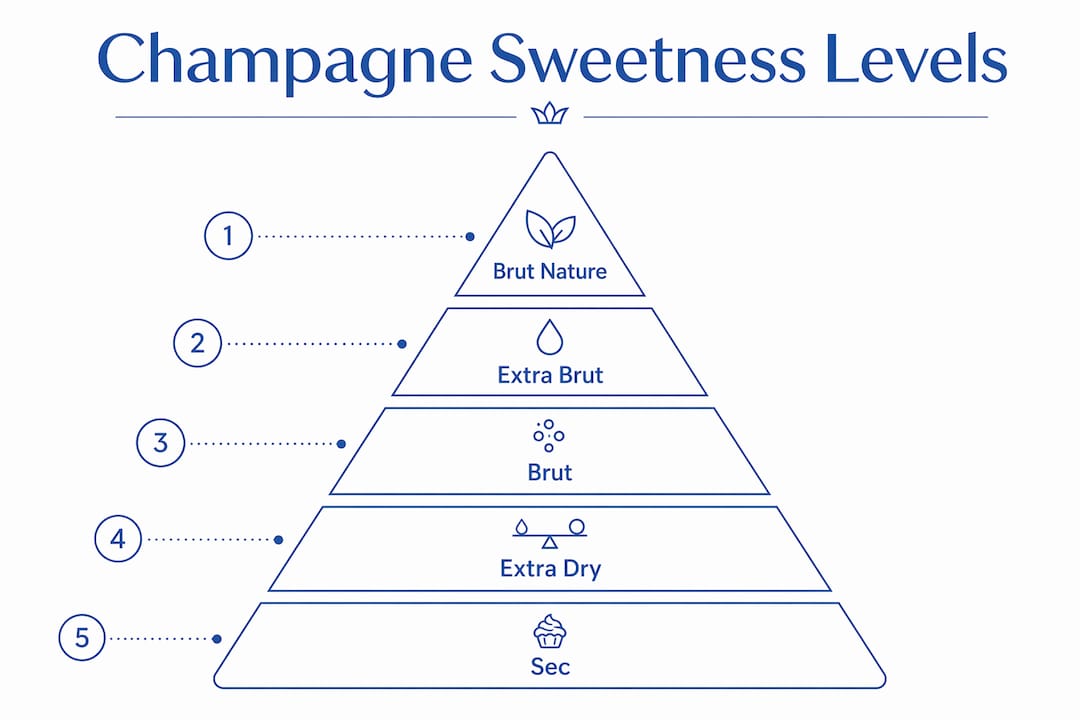
The seven official sweetness tiers, from driest to sweetest, are as follows:
| Classification | Residual Sugar (g/L) |
|---|---|
| Brut Nature | 0–3 g/L (no dosage added) |
| Extra Brut | 0–6 g/L |
| Brut | 0–12 g/L |
| Extra Dry | 12–17 g/L |
| Sec | 17–32 g/L |
| Demi-Sec | 32–50 g/L |
| Doux | 50+ g/L |
Pro Tip: If a label reads “Extra Dry,” do not assume it is drier than Brut. Extra Dry sits at 12–17 g/L, making it measurably sweeter. This is one of the most persistent points of confusion in the Champagne category.
How does brut Champagne taste?
Brut Champagne tastes dry, fresh, and lively, with a finish that feels clean rather than sweet. High acidity and CO2 content mask residual sugar, creating a crisp sensation on the palate even when the wine contains up to 12 g/L of sugar. This is why brut reads as dry to most drinkers, despite technically containing some sweetness. The carbonation amplifies the perception of acidity, which further suppresses any sugary impression.

Most commercial non-vintage Brut Champagnes carry 8–10 g/L of residual sugar, yet taste unmistakably dry. Grower producers and prestige cuvées often dose lower, at 4–8 g/L, to let the terroir and base wine speak more clearly. The result is a leaner, more mineral expression of the same classification.
Typical tasting notes for a well-made Brut Champagne include:
- Green apple, lemon zest, and white peach on the nose
- A palate of fresh citrus, brioche, and light toasted almond
- Fine, persistent bubbles that carry flavour across the tongue
- A dry, mineral finish with a clean, refreshing close
The style of Champagne also influences taste within the Brut category. A Blanc de Blancs made entirely from Chardonnay will taste leaner and more citrus-driven. A Blanc de Noirs from Pinot Noir or Pinot Meunier will feel fuller and more red-fruit forward. Both can carry the Brut classification while tasting quite distinct from one another.
Pro Tip: When assessing a Brut Champagne’s quality, pay attention to the length of the finish rather than the intensity of the bubbles. A long, dry, mineral finish signals a well-balanced dosage and a quality base wine.
Common misconceptions about brut Champagne
The most persistent misconception is that “Extra Dry” means drier than Brut. Extra Dry ranges from 12–17 g/L, making it measurably sweeter. The name is a historical quirk from an era when Champagne was far sweeter than it is today, and “Extra Dry” was genuinely considered restrained by the standards of the time. That context has long since vanished, but the label remains.
A second misconception is that Brut Nature or zero dosage always signals superior quality. Experts note that Brut is often more balanced and versatile than zero dosage styles, which can expose imbalances in the base wine. Without any dosage to integrate the components, a wine with high acidity or green fruit characters can taste austere or even harsh. Brut’s modest sugar addition rounds the wine without masking its character.
“Brut is the benchmark Champagne style precisely because it balances acidity, sugar, and flavour with enough flexibility to suit both the winemaker and the drinker.” — Champagne Club
A third area of confusion involves the regulatory tolerance margins. The EU allows a 3 g/L tolerance around each sweetness boundary, meaning a wine labelled Brut can legally contain up to 15 g/L of sugar. This does not indicate a lower quality wine. It simply reflects the natural variation in dosage across different production batches and vintages.
When choosing a Brut Champagne with confidence, keep these points in mind. Verify the classification tier on the label rather than relying on the name alone. Consider whether you prefer a leaner grower style or a richer non-vintage blend. And remember that a slightly higher dosage within the Brut range often produces a more approachable, food-friendly wine than a zero dosage alternative.
What food pairs well with brut Champagne?
Brut Champagne is one of the most food-friendly wines produced anywhere in the world. Its dryness and acidity make it ideal for aperitifs and for pairing with delicate dishes that would be overwhelmed by a richer or sweeter wine. The combination of fine bubbles and crisp acidity cuts through fat and salt with exceptional elegance.
Seafood is the natural partner for Brut Champagne. Oysters, prawns, scallops, and lobster all benefit from the wine’s mineral freshness. The salt of the sea and the citrus notes in the wine create a pairing that feels both classical and effortless. Caviar, in particular, reaches a new dimension of flavour alongside a well-chosen Brut, with the wine’s acidity lifting the brine and richness of the roe without competing with it.
Beyond seafood, Brut Champagne performs beautifully with:
- Soft cheeses such as brie and camembert, where the acidity cuts through the cream
- Lightly seasoned poultry, including roast chicken and turkey breast
- Canapés and finger food at cocktail events and celebrations
- Tempura and other lightly battered dishes, where the bubbles cleanse the palate
- Egg-based dishes such as quiche and frittata, which mirror the wine’s brioche notes
Brut also suits the full arc of a formal dinner. Served as an aperitif, it sharpens the appetite. Paired through the first and second courses, it maintains freshness without fatigue. For those hosting gourmet events or private celebrations, Brut Champagne is the single most versatile wine to anchor a menu.
Key takeaways
Brut Champagne is the world’s benchmark sparkling wine style, defined by 0–12 g/L residual sugar, masked by high acidity and carbonation to deliver a consistently dry, refined drinking experience.
| Point | Details |
|---|---|
| Brut is legally defined | EU regulation sets Brut at 0–12 g/L residual sugar, with a 3 g/L tolerance allowing up to 15 g/L. |
| Extra Dry is sweeter than Brut | Extra Dry contains 12–17 g/L sugar, making it a sweeter style despite the misleading name. |
| Acidity masks sugar | High acidity and carbonation suppress the perception of sweetness, producing a dry finish. |
| Dosage shapes the style | Grower producers dose at 4–8 g/L; commercial non-vintage Bruts typically sit at 8–10 g/L. |
| Brut pairs with almost everything | Its dryness and acidity make it ideal for seafood, poultry, soft cheese, and celebration aperitifs. |
Aptent’s view: why Brut remains the Champagne to know
Brut is the style I return to most consistently, and not simply because it is the most widely produced. It is because Brut represents the clearest expression of what Champagne does better than any other wine: balance. The tension between acidity, effervescence, and a whisper of sugar is what makes a great Brut feel alive in the glass rather than merely pleasant.
What I find most telling is how Brut suits the Australian palate particularly well. Australians tend to favour wines that are dry, fresh, and food-ready rather than overtly sweet or heavily oaked. A well-chosen Brut, whether a classic non-vintage blend or a Cuvée 1887 Brut from a boutique grower house, delivers exactly that character.
The dosage trend in 2026 continues to move toward lower sugar within the Brut range, particularly among grower producers who want their terroir to speak without interference. This is a welcome development, though I would caution against dismissing higher-dosed Bruts as inferior. A wine dosed at 10 g/L with exceptional base material will always outperform a zero dosage wine built on mediocre fruit.
My advice for anyone building their Champagne knowledge is to start with Brut. Taste it alongside an Extra Brut Blanc de Blancs to feel the difference that a few grams of sugar makes. Then try it with food. The moment Brut meets a plate of freshly shucked oysters or a sliver of aged brie, its purpose becomes entirely clear.
— Aptent
Aptent Gourmet’s curated Brut Champagne collection
Aptent Gourmet sources its Champagne collection directly from prestigious boutique grower houses in France, with each bottle selected for authenticity, provenance, and the kind of refined character that discerning drinkers expect.
Whether you are planning an intimate dinner, a corporate celebration, or simply wish to keep a bottle of exceptional Brut on hand, Aptent’s curated range offers the depth and variety to match the occasion. The collection spans classic non-vintage Bruts through to rare Grand Cru cuvées, each accompanied by tasting notes and pairing guidance. For those who appreciate the full luxury table, Aptent also offers a selection of fine caviar to accompany your Champagne with the elegance it deserves.
FAQ
What does brut mean in Champagne?
Brut is a legally defined Champagne classification indicating a residual sugar level of 0–12 g/L. The term signals a dry, crisp style shaped by high acidity and minimal dosage.
Is brut Champagne sweet or dry?
Brut Champagne is dry. Despite containing some residual sugar, its high acidity and carbonation mask sweetness, producing a clean, refreshing finish.
What is the difference between brut and extra brut?
Extra Brut contains 0–6 g/L of residual sugar, making it drier and leaner than standard Brut, which ranges up to 12 g/L. Extra Brut tends to emphasise terroir and mineral character more directly.
Why is Extra Dry Champagne sweeter than Brut?
Extra Dry ranges from 12–17 g/L of residual sugar, placing it above the Brut threshold. The name is a historical classification from an era when Champagne styles were generally much sweeter, and the terminology was never updated.
How much sugar does brut Champagne contain?
Most commercial non-vintage Brut Champagnes contain 8–10 g/L of residual sugar. Grower producers and prestige cuvées often dose lower, at 4–8 g/L, to highlight the purity of the base wine.


