
Classical French cuisine: history, techniques, and iconic dishes
Classical French cuisine is a codified culinary tradition built on precise technique, structured meal courses, and an unwavering commitment to seasonal, high-quality ingredients. Known formally as cuisine classique, it represents the systematic organisation of cooking methods, kitchen management, and meal service that has shaped professional kitchens across the globe. Its hallmark dishes, from the slow-braised opulence of Boeuf Bourguignon to the sun-drenched simplicity of Ratatouille, are not merely recipes but expressions of a philosophy: that the finest food emerges from discipline, not improvisation.
What defines this tradition at its core:
- Codified technique: every preparation follows a logical sequence, from foundational stocks and mother sauces through to precise pastry work
- Structured meal service: the classic progression of entrée, plat principal, cheese, and dessert, always accompanied by bread and wine
- Seasonal, high-quality ingredients: the cuisine prizes what is freshest and most flavourful, not what is merely available
- Formal presentation: colour, volume, and texture are considered with the same care as flavour
- Iconic repertoire: Boeuf Bourguignon, Coq au Vin, Bouillabaisse, Ratatouille, and Tarte Tatin form the canon that culinary schools still teach today
Its influence on culinary education is profound. Auguste Escoffier’s 1903 masterwork Le Guide Culinaire remains a core text at cookery schools worldwide, and the principles it codified continue to underpin professional training from Paris to Sydney.
How did classical French cuisine evolve through history?
The story of classical French cooking is one of remarkable transformation, driven by revolution, ambition, and the singular genius of a handful of chefs who refused to leave their methods undocumented.
Medieval origins and Italian influences
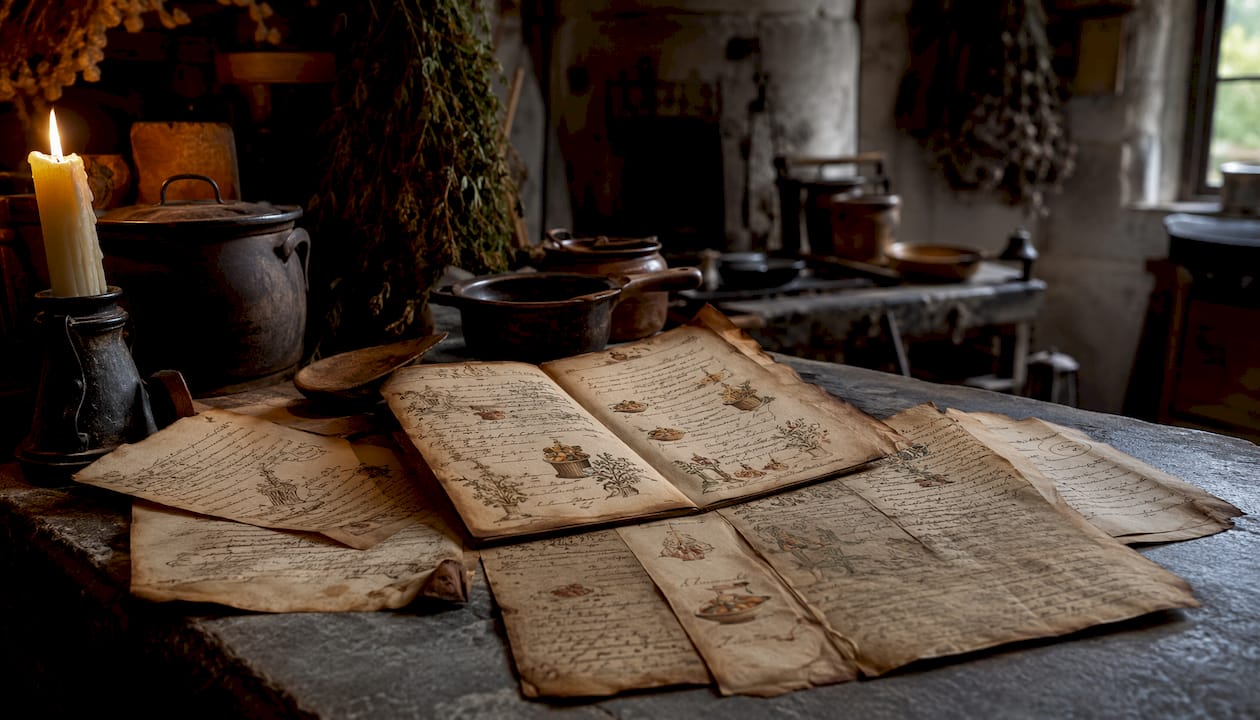
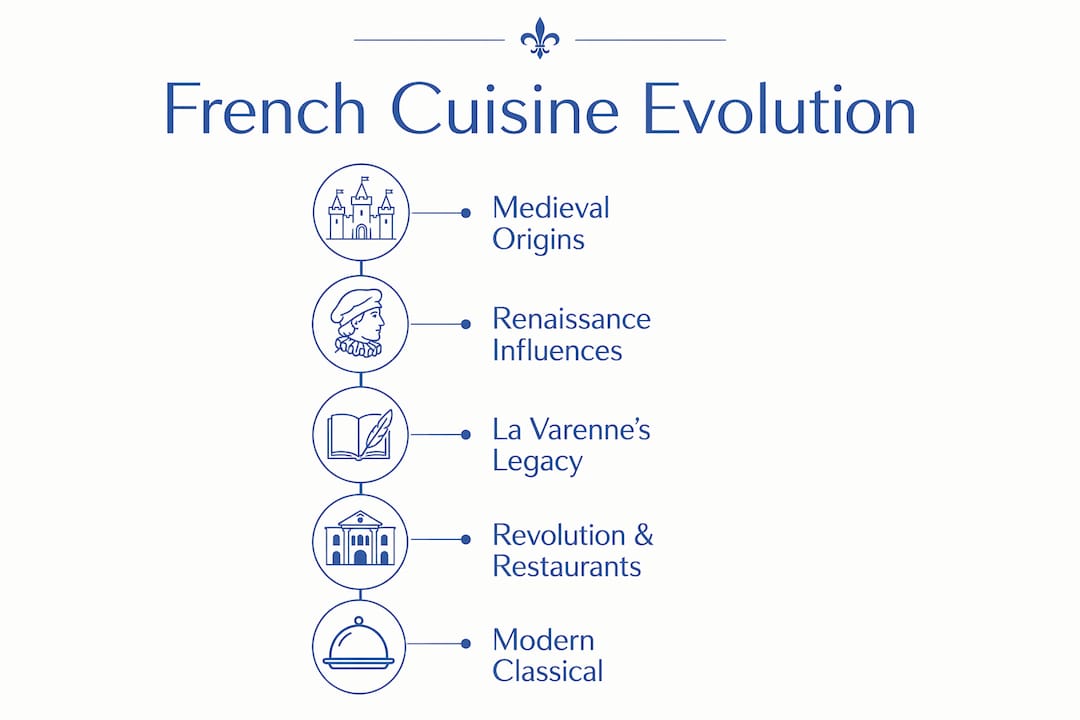
French cuisine’s earliest formal expression arrived in the 14th century, when Guillaume Tirel, the court chef known as “Taillevent,” compiled Le Viandier, one of the earliest recipe collections of medieval France. The cooking of this era leaned heavily on spices, imported flavours, and elaborate presentations designed to impress noble patrons. Italian influence arrived most dramatically with Catherine de Médicis in the 16th century, whose Florentine cooks introduced new ingredients, refined table manners, and a more structured approach to the meal.
La Varenne and the birth of a French identity
The decisive break from foreign influence came in the 17th century. François Pierre La Varenne shifted French cooking decisively toward regional and seasonal ingredients, away from the heavy spice palettes of medieval kitchens. His landmark work Le Cuisinier françois is credited as the first true French cookbook, and it contains the earliest known reference to roux made with pork fat, a technique that would become foundational to classical sauce-making. La Varenne’s recipes marked a move toward lighter dishes and more modest, elegant presentations.
The French Revolution and the rise of restaurants
- Pre-Revolution: cooking remained the exclusive province of aristocratic households, with chefs bound to noble patrons and their elaborate private tables.
- 1789 and its aftermath: the collapse of the monarchy displaced the great chefs of France. Rather than disappear, they opened restaurants, bringing refined cooking to the public for the first time. This era saw the invention of sauces such as béarnaise and hollandaise, and the codification of dishes like Bouillabaisse and Coq au Vin.
- Early 19th century: food critics and writers amplified the new culture. Grimod de La Reynière’s 1803 Almanach des Gourmands brought fine dining discourse to a broader audience, and in 1825 Jean-Anthelme Brillat-Savarin published Physiologie du goût, popularising the idea of cuisine as a distinctly French intellectual and sensory pursuit. His famous observation, “Tell me what you eat, and I will tell you who you are,” captured the status symbol nature of French gastronomy with elegant precision.
- Marie-Antoine Carême: born just before the Revolution and abandoned by his parents during it, Carême rose from kitchen boy to the chef of Napoleon and European royalty. He systematised French cooking with near-obsessive thoroughness, establishing the five grand sauces of France: Béchamel, Velouté, Espagnole, Hollandaise, and Tomato. He also introduced pièces montées, edible architectural sculptures that positioned food as art. Every sauce in the classical repertoire traces its lineage to these foundations.
- Auguste Escoffier and cuisine classique: Escoffier codified classical French cuisine in 1903, replacing service à la française (all dishes served simultaneously) with service à la russe (meals served in sequential courses) and formalising the preparation of sauces and dishes in Le Guide Culinaire. His system also reorganised the professional kitchen into the brigade de cuisine, assigning chefs to specific stations. This was not merely an administrative convenience; it was the architecture of the modern restaurant kitchen.
- Nouvelle cuisine: by the 1970s, a generation of chefs including Paul Bocuse, Jean and Pierre Troisgros, and Michel Guérard began rebelling against classical cuisine’s orthodoxy, championing freshness, lightness, and clarity of flavour. Nouvelle cuisine did not replace the classical tradition so much as it challenged it to evolve, and the tension between the two continues to animate French gastronomy today.
What are the distinct styles within classical French cuisine?
French culinary tradition is not a monolith. It divides into three principal styles: haute cuisine, cuisine bourgeoise, and regional cuisine, each with its own philosophy, audience, and characteristic ingredients. In practice, these categories overlap, and the most beloved dishes often migrate freely between them.
| Style | Defining approach | Typical audience | Characteristic ingredients |
|---|---|---|---|
| Haute cuisine | Elaborate, technically exacting, formally presented | Aristocracy, elite restaurants, fine dining establishments | Premium and out-of-season produce, truffles, foie gras, luxury proteins |
| Cuisine bourgeoise | Sophisticated yet approachable, home-style refinement | Affluent city dwellers, the prosperous middle class | Quality seasonal produce, wine, cream, butter, aromatic vegetables |
| Regional cuisine | Rustic, ingredient-driven, rooted in provincial tradition | Local communities, rural households, bistros | Locally sourced meats, legumes, herbs, and wines specific to each province |
Haute cuisine
Haute cuisine is the tradition most associated with classical French cooking in the popular imagination: the tasting menus, the architectural plating, the exacting standards. Haute cuisine focuses on mellow harmony, symmetry, and artful presentation, with colour, volume, and texture each considered as carefully as flavour. Fine restaurants in France operating in this tradition are typically formal, expensive, and built around a tasting menu. The training required to work at this level has been compared, not unreasonably, to the rigour of surgical training.
Cuisine bourgeoise
Cuisine bourgeoise occupies the elegant middle ground between haute cuisine’s formality and the rusticity of provincial cooking. It is the food of prosperous city households: technically accomplished, deeply flavourful, and made with quality ingredients, but without the theatrical presentation of a grand restaurant. Dishes like Coq au Vin and Pot-au-Feu belong here, as does the kind of cooking Julia Child made accessible to a generation of home cooks through Mastering the Art of French Cooking. Child’s essential insight was that mastery is mainly about understanding a logical sequence of themes and core techniques, not about intimidating complexity.
Regional cuisine
Regional cuisine is where France’s extraordinary geographic diversity expresses itself most vividly. Provence gives the world Bouillabaisse and Ratatouille; Burgundy contributes Boeuf Bourguignon and Coq au Vin; Alsace offers choucroute garnie and tarte flambée; Brittany is synonymous with buckwheat crêpes and fresh shellfish. Each region’s cooking reflects its climate, soil, and history.
Boeuf Bourguignon is a particularly instructive example of how these categories blur. It originated as a rustic Burgundian peasant dish, braised in the region’s celebrated Pinot Noir, but its refinement over generations elevated it into the repertoire of cuisine bourgeoise and eventually into the classical canon itself.
What are the most iconic traditional French dishes?
The classical French repertoire contains dozens of dishes that have earned their place through centuries of refinement, but a handful stand as the clearest expressions of the tradition’s values.
-
Boeuf Bourguignon: slow-braised beef in Burgundy red wine with lardons, pearl onions, and mushrooms. The long, unhurried braise transforms a tough cut into something of extraordinary tenderness and depth. It is the definitive expression of classical French patience applied to humble ingredients.
-
Coq au Vin: chicken braised in wine, typically a Burgundy or Champagne, with mushrooms, lardons, and aromatic vegetables. The dish dates to the post-Revolution era when chefs began codifying regional preparations, and it remains one of the most iconic dishes of classical French cuisine.
-
Bouillabaisse: the great fish stew of Marseille, made with at least three varieties of local fish, saffron, fennel, and a rouille-topped crouton served alongside. Bouillabaisse is as much a ritual as a recipe; the order in which fish are added, the quality of the saffron, and the character of the broth are all subjects of fierce local pride.
-
Ratatouille: a Provençal vegetable braise of courgette, aubergine, capsicum, tomato, and herbs. At its finest, it is a study in how classical French technique transforms simple, seasonal produce into something of genuine elegance. The dish rewards patience: each vegetable is ideally cooked separately before being combined.
-
Tarte Tatin: the celebrated upside-down caramelised apple tart, created by accident at the Hôtel Tatin in Lamotte-Beuvron in the late 19th century. Its genius lies in the caramelisation of the apples beneath the pastry during baking, producing a buttery, amber richness that no other preparation achieves.
Pro Tip: When preparing Boeuf Bourguignon, use a wine you would genuinely drink rather than a cheap cooking wine. The quality of the Burgundy Pinot Noir used in the braise directly determines the depth and complexity of the finished sauce.
The tradition of codifying dishes extends beyond flavour to legal protection. Cassoulet, the slow-cooked white bean and meat casserole of Languedoc, is subject to a 1966 French mandate requiring at least 30% pork, mutton, or preserved duck or goose, with the remainder comprising white beans and stock. Such codification reflects the French conviction that authenticity is not merely a preference but an obligation.
The classical meal structure that frames these dishes is itself a form of artistry. A traditional French meal follows a three-course architecture: entrée (starter), plat principal (main), and either cheese or dessert, always with bread and, in most households, wine. This three-course structure is not merely convention; it is a considered sequence designed to build and satisfy appetite in a particular order.
What culinary techniques define classical French cooking?
Classical French cooking is, at its heart, a system of techniques. French cuisine is renowned for transforming simple ingredients into refined dishes through precise technique, making even the most basic preparations astonishingly delicious. The techniques below form the backbone of that system.
Mother sauces and the roux
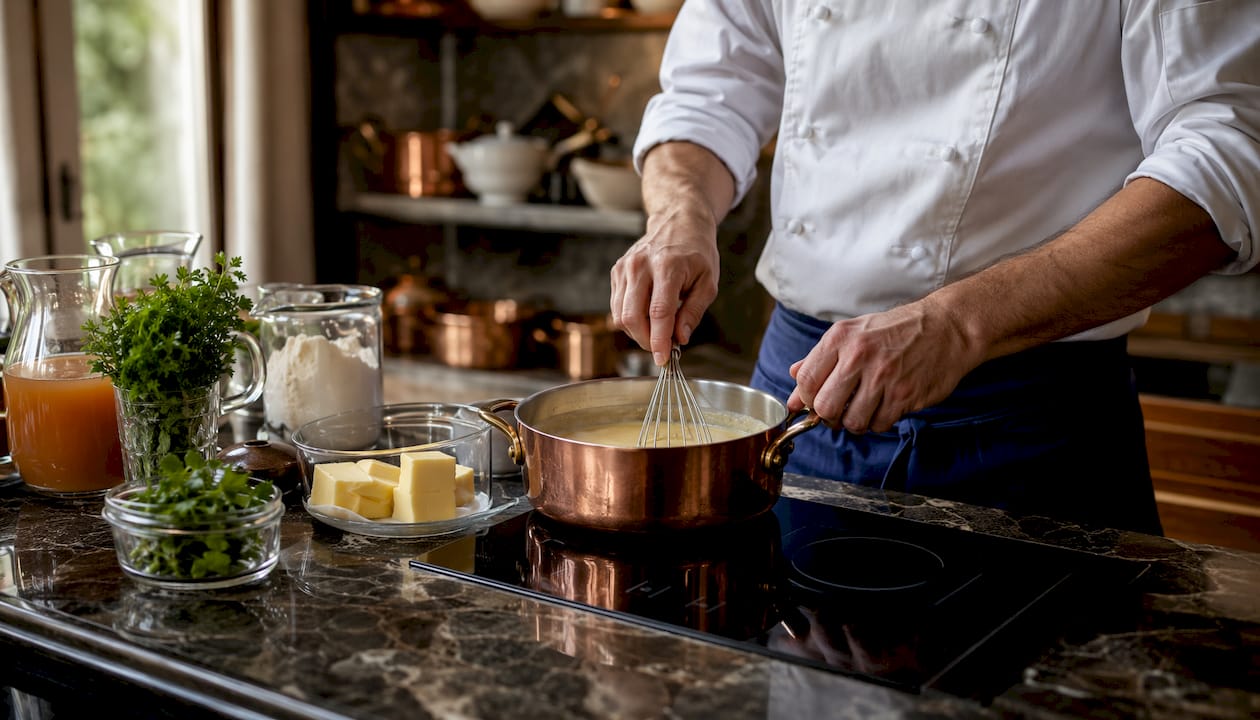
The five mother sauces established by Carême and refined by Escoffier, Béchamel, Velouté, Espagnole, Hollandaise, and Tomato, are the structural foundation of classical sauce-making. Each begins with a roux (a cooked mixture of fat and flour) or an emulsion, and each generates a family of derivative sauces. Mastering the roux is the first discipline a classical French chef learns: the ratio of fat to flour, the cooking time, and the temperature at which liquid is incorporated all determine whether the result is silky or lumpy, pale or nutty.
Braising
Braising is the technique that gives dishes like Boeuf Bourguignon and Coq au Vin their character. Meat is first seared at high heat to develop colour and flavour through the Maillard reaction, then submerged partially in liquid (wine, stock, or a combination) and cooked slowly in a covered vessel. The collagen in tougher cuts dissolves over time into gelatin, producing a sauce of extraordinary body and a texture in the meat that no other method replicates.
Poaching
Poaching demands a different kind of discipline: the liquid must be held at a precise temperature, never boiling, to cook delicate proteins like fish, eggs, or quenelles without toughening them. The classical court-bouillon, a lightly acidulated poaching liquid of water, wine, vegetables, and aromatics, is itself a preparation of some refinement.
Sautéing and the fond
Sautéing in classical French cooking is not merely frying quickly. The fond, the caramelised residue left in the pan after sautéing, is the starting point for pan sauces of great complexity. Deglazing with wine or stock lifts the fond and forms the base of a sauce that carries the full flavour of the seared protein.
Pastry work
Classical French pastry is a discipline unto itself, governed by near-mathematical precision. Pâte brisée, pâte sucrée, pâte feuilletée (puff pastry), and choux pastry each require exact ratios of fat, flour, and liquid, and each behaves differently depending on temperature and technique. The delicious pastries of the French tradition represent centuries of accumulated refinement, from the laminated layers of a croissant to the caramelised base of a Tarte Tatin.
- Mise en place: the classical discipline of preparing and organising all ingredients before cooking begins. It is not merely a practical habit but a philosophy of control and readiness.
- Julienne, brunoise, chiffonade: precise knife cuts that ensure uniform cooking and elegant presentation.
- Reduction: concentrating a liquid by simmering to intensify flavour and thicken texture, a technique central to classical sauce-making.
- Liaison: the finishing of a sauce with cream, butter (montée au beurre), or egg yolks to achieve a particular richness and sheen.
The discipline expected in professional classical French training is extraordinary. Aspiring chefs master colour, volume, and texture with a precision that leaves nothing to chance. This rigour is not pedantry; it is the reason that a classical French sauce tastes the same in Lyon as it does in a fine dining kitchen in Melbourne.
Classical French cuisine in Australia: luxury, fine dining, and gourmet culture
Australia’s relationship with classical French cuisine is one of genuine admiration and growing sophistication. The country’s fine dining scene has long drawn on French culinary traditions, from the brigade-style kitchens of Sydney and Melbourne’s most celebrated restaurants to the reverence for French wine regions that shapes the country’s most discerning tables.
The influence of classical French cooking on Australian gastronomy runs deeper than technique. The culture of the long, considered meal, the pairing of wine with each course, and the elevation of seasonal produce to something approaching ceremony, all carry the unmistakable imprint of the French tradition. Australian chefs trained at institutions such as Le Cordon Bleu’s Sydney campus have carried classical French principles into kitchens that now express them through distinctly local ingredients and sensibilities.
For those who wish to bring the spirit of classical French gastronomy into their own homes or events, the quality of ingredients is everything. A Boeuf Bourguignon made with a fine Loire Valley wine is a fundamentally different experience from one made with an anonymous table wine. The same logic applies to caviar: the classical French tradition of serving caviar as a luxury appetiser, a practice with roots in the grand restaurants of Belle Époque Paris, demands an ingredient of genuine provenance and character.
Aptent curates precisely this kind of ingredient for the Australian market. Its Baeri Signature Caviar exemplifies the standard that classical French haute cuisine demands: sourced from prestigious producers, handled with care, and presented with the kind of refinement that honours the tradition it belongs to. For those hosting a dinner that aspires to the standards of classical French gastronomy, the quality of every element on the table, from the wine to the caviar to the bread, determines whether the experience achieves genuine distinction.
Pro Tip: When assembling a classical French-inspired menu for a dinner party, consider the progression of flavours as carefully as the individual dishes. Begin with something delicate, perhaps a fine caviar or a light consommé, and build toward the richness of a braised main before finishing with the restrained sweetness of a Tarte Tatin.
Aptent’s curated selection of grand cru wines and premium caviar brings the opulence of classical French gastronomy to Australian tables, whether for a private dinner of quiet refinement or a bespoke event for the most discerning guests. Explore the full collection at Aptent Gourmet and discover what it means to dine with genuine intention.
Key takeaways
Classical French cuisine is a codified culinary tradition built on precise technique, iconic dishes, and a structured meal philosophy that has shaped professional kitchens and fine dining culture worldwide.
| Point | Details |
|---|---|
| Codified by Escoffier in 1903 | Le Guide Culinaire formalised sauce preparation, kitchen organisation, and sequential meal service. |
| Three distinct styles | Haute cuisine, cuisine bourgeoise, and regional cuisine overlap in practice, with dishes like Boeuf Bourguignon migrating across all three. |
| Iconic dish repertoire | Boeuf Bourguignon, Coq au Vin, Bouillabaisse, Ratatouille, and Tarte Tatin form the classical canon still taught in culinary schools today. |
| Technique is the foundation | Mother sauces, braising, poaching, sautéing, and precise pastry work define the discipline that separates classical French cooking from all others. |
| Legal codification of authenticity | Cassoulet must contain at least 30% pork, mutton, or preserved duck or goose by French law, reflecting the tradition’s commitment to preserving culinary integrity. |


