
5 Steps to Pick Champagne for Seafood: Aptent's Dish by Dish Pairings
For most seafood, reach for bright, mineral blanc de blancs or a well-balanced non-vintage brut. Reserve vintage or aged cuvées for buttery lobster and cream sauces, rosé for anything with real chilli heat, and keep the driest bruts away from spice altogether. Everything else is detail.
TL;DR:
- Light, high-acid Champagnes like blanc de blancs or extra brut are best for raw shellfish and oyster pairings, avoiding lees-aged styles that can overpower delicate flavors.
- Vintage or aged cuvées with autolytic notes suit buttery lobster and crab with cream sauces but should be avoided with raw oysters or seafood where freshness is key.
- Rosé Champagnes or slightly higher-dosage styles handle chili heat and smoked seafood better than ultra-dry bottles, which can accentuate spice or mask the merroir.
- Champagne’s minerality and acidity are crucial for balancing oily, rich, or sauced seafood, making it a better match than still white wines for many dishes.
- Serving temperature and glass choice are critical; serve non-vintage and blanc de blancs at 6 to 8°C in tulip glasses, and progress from light to richer courses with appropriate bottle changes.
Table of Contents
- What makes champagne and seafood such a natural pairing?
- Which champagne suits each seafood dish?
- How do you choose the right champagne for a seafood menu?
- How should you serve champagne with seafood?
- What does Aptent’s curator perspective bring to this pairing?
- Ready to build your own champagne and seafood tasting?
- Sources
What makes champagne and seafood such a natural pairing?
The mechanics are simpler than most people assume. Acidity is the workhorse: it slices through the natural oils in fish and shellfish, resetting your palate between bites in a way that still wine rarely manages with the same precision. The mousse itself does real work too, its fine bubbles lifting richness off the tongue rather than letting it linger.
Then there’s minerality. Champagne grown on chalk soils, particularly in the Côte des Blancs, often carries a saline, flinty character that echoes the brininess of oysters and other shellfish rather than competing with it, a point Champagne Club’s pairing research makes clear when comparing styles across seafood courses.
Lees ageing (autolysis) is where things get interesting, and where a lot of pairings go wrong. Extended time on lees gives Champagne brioche, nutty, almost buttery notes. That’s glorious with butter-poached lobster and disastrous with a raw oyster, where it can muscle out the delicate marine flavour you’re actually there for. Dosage, the sugar added at final bottling, is your last lever. Higher-dosage styles soften spice; bone-dry Brut Nature styles let raw seafood speak for itself.
Which champagne suits each seafood dish?
Matching style to dish is less about rules and more about weight. A Champagne needs to sit at the same intensity as the food, or it either disappears or dominates.
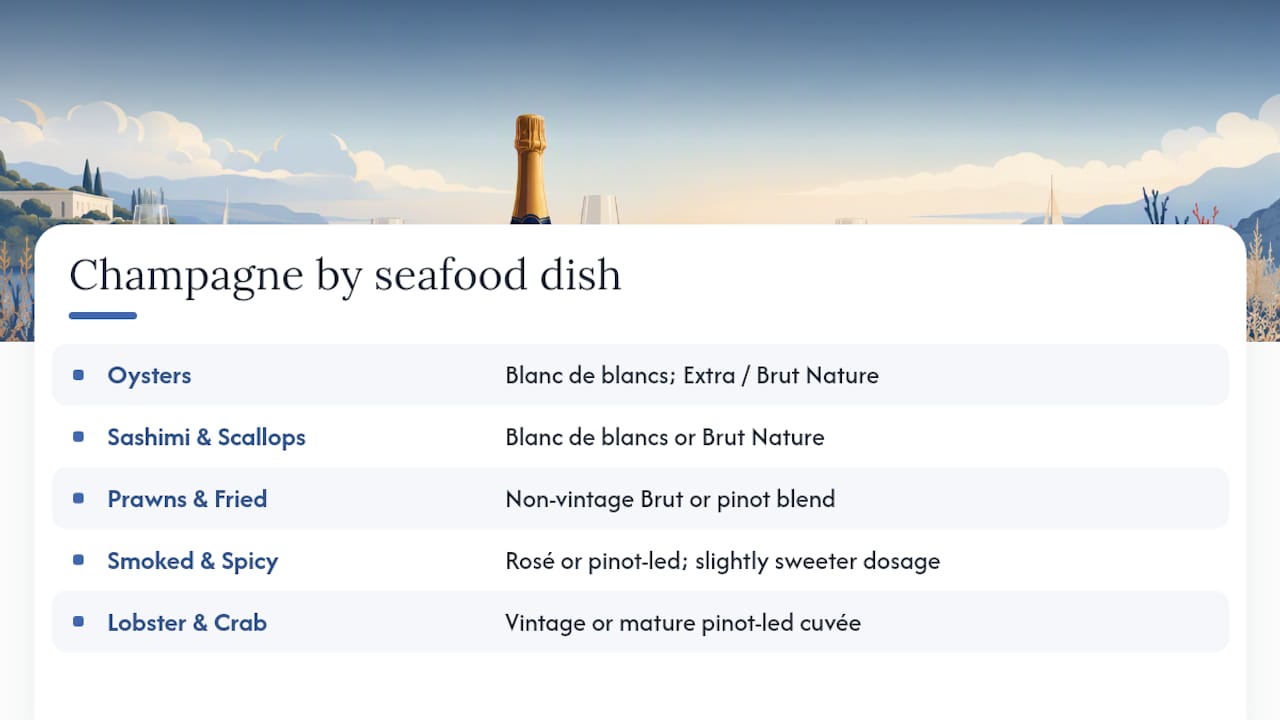
Oysters and raw shellfish call for restraint. A blanc de blancs, Extra Brut, or Brut Nature style keeps the focus on the oyster’s own character. Heavily lees-aged Champagnes tend to smother that briny snap, so save them for another course. Champagne consistently outperforms still white wine here because the bubbles lift the oyster’s texture while the acidity and minerality mirror its marine notes, a pairing Laurent-Perrier’s guide to oyster service covers in detail.
Pro Tip: Skip the lemon, or use it sparingly. Citrus can mask an oyster’s merroir, the specific mineral fingerprint of the water it grew in, so let the wine do the adjusting instead of the garnish.
Caviar deserves a low-dosage or mature non-vintage Champagne with genuine textural weight to stand alongside the roe’s own richness. For the finest caviar service, a prestige cuvée earns its place, especially with the classic blinis and crème fraîche accompaniments. Aptent’s expert guide to pairing caviar with Champagne walks through this combination in more depth.
Sashimi and crudo want a bright blanc de blancs or a refined Brut Nature. Anything heavier and the fish loses its clarity.
Scallops suit the same clean blanc de blancs, or a lightly lees-aged non-vintage brut for a slightly silkier match against the scallop’s natural sweetness.
Prawns and shrimp are flexible. Poached or grilled preparations do well with a standard non-vintage brut, while richer, more umami-driven grilled prawns can handle a blanc de noirs, built mostly or entirely from pinot grapes, for extra structure.
Lobster and crab in butter or cream sauces need a vintage Champagne or a mature pinot-led cuvée. The autolytic depth and firmer structure of an aged bottle stand up to dense, buttery flavours in a way a young, zippy brut cannot, as Mumm’s seafood pairing notes confirm. Worth noting: if the lobster itself was poached in a Champagne butter, the dish already carries autolytic sweetness, so an equally aged service wine becomes less essential.
Smoked salmon pairs best with rosé or a pinot-forward blend, since the wine needs enough weight and fruit to meet the smoke and fat.
Fried seafood, think tempura, calamari, or fish and chips, wants a non-vintage brut or pinot-led blend. The bubbles and acidity cut the oil while the wine’s structure matches the salt and crunch.
Spicy seafood is the genuine exception to the “dry Champagne wins” rule. Very dry Brut styles can turn sharp or metallic against chilli heat. Rosé Champagne or a style with slightly higher dosage handles spice far better, a distinction worth remembering before you reach for your driest bottle at a Thai-influenced seafood table.
How do you choose the right champagne for a seafood menu?
Buying decisions get easier once you think in terms of weight and structure rather than brand names alone.
- Match wine weight to dish intensity. Light, raw preparations call for light, high-acid Champagne; rich, sauced dishes need a wine with comparable structure and depth.
- Read the dosage on the label. Brut Nature or Extra Brut for raw seafood and caviar; a touch more dosage for anything spiced or glazed.
- Default to non-vintage or blanc de blancs for freshness. Save vintage or extended-lees cuvées for buttery, cream-based dishes where that richness has somewhere to go.
- Check the grape composition. A 100% Chardonnay blanc de blancs signals precision and citrus lift; a pinot-heavy blanc de noirs or rosé signals weight and red-fruit texture.
- Consider grower Champagne or a quality Crémant if budget matters. Both can deliver the fine mousse and saline texture seafood needs without the premium price tag, according to broader pairing guidance from Vinocritic.
How should you serve champagne with seafood?
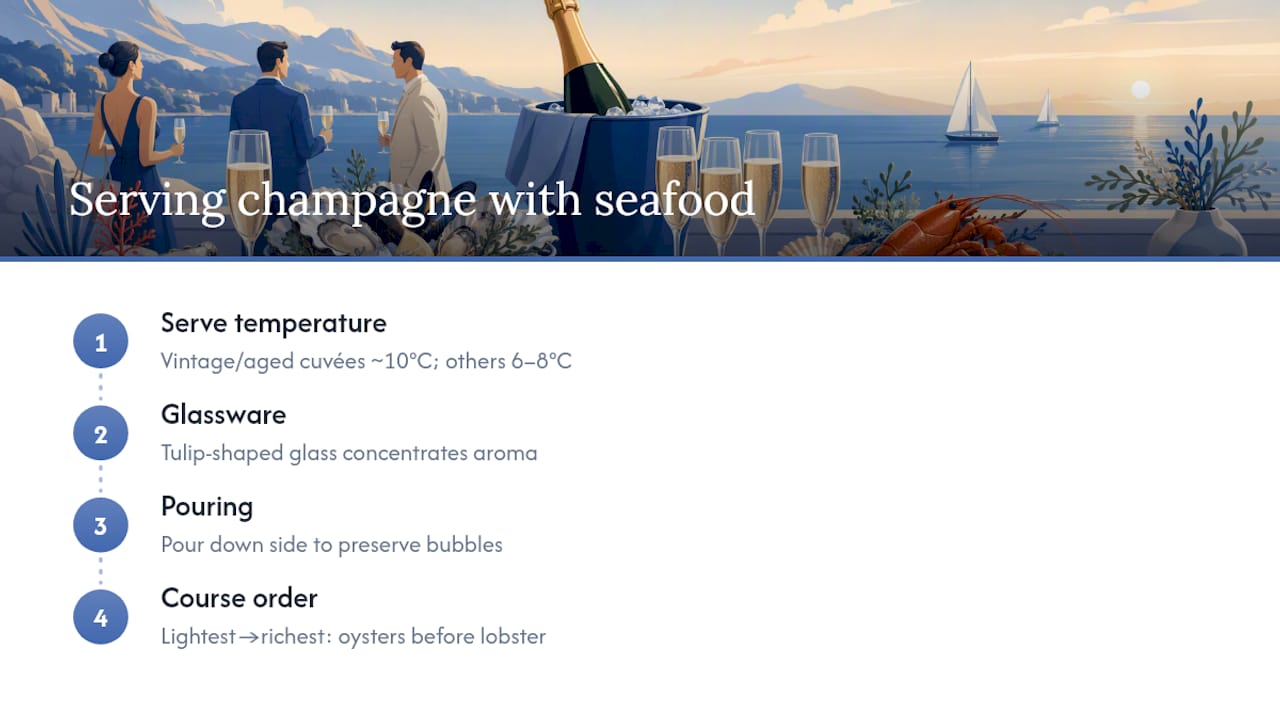
Serve blanc de blancs and non-vintage brut at 6 to 8°C; let vintage or aged cuvées warm slightly, closer to 10°C, so their complexity opens up. A tulip-shaped glass protects the mousse and concentrates aroma far better than a flat coupe. Pour gently down the side of the glass to preserve bubbles, and sequence courses from lightest to richest, oysters before lobster, never the reverse, changing bottles as the food gets heavier.
What does Aptent’s curator perspective bring to this pairing?
Aptent’s masterclass content, including its deep dive into the Cuvée 1887 Brut, treats pairing as a study in structure, not superstition. One curation Aptent returns to often: a mature, low-dosage Champagne alongside fine Baeri caviar, where texture meets texture and neither element competes for attention.
— APTENT
Ready to build your own champagne and seafood tasting?
Aptent sources Champagne and caviar directly from producers who share this same structural philosophy, so you’re not left guessing which bottle earns its place beside a plate of oysters or a lobster tail. That curation is the whole point of shopping with a specialist rather than piecing a tasting together from a general bottle shop.
If you’re building a seafood-focused tasting, the Champagne Symposium offers the structural depth suited to richer courses, while the Tradition Brut works as the reliable all-rounder across a mixed seafood menu. Pair either with the 250g Baeri Signature Caviar for the classic low-dosage, high-texture match discussed above. Browse the full range at Aptent Gourmet, or book a private tasting through Gourmet Events if you’d rather have the sequencing, glassware, and pours handled for you. For broader menu planning beyond the wine list, Wild Foodz’s event catering guide is a useful companion resource.
Sources
- The best Mumm champagnes to serve with seafood – G.H.Mumm
- Best champagne food pairings - Champagne Club
- Champagne oyster pairing – Laurent‑Perrier


