
Host a Luxury Caviar Tasting at Home in 90 Minutes
The fastest way to run a proper caviar tasting at home is to assemble three to five small tins from a trusted purveyor, keep every tin between 0°C and 4°C on crushed ice, and serve 10 to 20 grams per person per variety on mother-of-pearl or glass spoons. A curated flight from a specialist such as APTENT. GOURMET removes the guesswork on sourcing, leaving you to focus on sequence, pairing, and presentation.
TL;DR:
- Proper caviar tasting requires three to five tins of 30 to 50 grams each, served on mother-of-pearl or glass spoons, and kept at 0°C to 4°C.
- Opening with sustainably farmed Siberian sturgeon or Baeri caviar set the stage, progressing towards richer varieties like Osetra or Kaluga for complexity.
- Ensure tins are properly labeled with species, origin, grade, and packed date, and use insulated packaging with active ice packs for safe delivery.
- Sequence tasting from delicate to bold; guide guests through visual, aroma, and taste checks, and reset palate with water or neutral crackers between samples.
- Leftover caviar should be resealed, stored in the coldest fridge section, and consumed within two to four days, avoiding refreezing to preserve quality.
Table of Contents
- Which caviar varieties belong in a home tasting flight?
- How do you set the table for serving caviar correctly?
- What’s the right order to taste each caviar sample?
- What should you serve alongside the caviar?
- What should you check before ordering caviar online?
- What do professional caviar tastings get right that home tastings miss?
- How do you store leftover caviar after the tasting ends?
- What’s the step-by-step timeline for hosting a tasting at home?
- How should you set the mood and table for a caviar tasting?
- Should you DIY the tasting or book a boutique service?
- Ready to build your tasting flight with APTENT. GOURMET
- Sources
Which caviar varieties belong in a home tasting flight?
A well-built flight tells a story, moving your guests from delicate to intense without exhausting the palate along the way. Most hosts do best with three to five tins arranged on a curve: an approachable entry point, one or two mid-weight varieties, and a genuine splurge to finish on. Experts generally recommend opening with sustainably farmed Siberian sturgeon or Baeri, then building toward Osetra or a Kaluga hybrid, whose deeper, nuttier profile rewards a palate that has already warmed up.
Reading the tin matters as much as choosing the species. A properly labelled tin states the species, the country or region of origin, the grade, and the packed date, and if any of those are missing, treat it as a warning sign rather than an oversight. Grading terms such as Classic, Royal, Supreme, and Imperial signal egg size and perceived complexity, though taste tests consistently show that a higher grade doesn’t automatically mean a guest will prefer it.
For a flight of four guests, plan on:
- Three to five tins of 30g to 50g each, rather than one large jar
- 10 to 20g per person per variety, which keeps portions generous without waste
- One clear “splurge” tin, positioned last, to close the tasting on a high note
- A mix of pasteurised and fresh (malossol) product if you want to demonstrate texture differences
Small tins such as the 30g Baeri Signature Caviar are built precisely for this kind of comparative tasting, letting guests sample widely without any single jar going to waste.
How do you set the table for serving caviar correctly?
Temperature control is the one variable that separates a polished tasting from an amateur one. Caviar loses its clean, briny snap the moment it drifts above 4°C, so every tin needs to sit on a bed of crushed ice from the moment it leaves the fridge until the last spoonful is served.
Follow this sequence for a clean, professional presentation:
- Chill a serving tray or shallow dish with crushed ice at least 30 minutes before guests arrive.
- Keep tins sealed and dry in the coldest part of the fridge until just before service.
- Open each tin only moments before it reaches the table, never in advance.
- Nest each tin into the ice, angled slightly so the roe is visible.
- Serve using mother-of-pearl, glass, or bone spoons only. Metal reacts with the roe and dulls its flavour within seconds.
- Portion 10 to 20g per person per variety onto small plates or shells, keeping portions visually consistent across the table.
- Label each sample clearly with species and grade so guests can track what they’re tasting.
Pro Tip: For a group of four to eight, allow 45 minutes of prep before guests sit down. That covers icing the tray, opening tins in sequence, and setting spoons, leaving you free to greet guests rather than scrambling in the kitchen.
What’s the right order to taste each caviar sample?
Sequence protects the palate. Always move from the lightest, most delicate variety to the boldest, since tasting a rich Kaluga first will flatten your ability to notice the finer, briny notes in a Siberian sturgeon that follows it.
For each sample, guide guests through a simple three-step routine:
- Look: note bead size, colour, and how the roe catches the light, since larger, more lustrous eggs often signal a higher grade.
- Smell: a brief inhale before tasting reveals whether the aroma is clean and oceanic or has any off notes.
- Taste: place a small amount on the tongue and press gently against the palate rather than chewing, to release the full flavour as the beads pop.
Describe what you notice in plain terms: bead size, “pop,” salinity, and finish are the four words that matter most. A short rinse of water or a single neutral cracker between samples resets the palate cleanly, and it matters more than most hosts expect, since palate fatigue creeps in fast after the second or third tin.
What should you serve alongside the caviar?
Classic accompaniments exist to support the roe, never to compete with it. Restraint is the mark of a confident host, and it’s a common mistake to over-garnish, which masks the very nuance you’re asking guests to notice.
Reliable choices include:
- Warm blinis and a small spoon of crème fraîche, the traditional pairing for good reason
- Neutral potato chips or thin toast points for a modern, crunchier alternative
- A small mound of chilled sushi rice for guests who enjoy an Asian-inspired presentation
- Chives or a light squeeze of lemon on the side, added sparingly and never pre-mixed into the roe
On drinks, brut Champagne or a blanc de blancs is the benchmark pairing, and a crisp, high-acid dry white works nearly as well if you’d rather stay off sparkling wine. Ice-cold premium vodka is the traditional Russian match and suits bolder varieties particularly well. Our expert guide to pairing caviar with Champagne covers specific producer recommendations if you want to go further. Steer clear of sweet wines, heavily baked reds, or anything tannic, since all three flatten the roe’s delicate salinity.
What should you check before ordering caviar online?
The biggest risk in a home tasting isn’t the tasting itself, it’s what happens between checkout and your fridge. Before you order, confirm the vendor discloses species, origin, grade, and packed date on every listing; a retailer vague on these details is a retailer to avoid.
Once you’ve placed the order, watch for:
- Insulated packaging with active ice packs, not just a foam liner
- A reputable courier with tracked, temperature-sensitive delivery
- Insurance or signature-required delivery for higher-value tins, given how easily a missed delivery ruins a $200+ order
- Immediate refrigeration on arrival, storing tins in the coldest part of the fridge, not the door
- A 2 to 4 day window to consume caviar once a tin is opened
One buying habit worth adopting early: choose approachable farmed varieties for your first flight rather than the most expensive tin on the menu, since price and rarity don’t reliably predict which caviar you’ll actually prefer.
What do professional caviar tastings get right that home tastings miss?
Boutique tasting events run on the same fundamentals as a home flight, just with tighter execution. Professional tasters typically work blind, using a neutral carrier like plain blini or unsalted chips so texture and finish, not garnish, drive the comparison.
A few habits worth borrowing:
- Stick to one neutral carrier across the whole flight so comparisons stay fair
- Never let guests season a sample before their first unadorned taste
- Pour drinks after each caviar course, not alongside it, so the pairing doesn’t muddy the first impression
- Keep the room quiet enough that guests can actually discuss what they’re noticing
The standard to hit: professional guidance consistently points to the same numbers, serve at 0°C to 4°C on crushed ice, and portion 10 to 20g per person per variety. Those two figures alone separate a forgettable tasting from a memorable one.
For deeper detail on storage between courses, our guide to storing caviar at home covers fridge placement and shelf life once tins are opened.
How do you store leftover caviar after the tasting ends?
Leftover caviar is still valuable, and it deserves the same care you gave it during service. The moment tasting wraps up, reseal each tin as tightly as the original lid allows, pressing out any air pocket before closing.
Return every tin immediately to the coldest section of your fridge, ideally the back of a shelf near the compressor rather than the door, where temperature swings every time it opens. Opened tins hold their quality for two to four days at most, so plan to finish leftovers within that window rather than saving them for a future occasion. Never refreeze caviar once it has been opened and chilled; freezing ruptures the delicate egg membrane and turns a $150 tin into mush.
If multiple guests dipped into the same tin with their own spoons, treat that tin as a same-night finish rather than a leftover, since shared serving increases contamination risk. For unopened tins from the same order, check the packed date and follow the vendor’s stated shelf life, generally two to four weeks unopened in proper refrigeration, though this varies by species and processing method.
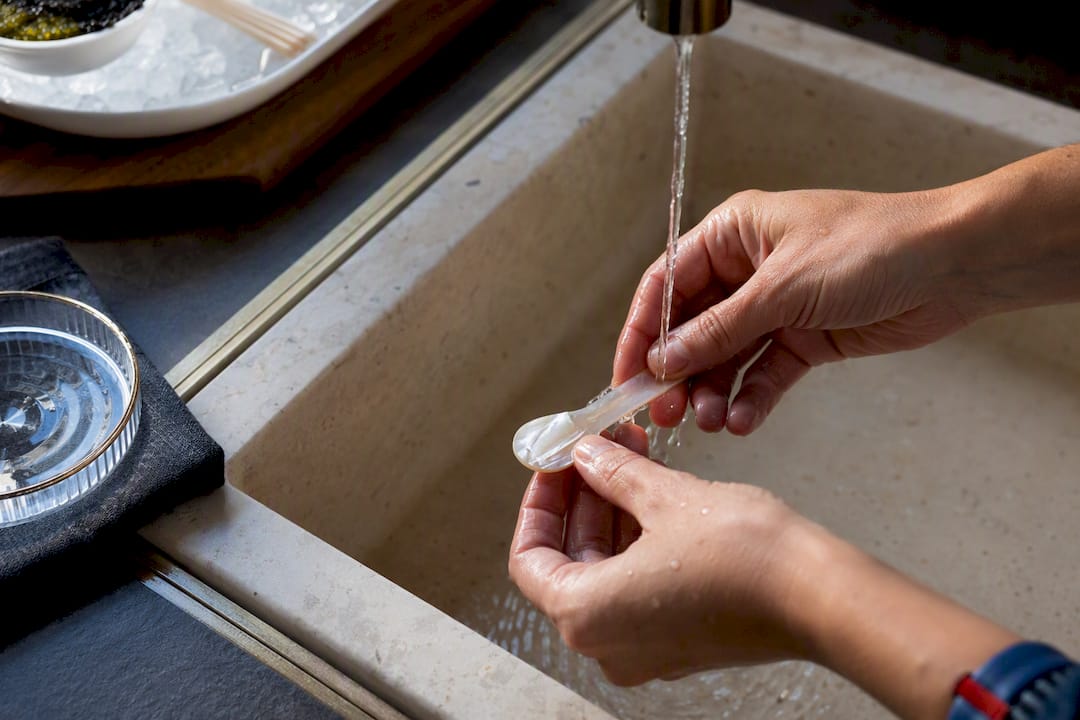
Wash mother-of-pearl or glass spoons by hand in warm water immediately after use. Avoid dishwashers, where high heat and detergent residue can degrade natural spoon materials over repeated cycles. Store spoons dry in a soft-lined box rather than loose in a drawer, since mother-of-pearl chips more easily than most hosts expect.
What’s the step-by-step timeline for hosting a tasting at home?
A tasting for four to eight guests runs smoothly on roughly 90 minutes of total preparation, split across the day.
Two hours before guests arrive, confirm your tin order is correct against your flight plan and pull spoons, plates, and ice trays from storage. One hour before, begin chilling the crushed ice tray and set the table, positioning name cards or small labels next to where each variety will sit. Thirty minutes before, pour Champagne or white wine into the fridge if it isn’t already chilled, and prepare blinis or toast points so they’re warm but not hot at serving time.
Fifteen minutes before guests sit down, nest each tin into the ice tray but leave lids sealed. Open tins one at a time as each course is served, starting with the lightest variety, never all at once at the start. Talk your guests through the look, smell, taste routine for each sample, allowing roughly eight to ten minutes per variety including conversation.
Budget 45 to 60 minutes for the tasting itself once everyone is seated, longer if you’re running a five-tin flight with drink pairings between each course. Close with your splurge tin and let it linger, since rushing the final, most expensive variety wastes the entire build-up.
How should you set the mood and table for a caviar tasting?
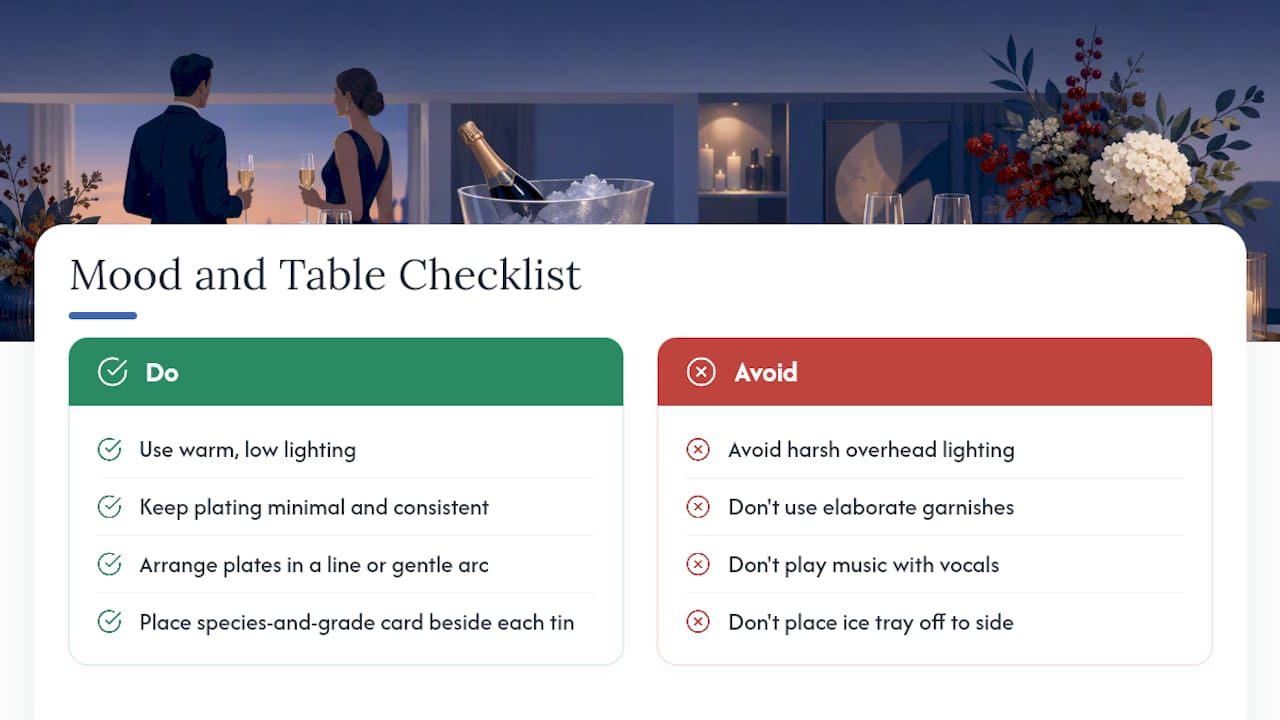
Ambiance shapes how caviar tastes almost as much as the roe itself. Warm, low lighting flatters the roe’s natural sheen far better than harsh overhead light, which tends to wash out the subtle colour variations between varieties.
Keep plating minimal and consistent: identical small plates or shell dishes for each variety, arranged in a straight line or gentle arc so guests can compare visually before they taste. A single small card beside each tin, noting species and grade, does more for the experience than any elaborate garnish. For broader plating inspiration that respects this kind of restraint, this collection of vibrant food presentation ideas is worth a browse before you finalise your table.
Background noise should stay low enough for conversation about what’s actually being tasted. Soft instrumental music works better than anything with vocals, which competes with the discussion you’re trying to encourage. Set the ice tray at the centre of the table rather than off to the side, so it becomes the visual and social focus of the evening, not an afterthought near the kitchen.
Should you DIY the tasting or book a boutique service?
Run the numbers on your own guest list before deciding. A DIY tasting suits four to eight guests, a host comfortable narrating the tasting sequence, and no complex dietary requirements to manage. Once you’re past eight guests, want staff-led pacing, or need a curated narrative around rarer varieties, a boutique service earns its cost.
What a specialist event adds isn’t better caviar, it’s staff who manage timing, pour drinks between courses, and keep the story moving so you can host rather than serve. Both paths lean on the same fundamentals: correct temperature, non-metal spoons, and sensible portioning. Our guide to caviar tasting event formats breaks down guest counts and logistics for each option.
— APTENT
Ready to build your tasting flight with APTENT. GOURMET
Aptent gives you a single, trusted source for an entire tasting flight, sourced tins, correct grading, and the right spoons, without piecing together an order from several unverified sellers.

Our 30g Baeri Signature Caviar is built for exactly this kind of comparative flight, small enough to pair with two or three other varieties without excess, and it ships with the species, origin, and grading clearly stated on every tin. Round out the table with a mother-of-pearl spoon or browse the full accessories collection for servingware that won’t dull the roe’s flavour.
If you’d rather have the whole evening handled for you, staff, pacing, and narrative included, our Gourmet Events page is where to start. Either way, the next step is simple: choose your tins, chill them properly, and book the date.
Sources
- How to host a caviar tasting flight
- The 7 best caviars you can buy online in 2026, tested & reviewed
- The best caviar to buy, according to our taste test


