
Types of caviar service vessels: what hosts need to know
The foundation of professional caviar service rests on three vessel types and one essential utensil: the two-piece caviar server (an outer crushed-ice bowl with a non-reactive inner glass or crystal bowl), the original tin nested in a chilled insert, and individual glass presentoirs for tasting flights, all paired with mother-of-pearl spoons. Every other vessel in the catalogue is a variation on these principles. The reason these choices matter comes down to two priorities: temperature control and flavour neutrality.
The essential vessel types at a glance:
- Two-piece caviar server (presentoir): outer ice bowl with suspended inner glass or crystal bowl
- Original tin served directly in a chilled insert: maximum authenticity and hygiene
- Clear glass or crystal bowls: ideal for tasting flights and portion-focused service
- Individual single-serve presentoirs: theatrical, hygienic, suited to events
- Multi-tier or stone platter servers: high-impact for large gatherings
Table of Contents
- Why vessel choice shapes temperature, flavour and presentation
- The main caviar service vessels and when to use each
- Utensils and small tools that protect flavour and portion caviar correctly
- How to set up caviar service at home or at an event
- How to clean and care for caviar vessels and utensils by material
- Why the two-piece server is the professional standard
- Key takeaways
- Aptent’s perspective on vessels for Australian hosts
- Where to find the right vessels and spoons in Australia
- Selected further reading
Why vessel choice shapes temperature, flavour and presentation
Temperature and material neutrality are the two functional priorities when selecting caviar serving dishes, and neither is negotiable at the level of refined service. Caviar held above 0°C begins to soften and lose the taut, jewel-like texture that defines a premium roe; held below –2°C, delicate pearls can fracture and the aromatics flatten. The ideal serving range sits between –2°C and 0°C, which is why the vessel’s ability to maintain that narrow band matters as much as its appearance.
Material reactivity is the second consideration. Glass, crystal and porcelain are preferred because they are chemically inert, meaning they will not interact with the salt or delicate oils in the roe. Uncoated silver, copper and some stainless steels can impart metallic notes that obscure the buttery smoothness of a fine Osetra or the silky depth of a Kaluga. If metal appears at the table for aesthetic reasons, the actual contact surface must be glass, crystal or a non-reactive liner.
Aesthetically, the vessel acts as a minimalist frame. Neutral glass or crystal draws the eye to the roe’s jewel tones — the deep obsidian of Baeri, the amber warmth of Osetra — while an extravagant outer stand adds theatre without touching the caviar itself. Restraint is the governing principle: the vessel should never overwhelm the product.
Pro Tip: Chill your inner bowl and spoons in the refrigerator for at least 30 minutes before service. A warm vessel, even briefly, can raise the surface temperature of the roe before the first spoon is lifted.
The main caviar service vessels and when to use each
The catalogue of caviar serving dishes spans several distinct formats, each suited to a different occasion, scale and caviar presentation style.
Two-piece caviar server (presentoir)
The two-piece server is the standard vessel in professional caviar service worldwide. Its outer bowl holds crushed ice; the inner glass or crystal bowl is suspended above, keeping the tin or roe cold without any direct contact with meltwater. This separation is the critical functional detail: meltwater dilutes flavour and can cause temperature shock if it seeps into the roe. The inner well typically accommodates standard tins of various common sizes, making it versatile for intimate dinners and larger gatherings alike. The Georg Jensen sterling silver presentoir, for example, pairs a handblown crystal inner dish with a hand-hammered silver outer bowl, demonstrating how the format can be both functional and deeply beautiful.
Pros: precise temperature control, elegant presentation, fits standard tin sizes. Cons: requires advance preparation (crushed ice), less portable for event service.
Original tin in a chilled insert
Serving caviar directly from its original tin, nested in a chilled insert or a bed of crushed ice, carries a certain authenticity that purists appreciate. The tin’s own seal preserves the roe until the moment of opening, and presenting it intact signals provenance and quality. This approach suits intimate dinners where the theatre of opening the tin at the table is part of the experience. Hygienically, it is also the cleanest format, since the roe never transfers to a secondary vessel.
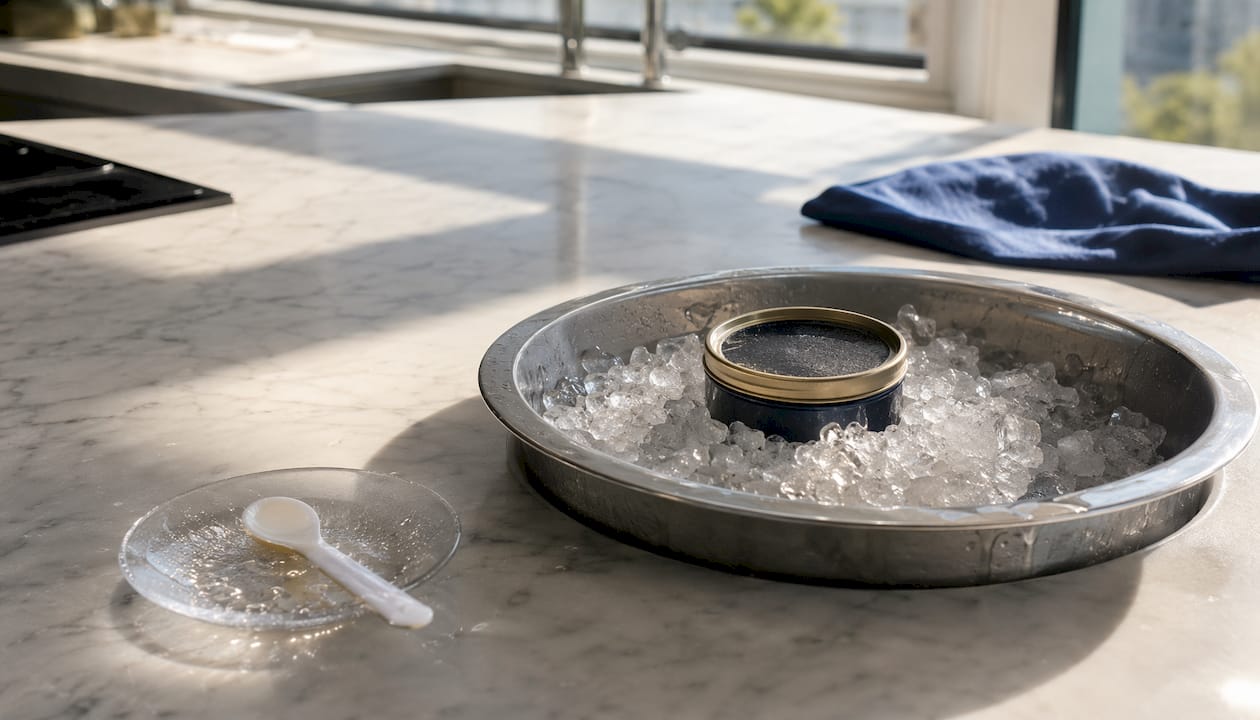
Pros: maximum hygiene, provenance theatre, no transfer risk. Cons: limited visual impact once the tin is open; less suited to multi-guest portioning.
Clear glass or crystal bowls
When the focus is on comparison — a tasting flight of Baeri alongside Oscietre, for instance — clear glass or crystal bowls allow guests to appreciate differences in roe size, sheen and colour without distraction. Restaurants serving tasting menus use matched glass bowls on chilled trays to facilitate focused sensory comparison. For Australian hosts planning a structured tasting, this format offers the clearest visual framing of each variety’s character.
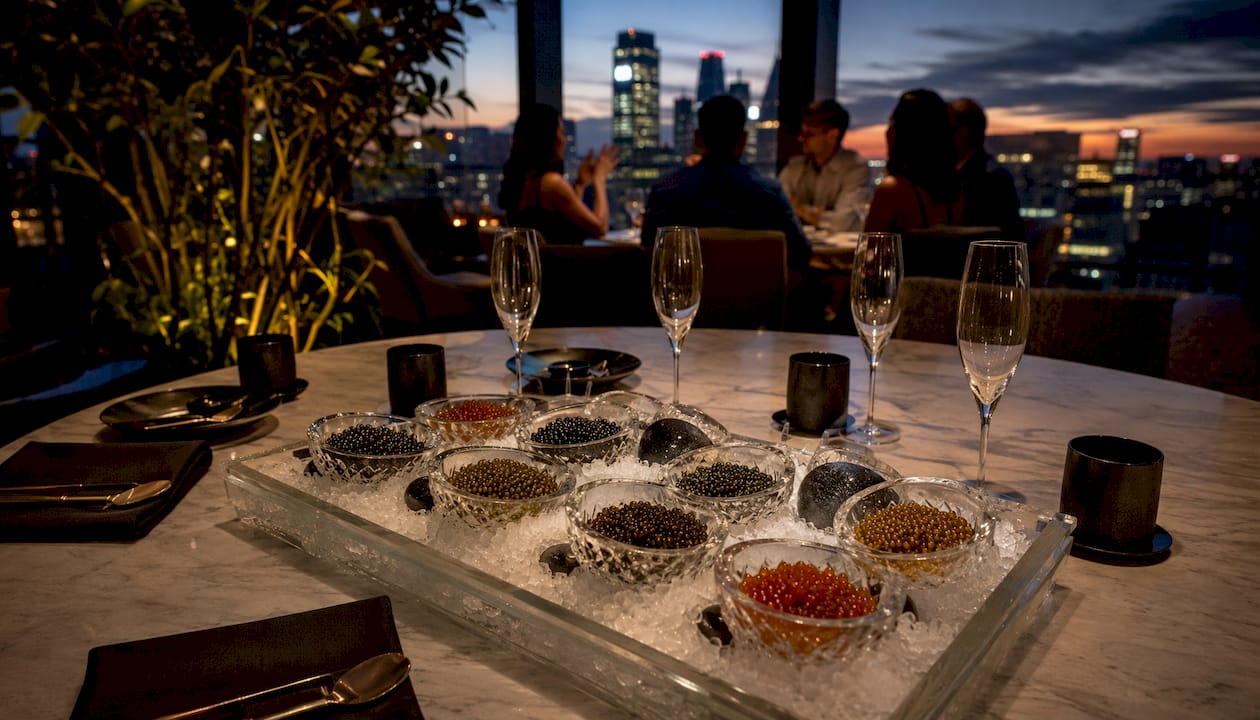
Pros: ideal for flights and comparison, visually transparent, widely available. Cons: requires a chilled tray or ice bed to maintain temperature; less theatrical than a full presentoir.
Individual single-serve presentoirs
For events where hygiene and portion control are paramount, individual glass presentoirs — each holding a single portion — are the professional’s choice. Each guest receives their own chilled vessel, eliminating the risk of double-dipping and allowing precise portioning. A 30g single-serve tin fits neatly into a single-serve presentoir, making the format particularly elegant for seated dinners. The theatrical effect of each guest receiving a personal vessel is considerable.
Pros: superior hygiene, precise portions, high visual impact per guest. Cons: requires more vessels and preparation time; higher cost at scale.
Multi-tier and theatrical servers
Multi-tier servers and custom stone platters with recessed wells are the domain of large events and high-production presentations. A polished black granite platter with carved wells, for example, keeps multiple portions cold through the stone’s thermal mass while creating a striking visual centrepiece. These formats suit cocktail receptions and corporate events where caviar is one element of a broader spread. The caution: stone and multi-tier formats require careful pre-chilling (at least two hours in a cool environment) and are less suited to intimate service where individual attention to temperature is possible.
Pros: dramatic visual impact, suits large-scale service. Cons: heavy, requires significant pre-chilling, less precise temperature control per portion.
| Vessel type | Best occasion | Key material | Chill method |
|---|---|---|---|
| Two-piece server (presentoir) | Dinner party, intimate tasting | Glass or crystal inner bowl | Crushed ice in outer bowl |
| Original tin in chilled insert | Intimate dinner, provenance service | Tin with glass/crystal insert | Crushed ice or chilled insert |
| Glass or crystal bowl | Tasting flight, comparison service | Borosilicate glass or crystal | Chilled tray or ice bed |
| Individual single-serve presentoir | Seated event, portion-controlled service | Glass | Individual ice bed or chilled tray |
| Multi-tier / stone platter | Large event, cocktail reception | Polished stone or tiered glass | Pre-chilled stone; ice wells |
Pro Tip: When selecting a two-piece server, check that the inner bowl’s diameter matches your most-used tin size. A 50g tin sitting loosely in an oversized inner bowl will shift during service and look untidy.
Utensils and small tools that protect flavour and portion caviar correctly
Mother-of-pearl spoons are the gold standard for caviar service, and the reason is straightforward: nacre does not oxidise and will not interact with the salt or delicate oils in the roe, preserving the full expression of flavour from the first taste to the last. The non-reactive quality of nacre is what separates it from every metal alternative, and it is why professional service teams reach for it without hesitation.
Approved utensil materials, in order of preference:
- Nacre (mother-of-pearl): the preeminent choice; non-reactive, elegant, widely available through specialist retailers in Australia
- Polished bone: inert and traditional; a refined alternative when nacre is unavailable
- Buffalo horn: non-reactive, with a warm, organic aesthetic that suits rustic-luxe presentations
- High-quality food-safe glass: practical for high-volume service; easy to sanitise
- Gold-plated spoons: decorative only; the gold layer prevents direct metal contact, but these are not recommended for repeated use as the plating can wear.
Untreated silver, copper and most stainless steels should never contact the roe directly. Even prestigious metals like silver can impart off-notes that obscure the buttery or nutty tones of a fine Osetra. If a silver spoon must appear at the table for aesthetic reasons, use it as a display piece only and serve with a nacre spoon nested inside.
Portioning guide
Portion size depends on the occasion and the role caviar plays in the menu.
- Canapé or amuse-bouche: 5–10g per guest per piece
- First course or tasting portion: 15–20g per guest
- Main caviar course (Russian-style service): 30–50g per guest
- Event reception (passed canapés): 5–8g per piece, multiple passes
For a dinner party of six to eight guests, a 50g tin of Baeri Signature or Oscietre works well as a tasting portion, while a 250g tin suits a more generous main course or a larger gathering.
Pro Tip: Store spare spoons on a small chilled ceramic or glass tray covered with a clean linen cloth. Never leave them loose on the table where guests might handle them before service begins.
How to set up caviar service at home or at an event
The sequence for elegant caviar service is: chill vessels and spoons, prepare accompaniments, place the tin or inner bowl in the server just before guests arrive, then portion and serve with composed choreography. Timing is everything.
- Two hours before service: place the outer ice bowl, inner glass bowl, spoons and any stone platters in the refrigerator or fill with crushed ice to pre-chill.
- Thirty minutes before guests arrive: fill the outer bowl with fresh crushed ice, ensuring the inner bowl is suspended above the ice level, not sitting in it. Meltwater contact is the most common error in home service.
- Ten minutes before service: remove the caviar tin from the refrigerator. Caviar storage and handling guidance recommends keeping it sealed until the last possible moment.
- At service: open the tin at the table or sideboard, place it in the inner bowl (or transfer a portion to the glass insert), and present with mother-of-pearl spoons alongside.
- Between courses: if service pauses for more than 15 minutes, return the tin to the refrigerator with its lid replaced. An open tin held at room temperature loses texture and aroma rapidly.
- For tasting flights: label each chilled glass bowl with a small card noting the variety and origin. Arrange on a chilled tray in order of intensity, lightest first.
- For large events: use individual presentoirs or a multi-tier server, with a dedicated team member responsible for portioning to avoid handling delays that warm the roe.
For a typical dinner party, an open tin remains at its best for 30–90 minutes. Beyond that window, texture softens noticeably.
Accompaniments for a classic Russian-style service include blinis, crème fraîche, finely chopped egg, chives and minced shallot. For a more contemporary presentation, lightly toasted brioche or potato crisps provide textural contrast without overwhelming the roe’s character. For advanced pairing ideas, a culinary resource like Forkward Kitchen offers chef-level techniques worth exploring.
Pro Tip: Choreograph the service so that spoons are placed on the vessel’s rim, not inside the tin. This prevents guests from double-dipping and keeps the remaining roe uncontaminated throughout service.
How to clean and care for caviar vessels and utensils by material
Rinse and hand-wash all caviar vessels and utensils immediately after service. The dishwasher is unsuitable for any delicate material in this category: thermal shock can crack crystal, delaminate nacre and strip gold plating in a single cycle.
Material-specific care:
- Glass and crystal: rinse with warm (not hot) water, wash with a mild unscented detergent, and dry immediately with a lint-free cloth to prevent water spotting. Store upright or in padded sleeves.
- Porcelain: as for glass; avoid abrasive sponges that can scratch the glaze and harbour odour over time.
- Mother-of-pearl (nacre): rinse immediately after use; never soak. Nacre is a layered organic material — prolonged water exposure causes delamination. Wash gently with a soft cloth and mild soap, rinse quickly, and dry flat on a clean towel. Store in a dry, padded case away from direct sunlight, which can cause discolouration.
- Horn and bone: wipe clean with a damp cloth; do not submerge. Dry immediately and apply a very light coat of food-safe mineral oil every few months to prevent cracking.
- Gold-plated decorative spoons: hand-wash only in lukewarm water with minimal detergent. Avoid any abrasive contact; the plating is thin and will wear through with repeated scrubbing.
| Material | Do | Don’t | Storage tip |
|---|---|---|---|
| Glass / crystal | Hand-wash, dry immediately | Dishwasher, hot water | Padded sleeve or upright in a dry cabinet |
| Porcelain | Mild detergent, soft cloth | Abrasive sponges | Stack with cloth dividers |
| Mother-of-pearl (nacre) | Quick rinse, gentle soap, dry flat | Soak, dishwasher, direct sunlight | Padded dry case |
| Horn / bone | Damp wipe, mineral oil occasionally | Submerge, dishwasher | Dry, ventilated drawer |
| Gold-plated | Lukewarm hand-wash | Abrasive cloth, dishwasher | Individual pouch or lined box |
If silver or plated metal items are used decoratively, clean them separately from the roe-contact surfaces and never use silver polish near any vessel that will hold caviar. Polish residue carries a chemical odour that transfers readily.
Pro Tip: After drying nacre spoons, store them in a small zip-lock bag with a single silica gel sachet. This prevents humidity from softening the adhesive layers within the nacre over time.
Why the two-piece server is the professional standard
The two-piece server is both aesthetic and functional, and the distinction matters: it prevents direct contact between the roe and ice or meltwater while maintaining the precise chill that preserves texture and aroma. This is not a stylistic preference — it is the mechanical reason the format became standard in professional service.
The inner well’s sizing is a practical detail that experienced teams attend to carefully. A well that is too large allows the tin to shift; one that is too small prevents the lid from being removed cleanly at the table. For tins between 30g and 125g, a well diameter suitable for common tin sizes is standard. Larger tins of 250g or more require a wider inner bowl, which is why event-scale servers differ from their dinner-party counterparts.
Professional choreography around the two-piece server involves several disciplines working together: the server arrives at the table already chilled, spoons are placed on the rim rather than inside the tin, accompaniments are plated and ready before the tin is opened, and the service team avoids handling the inner bowl with warm hands. Egg size and flavour intensity vary by caviar species, and a clear glass inner bowl allows guests to appreciate those differences — the large, glossy pearls of an Osetra against the smaller, more intensely flavoured pearls of a Sevruga, for example.
For high-end events, Aptent’s boutique event service brings this level of choreography to private gatherings across Australia, pairing curated caviar selections with the correct vessels, spoons and accompaniments as a complete, composed experience.
Key takeaways
The two-piece caviar server with a non-reactive inner bowl and mother-of-pearl spoons forms the non-negotiable foundation of elegant caviar service; every other vessel choice builds on these two principles.
| Point | Details |
|---|---|
| Keep it cold | Maintain roe between –2°C and 0°C using a two-piece server with crushed ice in the outer bowl. |
| Avoid reactive metals | Never let silver, copper or uncoated steel contact the roe; use glass, crystal, nacre or horn instead. |
| Use mother-of-pearl spoons | Nacre is non-reactive and preserves the full flavour profile of every caviar variety. |
| Match vessel to occasion | Individual presentoirs for events; a single two-piece server for intimate dinners; glass bowls for tasting flights. |
| Aptent for accessories and events | Aptent stocks mother-of-pearl spoons, serving sets and offers boutique caviar event services across Australia. |
Aptent’s perspective on vessels for Australian hosts
The conversation about caviar vessels often focuses on aesthetics, but the more consequential question is always material and temperature. At Aptent, the vessel selection we recommend to Australian hosts and event planners prioritises non-reactive surfaces first, thermal performance second, and visual refinement as the natural result of those two disciplines applied with care. A beautifully blown glass inner bowl suspended above crushed ice is not merely elegant; it is the correct answer to a precise functional problem. Aptent stocks mother-of-pearl spoons and curated serving accessories sourced to complement the caviar varieties we carry, and our boutique event service brings the full choreography of professional caviar presentation to private gatherings, corporate functions and intimate tastings across Australia. The vessel, the spoon, the tin and the temperature are not separate decisions; they are a single composed act of hospitality.
Where to find the right vessels and spoons in Australia

Aptent’s gourmet accessories collection brings together the key components of professional caviar service for Australian hosts: mother-of-pearl spoons, two-piece glass servers and curated serving sets, all selected to complement the caviar varieties available through the store. For those planning a structured tasting or a larger gathering, the Laval collection offers refined servingware suited to both intimate dinners and event-scale presentations. If you are considering a fully managed caviar experience, Aptent’s boutique event service handles vessel selection, portioning, choreography and pairing for private and corporate functions across Australia. Browse the accessories range or enquire about an event to bring the complete service to your table.
Selected further reading
The sources below offer authoritative guidance on caviar service temperature, vessel selection, etiquette and materials for hosts who wish to go deeper.
- How to Serve Caviar: Expert Techniques and Pairings — a thorough guide covering vessel types, spoon materials, temperature management and pairing principles; the most comprehensive single reference for hosts setting up service from scratch.
- How to Serve Caviar at a Dinner Party — practical guidance on classic Russian service, accompaniment selection and portioning for groups of six to eight guests.
- Formal Caviar Service Tips for Elegant Events — covers formal etiquette, non-metallic dish requirements, spoon selection and the role of accompaniments in a composed service.
- How to Serve Caviar: Christofle AUS — temperature guidance and vessel recommendations from a silversmith with deep experience in luxury table service; useful for understanding the –2°C to 0°C serving range.
- Packaging for Black Caviar: Basic Requirements — explains industry packaging standards for glass jars and metal tins, useful context for hosts serving from original containers.
- What Chefs Need to Know about Caviar Service — a chef-focused resource covering caviar variety characteristics, serving choreography and pairing principles from working culinary professionals.
- How to Serve Caviar: Creative Serving Ideas — explores contemporary and unconventional service formats while maintaining the temperature and neutrality principles that protect flavour.


