
How wine temperature affects service: practical rules
Serving temperature is the single variable that most immediately alters how a wine expresses itself in the glass. Warmer temperatures accelerate aroma volatility, amplify perceived sweetness and alcohol, and soften tannins; cooler temperatures suppress those same qualities, tightening structure and preserving freshness. The practical verdict for front-of-house teams: serve whites cooler than a standard kitchen fridge and reds several degrees below modern room temperature, then allow the wine to reveal itself as it gently warms.
For immediate service, three actions matter above all others:
- Pull whites from a dedicated wine fridge set to a temperature above typical domestic fridge chill, to avoid over-chilling aromatics.
- Serve full-bodied reds at a temperature noticeably below modern indoor room temperature, which often exceeds typical historic ‘room temperature’.
- When in doubt, serve slightly cooler: a wine can warm gracefully in the glass, but a bottle already too warm cannot be corrected at the table.
Table of Contents
- How does wine temperature affect service and sensory perception?
- What are the recommended serving temperatures by wine style?
- How should hospitality professionals control temperature during service?
- How do you cool or warm a bottle quickly and safely?
- What do the common service temperature rules actually mean?
- What does research say, and how does the Australian climate change the picture?
- Key takeaways
- The case for temperature as a non-negotiable service standard
- Aptent’s curated wines for events and professional service
- Useful sources and further reading
How does wine temperature affect service and sensory perception?
Temperature governs every sensory dimension of wine simultaneously, which is why understanding the underlying mechanisms allows hospitality professionals to predict changes rather than simply memorise rules.
Aroma volatility and headspace
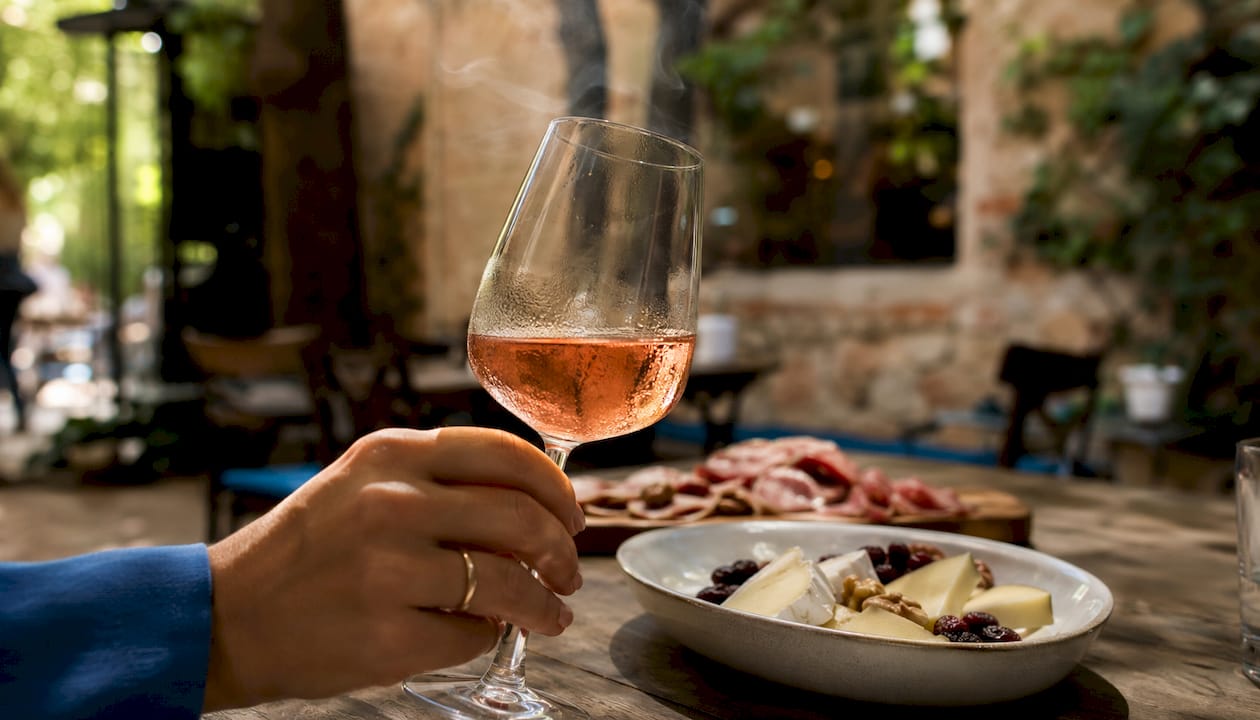
Volatile aromatic compounds escape from wine into the headspace above the glass at a rate governed by their vapour pressure, and that pressure rises with temperature. Chilled wines release fewer volatiles, which is why a Riesling served at 4°C smells almost neutral compared to the same wine at 10°C. Above 20°C, the picture reverses: alcohol volatilises aggressively, overwhelming the wine’s finer aromatic character with a pungent, coarse quality. The optimal window for fine aroma expression sits between 8°C and 18°C, with complex, aged wines occasionally benefiting from service as high as 20°C where their layered bouquet can fully unfold.
Taste modulation: sweetness, acidity, tannin and alcohol
Taste sensitivity peaks between 20–34°C; warming a wine towards that range increases perceived sweetness and diminishes bitterness and astringency, while cooling suppresses sweetness and amplifies acidity and tannin. This is why a chilled Shiraz can taste aggressively grippy and lean, yet the same wine at 17°C feels plush and integrated. Acidity itself does not change with temperature, but it becomes more pleasurable at cooler service temperatures, which is one reason crisp whites and sparkling wines are served cold. Alcohol perception follows a similar curve: the TRPV1 receptor, which detects heat and chemical irritants, responds more strongly as temperature rises, making a 14% ABV red served at 22°C feel noticeably hotter than the same wine at 16°C.
CO₂ and sparkling wine
Carbon dioxide solubility decreases as temperature rises, meaning a warm sparkling wine releases its gas rapidly, producing large, coarse bubbles and a flat, acidic finish. Served cold, CO₂ is released slowly and in fine streams, preserving the persistent perlage that defines a quality Champagne or Australian sparkling. The acid character of CO₂ also intensifies at higher temperatures, adding an unpleasant sharpness to the palate.
Pro Tip: Always err on the side of slightly cooler service. A wine can warm in the glass and reveal more complexity over the course of a meal, but a bottle already too warm offers no recovery at the table.
White wines are particularly sensitive to small temperature shifts: a deviation of just 2–3°C can noticeably close or open their aromatic profile, which is why fine-control wine fridges matter more for whites served by the glass than for reds.
What are the recommended serving temperatures by wine style?
Cellar storage temperature, historically around 13°C, is designed to preserve a wine’s development over time. It is not the same as serving temperature, which is calibrated to optimise sensory expression at the moment of pouring. A bottle pulled directly from a cellar fridge will almost always need adjustment before service.
| Wine style | Serving range | If too cold | If too warm |
|---|---|---|---|
| Sparkling / Champagne | 3–10°C | Aromas muted; mousse coarse | CO₂ releases fast; alcohol dominates |
| Light crisp whites | 7–12°C | Aromatics muted; flat | Loses freshness; feels flabby |
| Complex / oaked whites | 10–13°C | Texture suppressed; oak harsh | Alcohol forward; loses precision |
| Rosé | 7–12°C | Fruit closed; tight | Flabby, low acidity |
| Light reds (Pinot Noir, Gamay) | 12–16°C | Tannin harsh; fruit muted | Perfume flattens; alcohol hot |
| Medium/full reds (Cabernet, Shiraz) | 16–18°C | Grippy, lean, austere | Jammy, alcoholic, muddled |
| Dessert / fortified | 10–13°C | Sweetness suppressed | Alcohol overwhelming |
A few nuances worth noting for professional service:
- Young, tannic reds benefit from the warmer end of their range, where tannins integrate more gracefully.
- Aged reds with complex, fragile bouquets are best served at the cooler end, around 16°C, to preserve aromatic finesse.
- Fortified wines such as Tawny Port or Australian Muscat are often served slightly cooler than full reds to keep their sweetness in check and their aromatics precise.
For temperature guidance that extends into food and wine pairing decisions, the interaction between serving temperature and dish temperature adds another layer of refinement worth considering at the service station.
How should hospitality professionals control temperature during service?
Translating sensory science into front-of-house procedure requires a disciplined pre-service routine and an understanding of how temperature continues to shift once the bottle leaves the fridge.
Pre-service checks and timing
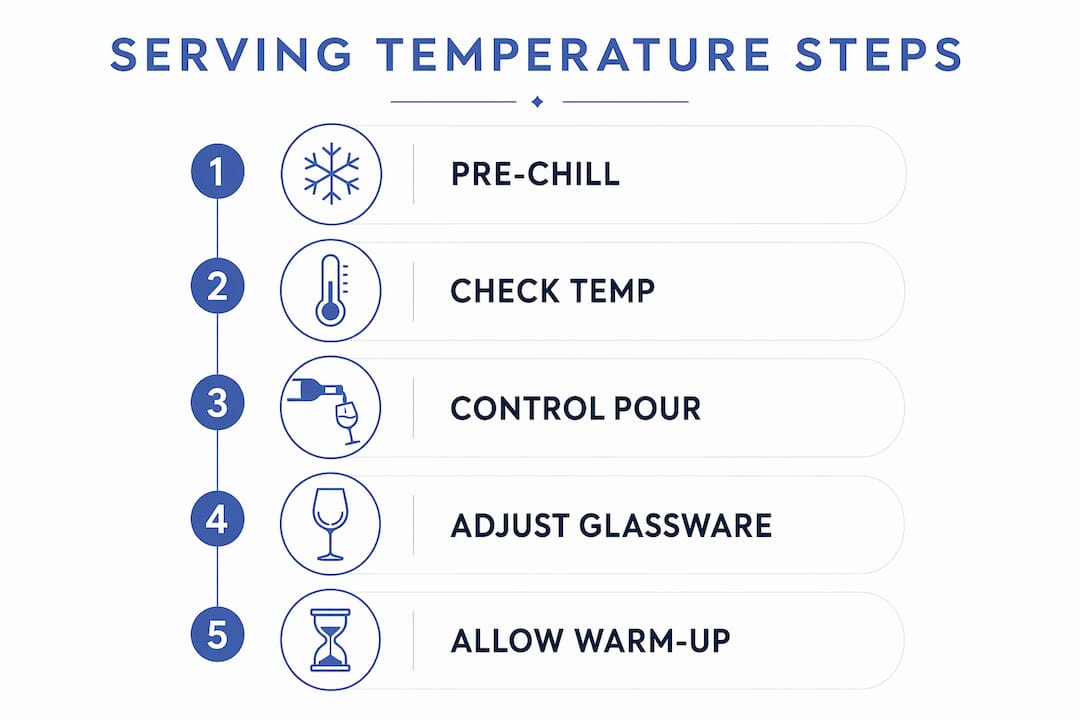
Set dedicated wine fridges to the midpoint of each style’s target range, not to cellar temperature. A full-bodied red stored at 13°C needs roughly 30–45 minutes at room temperature before service; a light white stored at 13°C needs 15–20 minutes of additional chilling in an ice-and-water bath to reach 8°C. Establish a bottle-to-service timeline at the start of each shift so wines are never pulled at the last moment.
Glassware and warming rate
Larger bowl glasses increase surface area and accelerate the rate at which wine warms, which is an advantage for a light red served slightly cool but a liability for a delicate white. A warm glass can raise wine temperature by approximately 2°C within the first few minutes of pouring. Pre-chill white wine glasses briefly in the fridge or rinse them with cold water before service on warm days; for reds, avoid pre-warming glasses beyond ambient temperature.
Decanting and pre-warming reds
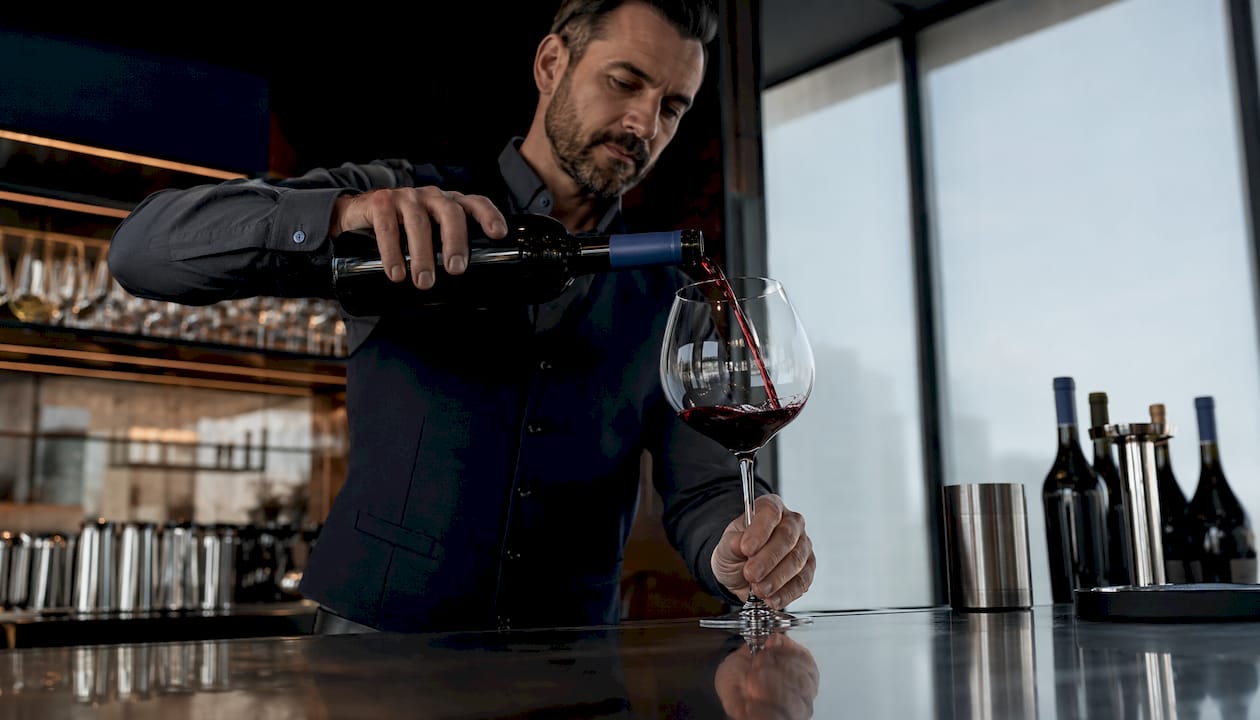
Decanting into a pre-warmed decanter is the most controlled professional method for raising a red’s temperature without applying direct heat. Rinse the decanter with hot water, empty it completely, then pour the wine in. The residual warmth lifts the wine’s temperature gently and evenly, typically by 2–4°C depending on the decanter’s mass and the water temperature used.
Pro Tip: Sequence your service so that sparkling wines are poured first, followed by whites, then reds. Each style sits at a progressively warmer temperature, and this order also allows the kitchen and sommelier to manage ice bucket and decanter logistics without overlap.
A practical checklist for service stations:
- Confirm fridge set points at the start of each service period.
- Pull reds from storage 30–45 minutes before the first cover.
- Place whites and sparkling in an ice-and-water bath (not ice alone) if they need rapid chilling.
- Check bottle temperature with a wine thermometer before pouring the first glass.
- Monitor glass-to-wine warming during extended service; replenish ice buckets every 20 minutes.
How do you cool or warm a bottle quickly and safely?
When a bottle arrives at the wrong temperature and service is imminent, a few reliable techniques can correct the situation without damaging the wine.
Safe cooling methods
An ice-and-water bath is significantly faster than ice alone because water conducts heat away from the bottle more efficiently. Adding salt to the water lowers the freezing point and accelerates chilling further, a technique useful when time is very short. Rotate the bottle gently every few minutes to ensure even cooling.
| Starting temp | Target temp | Method | Approximate time |
|---|---|---|---|
| 20°C | 10°C (light white) | Ice + water bath | 15–20 minutes |
| 20°C | 8°C (sparkling) | Ice + water + salt | 10–15 minutes |
| 18°C | 16°C (full red) | 10 minutes in fridge | 8 minutes |
| 13°C (cellar) | 8°C (crisp white) | Ice + water bath | 10–15 minutes |
These are approximate guides; ambient temperature, bottle size, and glass thickness all influence the actual rate of change.
Safe warming methods
For a red that is too cold, the most elegant solution is the pre-warmed decanter method described above. Alternatively, resting the bottle on the counter at room temperature for 20–30 minutes achieves a gentle, even rise. Holding the bowl of the glass in both hands can raise the wine’s temperature by 1–2°C within a few minutes, a useful last-resort technique at the table. Never place a bottle near a radiator, in direct sunlight, or in a microwave; sudden exposure to extreme heat can permanently alter the wine’s character and, in the case of sparkling wines, create a safety hazard.
Thermal shock is a genuine risk with aged bottles and those sealed with natural cork. Avoid rapid cycling between cold and warm environments, particularly for mature wines where the cork’s elasticity and the wine’s structural integrity are already under pressure. Rapid temperature swings can compromise seals, distort labels, and introduce oxidation.
What do the common service temperature rules actually mean?
Several shorthand rules circulate in hospitality training, and each has genuine utility within specific conditions. Understanding their assumptions prevents misapplication.
The 20-minute rule
This rule advises placing a red wine in the fridge for 20 minutes before service to bring it from modern room temperature (22°C+) down to approximately 16–18°C. It works well when the starting temperature is close to 22°C and the ambient room is not excessively warm. In an Australian summer kitchen running at 28°C, 20 minutes is insufficient; 30 to 35 minutes would be more appropriate.
The 30/30 rule
A white wine stored at cellar temperature (around 13°C) is placed in the fridge 30 minutes before service and removed 30 minutes before pouring, allowing it to settle at approximately 10°C. The logic is sound for complex whites, though lighter styles benefit from staying in the fridge until the moment of service.
The 75-85-95 rule
This heuristic refers to serving temperatures expressed in Fahrenheit: roughly 24°C for full reds, 29°C for whites, and 35°C for sparkling. It is rarely cited in contemporary Australian hospitality and reflects older, warmer service conventions that most modern sommeliers have moved away from. Common shorthand rules are heuristics tied to typical starting temperatures and the physics of small-volume cooling; they require adjustment for ambient conditions and the specific bottle at hand.
| Rule | What it claims | When it works | When it fails |
|---|---|---|---|
| 20-minute fridge rule | Cools a red to service temp | Starting temp ~22°C, moderate room | Hot kitchens, warm ambient |
| 30/30 rule | Whites from cellar to service | Cellar storage, complex whites | Light whites need more chilling |
| 75-85-95 (°F) | Broad style guidance | Historical reference only | Too warm by modern standards |
The old notion of “room temperature” for reds deserves particular scrutiny. Modern indoor temperatures in Australian homes and venues regularly exceed 22°C, which pushes full-bodied reds well above their optimal range. Service should always aim below modern room temperature for reds, not at it.
What does research say, and how does the Australian climate change the picture?
Peer-reviewed sensory trials have tested white wines at 4°C, 10°C, and 18°C, and red wines at 14°C, 18°C, and 23°C, with trained panels identifying significant differences in aroma intensity and attribute profiles at each temperature point. The findings confirm what experienced sommeliers observe daily: temperature is not a minor variable but a primary determinant of how a wine presents itself.
For Australian venues, the implications are more acute than in cooler climates. Summer ambient temperatures in Sydney, Melbourne, and Brisbane regularly reach 30°C or above, meaning a bottle of Barossa Shiraz left on a service counter for 15 minutes can climb from 17°C to 21°C or beyond. Outdoor events, rooftop terraces, and garden functions compound this challenge considerably.
Pro Tip: At outdoor Australian summer events, pre-chill all wines 2–3°C below their target service temperature before they leave the cellar. The ambient heat will bring them up to range within minutes of pouring, and you avoid the irreversible problem of an over-warm glass.
The WSET’s guidance reinforces that over-chilling below 6°C masks flavours in whites and sparkling wines just as surely as over-warming does in reds. For venues without dedicated cellars, a quality dual-zone wine fridge is the minimum investment that separates professional service from guesswork. Wine Australia’s resources for producers and hospitality operators offer further guidance on storage and service standards relevant to the local industry.
Temperature also shapes food and wine pairing at events: a cheese board served at room temperature alongside an over-chilled white will suppress the wine’s aromatic generosity precisely when the pairing calls for it to be most expressive.
Key takeaways
Serving temperature is the most immediate and correctable variable in wine service, and the difference between a wine at its best and a wine that disappoints is often a matter of just a few degrees.
| Point | Details |
|---|---|
| Serve slightly cool | A wine warms in the glass; an over-warm pour cannot be corrected at the table. |
| Know your ranges | Sparkling 3–10°C, light whites 7–12°C, complex whites 10–13°C, light reds 12–16°C, full reds 16–18°C. |
| Modern rooms are too warm for reds | Australian indoor temperatures regularly exceed 22°C; full reds should be served at 16–18°C, not at room temperature. |
| Glassware changes the rate | Larger bowls warm wine faster; pre-chill white wine glasses on warm days and monitor pour volumes. |
| Aptent’s curated selection | Aptent sources premium wines calibrated for precise service, with event support for temperature-controlled hospitality. |
The case for temperature as a non-negotiable service standard
At the level of luxury hospitality, temperature control is not a technical nicety reserved for sommeliers with thermometers. It is the difference between a wine that expresses the full refinement of its provenance and one that merely occupies a glass. The science is unambiguous: the same bottle, poured at 14°C versus 22°C, presents as two entirely different wines to a discerning palate.
What the research and the rules of thumb collectively reveal is that most service errors are errors of inattention rather than ignorance. The 20-minute rule fails not because it is wrong in principle but because no one checked the ambient temperature in the kitchen. The cellar fridge is set correctly, but the bottle sat on the pass for ten minutes before it was poured. These are procedural failures, and they are entirely preventable with a disciplined pre-service routine.
For Australian venues operating through summer, the margin for error is narrower than in cooler climates. A Champagne that arrives at the table at 13°C rather than 8°C is not a minor variation; it is a fundamentally different sensory experience, and at the price point of a prestige cuvée, that difference is felt acutely by the guest. The investment in dual-zone wine fridges, a supply of wine thermometers, and a trained team that understands why these standards exist is what separates a truly refined service from one that merely looks the part.
Aptent’s curated wines for events and professional service
For venues and hospitality professionals who hold service standards to the highest measure, the provenance and quality of the wine itself must match the precision of its service. Aptent curates a selection of fine wines and prestige products sourced from distinguished producers, chosen specifically for their capacity to reward the kind of attentive, temperature-controlled service this guide describes.

Whether you are planning an intimate tasting, a corporate function, or a large-scale gourmet event, Aptent’s event service offering provides curated wine lists, professional service support, and the assurance that every bottle has been selected and handled with the same rigour you bring to its presentation. The Aptent Gourmet collection spans fine wines, prestige sparkling, and exceptional accompaniments, all available for individual purchase or bespoke event supply. Contact Aptent to discuss your next event or to explore the curated selection.
Useful sources and further reading
The following authoritative sources informed the guidance throughout this article and offer valuable further reading for hospitality professionals and wine enthusiasts seeking deeper knowledge.
-
Left out in the cold: Serving wines chilled (PMC / NCBI): peer-reviewed research on the sensory and chemical effects of serving temperature on wine perception; the primary scientific basis for the aroma volatility and taste-modulation sections.
-
Effect of serving temperature on sensory attributes of red and white wines (Journal of Sensory Studies): trained-panel study testing whites at 4°C, 10°C, 18°C and reds at 14°C, 18°C, 23°C; directly supports the recommended ranges and the research-backed section.
-
WSET: Ideal serving temperatures and top tips for wine storage: authoritative guidance from the Wine & Spirit Education Trust on serving and storage temperatures, over-chilling risks, and the distinction between room temperature and optimal service temperature.
-
Jancis Robinson: How to serve wine: expert practical guidance on decanting, warming techniques, and the outdated “room temperature” convention for reds; one of the most respected voices in wine education globally.
-
DiWineTaste: Serving temperature: detailed technical explanation of how temperature affects aroma perception, flavour modulation, CO₂ behaviour, and glass temperature; useful for hospitality trainers building service programmes.
-
Wine Folly: Ideal serving temperature for wine: accessible visual reference for serving ranges by style; widely used in front-of-house training.
-
International Wine Authority: Wine serving temperatures: source for the common shorthand rules (20-minute, 30/30) and their practical limitations under varying ambient conditions.


