
Avoid Export Holds: 100 Litres and Australian Wine Shipping Law
Sending wine from Australia in a consignment over 100 litres legally requires shipping approval from Wine Australia through the WALAS system, plus product registration and, in many cases, an excise movement permission from the Australian Taxation Office. Domestic parcels face a separate layer of state liquor law, most notably Victoria’s declaration and signature rules enforced through carriers such as Australia Post. Anyone dispatching wine, whether a boutique producer in the Barossa or a collector gifting a case interstate, needs to check the 100‑litre threshold before booking freight.
TL;DR:
- Consignments over 100 liters require approval from Wine Australia and may need excise movement permission from the ATO before shipping.
- Product registration and label compliance must be confirmed in WALAS prior to applying for export approval, with lead times critical for approval processing.
- A valid ATO movement permission is necessary for transfer of excisable wine, with decisions potentially taking up to 28 business days, risking penalties if not obtained.
- Domestic shipments to states like Victoria involve strict signature and age verification rules, making compliance vital for successful delivery.
- Exemptions exist for volumes under 100 liters, but proper exemption requests and documentation are recommended to avoid future compliance issues.
Table of Contents
- What does wine shipping law in Australia actually require?
- Export controls and WALAS: approvals, registered products and shipping permits
- Excise, movement permissions and the ATO: when does excise law apply?
- Do state rules apply to domestic wine deliveries?
- Are there shipping exemptions under 100 litres?
- What labelling rules apply to exported wine?
- Practical compliance steps: timeline, documents and freight choices
- What are the penalties for non‑compliance?
- How Aptent approaches wine shipping compliance
- Sources
What does wine shipping law in Australia actually require?
Before a single bottle leaves the cellar door, there are five practical checks worth running. Skipping any of them tends to be the reason shipments get held at the border or bounced back by a courier.
- Measure the consignment against the 100‑litre threshold. Wine Australia treats a consignment as wine from one exporter to one port of discharge on one vessel or flight, and anything over that volume needs formal shipping approval.
- Confirm product approval numbers and label compliance. Every wine exported needs to be registered in WALAS with accurate label artwork before a shipping application can proceed.
- Work out whether an ATO movement permission applies. Underbond transfers, warehouse‑to‑warehouse moves and certain export movements of excisable wine need permission before the goods move.
- Choose a freight service built for wine. Not every courier handles temperature control or age verification, and getting this wrong is a common cause of damaged or refused deliveries.
- Lodge the WALAS application early. Build in lead time for the WBC export permit number, supporting invoices and FOB values, rather than applying the week goods are due to leave.
Pro Tip: Keep a running spreadsheet of consignment volumes across the same shipping period. Wine Australia aggregates by exporter and port of discharge, so several “small” shipments to the same destination in a short window can tip you over the 100‑litre exemption without you noticing.
Export controls and WALAS: approvals, registered products and shipping permits
An export licence and product approval become a legal requirement the moment a producer intends to sell Australian wine overseas, and both sit upstream of any shipping permit. You cannot apply for shipping approval on a product that has not been registered, so the sequence matters: register the product first, then apply to ship it.
The Wine Australia Licensing and Approval System, known industry‑wide as WALAS, is where all of this happens online. It replaces the paper‑based approvals process and covers product registration, label uploads, shipping approval applications and exemption requests in one portal, with quick reference guides for each task.
The statutory basis for the whole regime sits in the Wine Australia Regulations 2018, which define a consignment as wine from a single exporter to a single port of discharge on a single ship or aircraft. That definition is what makes the 100‑litre exemption workable in practice rather than a vague guideline.
To lodge a shipping application, expect WALAS to ask for:
- The destination country and port of discharge.
- Consignee details and contact information.
- Volumes for each product line in the consignment.
- FOB values for customs and excise purposes.
- Product IDs matching the registered label on file.
Lead times matter more than most exporters expect. Once an approval is issued, WALAS still allows edits to fields such as the estimated departure date up until that date, with vessel or flight changes permitted for up to 90 days after the original estimated departure date. Knowing that window in advance saves a lot of unnecessary resubmissions when a shipping line reschedules.
Excise, movement permissions and the ATO: when does excise law apply?
Excise control on wine begins the moment it is manufactured and does not lift until duty is paid or the wine is legitimately exported under permission. That single fact catches out a surprising number of small producers who assume excise is only a concern once goods cross the border.
The ATO recognises several categories of movement permission, and picking the right one determines how much paperwork you carry ongoing:
- Single movement permissions cover a one‑off transfer of excisable wine between specified places.
- Continuing movement permissions suit businesses making the same underbond transfer repeatedly, such as a winery moving stock to a bonded warehouse each vintage.
- General movement permissions apply more broadly across multiple sites or product lines for established operators.
- Export movement permissions specifically authorise the movement of excisable wine to a port for export.
Security arrangements, accurate recordkeeping and realistic timeframes all factor into whether an application is approved quickly. The ATO’s own guidance notes that decisions on some movement permission applications can take up to 28 business days, so lodging at the same time you start packing cartons is cutting it fine.
Moving excisable wine without the correct permission from the ATO is not a paperwork technicality. It is treated as a breach of excise law, and penalties can extend to imprisonment as well as fines calculated against the unpaid duty on the goods moved.
Do state rules apply to domestic wine deliveries?
Shipping wine from Sydney to Perth involves a completely different rulebook to exporting overseas, and it trips up plenty of businesses that assume domestic dispatch is a formality. Carriers themselves enforce much of this compliance, which means your freight choice is also a compliance choice.
Australia Post runs dedicated wine parcel services with packaging standards built around glass breakage and leakage risk, and every consignor needs to complete a Wine and alcohol declaration at the point of lodgement.
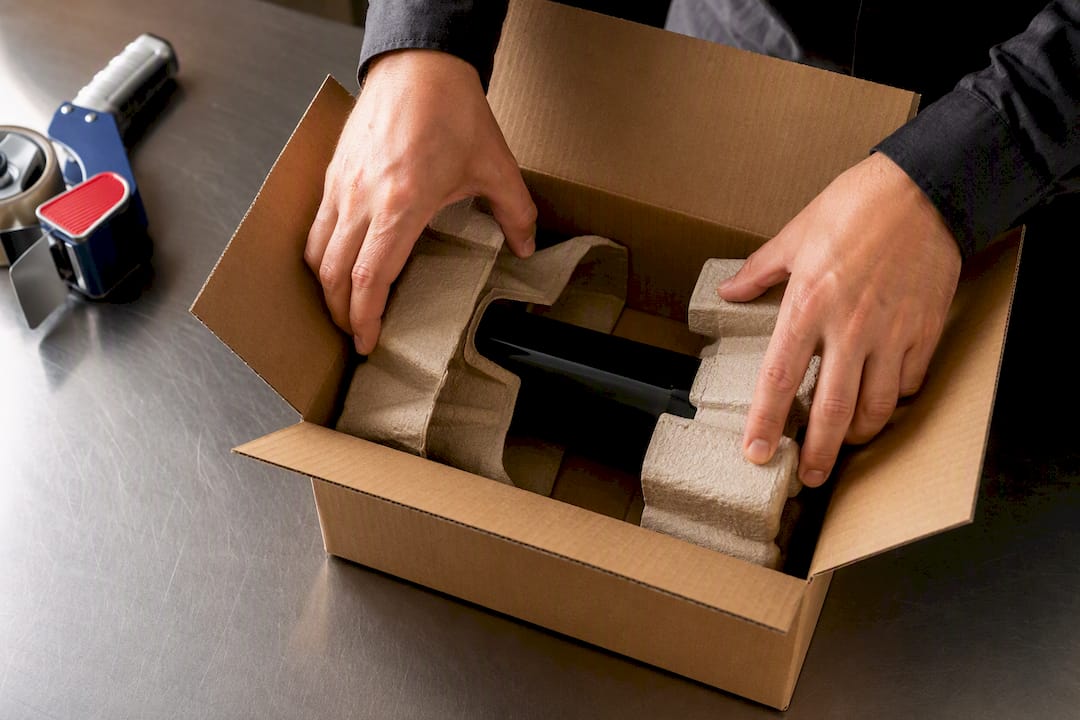
Victoria applies some of the strictest domestic rules in the country. A parcel addressed there as a gift, or to a recipient who has not received alcohol from that sender before, triggers a mandatory adult signature and ID check on delivery, a rule built directly into the courier’s declaration process rather than left to the sender’s discretion.
A quick statistic worth remembering: Wine Australia’s own framework treats any consignment over 100 litres as requiring formal shipping approval, and that single figure underpins almost every downstream compliance decision in this article, export or domestic.
Practically, this means:
- Delivery windows for wine parcels are often narrower than standard parcels, since a signature has to be captured in person.
- Businesses selling wine online should build a mandatory age declaration into checkout, not just a tick box buried in the terms.
- Gift orders to Victorian addresses need clear customer messaging that someone over 18 must be home to sign.
- Dispatch teams should treat state variations as part of the standard operating procedure, not an exception to be handled case by case.
Are there shipping exemptions under 100 litres?
Not every wine movement needs a shipping approval. The Wine Australia Regulations 2018 carve out a small‑consignment exemption for volumes under 100 litres, measured per exporter, per port of discharge, per vessel or flight, which covers a genuine share of personal and one‑off shipments.
Common exemption scenarios include:
- Wine carried in personal luggage by a traveller leaving Australia.
- Household goods shipments that happen to include a modest personal wine collection.
- Samples sent to a prospective overseas buyer or distributor ahead of a larger order.
- Wine taken to an international trade fair for tasting or display purposes.
- Allowances for diplomatic or consular consignments under separate arrangements.
Even where an exemption applies, it is worth lodging the relevant WALAS exemption request rather than assuming silence is approval, since supporting documentation such as invoices or a packing list can be requested later. Good recordkeeping, even for a shipment you believe is exempt, is the cheapest insurance policy against a compliance query months after the wine has already landed.
What labelling rules apply to exported wine?
Label compliance sits at the intersection of two systems: the Food Standards Code, which governs what must legally appear on any food or beverage sold in Australia, and Wine Australia’s product registration data, which locks in the claims made on that label for export purposes.
Before applying for export approval, check that the label carries:
- The correct product name, vintage and region claims matching what is registered in WALAS.
- Standard drinks information and alcohol by volume, stated accurately against the finished product.
- Allergen declarations, most commonly for sulphites and any fining agents used in production.
- Net contents and the name and address of the bottler or exporter of record.
Origin and vintage claims are not just marketing copy. If a label states a specific region or vintage, that claim has to match the data held against the product’s registration, and a mismatch can hold up a shipping approval entirely. It pays to review label artwork against the registered product file every time a new vintage is bottled, rather than assuming last year’s approval simply carries over.
Practical compliance steps: timeline, documents and freight choices
A working compliance timeline pulls WALAS, the ATO and freight booking into a single sequence rather than three separate to‑do lists. Getting the order right avoids the classic trap of booking a vessel before the shipping approval exists to put on it.
- Register the product in WALAS, including finalised label artwork, before any shipping application is lodged.
- Assemble the commercial invoice, packing list, product IDs and FOB values needed for the shipping approval application.
- Lodge the WALAS shipping approval with enough lead time to receive the WBC export permit number before freight is booked.
- Apply for any required ATO movement permission in parallel, given decisions can take several weeks.
- Book freight with temperature control appropriate to the route, and confirm whether the contract terms are FOB or CIF, since that determines who carries risk in transit.
- Match the WBC export permit number to the export declaration lodged with the Australian Border Force before the shipment departs.
Freight terms deserve more attention than they usually get. Under FOB terms, risk passes to the buyer once goods are loaded, while CIF terms leave the seller carrying insurance and freight cost through to the destination port. Either way, insured value should reflect the true landed cost of the wine, not just the FOB invoice figure, particularly for temperature‑sensitive premium parcels.
Pro Tip: Retain a small hold‑back sample from every high‑value consignment before it leaves the warehouse. If a claim arises over temperature damage or spoilage in transit, having a reference bottle from the same batch makes the difference between a quick insurance resolution and a drawn‑out dispute.
Freight guidance from international carriers such as DHL is genuinely useful for packaging and temperature‑control best practice, though it should never be treated as a substitute for Wine Australia or ATO requirements on the legal side.
What are the penalties for non‑compliance?
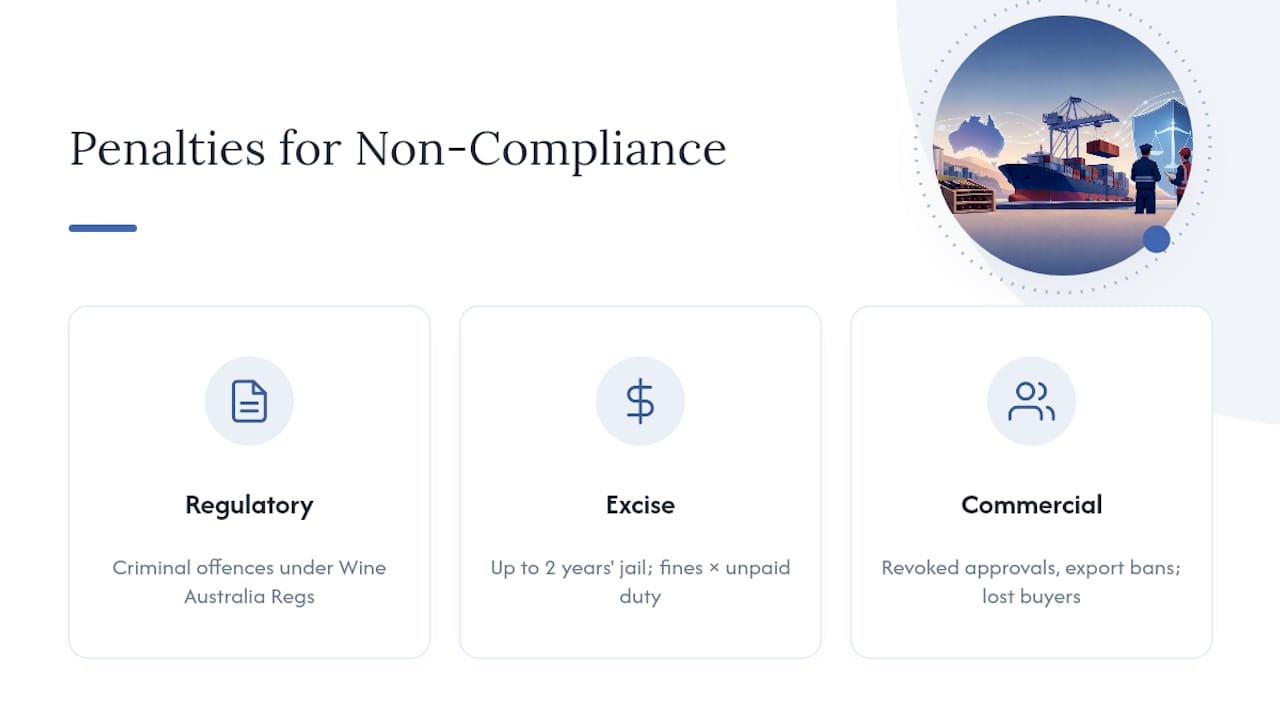
Shipping wine without the required approvals is not a grey area. Exporting a consignment over 100 litres without shipping approval breaches the Wine Australia Regulations 2018, and offences under that regime carry criminal penalties, not just administrative fines.
On the excise side, moving excisable wine without a valid ATO movement permission exposes a business to penalties that can include imprisonment of up to two years and fines calculated as multiples of the unpaid duty on the goods involved.
Beyond the legal exposure, the commercial fallout tends to hurt longer. A revoked shipping approval or an export ban follows a business through every future application, and international buyers rarely give a second chance to a supplier whose wine got stuck at a foreign port over a paperwork failure.
How Aptent approaches wine shipping compliance
Handling rare wine and caviar for discerning clients means Aptent treats every consignment’s product approvals and courier declarations as non‑negotiable, not optional paperwork. High‑value orders move through adult‑signature courier services, and hold‑back samples are retained on premium parcels so any transit issue can be resolved against a genuine reference bottle rather than guesswork.
That same rigour extends to how Aptent packages and insures shipments, drawing on practical guidance around preserving and shipping luxury food gifts and correct fine wine storage. Clients ordering rare bottles or booking a private tasting event through Aptent’s gourmet collection can expect the same compliance discipline applied to every parcel that leaves the warehouse.
— APTENT


