
Building a premium wine list: the definitive guide
A truly distinguished wine list does not happen by accident. It is the product of deliberate selection, informed by provenance, ageing potential, and an intimate understanding of personal taste. Whether you are curating a private cellar or orchestrating the wine programme for a luxury event, the finest lists share a common architecture: they balance the pleasure of drinking with the discipline of investment, drawing on authoritative benchmarks like the Langtons Classification to identify wines of enduring quality and market resilience.
The essential components of a premium wine list include:
- Wines selected for structured tannins, high acidity, and oak influence, which age with distinction rather than fade
- Representation across key Australian regions: Barossa Valley Shiraz, Mornington Peninsula Pinot Noir, and Western Australian Chardonnay
- A considered mix of First Classified and Classified wines per Langtons, alongside select Old World benchmarks
- Provenance-verified bottles sourced from reputable merchants or directly from acclaimed estates
- A clear purpose for each wine: immediate enjoyment, medium-term cellaring, or long-term investment
Pro Tip: Align your selections with what you genuinely love to drink. A list built purely on speculation, divorced from personal palate, tends to lose coherence over time. Investment value and sensory pleasure are not mutually exclusive; the finest collections honour both.
Table of Contents
- How to build your premium wine list step by step
- How should you store premium wines to protect their value?
- Pricing and valuing wines within your collection
- Legal considerations for importing premium wines into Australia
- Pairing premium wines with gourmet cuisine at luxury events
- Aptent brings the art of curation to your table
- Key takeaways
How to build your premium wine list step by step
Curating a wine selection of genuine distinction begins with defining your purpose. Are you building for private enjoyment, for the theatre of luxury events, or as a considered financial asset? Most serious collectors pursue all three, which demands a tiered approach.
- Define your collection goals before purchasing a single bottle: investment, entertaining, or personal discovery
- Consult the Langtons Classification to identify benchmark and investment-grade Australian wines with proven market performance
- Read reviews from trusted Australian sommeliers and follow regional vintage reports to understand quality variation year to year
- Buy in multiples of three or six bottles per wine, allowing periodic tasting to track development while preserving bottles for peak maturation
- Diversify across varietals, regions, and vintage years to build depth and resilience into the list
- Source from reputable merchants, boutique vineyards, and pre-release allocations from acclaimed estates to access the finest vintages before they disappear
- Use a cellar management tool or spreadsheet to track drinking windows, purchase prices, and tasting notes
Avoid deep-discount sites offering unfamiliar wines at implausible markdowns. As Michael Anderson, Head of Auctions and Secondary Market at Langtons, advises: stick to well-known producers with strong write-ups from trusted wine reviewers.
How should you store premium wines to protect their value?
Proper storage is the silent guardian of every premium wine list. Temperature stability of around 12–15°C and humidity near 70% are the non-negotiable conditions for preserving both quality and financial value. Fluctuations in either accelerate spoilage and erode the very characteristics that make a wine worth collecting.
- Maintain temperature in a stable cool range and humidity at optimal levels to protect wine quality
- Eliminate exposure to direct light, vibration, and heat sources
- Store bottles horizontally to keep corks moist and seals intact
- Consider purpose-built off-site storage for collections of serious scale, where climate control is consistent and professionally monitored
- Document provenance meticulously: purchase receipts, storage history, and tasting notes all contribute to resale value
- Insure the collection; meticulous provenance records and insurance coverage protect the financial investment as much as the cellar conditions do
Pro Tip: Purchase wines in multiples specifically to open one bottle every few years. This longitudinal tasting practice reveals how a wine is evolving and tells you precisely when to drink the remainder at its peak.
Pricing and valuing wines within your collection

Fine wine pricing is driven by scarcity, provenance, maturity, and market depth rather than sentiment alone. Structured red wines typically take several years before reaching their optimal drinking period, and the strongest resale demand typically emerges when a wine is entering or sitting within that optimal period.
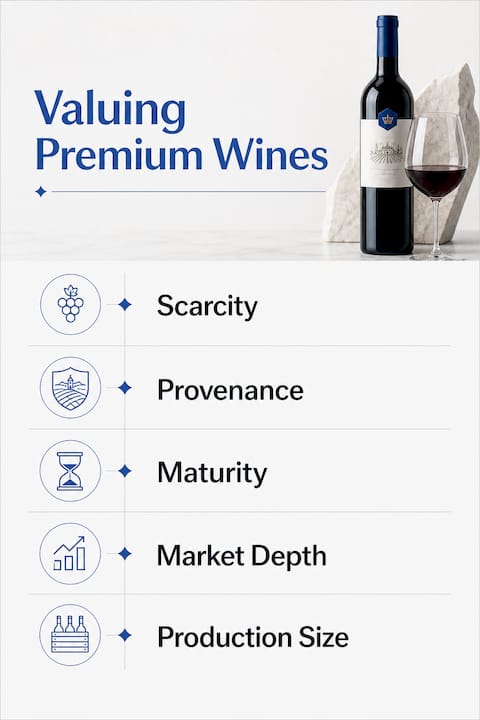
When valuing your collection, assess original production size, remaining global supply, and recent comparable auction results. Wines with active secondary market trading are considerably more liquid than niche bottles, which may require patience to sell at a rewarding price. Separating bottles held for resale from those intended for drinking preserves the integrity of both purposes. The role of curation in luxury extends beyond taste: a well-documented, strategically assembled list commands premiums that a casually assembled cellar simply cannot.
Legal considerations for importing premium wines into Australia
Importing wine into Australia requires compliance with the Australian Border Force and the Australian Taxation Office’s excise and customs framework. All imported wine attracts customs duty and the Wine Equalisation Tax (WET), which applies at the point of entry. Personal importation allowances permit adults to bring in up to 2.25 litres duty-free when returning from overseas, but commercial or collector-scale imports require a formal import declaration and payment of applicable duties and taxes.
Biosecurity regulations administered by the Department of Agriculture, Fisheries and Forestry also apply; all imported wine must meet labelling requirements under Food Standards Australia New Zealand. Engaging a licensed customs broker is advisable for significant acquisitions, particularly when sourcing aged Burgundy or Bordeaux from European cellars.
Pairing premium wines with gourmet cuisine at luxury events
At a luxury event, the wine list and the menu are inseparable. The finest wine and tasting course pairings follow a logic of complementary and contrasting flavours: a mineral-driven Chablis against freshly shucked oysters, a structured Barossa Shiraz alongside slow-roasted lamb, or a late-harvest Riesling paired with a delicate blue cheese course.
For multi-course events, sequence wines from lightest to most full-bodied, allowing each pairing to build on the last without overwhelming the palate. Champagne or a prestige cuvée serves beautifully as an aperitif, setting a tone of refinement before the first course arrives. When selecting wine for a collector or event host, consider the arc of the entire meal rather than optimising each course in isolation.
Aptent brings the art of curation to your table
For those who want a premium wine and gourmet experience without the months of research and sourcing, Aptent offers something genuinely distinct: a curated collection of luxury food and wine products sourced directly from prestigious producers, available for private enjoyment or bespoke event hosting.
Aptent’s gourmet events service is designed specifically for high-net-worth individuals and businesses seeking boutique experiences where every detail, from the wine selection to the table, reflects considered refinement. The collection extends to exceptional accompaniments including signature caviar, making it the natural partner for a luxury event where the wine list demands equally distinguished company. Visit Aptent to explore the full range and enquire about a bespoke event.
Key takeaways
Building a premium wine list requires equal parts personal discernment and strategic discipline, anchored by provenance, proper storage, and authoritative benchmarks like the Langtons Classification.
| Point | Details |
|---|---|
| Balance enjoyment and investment | Select wines you love to drink alongside structured, age-worthy bottles with proven secondary market performance. |
| Use Langtons Classification | This data-driven benchmark identifies Australia’s top investment-grade wines across First Classified and Classified tiers. |
| Buy in multiples | Purchasing three or six bottles per wine allows periodic tasting to track development while preserving peak-maturity bottles. |
| Store at 12–15°C with 70% humidity | Temperature and humidity stability are non-negotiable for protecting both quality and financial value over time. |
| Aptent for curated luxury experiences | Aptent’s gourmet events service and curated collection offer a bespoke path to premium wine and food experiences for private and event settings. |


