
Buy Now or Cellar 10–50 Years: Left Bank vs Right Bank Bordeaux
Left Bank Bordeaux is Cabernet Sauvignon-led, built on gravel that produces firm tannins and decades of ageing potential. Right Bank Bordeaux is Merlot-led, grown on clay and limestone that yields plush, earlier-drinking wines. The exceptions matter: top Right Bank estates like Pétrus and Cheval Blanc age as gracefully as any Left Bank First Growth. The right choice depends on the occasion, the vintage, and what you’re pouring it for.
TL;DR:
- Soil type remains the primary factor influencing Bordeaux styles, with gravel favoring Cabernet Sauvignon on the Left Bank and clay-limestone supporting Merlot on the Right Bank.
- Bordeaux’s appellations and classifications, such as 1855 and Saint-Émilion tiers, help identify quality and ageing potential but do not guarantee specific wine aging behaviors.
- Top Right Bank wines like Pétrus and Cheval Blanc can age as long or longer than First Growths from the Left Bank, despite their usual reputation for earlier drinking.
- Price patterns show Left Bank First Growths maintain stable, historically anchored values, while Right Bank prices are driven more by scarcity and reputation, often increasing faster in strong vintages.
- For optimal tasting, compare Bordeaux banks side by side to understand stylistic differences rather than relying solely on label or classification cues.
Table of Contents
- Where left bank vs right bank Bordeaux actually sits on the map
- Why gravel and clay produce two different wines
- Which appellations define each bank’s style?
- How long should you cellar each style?
- What do 1855 and Saint-Émilion classifications tell you?
- How do you choose a bottle for tonight versus the cellar?
- How Bordeaux’s two banks earned their reputations
- Why Right Bank prices are catching up fast
- Producers that show each bank’s range
- Does winemaking technique widen the gap between the banks?
- The one rule worth remembering about Bordeaux
- Explore both banks through APTENT. Gourmet’s curated cellar
- Sources
- FAQ
Where left bank vs right bank Bordeaux actually sits on the map
The Gironde estuary and its two tributaries, the Garonne and the Dordogne, carve Bordeaux into distinct halves. This is the entire basis for the left bank vs right bank Bordeaux distinction that confuses so many newcomers to French wine.
The convention comes from river geography: you name the banks by looking downstream, the same principle used to describe any river system anywhere in the world. Face the direction the water flows and the Left Bank sits on your left, the Right Bank on your right. In Bordeaux’s case, that puts the Left Bank on the western and southern side of the Gironde and Garonne, home to the Médoc and Graves. The Right Bank sits north and east, around Saint-Émilion and Pomerol, and the Gironde estuary’s split between gravel-rich Left Bank soils and clay-limestone Right Bank terrain is the foundation for everything that follows in glass and price.
Between the two rivers sits Entre-Deux-Mers, a large zone that produces mostly whites and doesn’t fit neatly into the Left/Right binary at all.
A few practical cues help when you’re reading a label or a map:
- If the appellation is Médoc, Margaux, Pauillac, Saint-Julien, Saint-Estèphe, Graves or Pessac-Léognan, you’re on the Left Bank.
- If it’s Saint-Émilion, Pomerol, or one of the Saint-Émilion satellite villages, you’re on the Right Bank.
- Bordeaux city itself sits on the Left Bank of the Garonne, which is worth remembering if you’re ever navigating the region by car.
Why gravel and clay produce two different wines
Soil physics explains almost everything about the left bank vs right bank Bordeaux divide, more than climate, more than winemaking philosophy, more than tradition.
Left Bank gravel drains fast and reflects heat back up into the vine canopy, which suits Cabernet Sauvignon perfectly. Cabernet is a late-ripening variety that needs every extra degree of warmth it can get, and gravel beds (some running many metres deep around Pauillac and Margaux) give the roots exactly that stress and warmth combination. The vine has to work for its water, and that struggle concentrates flavour and tannin in the skins.
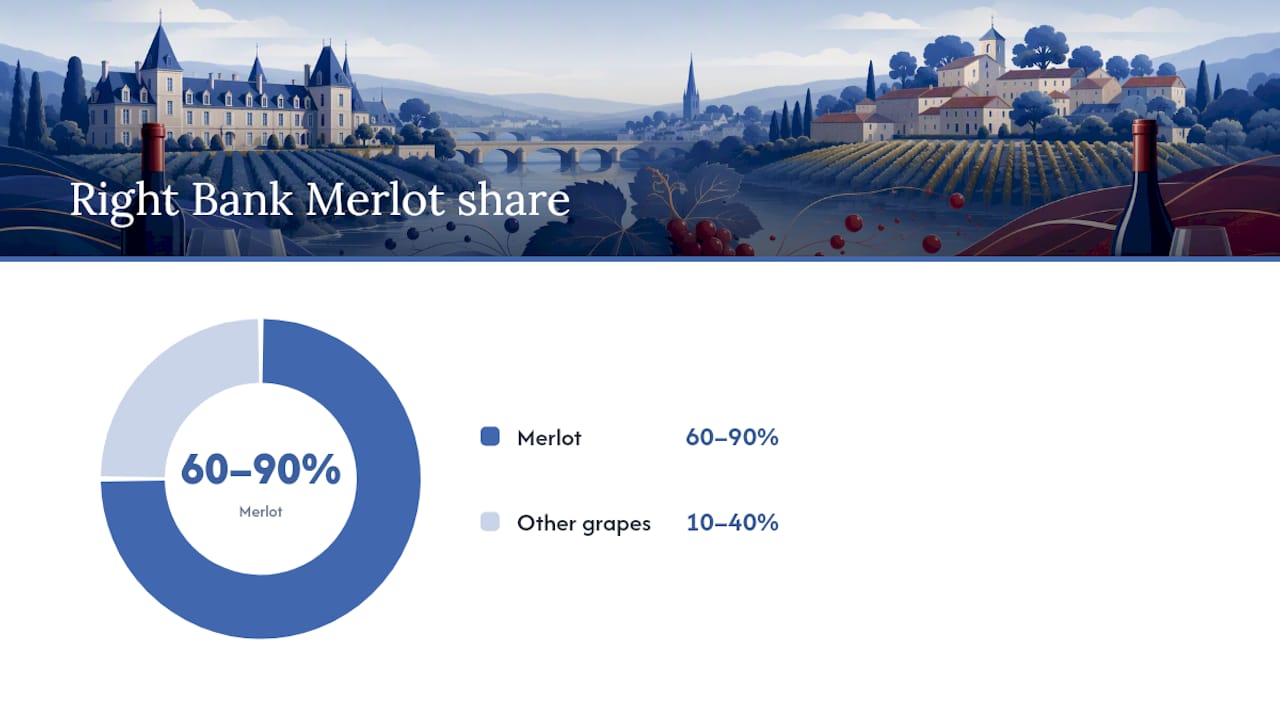
Right Bank soils flip the equation, a dynamic well discussed in this article de blog · Gin de Chimay. Clay and limestone hold moisture and stay cooler, conditions that suit Merlot and Cabernet Franc, both of which ripen earlier and don’t need the same heat load. Merlot-dominant Right Bank blends typically run 60 to 90% Merlot, producing riper tannins and a softer, fleshier texture from the outset.
Climate is shifting this equation for both banks. Harvest dates across Bordeaux have moved roughly 20 days earlier over the past three decades, a change significant enough that INAO approved new grape varieties in 2021 to help growers adapt. Warmer years compress the ripening window further, which is one reason vintage now matters more than it used to when picking between banks.
- Gravel: fast drainage, heat retention, favours Cabernet Sauvignon.
- Clay/limestone: moisture retention, cooler profile, favours Merlot and Cabernet Franc.
- Maritime influence: moderates extremes but doesn’t erase the soil-driven ripening gap.
Which appellations define each bank’s style?
Knowing the commune tells you more about what’s in the bottle than reading the back label ever will. Here’s how the major appellations break down.
- Pauillac anchors the Left Bank’s reputation for power. Three First Growths call it home, and the wines lean toward cassis, graphite, and cedar with serious tannic structure.
- Margaux trades power for perfume. Expect a lighter, more aromatic Cabernet blend with violet and red-berry lift alongside its tannic backbone.
- Saint-Julien sits between the two in style, often described as the most “balanced” of the Médoc communes, neither as brawny as Pauillac nor as delicate as Margaux.
- Saint-Estèphe tends toward firmer, earthier wines with a higher proportion of clay in an otherwise gravel-dominant commune.
- Pessac-Léognan (within Graves) produces both structured reds and some of Bordeaux’s few serious dry whites, making it the most versatile Left Bank appellation.
- Saint-Émilion wines built on limestone plateau soils show more structure and minerality than the merely clay-based Right Bank wines, with plum, dark chocolate, and violet notes typical.
- Pomerol has no formal village hierarchy, but its iron-rich clay (known locally as crasse de fer) produces some of the most concentrated Merlot in the world.
If a tasting note leans on cassis, graphite, and cedar, you’re almost certainly tasting Left Bank Cabernet. Plum, chocolate, and violet point straight to Right Bank Merlot.
How long should you cellar each style?
Ageing windows follow the same soil logic, with one significant complication at the top.
Standard Left Bank classified growths from strong vintages typically reward 10 to 20 years in the cellar, with First Growths often improving for 30 years or more. Quality Pomerol tends toward a 10 to 15 year window, drinking beautifully in that stretch without demanding the patience a Pauillac First Growth requires. Saint-Émilion’s top A-tier wines split the difference, often needing 15 to 25 years to show their best.
Then there’s the exception that breaks the whole framework. Pétrus and Cheval Blanc, both Right Bank, can demand 20 to 50 years of cellaring before they’re fully resolved, putting them squarely in First Growth longevity territory despite sitting on the “drink young” side of the map. Pétrus owes this to its almost pure Merlot planting on that iron-rich clay, which produces extraordinary concentration and fine-grained tannin rarely seen elsewhere in the variety. Cheval Blanc’s unusually high Cabernet Franc content gives it a similar structural backbone, an aromatic outlier that ages more like a Left Bank wine than a typical Right Bank one.
- First Growths and top classified Médoc: 15 to 30+ years.
- Quality Pomerol: 10 to 15 years.
- Saint-Émilion A tier: 15 to 25 years.
- Pétrus, Cheval Blanc and similar outliers: 20 to 50 years.
Pro Tip: Buy Left Bank wines the vintage they’re released if you’re planning to cellar; buy Right Bank wines a few years after release, once early reviews confirm how the vintage is actually ageing, since Merlot-driven wines can shift character faster in bottle.
What do 1855 and Saint-Émilion classifications tell you?
Classifications are shorthand for quality, but they only cover part of the region, and reading them correctly saves you from paying First Growth prices for a Right Bank wine that was never eligible for that list in the first place.
The 1855 classification ranks Médoc châteaux (plus one Graves estate, Haut-Brion) into five tiers, with Lafite, Latour, Margaux, Haut-Brion, and Mouton Rothschild as First Growths. It has barely changed in over 170 years and remains the market’s strongest Left Bank trust signal.
Saint-Émilion runs its own classification, revised roughly every decade, ranking estates as Premier Grand Cru Classé A or B, and Grand Cru Classé. Pomerol has never adopted a formal historic ranking system at all, so reputation there rests entirely on producer track record and vintage performance rather than a printed tier list.
- Use 1855 rankings as a guide to Left Bank pedigree, not a guarantee of a specific vintage’s quality.
- Treat Saint-Émilion’s classification as more current than 1855, since it’s periodically reassessed.
- Judge Pomerol on the producer’s name and the vintage report, since no formal list exists to lean on.
How do you choose a bottle for tonight versus the cellar?
Match the bank to the occasion rather than defaulting to whichever bottle looks more impressive.
For tonight’s dinner, reach for Right Bank Merlot; it’s softer and ready without decanting for hours. For a roast or grilled red meat, Left Bank Cabernet’s tannin cuts through fat beautifully. For long-term cellaring, Left Bank classified growths are the safer bet, given their proven track record for structured, slow-developing ageing. For a gift to a serious collector, a top Right Bank name like Pétrus or a Left Bank First Growth both land well, though the Right Bank pick is the rarer surprise.
- Check the vintage: cooler, wetter years favour Right Bank ripeness; warm, sunny years let Left Bank Cabernet fully ripen.
- Read the commune name first, the grape percentage second, since appellation names are the stronger style signal on most labels.
- Pair Left Bank with lamb, beef, or aged cheese; pair Right Bank with duck, mushroom dishes, or softer cheeses.
If you want to test both banks side by side, an at-home tasting format built around one Left Bank and one Right Bank bottle is the fastest way to learn the difference by palate rather than by memorising appellation charts.
How Bordeaux’s two banks earned their reputations
The Right Bank’s prestige is a comparatively recent story. Saint-Émilion has Roman-era vine cultivation, but Pomerol only rose to global recognition in the mid-20th century, largely on the back of Pétrus’s reputation and a handful of driven proprietors who proved clay-based Merlot could rival anything the Médoc produced. Before that, Right Bank wines were often sold as blending material or bottled under less prestigious labels.
The Left Bank had a two-century head start on formal recognition. Bordeaux’s gravel estates were already trading internationally, particularly through British and Dutch merchants, well before the 1855 classification made that hierarchy official for the Exposition Universelle de Paris. That list froze a snapshot of market reputation from the mid-19th century, and remarkably, most of it still holds today, a rare case of a marketing exercise ageing better than most of the wines it ranked.
Right Bank estates never had that early institutional backing, which is precisely why Saint-Émilion eventually built its own classification system in 1955, a full century after the Médoc’s, and why Pomerol still operates without one. The absence of a Pomerol hierarchy isn’t an oversight; it reflects a region that built its name through individual producer reputation rather than a fixed 19th century snapshot. That history still shapes buying psychology now: Left Bank names carry inherited prestige, while Right Bank names, Pétrus aside, often win recognition estate by estate, vintage by vintage.
Why Right Bank prices are catching up fast
Left Bank First Growths have always commanded the headline prices, and the 1855 list gives buyers a stable, decades-old reference point for what they’re paying for. That stability is exactly why Left Bank en primeur pricing tends to move in step with broad market sentiment. Strong global demand lifts the whole tier together, and a soft vintage can still fetch respectable prices purely on the château’s name.
Right Bank pricing behaves differently, and more unpredictably. Because Pomerol has no formal classification, price is driven almost entirely by scarcity and individual reputation. Pétrus produces a tiny volume compared with a typical Médoc First Growth, and that scarcity, not a printed ranking, is what pushes its prices into rarefied territory. Cheval Blanc and Ausone occupy similar ground: small production, cult followings, and prices that can outpace Left Bank peers with far larger vineyard holdings.
Demand patterns also diverge by market. Left Bank First Growths remain the benchmark for collectors building long-term cellars, particularly in markets that treat Bordeaux as a store of value alongside wine to drink. Right Bank cult wines increasingly attract buyers chasing rarity itself, a different motivation that can make small-production Pomerol and Saint-Émilion bottles appreciate sharply in strong vintages, sometimes faster than their Left Bank counterparts. For everyday buying rather than speculation, this means Right Bank wines outside the very top tier often represent better relative value, since you’re not paying a 170-year-old reputation premium on every bottle.
Producers that show each bank’s range
No single château defines an entire bank, but a handful illustrate the spread of styles worth knowing.
On the Left Bank, Château Margaux shows the perfumed, elegant end of Cabernet expression, while Château Latour in Pauillac sits at the powerful, dense end of the same grape. Château Léoville Las Cases in Saint-Julien demonstrates why that commune’s “balanced” reputation holds up in the glass: structured but not austere. In Pessac-Léognan, Château Haut-Brion (the sole non-Médoc estate in the 1855 First Growth tier) proves gravel-driven power isn’t confined to the Médoc peninsula.
On the Right Bank, Pétrus remains the reference point for what iron-rich Pomerol clay can do with nearly pure Merlot, a wine built on scarcity as much as concentration. Cheval Blanc, with its unusually high Cabernet Franc content, shows how a Right Bank estate can produce structure that rivals Left Bank ageing potential. Château Ausone, perched on Saint-Émilion’s limestone plateau, leans into that mineral backbone rather than pure fruit richness. Further down the price scale, satellite appellations around Saint-Émilion offer accessible entry points into the Right Bank’s plush, earlier-drinking style without the cult pricing.
Together these names map the real spectrum: power at Latour, perfume at Margaux, concentration at Pétrus, structure at Cheval Blanc. Reducing either bank to a single flavour profile misses how much diversity exists within each side of the river.
Does winemaking technique widen the gap between the banks?
Soil and grape variety set the foundation, but cellar choices reinforce the stylistic split rather than closing it.
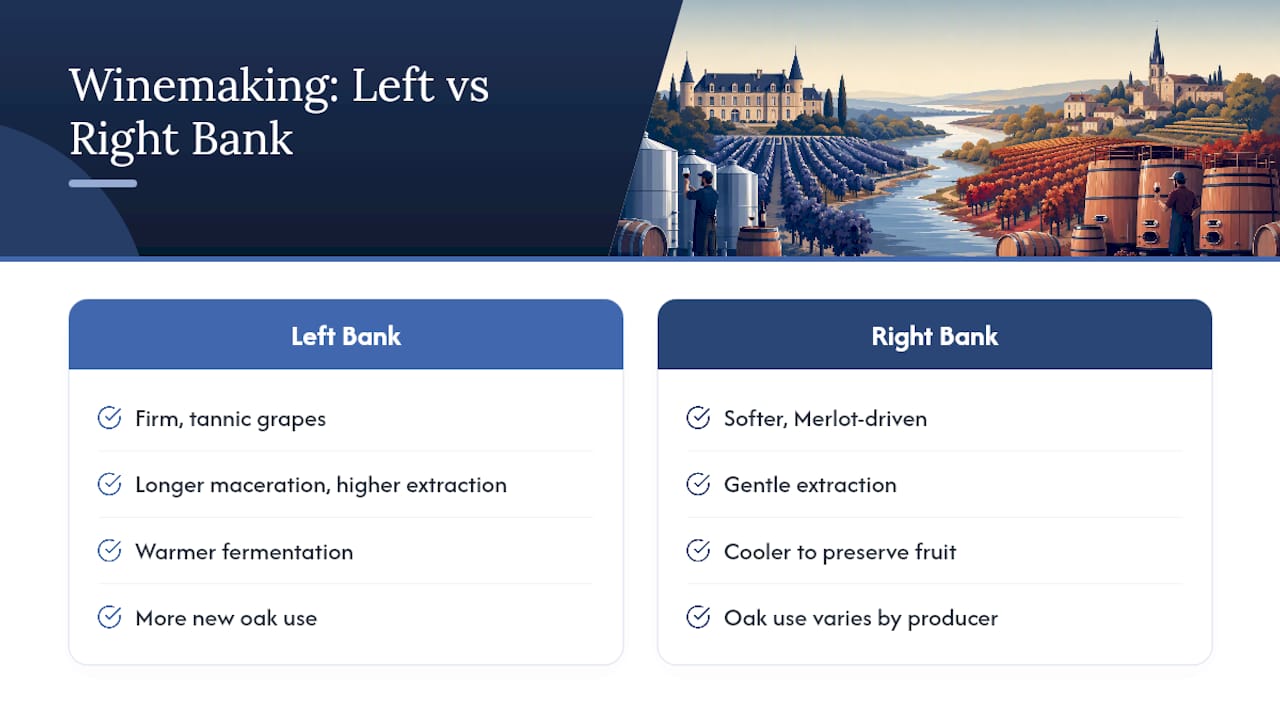
Left Bank estates, working with firmer, more tannic Cabernet, often lean on longer maceration times and a higher proportion of new oak barrels to soften and integrate that tannin over the ageing process.
Right Bank winemakers generally use a gentler hand, given Merlot’s naturally softer tannin and earlier drinkability. Fermentation temperatures and extraction levels are often calibrated to preserve fruit purity rather than build additional structure the grape doesn’t need. Oak use varies more by producer here than by appellation, with some Pomerol estates using new oak assertively (Pétrus among them) while others favour older barrels to let the fruit and terroir speak without added spice.
The result is that technique amplifies what the soil already decided. A winemaker can nudge a wine’s texture at the margins, but nobody is turning Pomerol clay into gravel-driven Cabernet structure through barrel choice alone. That’s worth remembering next time a producer’s technique gets more airtime than their vineyard’s geology; the dirt usually wins.
The one rule worth remembering about Bordeaux
The conventional wisdom, Left Bank for cellaring, Right Bank for drinking now, is a genuinely useful starting point, and most of the region’s 8,000-plus châteaux fit it without complaint. Where that advice fails readers is at the exact moment they’re standing in front of a bottle from Pomerol or Saint-Émilion’s top tier, assuming it will drink young simply because of its postcode.
What the research actually supports is narrower and more useful: soil and grape variety set the default style, but concentration and producer ambition can override that default at the top of the market. Pétrus and Cheval Blanc aren’t quirks to memorise and forget; they’re proof that geology sets the odds, not the outcome. The same logic applies in miniature further down the price ladder, where an ambitious Right Bank producer in a strong vintage can easily out-age a mediocre Left Bank château in a weak one.
Prioritise the vintage and the producer’s reputation before you default to bank-based assumptions. A gravel address doesn’t guarantee greatness, and a clay one doesn’t guarantee an early death. Read the commune, check the year, then decide, in that order.
— APTENT
Explore both banks through APTENT. Gourmet’s curated cellar
Reading about the Left Bank’s gravel and the Right Bank’s clay only gets you so far; tasting the two side by side is what actually trains your palate. Aptent’s curated collection of rare French wines is built specifically for that kind of comparison, sourced directly from prestigious producers on both banks rather than assembled from whatever a mass retailer happens to have in stock.
For readers who want to taste Left and Right Bank Bordeaux together properly, guided rather than guessing at pairings alone, APTENT Privé’s private tasting events bring that comparison to your table with the context to make sense of what you’re drinking. Businesses planning a client dinner or a milestone celebration can look to Gourmet Events for a bespoke Bordeaux pairing built around the occasion, and anyone buying for a serious collector will find Corporate & VIP gifting a more considered route than a generic bottle shop. Browse the current Bordeaux selection or enquire about booking a private tasting to see how the two banks compare in your own glass.
Sources
- Left and Right Bank Bordeaux: What is the difference? — Decanter
- Left Bank vs. Right Bank Bordeaux — WineWithSeth (WineWiki)
- Left Bank vs Right Bank Bordeaux: Style, Aging & Structure Explained — CollectorCellar
- Left Bank vs Right Bank Bordeaux: Here’s Why It Matters — Food & Wine
FAQ
Why is Bordeaux split into Left Bank and Right Bank?
The Gironde estuary and its Garonne and Dordogne tributaries physically divide the region, and each side developed different soils over millions of years. That geological split is why left bank vs right bank Bordeaux became the industry’s default way to talk about style, not just location.
Is Margaux located on the left or Right Bank of Bordeaux?
Margaux sits on the Left Bank, within the Médoc, on gravel soils that suit Cabernet Sauvignon. It’s known for a more perfumed, elegant style than the power-driven wines of nearby Pauillac.
Is Médoc left or Right Bank?
Médoc is entirely Left Bank, running along the western side of the Gironde estuary north of Bordeaux city. It contains the Pauillac, Margaux, Saint-Julien, and Saint-Estèphe appellations along with most of the 1855 classified growths.
Which Right Bank Bordeaux wine is considered the best?
Pétrus is widely regarded as the Right Bank’s most celebrated wine, prized for its near-pure Merlot composition grown on Pomerol’s iron-rich clay. Cheval Blanc, from Saint-Émilion, is frequently mentioned alongside it for its unusually high Cabernet Franc content and long-term ageing capacity.


