
Protect the Roe: Open a Caviar Tin in 5 Careful Steps for Hosts
The safest way to open a caviar tin is to release its vacuum seal with a caviar key or a clean coin, never a standard can opener, and lift the lid slowly once the seal breaks. Keep the tin chilled and resting on a stable, flat surface throughout. Work the rim gently rather than forcing a single point, which protects the delicate pearls from crushing and keeps the tin’s lining intact.
TL;DR:
- Using a caviar key or a clean coin at a shallow angle minimizes the risk of damaging the delicate pearls during opening.
- Keep the tin chilled between 0°C and 4°C and work on a stable flat surface to prevent spills and preserve quality.
- Gently twist around the seam, shifting points if the lid resists, rather than applying force or using a standard can opener.
- Once opened, reseal quickly with plastic wrap and store in the coldest fridge section to maintain freshness for one to two days.
- Avoid metal utensils, especially silver, and handle the roe minimally while serving to prevent dulling flavor and breaking the pearls.
Table of Contents
- Quick pre-opening checklist
- Step-by-step: release the vacuum and open the tin safely
- Tools and safe alternatives
- Aftercare and short-term storage once opened
- Serving tips: utensils and presentation
- Expertise and practical proof points
- Common mistakes and quick professional shortcuts
- Buy caviar and the right accessories together
- Sources
- FAQ
Quick pre-opening checklist
Before you touch the seam, a few minutes of preparation separates a clean opening from a messy one. Premium roe is temperature sensitive and unforgiving of clumsy hands, so set the stage properly.
- Chill the tin to serving temperature, ideally between 0°C and 4°C, before attempting to open it.
- Choose a flat, stable surface with no risk of slipping, away from the edge of a bench.
- Gather your tools: a caviar key if you have one, otherwise a clean coin, with a butter knife kept only as a last resort.
- Have your serving spoon and an ice bed or chilled dish ready so the roe moves straight from tin to table.
Step-by-step: release the vacuum and open the tin safely
Every quality caviar tin is vacuum sealed rather than crimped like a standard tinned good, which is precisely why an ordinary can opener has no business near it. The mechanical blade that slices a can of tomatoes will tear the lining and crush eggs against the rim. The technique below works whether you are handling a 30g tasting tin or a 250g centrepiece.
- Inspect the seam. Run your eye and thumb around the rim, checking for dents, bulges, or damage before you begin.
- Position your tool. Slide a caviar key or a clean coin at a shallow angle into the seam where the lid meets the tin wall.
- Twist gently. Rotate the tool slowly rather than levering it upward. You are listening and feeling for a soft pop as the vacuum releases, not prying the metal apart.
- Move around the rim. If one point feels stubborn, shift a centimetre or two along the seam instead of pushing harder on the same spot.
- Lift evenly. Once the seal has broken, raise the lid straight up and level, keeping it parallel to the roe beneath.
The instinct to break the seal with controlled, minimal movement rather than brute force is what separates a clean opening from a disaster; purpose-built keys are designed around exactly that motion. If the lid resists at every point you try, stop immediately. Do not add force. A warm cloth held briefly against the seam (never direct heat) can sometimes loosen a stubborn seal, but a tin that still won’t budge, or one that arrived dented, is a matter for your supplier rather than your kitchen bench, since most professional sellers will replace or repair a faulty tin rather than have you fight it open.
Pro Tip: Keep a folded tea towel under the tin as you twist. It stops the metal slipping under your fingers and saves you from gripping too hard, which is a common cause of accidental dents to the lid.
Tools and safe alternatives
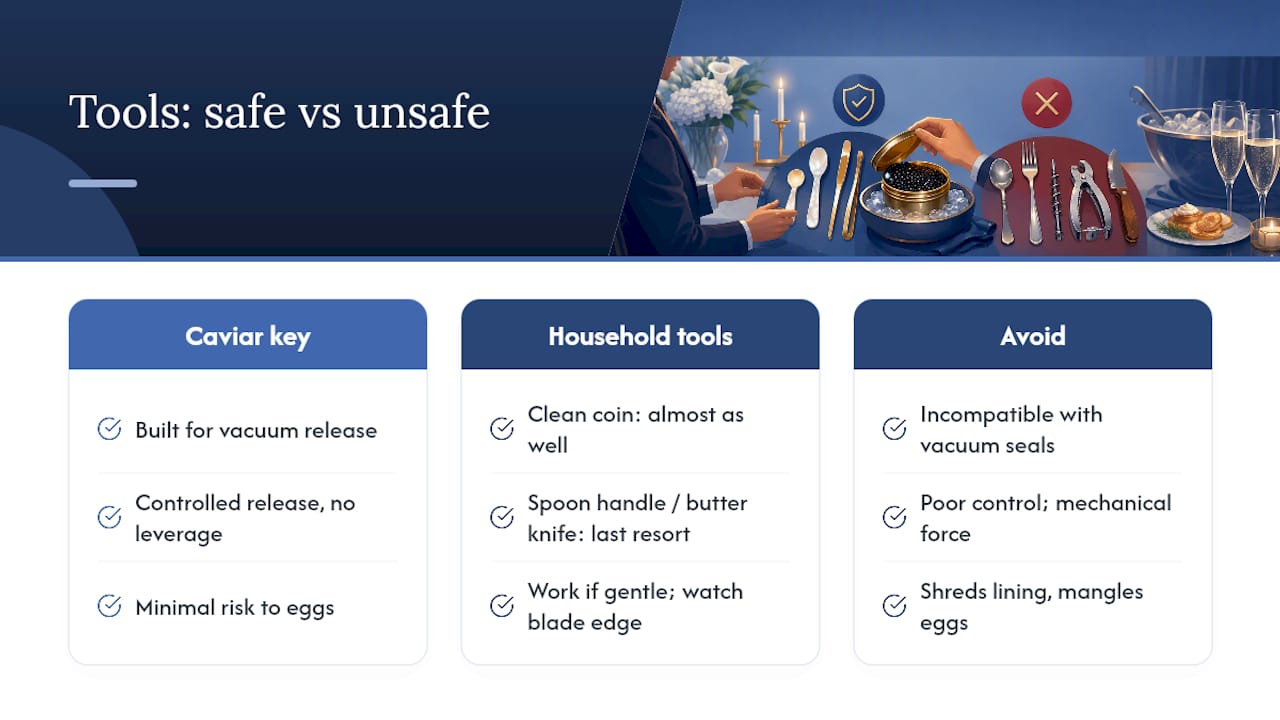
A caviar key earns its place in a host’s kit because its thin, angled edge is built for exactly one job: controlled release of a vacuum seal without any leverage against the eggs themselves. Most quality producers will include one with an order on request, so it’s worth asking before you improvise.
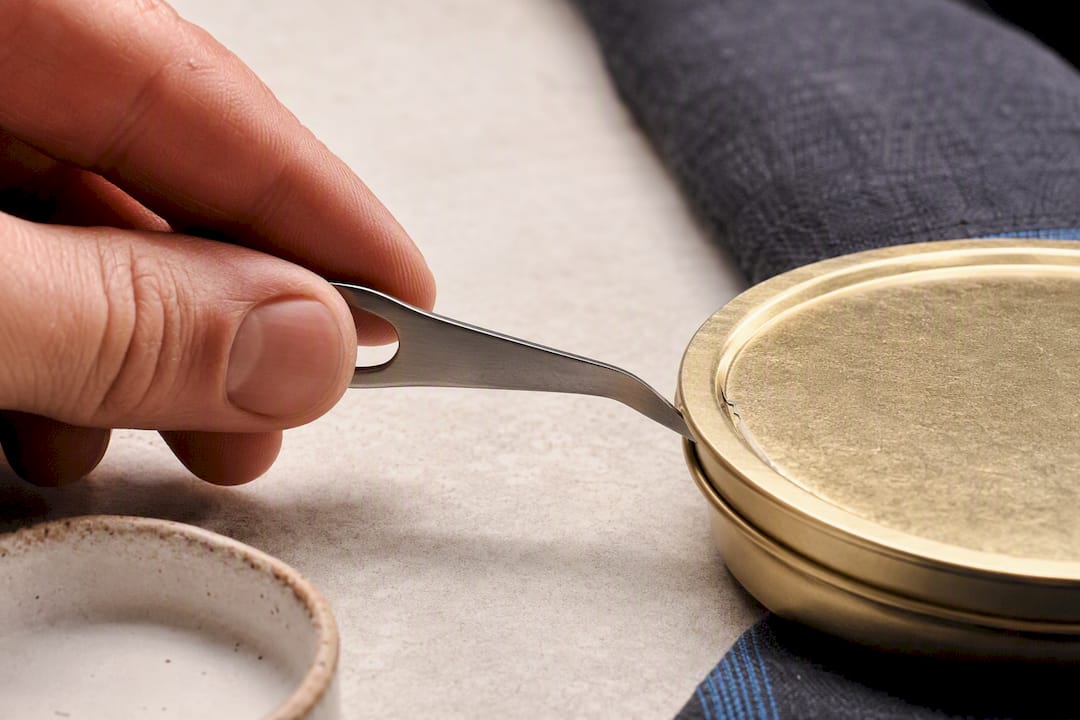
Without a key, a clean coin does the job almost as well when guided with a gentle twisting motion rather than jammed in and forced. A spoon handle or, failing that, a butter knife inserted carefully between lid and rim works as a genuine last resort, provided you’re mindful of the blade’s edge against your fingers.
What you should never reach for is a standard can opener or a sharp kitchen knife. Vacuum seals behave nothing like the crimped seams on tinned vegetables, and mechanical blades tend to shred the tin’s inner lining and mangle the eggs closest to the rim.
Aftercare and short-term storage once opened
Once the tin is open, the clock starts ticking on flavour and texture, so treat the next few minutes as part of the opening process, not an afterthought.
- Press the original lid back down over the roe and lay plastic wrap directly against the surface to cut oxygen exposure.
- Return the tin immediately to the coldest section of your fridge, ideally close to 0°C, following expert advice on how to best conserver un Spritz après ouverture to maintain flavor and freshness.
- Expect a short window of peak quality once opened; consume within a day or two rather than treating it as a pantry staple.
- Watch for a sour or ammonia-like smell, a mushy texture, or discoloured, cloudy liquid pooling at the base. All three signal it’s time to discard.
- Serve with non-metal spoons and get it to the table promptly rather than leaving it to sit at room temperature.
A guide on storing caviar at home covers refrigeration windows in more depth if you’re planning ahead for an event rather than serving immediately.
Serving tips: utensils and presentation
Metal cutlery, particularly anything silver, reacts with roe and dulls its buttery richness within seconds of contact. Mother-of-pearl, horn, and glass spoons avoid that entirely, and a gold-plated spoon does the same job with a touch more polish for a formal table.
- Serve over a bed of crushed ice to hold serving temperature throughout a tasting.
- Portion in small increments; a few grams per guest is enough for a proper tasting rather than a heavy scoop.
- Handle the roe as little as possible once plated. Overworking the pearls with a spoon breaks them down and loses the pop that makes good caviar worth the price.
- For guidance on vessels and pairing at a larger gathering, Aptent’s notes on caviar service vessels and portioning for tastings are worth a read before you host.
Expertise and practical proof points
The guide highlights caviar curated for consistency of texture and flavour, alongside accessories that make serving it properly straightforward rather than stressful.
The difference between a satisfying tasting and a disappointing one often comes down to the few minutes between opening the tin and getting the roe onto a spoon. Getting that window right protects everything the producer worked to preserve.
Home hosts preparing caviar for a dinner or celebration can browse caviar and matching accessories to see sizing and tools together.
Common mistakes and quick professional shortcuts
The two mistakes we see most often are forcing a stuck lid and opening a tin that’s still warm from the counter rather than the fridge. Professionals work the rim gradually, point by point, and always have a key or coin within reach before they start. If a tin won’t budge after two or three attempts, stop and call your supplier rather than risk the roe.
Buy caviar and the right accessories together
There’s little point mastering the technique for opening a tin if the tools sitting in your kitchen drawer aren’t built for the job. Rare Oscietre and Baeri tins are offered alongside caviar accessories built specifically for a clean, controlled seal release, avoiding the need to improvise with a butter knife on the night of an event.

Browse the caviar collection to choose a tin size that suits your gathering, from an intimate tasting to a larger celebration, and add a proper key or mother-of-pearl spoon set while you’re there. Hosting something bigger? Aptent’s Gourmet Events service pairs caviar and wine selections for private occasions, and Corporate & VIP gifting covers client and celebration gifts where presentation matters as much as the product itself. Whichever you choose, ordering the tin and the correct opener together means you’ll never be caught reaching for the wrong tool when it counts.
Sources
This guide draws on established retailer and producer technique pages, including Caviar Guide’s expert opening instructions, Dariush Caviar’s container guidance, and troubleshooting steps from Imperia Caviar’s help centre, each demonstrating the same gentle, vacuum-release approach described above.
- How to Open a Caviar Tin Correctly | Expert Guide
- How to open and close the caviar container properly
- How to open a tin of caviar
- How to open a tin of caviar
FAQ
How do you open a tin of caviar?
Slide a caviar key or a clean coin into the seam at a shallow angle, twist gently until the vacuum releases, then lift the lid straight up. Avoid a standard can opener, which can tear the lining and crush the eggs.
How long is caviar good for after opening the tin?
Opened caviar holds its best quality for only a short window, typically a day or two, when resealed with plastic wrap and kept in the coldest part of the fridge. Discard it if you notice a sour smell, mushy texture, or cloudy liquid.
How can I open a tin of caviar without a key?
A clean coin or a spoon handle works well when guided with a gentle twisting motion rather than force; a butter knife is a workable last resort if handled carefully. Never substitute a can opener or sharp knife.
How do I open a caviar tin if the lid seems stuck?
Try a different point around the rim rather than pushing harder on the same spot, since forcing a stuck lid risks crushing the roe. If it still won’t release, contact your supplier for a replacement opener or tin.
Does Aptent sell caviar tin openers?
Aptent’s caviar accessories collection includes the tools needed to open and serve tins properly; current pricing is available on the site.


