
Roe vs Caviar in Australia: How to Buy and Serve with Confidence
All caviar is fish roe, but not all roe earns the name caviar. True caviar means salt-cured eggs from sturgeon, a distinction rooted in both biology and centuries of culinary tradition. Everything else, from glistening salmon pearls to crackling tobiko, belongs to the broader roe family. That single fact explains most of the price gap, the flavour differences, and the confusion on supermarket shelves.
TL;DR:
- Genuine caviar must come from salt-cured sturgeon eggs, which are typically labeled as malossol with strict traceability requirements, unlike other fish roe.
- Sturgeon take decades to mature, and each yields roe infrequently, contributing significantly to caviar’s high cost compared to quicker-harvested roe like salmon or trout.
- The texture, flavor, and serving etiquette differ greatly: caviar offers a buttery, delicate pop, while roe like salmon or tobiko is bursty, crunchy, or used mainly as garnish.
- Proper sourcing involves checking for species labels, CITES documentation, and avoiding vague terms like “caviar style” to ensure authenticity and compliance.
- Price does not always correlate with enjoyment; sourcing integrity and matching product type to the occasion are more important than simply choosing the most expensive option.
Table of Contents
- What is fish roe? The umbrella term explained
- What is caviar? Real caviar defined and its quality clues
- Roe vs caviar: a side-by-side comparison
- Why caviar usually costs more
- Taste, texture, and how to serve each one
- Nutrition and dietary considerations
- Sourcing, sustainability, and what labels should tell you
- How to buy roe or caviar with confidence
- Why this distinction matters more than most guides admit
- Where to find genuine caviar and how to taste it properly
- Sources
What is fish roe? The umbrella term explained
Roe refers to the unfertilised eggs of any fish species, and the term covers a far wider world than most shoppers realise. Each species produces eggs with distinct size, colour, and flavour, shaped by diet, water temperature, and biology.
The varieties you’re most likely to encounter include:
- Salmon roe (ikura): large, orange-red beads with a firm pop and briny sweetness, popular in Japanese and Russian cuisine as a marinated topping.
- Trout roe: smaller and paler than salmon, with a milder, less oceanic flavour.
- Tobiko (flying fish roe): tiny, crunchy eggs often dyed for sushi, prized for texture over taste.
- Lumpfish roe: dyed black or red, budget-friendly, and common as a garnish rather than a centrepiece.
- Whitefish roe: delicate, golden, and mild, often used in canapés.
None of these are caviar, no matter how a label tries to dress them up. They’re roe, and there’s nothing lesser about saying so.
What is caviar? Real caviar defined and its quality clues
Caviar is specifically the salt-cured, unfertilised eggs of sturgeon. According to America’s Test Kitchen, that curing process, not the fish alone, is what separates caviar from roe in the first place. Most true caviar carries a malossol label, meaning “little salt” in Russian, a curing method using minimal salt to preserve the egg’s natural flavour rather than mask it.
Sturgeon species vary considerably in what they deliver, offering a range of egg sizes, colours, and flavours from buttery and rare to nutty, complex, and briny types.
Quality grading looks at egg integrity (whole, unbroken pearls), colour consistency, and finish on the palate. Robb Report notes that ageing and the sturgeon’s diet and environment shape flavour just as much as species does, and that farmed caviar has closed much of the gap with wild caviar in both availability and consistency. For a closer look at how the major sturgeon varieties stack up, see how types of caviar rank from Beluga to Baeri.
Roe vs caviar: a side-by-side comparison
Once you line the two up, the practical differences become obvious fast.
| Attribute | Sturgeon caviar | Common roe (salmon, trout, tobiko, lumpfish) |
|---|---|---|
| Source species | Sturgeon only | Salmon, trout, flying fish, lumpfish, whitefish, and more |
| Processing | Salt-cured (malossol), often aged | Fresh, lightly brined, smoked, or dyed |
| Egg size | Medium to large, uniform | Ranges from tiny (tobiko) to large (salmon) |
| Colour | Grey to black to golden-brown | Orange, red, black-dyed, or pale gold |
| Texture | Firm pearl with a delicate, buttery pop | Crunchy (tobiko) to juicy-firm (salmon) |
| Typical price | High to very high | Low to moderate |
| Culinary role | Standalone luxury course | Garnish, sushi topping, or recipe ingredient |
| Labelling | Must name the sturgeon species | Often marketed as “caviar style” or by colour |
The takeaway is straightforward: reach for genuine sturgeon caviar when the occasion calls for restraint and ceremony, a few grams on a blini, eaten slowly. Reach for salmon roe or tobiko when you want volume, colour, and texture in a dish, on sushi rolls, over pasta, or folded through a potato salad. Neither is a lesser choice; they’re built for different jobs.
Why caviar usually costs more
Sturgeon are slow. Some species take eight to twenty years to mature enough to produce eggs, and each fish yields roe only once every few years under farmed conditions. Compare that to salmon, which spawn annually and reach harvest roe far faster, and the economics start to make sense before you even factor in processing.
Beyond biology, several forces push the price up further:
- Hand-grading each batch for egg size, colour, and integrity is slow, skilled labour.
- Ageing caviar to develop flavour ties up inventory for months.
- CITES compliance and traceability documentation add cost at every step from farm to plate, since sturgeon are protected under international trade regulation.
- Small-batch handling and cold-chain logistics carry a premium that mass-produced roe never incurs.
In the numbers: Food Republic points to sturgeon’s slow growth cycle, intensive hand-grading, and regulatory traceability as the three biggest drivers separating caviar’s price tag from that of common roe.
None of this is manufactured scarcity. It’s the genuine cost of farming a fish that takes two decades to mature, then treating its eggs the way a winemaker treats a single vintage.
Taste, texture, and how to serve each one
Sturgeon caviar delivers a buttery smoothness with a clean, briny finish that lingers rather than announces itself, the eggs release flavour slowly as they burst. Salmon roe brings a bigger, juicier pop and a saltier, more oceanic hit. Tobiko is almost entirely about crunch, its flavour is mild and secondary to texture. Lumpfish sits at the blunt end of the spectrum, salty and straightforward, built for garnish rather than contemplation.
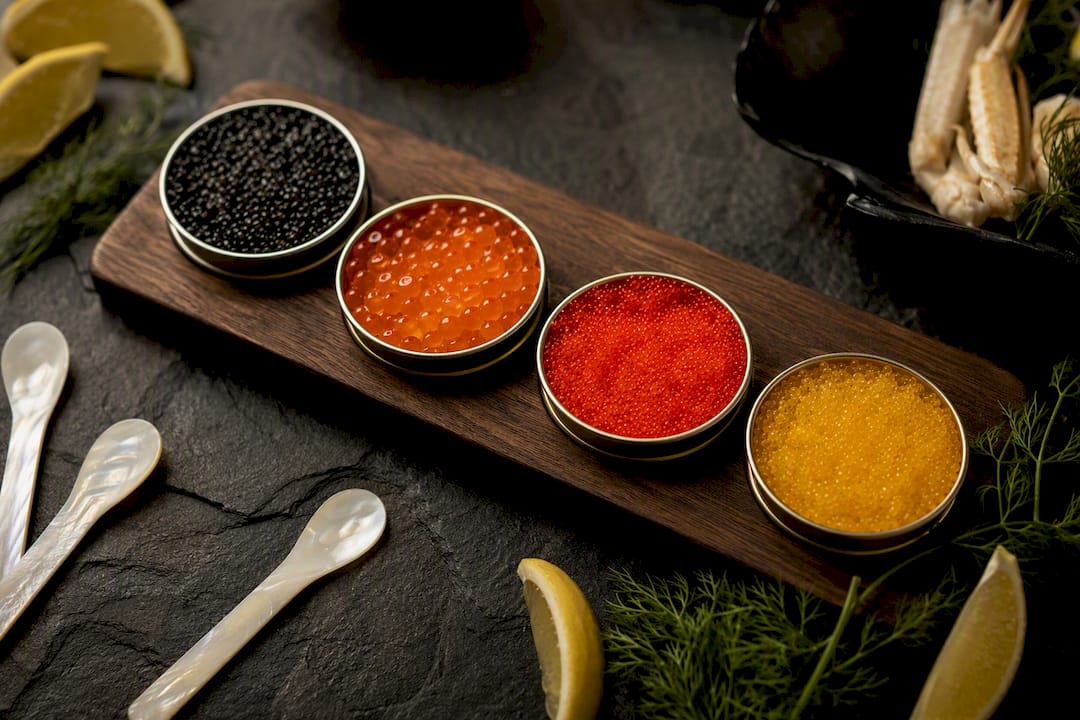
Serving etiquette for caviar keeps things deliberately minimal: a small spoonful on the back of the hand or a blini, a squeeze of lemon at most, and always a mother-of-pearl or bone spoon rather than metal, which can taint the flavour. Roe is far more forgiving and works beautifully folded into sushi, spooned over buttered toast, or stirred through a cream sauce for pasta.
Pro Tip: Add roe or caviar at the very last moment, off the heat and off the plate’s hot zone. Heat and prolonged contact with acidic dressings break down the egg membrane, pushing out salt and turning a delicate pop into mush.
For plating ideas and pairing suggestions beyond the basics, how to serve caviar covers the finer details.
Nutrition and dietary considerations
Nutritionally, the two categories diverge more than most people expect. A 2024 review comparing sturgeon and salmon roe found sturgeon protein levels ranging from roughly 14.84% to 24.2%, against salmon’s 27.5% to 30.4%, with salmon roe also showing higher reported ranges of the omega-3 fats EPA and DHA. Sturgeon roe tends to carry more total lipid content overall, so the two aren’t simply “better” or “worse”, they trade off differently.
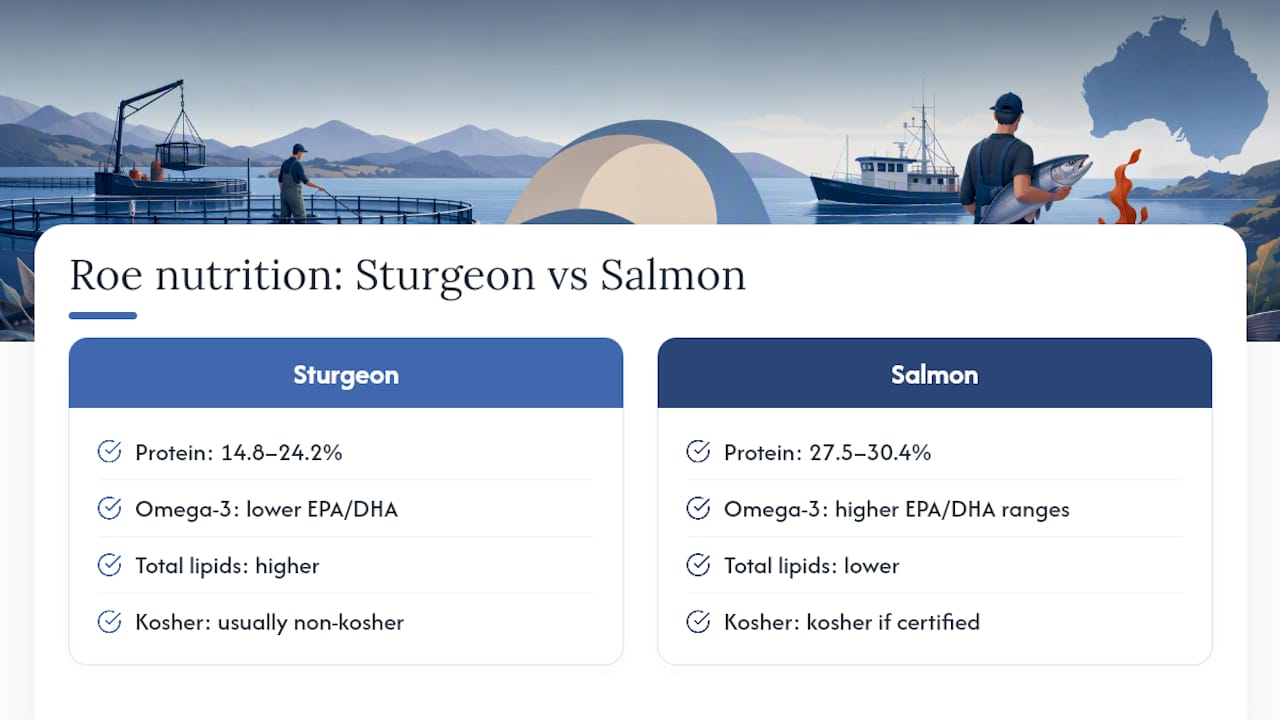
Kosher status is where the two categories split sharply. Kosher law requires fish to have fins and true scales, and sturgeon generally lack the latter, meaning sturgeon caviar is usually not considered kosher. Salmon and trout roe can be acceptable, but only when processed under proper kosher certification, so check the label rather than assume.
On safety, pasteurised caviar has a longer shelf life but a softer texture than fresh, unpasteurised product, and both need consistent refrigeration once opened.
Sourcing, sustainability, and what labels should tell you
Wild sturgeon populations have faced serious conservation pressure for decades, which is why farmed sturgeon now supplies the overwhelming majority of caviar sold globally. Farming has also made “no-kill” extraction methods more common, where roe is harvested without slaughtering the fish, though this remains a smaller share of production.
This is where traceability earns its keep. Every legitimate shipment of sturgeon caviar crossing international borders needs CITES documentation, and reputable producers stamp tins with a traceability code linking the product back to a licensed farm.
Watch for these warning signs on a label:
- Vague terms like “caviar style” or “caviar substitute” instead of a named species.
- No stated country of origin or farm source.
- Missing CITES code on anything claiming to be genuine sturgeon caviar.
- A price that looks implausibly low for the sturgeon variety claimed.
How to buy roe or caviar with confidence
A short checklist takes most of the guesswork out of a purchase, whatever your budget:
- Check the species name. Genuine caviar names the sturgeon (Baeri, Oscietre, Beluga); anything vaguer is roe wearing a costume.
- Look for “malossol” on sturgeon caviar, it signals a traditional low-salt cure rather than a heavy-handed one.
- Confirm country of origin and a CITES or traceability code for anything marketed as sturgeon caviar.
- Note pasteurised versus fresh on the label, this affects both shelf life and texture.
- Match price to expectation. Entry-level tins of farmed Baeri sit well below premium Oscietre or Beluga; a bargain sturgeon tin at rock-bottom pricing is a red flag, not a deal.
- Buy from a specialist retailer with clear sourcing information rather than an unlabelled online marketplace listing.
Why this distinction matters more than most guides admit
Most explainers stop at “caviar is expensive roe,” which flattens a far more interesting story. The real distinction is that caviar and common roe are built for different sensory experiences entirely, not competing on a single quality scale. A Beluga tin isn’t a fancier version of salmon roe; it’s a different category of eating, built around restraint, patience, and a fish that took two decades to give you that spoonful.
Where we’d push back on conventional wisdom: price is not a reliable proxy for enjoyment. Consumer taste testing has repeatedly found personal preference varies enormously, and the priciest tin on the table doesn’t always win. What matters more is sourcing integrity, curing skill, and matching the product to the occasion, a loud sushi night calls for tobiko’s crunch, not Oscietre’s quiet complexity.
Our sourcing philosophy at Aptent starts from that same premise: curation over hierarchy. We select Baeri and Oscietre lines for their consistency and traceability, not because they outrank every other roe on a price chart, but because they deliver exactly what genuine sturgeon caviar promises.
— APTENT
Where to find genuine caviar and how to taste it properly
Aptent gives you a direct line to authentic sturgeon caviar without wading through vague labelling or guessing at provenance. Our signature range includes Baeri in tasting-friendly 30g and 50g formats through to the full 250g Baeri tin for larger gatherings, alongside the richer, nuttier Oscietre for those wanting more complexity in the glass.

Every tin we carry comes with clear species labelling and traceable sourcing, the exact checks this article just walked you through, so you’re never left guessing what’s actually in the container. Beyond the caviar itself, our accessories collection covers the mother-of-pearl spoons and serving pieces that keep flavour intact, and our private tastings and events pair caviar selections with fine wine for anyone planning a celebration worth remembering. Start with a smaller format if you’re new to sturgeon caviar, or browse the full Aptent Gourmet range to compare tins side by side before you commit.
Sources
- Records of Agricultural and Food Chemistry — review comparing sturgeon and salmon roes
- America’s Test Kitchen — Caviar? Roe? What’s the difference?
- Food Republic — Caviar vs roe: differences and why caviar is more expensive
- Robb Report — What is caviar and where to source the best


