
Beluga vs Osetra: what actually sets these caviars apart
Beluga delivers the largest eggs and the silkiest, buttery finish of the great caviars, and its scarcity keeps prices at the top of the market. Osetra offers a firmer bite and a nuttier, more layered flavour that many chefs consider more versatile at the table. Provenance, curing method and grading still shift the outcome tin to tin, so the “better” choice depends on your palate and occasion as much as the species.
TL;DR:
- Larger tin sizes typically offer better value per gram, especially when comparing premium Beluga with more affordable Osetra options.
- The size and colour of caviar eggs reveal provenance, with Beluga eggs being larger and grey to black, and Osetra eggs ranging from gold to brown.
- Farmed caviar now predominates due to wild stock decline, with credible producers providing transparency on origin and farming practices.
- Serving caviar chilled between 2°C and 4°C on non-metallic utensils preserves its delicate texture and flavor, with specific pairings to enhance each variety.
- Nutritionally, both varieties provide high protein and unsaturated fats, but sodium levels can be significant and should be considered in larger tasting menus.
Table of Contents
- What is Beluga caviar?
- What is Osetra caviar?
- Beluga vs Osetra: flavour, texture and appearance compared
- Why does Beluga cost more than Osetra?
- Is farmed caviar sustainable, and does it matter for quality?
- How should you serve, pair and store each caviar?
- How do Beluga and Osetra compare nutritionally?
- Beyond the spoon: how chefs actually use Beluga and Osetra
- What does Aptent recommend for tasting, gifting and cooking?
- Ready to taste the difference for yourself?
- Sources
What is Beluga caviar?
Beluga comes from Huso huso, the great sturgeon of the Caspian and Black Sea basins, a fish with a notably long maturation period before producing roe. That patience is part of what makes Beluga rarer and pricier than almost any other caviar on the market, with much of today’s commercial supply now coming from carefully managed aquaculture rather than wild catch.
What you notice first is the size and colour of the pearls, followed by a texture that seems to dissolve before you’ve properly chewed it. Key hallmarks to look for:
- Eggs ranging from pale grey to near-black, often the largest of the classical varieties
- A buttery, almost creamy mouthfeel with minimal graininess
- A clean, mineral finish with faint brininess rather than aggressive salt
- Flavour shaped heavily by malossol curing, the low-salt method that preserves the roe’s natural character instead of masking it
Because genuine Beluga is scarce, documentation and sourcing history matter more here than with almost any other luxury food purchase.
What is Osetra caviar?
Osetra is harvested from Acipenser gueldenstaedtii, another Caspian native, but one that reaches maturity faster and adapts more readily to modern aquaculture. That biological head start is a large part of why Osetra sits in a more accessible price bracket while still delivering serious complexity.
The eggs are medium to large, and the colour range is where Osetra really distinguishes itself from Beluga’s tighter grey-to-black spectrum:
- Shades spanning pale gold through amber to deep brown, occasionally almost olive
- A firmer, more defined pop when the eggs meet the palate
- A nutty, layered flavour with buttery undertones and a savoury, almost mineral edge
- Premium “golden Osetra” lots, prized for their rare colouring and flavour depth
Grading and farming conditions influence all of this considerably. Two tins labelled Osetra from different producers can taste meaningfully different depending on water quality, feed and the age at harvest.
Beluga vs Osetra: flavour, texture and appearance compared
Set a spoon of each side by side and the differences announce themselves quickly. Beluga eggs are larger and softer, breaking down almost instantly into a buttery wash across the tongue. Osetra eggs hold their shape longer, giving a firmer, more textural “pop” before the nutty, layered flavour unfolds.
- Flavour: Beluga leans mild and creamy with subtle brine; Osetra brings a nuttier, more complex profile that some describe as verging on savoury-sweet.
- Texture and size: Beluga’s eggs are typically the largest of the three classical varieties and melt almost immediately; Osetra’s medium-to-large pearls offer more resistance and a longer finish.
- Colour and sheen: Beluga runs grey to black with a soft, matte lustre; Osetra spans gold to brown, and a glossy, uniform sheen across the pearls is a good sign of freshness and careful handling.
- Salt and curing: Both varieties rely on malossol processing, but even small variations in salt level change how creamy or firm the roe reads on the palate.
Tin date matters more than most buyers realise. Caviar continues to develop subtly even under refrigeration, and a Beluga or Osetra tin nearing the end of its recommended window can taste flatter and saltier than one opened fresh.
Pro Tip: Taste both varieties chilled but not ice-cold, straight off the back of your hand rather than a metal spoon. Metal can dull the delicate nutty notes in Osetra and flatten Beluga’s buttery finish before you’ve had a proper chance to judge it.
Why does Beluga cost more than Osetra?
Beluga’s price tag comes down to biology and history in roughly equal measure. Wild stocks were pushed to the brink by decades of overfishing, and the sturgeon’s long maturation period means farmed production can’t simply be scaled up overnight to meet demand. Osetra, by contrast, matures in roughly eight to twelve years, which lets aquaculture operations turn over stock more efficiently and keep supply comparatively steadier.
When you’re comparing tins side by side, a few practical cues help:
- Larger tin sizes generally offer better value per gram than small gift tins
- Grade notations (such as “Classic” or “Imperial” style labels) reflect egg size, colour uniformity and firmness
- Farmed provenance with clear certification is now the norm for both varieties, not a red flag
- Expect Osetra to sit in a noticeably more attainable price band than Beluga of comparable quality
Is farmed caviar sustainable, and does it matter for quality?
Wild Beluga and Osetra populations have faced sustained pressure from historic overfishing and habitat loss in the Caspian and Black Sea basins, which is why aquaculture has become the backbone of the legitimate trade rather than a compromise. Credible farms document water quality, feed and harvest age, and this transparency correlates closely with consistent flavour and texture.
What to look for before you buy:
- A named farm or region of origin, not just a species label
- Evidence of CITES compliance or equivalent trade documentation for wild-adjacent species
- Reputable retailers willing to answer provenance questions directly
For Australian buyers especially, farmed sourcing is effectively the standard route to genuine, safely handled Beluga and Osetra, and asking a seller about their supply chain is a completely reasonable, expected question.
How should you serve, pair and store each caviar?
Both varieties reward a careful hand at service, but for a deeper understanding of the sensory dining experience, the details differ slightly by variety. For a broader look at building a course around these flavours, see What Is a Culinary Experience? A Sensory Guide.
- Serve chilled, ideally between 2°C and 4°C, and never on a warm plate that will soften the eggs prematurely.
- Use mother-of-pearl, bone or glass spoons. Metal utensils react with the roe and dull its flavour, particularly Osetra’s nuttier notes.
- Pour small portions, around a teaspoon per taste, so the caviar stays cold and intact rather than warming in a large mound.
- Pair Beluga with a crisp, minerally champagne or well-chilled vodka to let its buttery softness stand alone as the star.
- Let Osetra sit alongside a slightly richer white Burgundy or a dry blini base. Its layered flavour holds up to more complexity on the plate.
- Keep unopened tins refrigerated and consume within the producer’s stated window; once opened, finish within 24 to 48 hours for the best result.
Pro Tip: If you’re building a tasting flight, serve Osetra before Beluga. Its firmer texture and nuttier profile prime the palate, so Beluga’s buttery finish lands as the more dramatic, memorable note. For a broader look at building a course around these flavours, Aptent’s caviar pairing guide walks through matching each variety to specific dishes and drinks.
How do Beluga and Osetra compare nutritionally?
Both caviars are dense, nutrient-rich foods, and the differences between them are more about eating habits than dramatic nutritional gaps. A standard 28-gram (roughly one-ounce) serving of either variety sits around 90 to 100 calories, with protein contributing the bulk of that energy at roughly 7 to 8 grams per serving thanks to the roe’s high natural protein content.
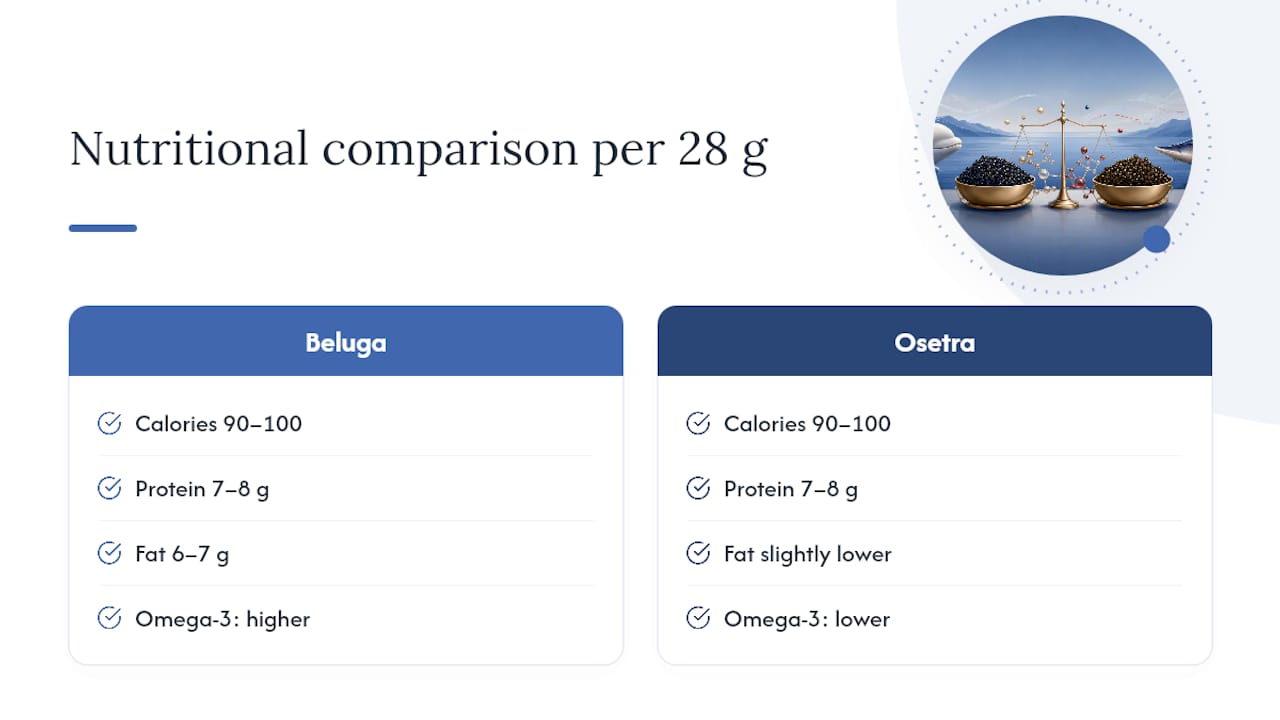
Fat content runs slightly higher in Beluga because of its larger, richer eggs, typically in the range of 6 to 7 grams per serving, mostly unsaturated fats including omega-3 fatty acids. Osetra sits marginally lower on fat given its firmer, less oil-rich pearls, though the gap is modest rather than dramatic. Both varieties are naturally low in carbohydrates, essentially negligible, which is part of why caviar has long featured in low-carb luxury dining.
Sodium is the figure worth watching for either variety, since the malossol curing process, while gentle compared to older heavy-salt methods, still leaves caviar meaningfully saltier than most other proteins gram for gram. A typical serving can carry several hundred milligrams of sodium, which matters if you’re serving caviar as part of a larger tasting menu with other salt-forward courses. Neither Beluga nor Osetra is a significant source of carbohydrates or sugar, and both offer trace amounts of vitamin B12, selenium and iron, nutrients naturally concentrated in fish roe.
Beyond the spoon: how chefs actually use Beluga and Osetra
Classic service, straight from the tin onto a blini or against the back of the hand, remains the benchmark for a reason. It’s the format that lets Beluga’s buttery melt and Osetra’s nutty complexity speak without distraction. But both varieties turn up well beyond that traditional presentation in contemporary kitchens.
Osetra’s firmer eggs and layered flavour hold their structure when folded gently into soft scrambled eggs, stirred through a chilled potato or cauliflower velouté just before serving, or used to top a raw preparation like oysters, tartare or crudo where its nutty note plays against clean, briny or citrus flavours. Its resilience under light heat and handling makes it the more forgiving variety for a chef building a composed dish rather than a single showcase bite.

Beluga tends to stay closer to its purest form. Because the eggs are larger and more delicate, aggressive mixing or heat will break them down and lose the very texture that makes Beluga special. Where you will see it used creatively is as a finishing garnish, a scattering across silky seafood dishes like a chilled lobster salad, or paired with something equally rich, like a soft-scrambled egg custard, where the two textures echo each other rather than compete. Both varieties also appear in modern tasting menus as a standalone course, served with nothing more than a spoon and good champagne, letting the caviar carry the entire moment.
What does Aptent recommend for tasting, gifting and cooking?
For pure, contemplative tasting, Beluga’s buttery softness makes the stronger impression. For gifting, its rarity carries genuine prestige. Chefs and hosts building a course, however, often get more mileage from Osetra’s layered complexity and versatility. Aptent’s ranking of caviar varieties is a useful next stop, and a smaller tasting selection is a sensible way to find your preference before committing to a larger tin.
— APTENT
Ready to taste the difference for yourself?
Aptent gives you a curated, provenance-checked route to both these caviars, without the guesswork of comparing unfamiliar sellers or unclear sourcing. Every tin in the collection, including the Oscietre Signature Caviar and the Baeri Signature Caviar, comes with a clear farming and quality story behind it, so you know exactly what’s in the tin before you commit.

If you’d rather taste before you buy in bulk, Aptent’s private tasting events pair Beluga-style and Osetra-style tins side by side with matched wines and expert guidance, ideal for a milestone celebration or a corporate gathering. Building your own service ritual at home first? The serving guide and a set of proper caviar accessories will get the presentation right from the first spoonful. Browse the current caviar and gourmet collection or book a tasting to find your preference between these two remarkable varieties.
Sources
- Beluga Caviar Vs Osetra: What’s The Difference?
- Osetra caviar: Taste, texture, price & expert guide
- So is Australian caviar good or what?


