
Home Drinkers: 3 Wine Opener Types for Young, Screwcap & Aged Corks
Most home drinkers only need one of three opener styles to handle nearly every bottle: a double-hinged waiter’s corkscrew for everyday control, a lever or “rabbit” for effortless speed, and an Ah-So two-prong puller for aged or fragile corks. The selection rule that matters more than any gadget: check the closure first, since screwcaps need no tool at all, then match the opener to the cork’s condition and your own grip strength.
TL;DR:
- A double-hinged waiter’s corkscrew is best for most bottles, especially older ones, due to its controlled two-stage lifting mechanism.
- Lever-style “rabbit” openers and electric models require less physical effort, making them ideal for limited hand strength or frequent use.
- The Ah-So two-prong puller is the safest choice for crumbly or fragile corks, as it lifts corks without piercing or tearing.
- Screwcaps do not need openers and should be prioritized when opening bottles sealed with metal closures.
- Proper technique, matched to the cork’s age and condition, is more important than the tool itself for successfully opening wine.
Table of Contents
- Wine opener types explained: which one suits which bottle
- Which wine opener is easiest, and which suits which bottle
- How to open a bottle properly, step by step
- Buying and caring for a wine opener that lasts
- What years of curating fine bottles teaches you about openers
- Why the gadget-heavy approach to wine openers misses the point
- Where to find the right opener and the right occasion to use it
- Sources
- FAQ
Wine opener types explained: which one suits which bottle
Understanding wine opener types starts with recognising that each design solves a different problem. Some prioritise raw force, some prioritise finesse, and a few exist purely for spectacle behind a bar.
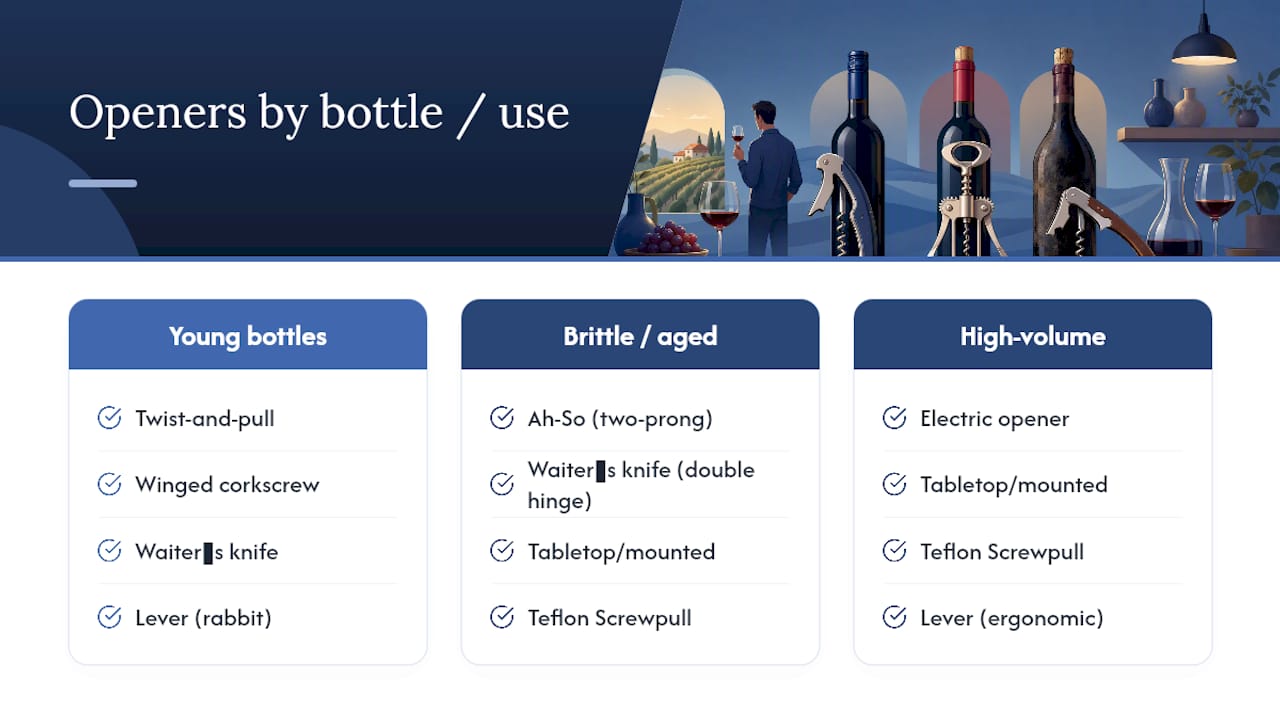
The waiter’s corkscrew (also called a sommelier knife) remains the professional standard. It folds a worm, a small blade for foil, and a hinged lever into one pocket-sized tool. Sommeliers favour it because the double-hinge lets you lift the cork in two controlled stages rather than one abrupt yank, which matters enormously on an older bottle where the cork has softened. Wirecutter’s testing consistently ranks a double-hinged waiter’s knife as the best all-round tool for most households, prizing its blend of portability, cost and control.
The winged corkscrew, with its two side levers that rise as the worm descends, is the one gathering dust in most kitchen drawers. It’s simple to grasp and cheap to buy, but the mechanism puts uneven lateral pressure on the cork, and it’s notably prone to snapping older, drier corks in half.
Lever-style openers, often branded as “rabbit” corkscrews, clamp onto the neck and extract the cork with a single squeeze-and-lift motion. They’re the most ergonomic option going, since they demand far less twisting force than a manual key, which is exactly why they suit anyone with limited hand strength. Their weakness shows up on brittle, crumbling corks, where the speed of extraction can shatter what a slower tool would have lifted whole.
Electric openers take the lever concept further, driving the worm in and the cork out at the push of a button. They’re genuinely convenient for anyone opening several bottles at an event, but they need charging or fresh batteries, and they share the rabbit’s blind spot: they don’t sense resistance, so an aged cork can crumble before the motor even registers a problem.
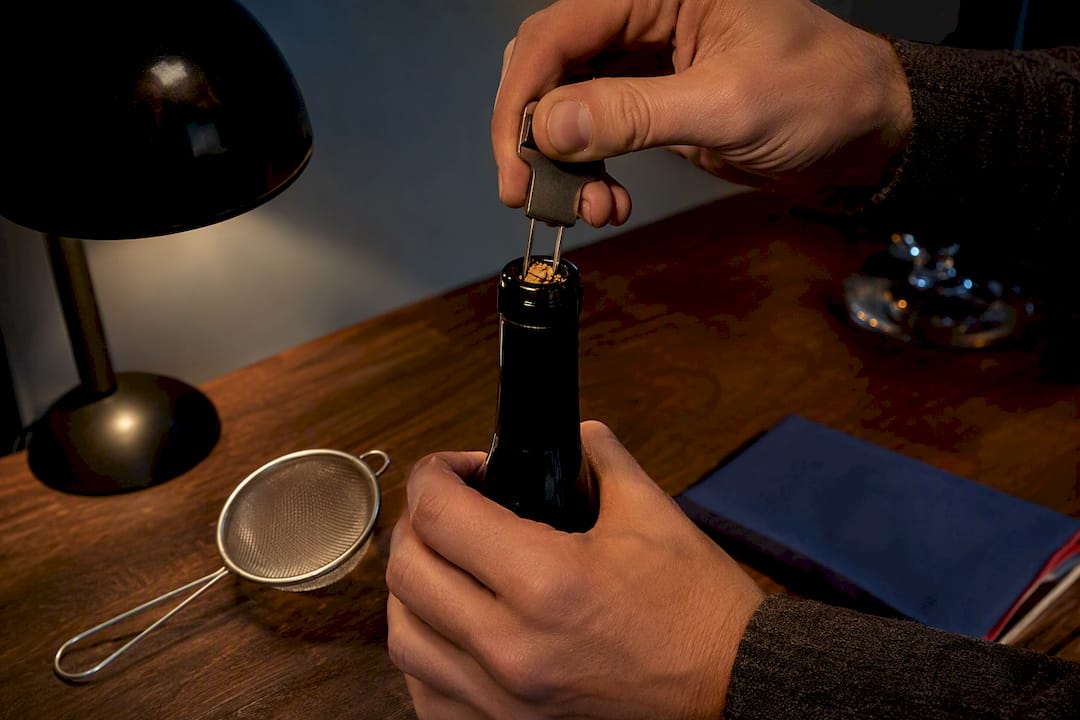
The Ah-So, or two-prong puller, looks unlike anything else in the drawer, and that’s precisely why it belongs there. Instead of piercing the cork, its two flat prongs slide down either side of it. Worked correctly, using the “walk-in” technique of rocking the prongs alternately deeper, it lifts crumbly corks intact when every other tool would have torn them apart.
An air pressure pump, which injects gas through a thin needle pushed into the cork, forces the cork out from below. It works, but there’s a real risk of over-pressurising an older or already-cracked bottle, occasionally cracking glass or letting the seal fail entirely, so it’s a tool for confident hands rather than a default choice.
Tabletop and mounted systems, along with Teflon-coated Screwpull-style corkscrews, appeal to collectors and high-volume service settings. The reduced friction of a coated spiral pulls corks with minimal force, extracting them whole rather than leaving fragments behind. A basic twist-and-pull corkscrew, meanwhile, is perfectly fine for young, fresh corks straight from the shop, and novelty openers are exactly that: novelty.
Pro Tip: Keep at least one Ah-So in the house even if you never plan to collect wine. The day you finally open that dusty bottle gifted three Christmases ago, it’ll be the only tool that gets the cork out in one piece.
Which wine opener is easiest, and which suits which bottle
The honest answer depends on two things: your grip strength and the age of the cork in front of you.
- Limited hand strength or mobility concerns: a lever or rabbit, or electric opener wins outright, since both remove almost all twisting effort.
- Maximum control on a delicate or older cork: the waiter’s corkscrew, worked in two slow stages, gives you tactile feedback a lever simply can’t.
- A cork that’s already crumbling: reach for the Ah-So before anything else; avoid the rabbit here, as its speed and grip pressure are exactly wrong for brittle cork.
- A screwcap bottle: skip the corkscrew conversation altogether, since screwcaps need no opener at all.
- Travelling or attending events: portability favours the compact waiter’s knife over any bulky lever mechanism.
The trade-off worth remembering: speed and portability sit at one end of the spectrum, gentle handling sits at the other, and almost no single tool excels at both.
How to open a bottle properly, step by step
Using a waiter’s corkscrew:
- Cut the foil cleanly below the lip using the built-in blade.
- Centre the worm on the cork and turn until one coil remains visible.
- Rest the first notch of the lever on the bottle rim and lift halfway.
- Reposition the lever on the second notch and lift the rest of the way, slowly.
Using an Ah-So on an aged cork:
- Insert the longer prong first, pressed against the bottle neck.
- Work the shorter prong in on the opposite side, then rock both prongs alternately, “walking” them down the neck until fully seated, following the technique documented for two-prong pullers.
- Twist gently while pulling upward, never yanking straight up.
Lever and electric openers are safe used exactly as designed, but stop immediately if you feel unusual resistance. That resistance is the cork telling you it’s about to fail, and pushing through it is how corks break inside the neck.
If a cork does break, the Ah-So can sometimes still extract the remaining piece. Failing that, a sanitised utensil can push the fragment through into the bottle as a last resort, though decanting through a fine sieve or coffee filter afterwards removes floating particles before serving. Roughly one in every handful of older bottles will test your patience this way, which is exactly why collectors keep an Ah-So on hand rather than relying solely on a waiter’s knife.
Buying and caring for a wine opener that lasts
Build quality shows up first in the worm: a longer, Teflon-coated spiral (the Screwpull-style approach) grips more cork surface and pulls with less friction than a short, uncoated one. A built-in foil cutter is a genuine convenience, saving you from hunting for a separate blade every time.
Price bands tell you what you’re buying more than any marketing copy does. Budget waiter’s knives under $20 work fine for occasional use but wear out their hinge within a year or two of regular service. Mid-range and professional-grade tools, often $40 and up, use replaceable worms and hardened steel, which matters if you’re opening bottles weekly rather than at Christmas.
- Wipe the worm dry after each use to prevent corrosion.
- Store folding models closed, away from cutlery drawers where the hinge takes constant knocks.
- Replace the worm the moment it feels blunt rather than waiting for it to fail mid-cork.
Pro Tip: If you’re hosting regularly, keep a spare opener in a drawer specifically for events. A jammed or broken corkscrew mid-dinner is the one hospitality failure nobody plans for.
What years of curating fine bottles teaches you about openers
Experience sourcing rare French wines and running private tastings involves handling everything from screwcap-sealed young vintages to decades-old corked bottles, and the tool that matters changes with the bottle in front of you. Closure choice isn’t cosmetic. Readers cellaring anything long-term should read Aptent’s guide to storing fine wine correctly, since how a bottle is stored dictates exactly how fragile its cork will be by the time you reach for an opener.
Why the gadget-heavy approach to wine openers misses the point
Most buying guides rank openers purely on convenience, pushing lever and electric models as the universal answer. That advice serves people opening young, fresh bottles at dinner parties, and not much else.
It falls apart the moment a genuinely old bottle enters the picture. A rabbit corkscrew’s speed, the very thing that makes it appealing, is a liability against a cork that’s spent fifteen years softening in a cellar. The AWRI’s research on closure performance confirms natural cork ages with far more variability than screwcaps, which means the “best” opener genuinely depends on what’s sealing the bottle, not on which tool looks most impressive on a countertop.
Our judgement, drawn from serving wine across countless private events: prioritise technique over hardware. A double-hinged waiter’s knife, used correctly, handles the vast majority of bottles a home drinker will ever face. Learn the Ah-So for the rare aged bottle, and treat every other opener as a convenience layer on top of that foundation, not a replacement for it.
— APTENT
Where to find the right opener and the right occasion to use it
Once you know which opener a bottle calls for, the next question is usually where to source good tools, and good wine, to go with them. A curated range of gourmet accessories suited to exactly the techniques covered above, from waiter’s knives to two-prong pullers, can be found alongside curated wine and champagne collections that make the choice of opener actually matter.

For anyone hosting rather than simply opening a bottle at home, a Gourmet Events service can bring professional wine service, correct handling of aged bottles, and the right tool for every closure directly to your gathering, so nobody’s fumbling with a lever opener on a cork that needed an Ah-So. Corporate hosts organising client gifts can also look at corporate and VIP gifting options, pairing fine bottles with the accessories to open them properly. Browse the accessories collection or enquire about a Gourmet Event to have the right opener, and the right bottle, sorted before your next occasion.
Sources
For deeper technical detail, the AWRI’s technical review of closure performance covers cork versus screwcap ageing data, Wikipedia’s corkscrew entry documents opener history and technique, and Wirecutter’s corkscrew testing offers independent, hands-on comparisons.
- Australian Wine Research Institute technical review (October 2020)
- Corkscrew — Wikipedia
- Wirecutter — the best corkscrew (NYTimes)
FAQ
What are the different types of wine openers?
The main types are the waiter’s/sommelier corkscrew, winged corkscrews, lever (rabbit) openers, electric openers, Ah-So two-prong pullers, air pressure pumps, and mounted or Screwpull-style systems, each suited to different corks and situations.
What is the easiest wine opener to use?
Lever-style rabbit openers and electric openers require the least physical effort, since they replace manual twisting with a squeeze or a button press.
What corkscrew is easiest for seniors to use?
A lever/rabbit corkscrew is generally the easiest option for seniors or anyone with limited grip strength, because it needs far less twisting force than a traditional manual key.
What is the fancy wine opener called?
The double-hinged sommelier knife, commonly called a waiter’s corkscrew, is the tool most professionals and sommeliers reach for, valued for its portability and precise, two-step control over the cork.


