
Serve Caviar Profitably: 3 g Bumps or 28 g Tastings for Chefs
The simplest way to start adding caviar to a menu is a small, chilled spoonful used as a finishing garnish, never a cooked ingredient, applied at the last possible moment with a non-reactive utensil. This one move preserves the roe’s texture and briny character while keeping costs contained. What follows covers serving protocol, pairings, dish ideas, portioning economics, and sourcing, with Baeri and Oscietre signature caviars offered as a reliable starting point for kitchens ready to commit.
TL;DR:
- Use small amounts, usually 3 to 10 grams, for appetizers and garnishes to maintain quality without excessive costs.
- Serve caviar on cold, non-reactive surfaces, and handle only with mother-of-pearl, horn, bone, or gold utensils to preserve its delicate flavor.
- Pair caviar with neutral, slightly fatty bases like blinis, brioche, or boiled potatoes, and avoid overpowering garnishes to frame its taste.
- Offer a limited variety of drink pairings, such as dry sparkling wine or chilled vodka, avoiding aromatic or oaked wines that clash with the roe.
- Source farmed caviar varieties like Baeri and Oscietre in small, traceable portions, and store unopened tins properly to ensure freshness and quality.
Table of Contents
- Golden rules for serving caviar
- What pairs well with caviar on a menu?
- Menu and dish ideas that actually work
- How much caviar per portion, and what does it cost?
- Sourcing and storing caviar before service
- How Aptent supports kitchens adding caviar to the menu
- Caviar’s move from rare indulgence to everyday luxury
- Order caviar or book an event with Aptent
- Sources
Golden rules for serving caviar
Caviar rewards restraint far more than technique. It should arrive at the table just above freezing, cradled in crushed ice rather than buried in it, and returned to that ice between spoonfuls so the roe never sits at room temperature long enough to soften or oxidise. Professional serving guidance consistently points to chilled service and careful handling as the difference between a dish that sings and one that turns oily.
Reactive metals are the enemy here. Silver and most stainless utensils can lend the roe a faint metallic edge, so mother-of-pearl, horn, bone or gold-plated spoons remain the standard in serious kitchens.
- Serve straight from crushed ice, tin cradled rather than submerged
- Use mother-of-pearl, horn, bone or gold-plated spoons only
- Add caviar after cooking, as the final gesture on the plate
- Open tins as close to service as the kitchen’s workflow allows
Pro Tip: Open the tin table-side or immediately before plating. Air exposure and warmth are what age caviar fastest, not time in the fridge.
Classic tasting-room service and modern à la minute plating agree on one point: caviar is never simmered, baked or folded into a hot component. It finishes the dish, added after cooking once everything else has cooled slightly, so the beads stay distinct rather than collapsing into the sauce.
What pairs well with caviar on a menu?
Caviar performs best against neutral, slightly fatty or starchy bases that cushion the pop of each bead without competing for attention. Blinis remain the reference point, their buckwheat tang and soft crumb doing exactly what caviar needs. Toast, ideally a rich brioche or a plain sourdough, offers crunch and a blank canvas. Warm potato, whether a blini alternative or a simple boiled chat potato, brings a starchy backdrop that Russian and French service have relied on for generations.
- Blinis: the classic base, best warm and slightly buttery
- Brioche toast: richer, works well for canapés at events
- Boiled or roasted potato: earthy, lets salinity carry through
- Crème fraîche: the only dairy garnish that consistently works, used sparingly
Garnishes should stay minimal. A little sieved egg white and yolk, finely chopped chives, and a small dab of crème fraîche round the dish out. Anything beyond that starts masking the roe rather than framing it, and framing is the entire job of a good accompaniment.
Drinks follow the same logic of restraint. Dry sparkling wine, particularly a brut Champagne with low dosage, and clean, well-chilled vodka are the two pairings that never fight the caviar’s salinity. Aromatic or oaked wines tend to clash, pulling flavour away from the roe rather than supporting it. Aptent’s own guide to pairing caviar with Champagne breaks down which styles hold up and which overwhelm the dish, and the broader logic of building a caviar pairing menu is worth reviewing before finalising any tasting sequence.
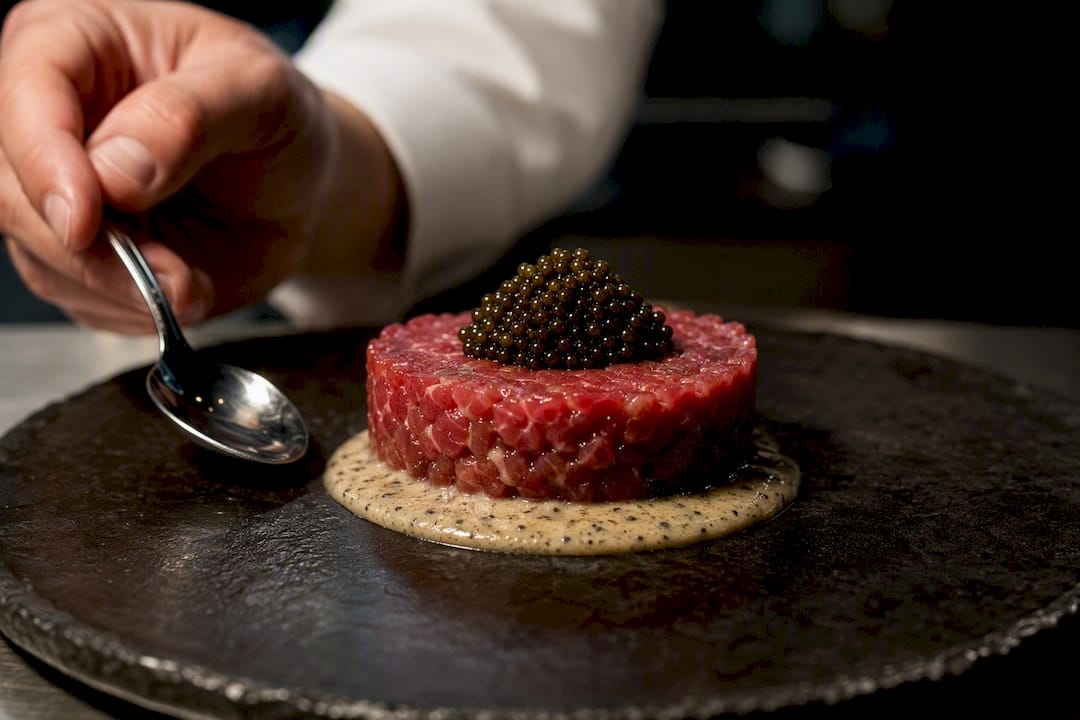
Stronger flavours such as truffle or wagyu can share a plate with caviar, but only in small doses and only when one element clearly leads. A truffle emulsion under a wagyu tartare with a caviar bump on top works because each layer has a defined role. Two dominant luxury ingredients competing for the same bite usually cancel each other out.
Menu and dish ideas that actually work
Caviar earns its place on a menu when the format matches the occasion, whether that’s a seated tasting menu or a standing canapé service.
- Classic blini stack — warm blini, crème fraîche, 5 g of caviar, single chive. The benchmark canapé for any cocktail event.
- Devilled egg with caviar — halved egg, piped yolk filling, 3 g caviar bump on top. Reliable, portable, and instantly upscale.
- Potato canapé — boiled chat potato, crème fraîche, 3 to 5 g caviar. Cheaper base than brioche, works at scale for larger guest counts.
- Caviar bump on tartare — 3 g caviar spooned directly onto a beef or tuna tartare just before service. A minimal-effort lift that photographs well.
- Chawan mushi with caviar — savoury egg custard finished with a small spoonful, ideal for a tasting-menu course that wants a luxury signal without heaviness.
- Caviar and fried chicken — a small piece of crisp fried chicken topped with 3 to 5 g of caviar and a touch of hot honey. The salt-fat-brine combination is why these high-low pairings keep going viral, though it only works when the fried element is genuinely excellent on its own.
- Caviar and vanilla ice cream — a tiny quenelle finished tableside with 2 to 3 g of caviar. Playful, but success depends on real contrast between sweet and salty rather than novelty alone.
Playful applications such as popcorn or fried chicken can lift a menu’s social profile, but that kind of pairing lives or dies on genuine balance between texture, salt and sweetness rather than shock value.
How much caviar per portion, and what does it cost?
Portioning is where caviar either becomes a profitable menu line or a margin problem. A small bump is the smallest workable service, enough to register as a genuine caviar moment on a canapé or tartare without meaningful cost exposure. A moderate garnish suits a plated course where the roe needs to read clearly against a base like blini or potato. A full by-the-ounce service, sold as a standalone tasting portion with blinis and garnishes, belongs on tasting menus or premium supplements rather than everyday specials.
- 3 g: canapés, bumps, tartare finishes
- 5 to 10 g: plated starters and tasting-menu courses
- 28 g: by-the-ounce tableside service or shareable tastings
Small, affordable portions let kitchens introduce caviar at a lower price point while still commanding a premium supplement, often two to three times the raw ingredient cost once garnish and labour are factored in. Pre-portioning tins into weighed pots during prep, rather than spooning to order under pressure, keeps plating consistent and cuts waste from over-serving during a busy service.
Sourcing and storing caviar before service
Farmed sturgeon roe, particularly Baeri and Oscietre varieties, has made consistent, traceable supply achievable for kitchens that could never have accessed wild caviar. Broader availability of farmed caviar has been the single biggest factor in bringing prices down enough for creative, everyday menu use. Freshwater alternatives sit at a lower price point again, useful for high-volume canapé service where the roe is one element among many.
- Unopened tins keep well under standard chilled storage, well below normal fridge temperature
- Once opened, consume within 24 to 48 hours for peak texture and aroma
- Check delivery boxes for consistent chill on arrival, and reject any tin that has warmed in transit
- Keep a rolling inventory so older tins are used first, rather than left to sit
Reviewing the right service vessels and spoons before an event avoids last-minute scrambling for non-reactive presentation pieces.
How Aptent supports kitchens adding caviar to the menu
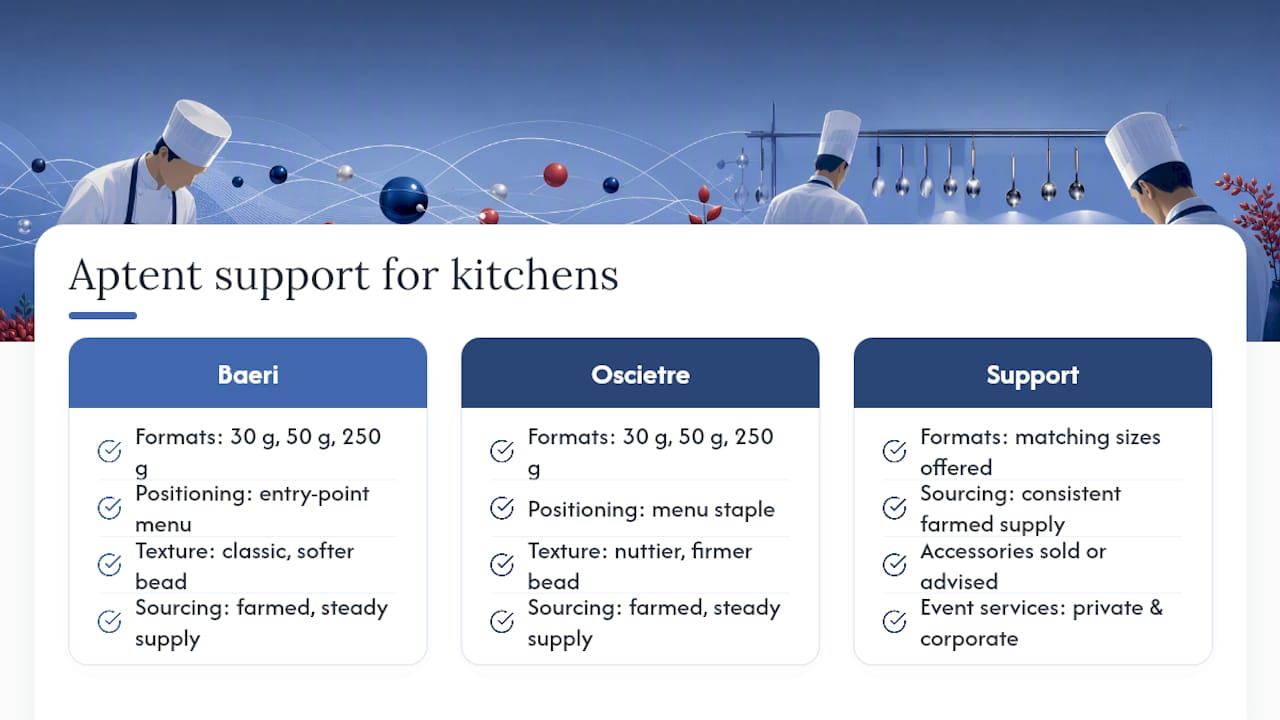
Aptent’s range gives chefs a straightforward entry point: Baeri Signature Caviar in 30 g, 50 g and 250 g formats, alongside Oscietre Signature Caviar in matching sizes for kitchens wanting a nuttier, firmer bead. Both lines carry the sourcing consistency that farmed varieties now allow, without the supply gaps that once made caviar a special-occasion risk rather than a standing menu item.
Beyond the tins, accessories like mother-of-pearl spoons, service vessels, and ice presentation pieces turn a good caviar plate into a properly staged one. For chefs planning something bigger, event services pair caviar and wine for private tastings, corporate functions and launches, with tasting guidance included. A sample order or a short consultation is the easiest way to test a product line before committing it to a permanent menu position.
Caviar’s move from rare indulgence to everyday luxury
Caviar’s spread across casual and fine-dining menus alike isn’t a fad so much as a correction. Farmed sturgeon made supply predictable, small-portion service made cost manageable, and social media rewarded the visual drama of a caviar bump landing on an otherwise humble dish. None of that required the roe to lose its status. It just widened who gets to use it.
The risk sits with chefs who reach for caviar as decoration rather than flavour. A bump on fried chicken or a quenelle of ice cream only works when the base dish already earns its place on the menu, and that’s the same discipline covered in broader coverage of luxury event trends, where curated ingredients succeed by supporting an occasion rather than substituting for one. Our recommendation stays simple: let the roe lead the flavour, keep the supporting cast small, and resist the urge to pile it on everything just because the menu can now afford to.
Order caviar or book an event with Aptent
Aptent turns caviar from a daunting supply problem into a straightforward line item. Start small with the 30 g Baeri Signature Caviar for trialling new dishes, move to the 50 g size once a canapé or tartare finish earns its spot on the regular menu, and order the 250 g Oscietre Signature Caviar for events and tasting nights that need volume without a compromise on quality.

Pair any order with gourmet accessories, non-reactive spoons and proper service vessels, so presentation matches what’s in the tin. For larger functions, Aptent’s gourmet events service handles sourcing, staging and tasting guidance directly, which spares a kitchen the trial-and-error of building caviar service from scratch. Browse the full range at APTENT. Gourmet and request a sample tin or event consultation before your next menu update.
Sources
For deeper technical grounding, CaviarGuide’s serving guide covers temperature and handling in more depth than any menu article can. Forbes’ coverage of high-low pairings explains the social dynamics behind the caviar-bump trend, while Nation’s Restaurant News tracks the pricing shift that made this all possible.
- How to serve caviar: expert techniques & pairings
- The caviar craze shows why high-low food combinations are so appealing
- Caviar becomes a more affordable luxury on restaurant menus
- Caviar Dubai viral fine dining coverage


