
4 Sabrage Saber Types and Which One Suits Australian Events
A champagne saber is a blunt-spined blade purpose-built for sabrage, the ceremonial technique of striking a bottle’s neck so pressure ejects the collar and cork in one clean sweep. The main types you’ll encounter are ceremonial sabres, sommelier or sciabola styles, short travel blades, and decorative collector pieces, each suited to a different setting. Sabrage carries genuine risk, so choosing the right sabre and following safe technique matters more than showmanship.
TL;DR:
- Shorter sabres, around 25 to 30 centimeters, are better suited for beginners due to their ease of control and lower risk of mishandling.
- Forged stainless steel sabres resist tarnishing and corrosion better than stamped steel, making them more durable for frequent use.
- The blade’s weight distribution towards the handle enhances control and reduces overshooting during the strike.
- Traditional-method sparkling wines like Champagne and Crémant, with higher pressure and thicker glass, offer cleaner, more predictable sabrage outcomes.
- Proper storage, gentle cleaning, and choosing a high-quality, properly balanced sabre significantly improve the safety and ceremonial impact of the ritual.
Table of Contents
- Sabrage saber types: ceremonial, sommelier, travel and collector styles
- What to look for when buying a champagne saber
- How does saber design change the sabrage technique?
- Sabrage safety essentials and risk mitigation
- Which sparkling wines work best for sabrage?
- Caring for and storing your champagne saber
- Why a proper sabre elevates the ceremony
- Buying champagne, sabres and event services through Aptent
- Sources
Sabrage saber types: ceremonial, sommelier, travel and collector styles
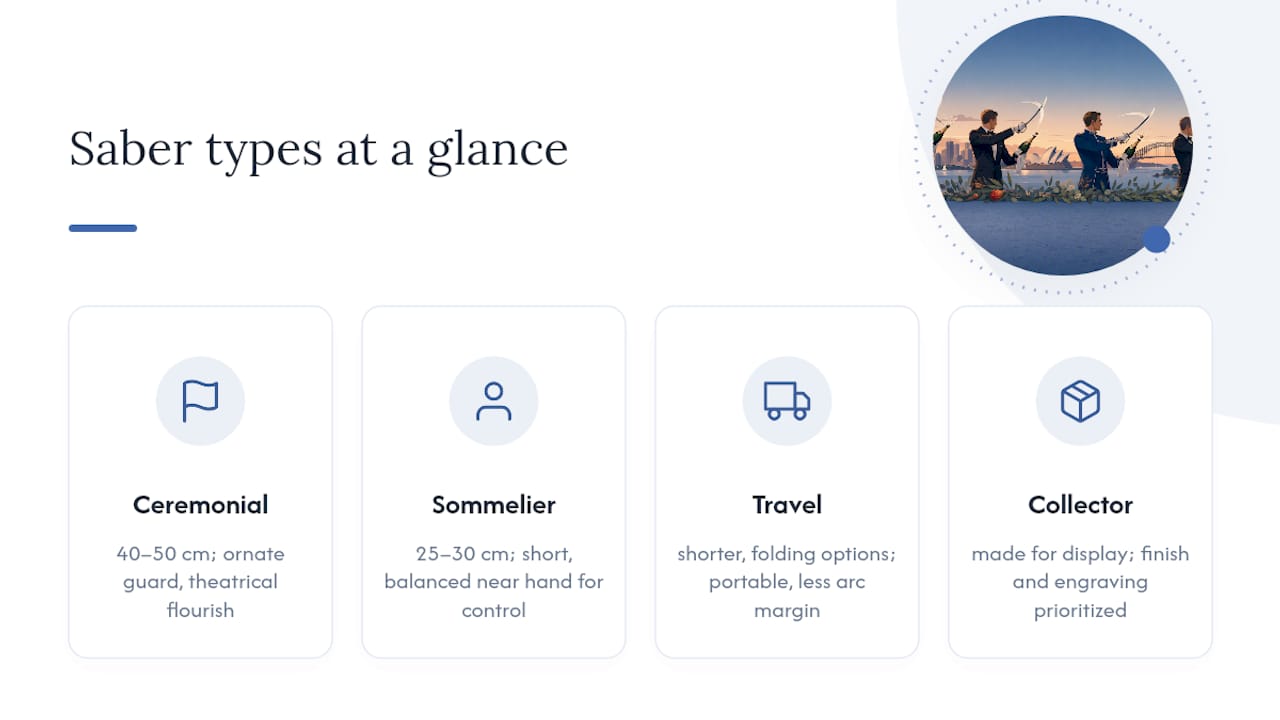
Walk into any specialist cutlery house and you’ll find the same four families of sabre, each shaped by a different job.
Ceremonial sabres run long, often 40 to 50 centimetres, with an ornate guard and a substantial pommel built for theatre. They’re the choice for weddings, product launches, and any moment where the reveal matters as much as the pour. The extra length gives a wider arc and more visible flourish, but it demands more room and more confidence from the person wielding it.
Sommelier or sciabola styles trade drama for precision. Shorter and lighter, typically 25 to 30 centimetres, these are the working tools of hospitality staff who need to open several bottles a night without ceremony fatigue setting in. Balance sits closer to the hand, giving tighter control over the strike.
Short and travel sabres compress further still, sometimes folding or shipping with a hard case. Portability comes at a cost: a shorter blade means a shorter arc and less margin for error, so these suit the practised hand more than the first attempt.
Decorative and collector sabres are built to be displayed, not swung. Finish, engraving, and mounting take priority over functional balance, and many owners never use them for an actual strike.
Construction matters as much as category. Artisanal forged steel holds an edge profile and resists corrosion better over decades, while stamped stainless sabres are lighter on the wallet and perfectly serviceable for occasional use. Neither needs to be sharp: the blunt spine does the work, not a cutting edge.
What to look for when buying a champagne saber
Blade length is the first decision, and it should match your experience rather than your ambition. A shorter blade, often around 25 to 30 centimetres, gives beginners more control and a lower risk of a fumbled strike, while longer ceremonial blades reward practice.
Material comes next. Forged stainless resists tarnishing and pitting far better than cheaply stamped steel, particularly if the sabre lives near a bar or humid kitchen rather than a display case.
A few checks separate a genuine tool from a novelty:
- Blunt spine, not a sharpened edge — sabrage relies on impact, and a sharp blade adds risk without adding effectiveness.
- A guard sized to your hand — it should stop your grip sliding forward on the strike.
- Balance weighted toward the handle — this gives control rather than momentum you can’t arrest.
- Origin markers worth trusting — established cutlery regions such as Maniago in Italy, Laguiole in France, and select German workshops are often reliable signals of steel quality and finish.
Prices span from budget stamped sets through to artisanal forged pieces that sit closer to fine cutlery than kitchenware. A dedicated sabre also preserves the ceremonial character of the ritual in a way a kitchen knife or spoon back never quite manages.
Pro Tip: If you’re buying your first sabre, choose the shortest blade that still feels substantial in the hand. You can graduate to a longer ceremonial piece once the motion feels automatic.
How does saber design change the sabrage technique?
Blade length dictates the arc you need to generate enough speed at impact, which is why longer ceremonial sabres ask for a bigger, more confident swing than a compact sommelier blade. Weight distribution matters just as much: a sabre balanced toward the handle lets you control the strike rather than simply following the blade’s momentum, which reduces the chance of overshooting the target.
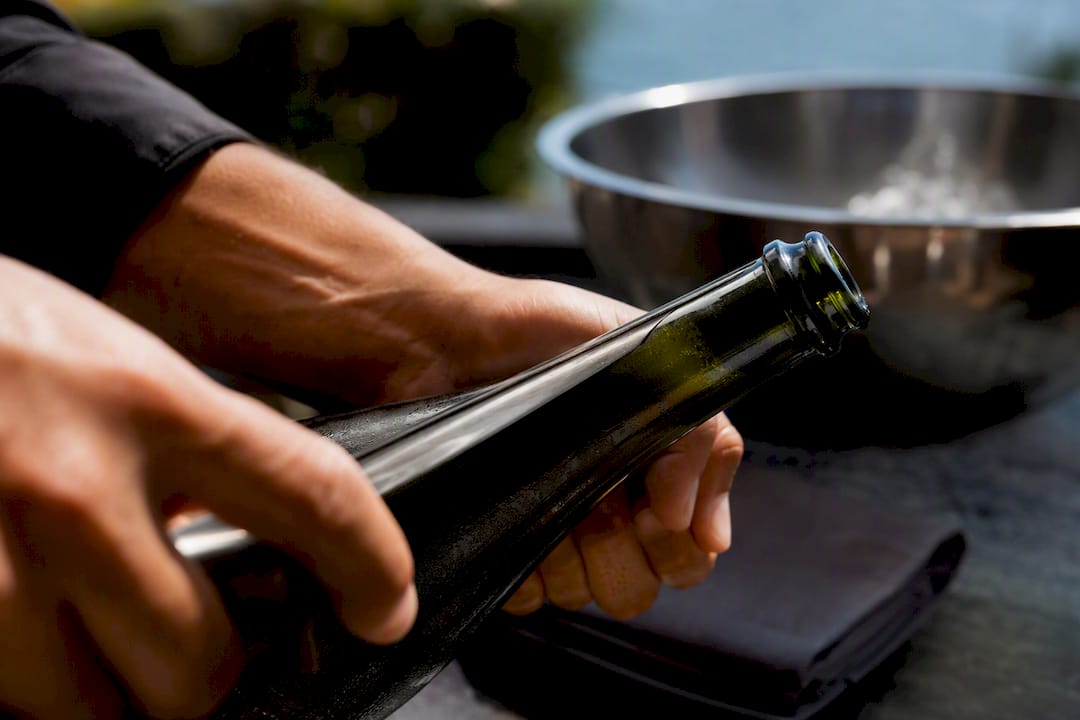
The guard shapes your grip, and a well-fitted one stops your hand sliding forward mid strike. Technically, success comes down to the bottle seam, the raised line running up the glass, which acts as a track guiding the blade to the lip. A slightly convex, stiff spine engages that seam more consistently, producing a cleaner break than a flexible or poorly shaped blade. Chill the bottle well beforehand, angle it away from anyone watching, and let the sabre travel along the seam rather than swinging at the neck itself.
Sabrage safety essentials and risk mitigation
The hazards are real: flying cork and glass, a bottle tip that catches someone standing too close, and occasionally an over-pressurised bottle that behaves unpredictably. Retailers and practitioners are consistent on this point, recommending caution and supervision for anyone new to the technique.
Before you strike, run through this list every time:
- Clear the strike zone and point the bottle away from people, glass, and anything breakable.
- Chill the bottle properly. Colder wine is calmer and more predictable.
- Slide the blade along the seam rather than hacking at the neck.
- Let a small flow of wine run out after the strike, then check the first glass poured for glass shards before anyone drinks it.
Skip sabrage on any bottle that’s damaged, has been dropped, or shows a chip or crack near the neck. Low-pressure tank-method wines are a poor candidate too, for reasons the next section covers. If you’ve never tried it before, practise on inexpensive bottles under supervision rather than opening a prized vintage as your first attempt.
Which sparkling wines work best for sabrage?
Traditional-method wines, meaning Champagne, Cava, Crémant, Franciacorta, and Cap Classique, generally carry higher internal pressure and thicker glass, which gives sabrage a cleaner, more predictable outcome. Charmat-method wines, including most Proseccos, tend to sit at lower pressure with thinner glass, which makes the break less consistent and the risk higher.
Chill any bottle thoroughly before attempting sabrage, and lean toward traditional-method wine whenever you have the choice. If you’re building an event around the ritual, a bottle like those in Aptent’s Champagne selection suits the technique far better than a delicate tank-method sparkling. It’s worth rehearsing on a cheaper bottle before you commit to the one you’re actually serving.
Caring for and storing your champagne saber
Wipe the blade dry immediately after use. Wine residue left on steel, even stainless, accelerates corrosion over time. Avoid abrasive cleaners or dishwasher cycles; a soft cloth and mild soap are enough.
Store the sabre somewhere dry, ideally in a sheath or display case away from humidity, and check periodically for pitting near the spine. If the blade develops rust spots or the guard loosens, a craftsman specialising in bladed cutlery can usually restore it rather than needing a replacement.
Why a proper sabre elevates the ceremony
Sabrage can be seen as theatre with substance behind it, not just a party trick. A well-made sabre, matched to the right bottle, turns a simple pour into a moment guests remember, which is exactly the kind of detail that separates a curated luxury event from an ordinary one.
— APTENT
Buying champagne, sabres and event services through Aptent
Choosing a specialist retailer can provide a more relaxed route to a flawless sabrage moment, whether that means choosing the right bottle or leaving the whole ritual to professionals. If you’d rather not gamble a special bottle on a first attempt, expert teams can handle the pour as part of fully managed tastings, sourcing traditional-method Champagne with the pressure and glass strength sabrage actually needs.

Buy the sabre and practise at home if you want the skill for yourself, but book a professional if the occasion is one you can’t afford to get wrong. Browse Aptent’s Champagne and caviar collection for bottles suited to the ritual, or look into our Gourmet Events service if you’d rather have a specialist handle the sabrage at your next gathering. Either way, the next step is simple: pick your bottle, or pick your date, and let us take care of the rest.
Sources
For a fuller technical and historical grounding, the Wikipedia entry on sabrage covers its origins and mechanics well. For wine suitability and pressure differences, see Wine with Seth’s explainer, and for regional sparkling wine context, Lost and Found Brighton’s guide to Sussex sparkling wine is worth a look.
- Sabrage — Wikipedia
- Sabrage: opening champagne with a sword blade — Wine with Seth
- Do you actually need a Champagne saber? — InsideHook
- What is a Champagne Saber? — Sonoma Champagne Sabres


