
Examples of rare spirit pairings for luxury events
The most compelling examples of rare spirit pairings for luxury events include: smoky mezcal with high-charred wagyu skewers; tea-infused gin with delicate Tasmanian scallops; a vodka martini alongside an upscale taco (a pairing championed by mixologist Agostino Perrone); ex-sherry bourbon with aged dark chocolate; PX-finished rum with a cigar-style dessert; a nitro stout cocktail with freshly shucked oysters; tea-proofed rye whiskey with an umami savoury course; and barrel-finished gin with Baeri Signature Caviar from Aptent. Each pairing succeeds because weight, texture, and aromatic compounds align rather than compete — a principle Iain McPherson has articulated in recontextualising unexpected ingredients for refined settings.
- Mezcal + charred wagyu skewer. Smoke echoes smoke; the spirit’s agave sweetness lifts the meat’s char. Serve in a wide-mouthed rocks glass, one small pour per skewer portion.
- Tea-infused gin + Tasmanian scallop. Floral, vegetal notes bridge the brine. Chilled coupe, 30 ml, scallop served on a half-shell.
- Vodka martini + upscale taco. Acidity and clean spirit cut through fat and spice. Classic martini glass, taco portioned to two bites.
- Ex-sherry bourbon + aged dark chocolate. Dried-fruit richness in the cask finish mirrors the chocolate’s depth. Tulip nosing glass, chocolate at room temperature.
- PX-finished rum + cigar-style dessert. Pedro Ximénez sweetness and tobacco-like bitterness create a weight-matched pairing. Snifter, dessert served warm.
- Nitro stout cocktail + freshly shucked oyster. Velvety, seafoam texture meets the oyster’s oceanic salinity. Stout glass, 120 ml pour, oyster on crushed ice.
- Tea-proofed rye whiskey + umami savoury course. Tea-proofed rye preserves floral and woody notes that amplify fermented or aged savoury flavours. Rocks glass, 30 ml, served alongside a miso-glazed element.
- Barrel-finished gin + Oscietre Signature Caviar. Oak-softened botanicals meet the caviar’s nutty, briny intensity for a pairing of genuine opulence. Chilled crystal coupe, 30 ml gin, 10 g caviar on a mother-of-pearl spoon.
Pro Tip: Pace a limited number of pairing moments per guest at a seated event. Palate fatigue arrives faster with spirits than with wine, so build in an acidic interlude — a small pour of champagne vinegar shrub or sparkling water with citrus — between the third and fourth courses.
Table of Contents
- What makes rare spirit pairings actually work?
- Seven pairing notes you can rehearse and serve tonight
- How do you source rare spirits and luxury accompaniments in Australia?
- How should you present rare spirit pairings at a luxury event?
- How to test and refine pairings before the event
- Key takeaways
- Aptent’s view on crafting rare spirit pairings
- Aptent’s curated pairing packages and event services
- Useful sources
What makes rare spirit pairings actually work?
The foundation of any successful uncommon drink pairing is weight matching: a delicate spirit alongside a delicate food, a full-bodied spirit alongside something rich enough to hold its own. When weight is misaligned, one element simply erases the other. Alcohol intensity compounds this — a cask-strength pour at 60% ABV will overwhelm most foods, which is why practitioners reach for lower-proof bottlings or spirits finished in sweet casks such as ex-sherry or Pedro Ximénez.
Contrast and shared aromatic compounds are the two other levers. Contrast works when the spirit’s character cuts through the food’s dominant texture — acidity slicing through fat, effervescence lifting spice. Shared aromatics work when both elements carry the same volatile compounds: smoke in mezcal echoing charred, umami-rich foods, or floral tea notes in a gin bridging the brine of seafood.
Iain McPherson has made the case that ingredients once dismissed as low-brow — pickle brine, melon liqueur — become genuinely sophisticated when sourced with artisanal provenance and presented with intention. The ingredient itself is rarely the problem; the sourcing and framing are everything. Agostino Perrone’s vodka martini and taco pairing illustrates the same logic from the other direction: a classically elegant spirit paired with something casual, the contrast generating what food writers call flavour fireworks.
Acidity deserves particular attention in multi-course settings. Champagne vinegar, kombucha, and shrubs act as structural bridges between courses, cutting viscosity and resetting the palate so each successive pairing registers with full clarity.
Seven pairing notes you can rehearse and serve tonight
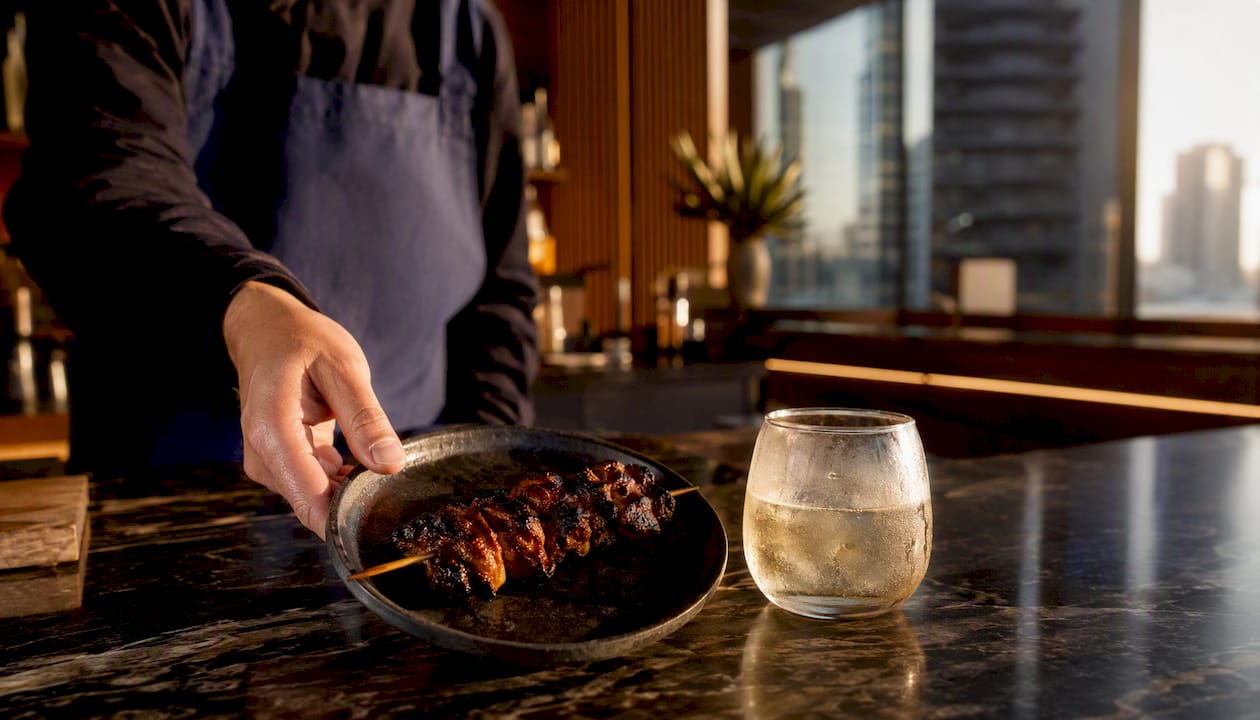
1. Mezcal + high-charred wagyu skewer
The mezcal’s smoke and agave sweetness echo the Maillard char on the meat, while the spirit’s acidity cuts through the fat. Tasting note: dried chilli, charcoal, and a long savoury finish. Serve in a wide-mouthed rocks glass at room temperature; plate the skewer on a slate tile with a smoulder of dried herbs in a small ceramic bowl beside it for theatrical effect.
2. Tea-infused gin + delicate Tasmanian scallop
Producers are increasingly using white tea and kombucha to add floral acidity to gin expressions, and those notes bridge the oceanic brine of a freshly seared scallop with remarkable precision. Tasting note: jasmine, sea salt, and a clean mineral finish. Chilled coupe serving with scallop on a half-shell with a single drop of yuzu.
3. Vodka martini + upscale taco
Clean spirit, high acidity from the olive or lemon twist, and a fat-rich filling create a textural contrast that is genuinely arresting. Tasting note: crisp, saline, with a lingering richness from the taco filling. Classic martini glass, taco portioned to two bites and presented on a warmed silver tray.
4. Ex-sherry bourbon + aged dark chocolate or aged cheese
The dried-fruit and vanilla character of a sherry-cask finish mirrors the deep cocoa notes in 72% dark chocolate, or the crystalline texture of a well-aged hard cheese. Tasting note: fig, toffee, and a warm spice finish. Tulip nosing glass, 30 ml; chocolate at room temperature, cheese at 18°C on a marble board.
5. PX-finished rum + cigar-style dessert
Pedro Ximénez sweetness in the rum’s finish and the tobacco-like bitterness of a dark praline or smoked caramel create a pairing of matched richness. Tasting note: raisin, dark molasses, and a lingering bitter-sweet close. Snifter, dessert served warm with a single edible gold leaf for presentation.
6. Nitro stout cocktail + freshly shucked oyster
The velvety, almost seafoam quality of a nitro stout — its nitrogen-charged texture — is a natural counterpart to the oceanic salinity of a freshly shucked oyster. Tasting note: roasted grain, brine, and a creamy, lingering finish. Stout glass; oyster on crushed ice with a mignonette droplet.
7. Tea-proofed rye whiskey + umami savoury course
FEW Immortal Rye, proofed to bottling strength using cold-extracted ‘8 Immortals’ tea, carries floral and woody notes that amplify fermented or aged savoury elements — miso, aged soy, or a dashi-based sauce. Tasting note: oolong, dried apricot, and a long woody finish. Rocks glass, served alongside a miso-glazed element on a chilled ceramic plate.
How do you source rare spirits and luxury accompaniments in Australia?
Sourcing for high-end events in Australia requires planning well ahead of service. Limited-release bottlings from small-batch distillers often arrive in small allocated releases nationally, and specialist retailers in Sydney, Melbourne, and Brisbane tend to sell through within days of release. Imported caviar requires several weeks’ lead time for chilled freight delivery, with premium tins requiring temperature-controlled storage at 0°C–4°C on arrival.
| Category | Typical lead time | Storage requirement | Authenticity check |
|---|---|---|---|
| Premium small-batch spirits | several weeks for allocated releases | Upright, cool and dark | Distillery lot number, importer documentation |
| Imported caviar (e.g. Baeri, Oscietre) | several weeks chilled freight | 0°C–4°C, unopened tin | Producer seal, harvest date, species certification |
| Artisanal kombucha / shrubs | a few days domestic | Refrigerated, 2°C–6°C | Batch date, certified producer |
| Tea-infused or collaboration spirits | several weeks | As per spirit category | Collaboration documentation, bottling date |
- Confirm the importer’s cold-chain protocol before ordering caviar; a single temperature break compromises flavour irreversibly.
- Request lot numbers and distillery documentation for allocated spirits; provenance is a selling point at luxury events and guests will ask.
- For curated gourmet sourcing, Aptent’s provenance standards include producer certification and harvest-date verification for all caviar products.
- Build in a two-week buffer for any imported product; Australian customs clearance for chilled goods can extend timelines unexpectedly.
- Allergen documentation — particularly for shellfish, dairy, and sulphites in spirits — must accompany every product into a catered event.
How should you present rare spirit pairings at a luxury event?
Three service formats suit luxury spirit pairings, each with distinct advantages. A dedicated tasting table allows guests to move at their own pace, encourages conversation, and suits cocktail-style receptions where a sommelier or brand ambassador can narrate each pairing. Passed canapé pairings — a single-bite food element alongside a 20 ml spirit pour on a shared tray — create a sense of theatre and work well for standing receptions of up to sixty guests. Seated course pairings offer the most control over pacing and narrative, and are the format best suited to showcasing the full depth of each creative spirit mix.
Pacing is the variable most often underestimated. Three to four pairing moments per guest is the practical ceiling before palate fatigue sets in; beyond that, the nuance of each subsequent pairing is lost. Between the second and third courses, an acidic interlude — a small pour of champagne vinegar shrub or a sip of effervescent water with citrus — resets the palate without interrupting the programme. For wine pairing station ideas that translate directly to spirit stations, Aptent’s event guides offer practical operational formats.
Provenance lines need not be lengthy. A single sentence naming the distillery’s region, the cask type, or the tea used in proofing is sufficient to anchor the guest’s attention. Aptent’s Gourmet Events service builds these provenance narratives into every curated pairing programme, drawing on direct producer relationships to ensure the story is accurate and specific.
How to test and refine pairings before the event
A three-round tasting protocol is the most reliable method for validating any pairing before service. In round one, taste the spirit alone and note its dominant characteristics: weight, finish, aromatic profile. In round two, taste the food alone, noting texture, fat content, acidity, and any dominant flavour compounds. In round three, take a sip of the spirit, a bite of the food, and a second sip of the spirit; assess whether the combination amplifies, contrasts, or cancels.
- Round one: Spirit alone — score weight (light/medium/full), finish length, and primary aroma.
- Round two: Food alone — score texture (delicate/rich/fatty), dominant flavour, and acidity level.
- Round three: Combined — score balance (1–5), finish (does it lengthen or shorten?), mouthfeel (does texture integrate?), and dominance (does one element erase the other?).
A panel of three to six tasters produces reliable consensus without logistical complexity. Recruit tasters with varied palate sensitivities — at least one who is sensitive to bitterness and one who is sensitive to acidity — to catch imbalances that a homogeneous panel might miss.
Pro Tip: If a pairing feels unbalanced because the spirit is too dominant, try a lower-proof expression of the same base spirit before changing the food element. A 10% ABV reduction often restores the food’s presence without altering the pairing’s character. Document every adjustment on a tasting sheet so the final version is reproducible by any member of the service team.
Key takeaways
Rare spirit pairings succeed when weight, aromatic compounds, and acidity are aligned, not when the ingredients are simply unusual.
| Point | Details |
|---|---|
| Match weight first | Pair delicate spirits with delicate foods and full-bodied spirits with rich accompaniments before considering flavour. |
| Use acidity as a reset | Champagne vinegar shrubs or kombucha between courses preserve palate clarity across successive spirit pairings. |
| Source with lead time | Allow two to three weeks for imported caviar and one to three weeks for allocated spirit releases in Australia. |
| Test with a three-round protocol | Score balance, finish, mouthfeel, and dominance across a panel of three to six tasters before finalising any pairing. |
| Aptent for caviar and events | Aptent’s Baeri and Oscietre Signature Caviars and Gourmet Events service provide curated pairings and provenance-verified products. |
Aptent’s view on crafting rare spirit pairings
The prevailing assumption in luxury hospitality is that rarity alone justifies a pairing’s place on the menu. Aptent’s position is more demanding than that. A spirit or a food earns its place not because it is scarce or expensive, but because it does something specific and irreplaceable in the pairing: it amplifies a texture, resolves a contrast, or introduces an aromatic dimension the other element cannot supply alone. Scarcity is a sourcing consideration; it is not a sensory argument.
This philosophy shapes how Aptent approaches dietary and allergen sensitivity in bespoke pairings. Every curated event programme accounts for shellfish, sulphite, and dairy sensitivities from the outset, not as an afterthought. A guest who cannot eat caviar or consume certain spirits should receive a pairing of equivalent refinement, not a substitution that signals they have been accommodated rather than considered. The standard for every guest is the same: a pairing that is specific, provenance-verified, and genuinely pleasurable.
Aptent’s curated pairing packages and event services
Aptent offers a rare combination of provenance-verified luxury products and fully managed event experiences, making it the natural choice for planners who want both the ingredients and the expertise in one place. The Baeri Signature Caviar and Oscietre Signature Caviar are available in formats suited to tasting portions through to statement centrepieces, each supplied with full producer documentation and harvest-date verification.
For event planners, Aptent’s Gourmet Events service delivers bespoke pairing programmes for private and corporate gatherings, with curated spirit and caviar pairings, provenance storytelling, and full dietary and allergen management built into every brief. Contact Aptent to discuss a curated pairing programme for your next luxury event.
Useful sources
- Unusual food and drink pairings | CNN — Expert commentary from Agostino Perrone and Iain McPherson on textural contrast and recontextualising unexpected ingredients; foundational for the pairing principles section.
- Try these uncommon food and drink pairings | Seattle Weekly — Practitioner notes on nitro stout and oyster, Rob Roy and burger; useful for textural contrast examples.
- Four world-class cigar and spirit pairings | Whiskey Consensus — Technical analysis of weight matching, lower-proof selection, and sherry-cask finishing for spirit and food pairings.
- Spirit tea cocktails | KOVAL Distillery — Practitioner guide to using tea as a bridge between spirits and food via shared aromatic compounds.
- FEW Immortal Rye and The Tea Spot | World Tea News — Detailed account of tea-proofing technique and the ‘8 Immortals’ collaboration; reference for tea-proofed whiskey pairings.
- Distilled Happy Minds Kombucha G&T | Spirit of Njord — Example of fermented acidic elements (white tea kombucha) used to add complexity and acidity to gin-based drinks.
- Unique cocktails and structural acidity | Slightly Pretentious — Practitioner-level analysis of how champagne vinegar, shrubs, and kombucha function as structural bridges in multi-course tasting menus.
- Pairing food and cocktails | Escoffier Online — Overview of weight and viscosity matching principles; useful for planners new to spirit and food pairing theory.


