
Hosts: 15–20g Portions and Caviar Accompaniments That Impress
Serve caviar on lightly buttered toast points or blinis, with crème fraîche, finely chopped hard-boiled egg and chives close at hand, and you have covered the essentials. The one rule that overrides every other decision: keep the roe bitterly cold and never let it touch metal. Taste premium caviar plain first, then dress it sparingly, since the finer the grade, the less it needs.
TL;DR:
- Serving caviar on lightly buttered toast points or blinis keeps it warm and provides a neutral carrier that does not compete with the roe’s delicate flavor.
- Pairing caviar with fresh oysters, seared scallops, or lightly smoked salmon enhances its briny qualities without overpowering it.
- Keep caviar at a constant cold temperature in a double-bowl setup with non-metallic utensils to preserve its texture and prevent metallic tastes.
- Use small portions, about 15 to 20 grams per guest, to maintain the focus on quality and prevent overwhelming the palate.
- Complement caviar with Champagne, dry sparkling wine, or chilled vodka to balance its salinity and richness, avoiding overly sweet or pungent drinks.
Table of Contents
- What are the classic accompaniments and why do they work?
- Which modern pairings actually work with caviar?
- How should caviar be served: temperature, utensils and portions?
- What drinks pair best with caviar?
- How do you assemble a caviar board at home?
- How does Aptent source and present its caviar?
- How do you accommodate dietary needs at a caviar service?
- What’s the etiquette for serving and eating caviar?
- When should you keep it simple, and when should you experiment?
- How Aptent can help you plan a caviar service
- Sources
- FAQ
What are the classic accompaniments and why do they work?
Every traditional caviar accompaniment earns its place by doing one of two things: adding gentle richness or offering a neutral base that carries the roe without competing with it. Blinis, the small yeasted buckwheat pancakes of Russian tradition, remain the benchmark carrier. Buckwheat blinis have a faint nuttiness and a slightly denser crumb than wheat versions, which holds up better under a spoonful of roe. Keep them warm under a clean tea towel and serve them roughly two to three centimetres across, small enough for a single elegant bite.
Toast points and neutral crackers do the same job with less fuss. Use unsalted bread, toast it until firm rather than crunchy, and apply the thinnest film of unsalted butter. Salted butter or heavily seasoned crackers fight with the caviar’s own salinity, and neutral carriers keep the roe the star of the plate.
Crème fraîche and unsalted butter provide the fat that balances caviar’s brine, while the crème fraîche’s mild acidity cuts through that richness rather than adding to it. A teaspoon per serving is generous; more than that and the dairy overwhelms the roe’s texture.
Chopped hard-boiled egg, prepared in the French mimosa style, separates yolk from white for visual contrast and two distinct textures. The classic caviar spread includes:
- Buckwheat blinis or lightly buttered toast points, kept warm and cut small
- Crème fraîche and unsalted butter, portioned in small dishes
- Sieved egg yolk and finely chopped egg white, presented separately
- Boiled baby potatoes or good-quality kettle chips as a neutral, starchy base
- Finely minced chives, shallot and capers, served in their own small bowls
Potatoes deserve particular mention. Warm boiled baby potatoes, split and topped with a small spoonful of crème fraîche and caviar, are a classic pairing that Great British Chefs singles out for how well the starch’s mildness suits the roe. Kettle chips offer the same neutrality with a satisfying crunch, which makes them a popular, low-effort alternative at a cocktail-style gathering. Chives, shallot and capers should be minced fine enough to scatter rather than chunk, and offered in small bowls so guests choose their own intensity.
Which modern pairings actually work with caviar?
Contemporary chefs have expanded the caviar repertoire well beyond blinis, and several combinations now show up on serious tasting menus for good reason. Oysters and caviar double up on brine in a way that reads as indulgent rather than repetitive, provided the oyster is freshly shucked and served icy cold. Seared scallops, with their natural sweetness, offer a contrast that makes the caviar’s salinity feel more pronounced. Smoked salmon works too, though it carries enough flavour of its own that a light hand with the roe matters more than usual.
Soft-scrambled eggs and creamy egg-based pasta dishes have become a favourite modern setting for caviar, largely because chefs now treat the roe less as a garnish and more as a seasoning. Chef Bonnie Morales and others recommend using caviar in small amounts as a finishing touch on richer dishes, spooned on at the very end so the heat of the plate never touches it directly. The same logic extends to gourmet potato chips, warm brioche, or even a scallion pancake cut into small squares. Any dish with a soft, slightly fatty base and a mild flavour is a candidate.
Pro Tip: Think of caviar the way you’d think of a finishing salt. A few beads scattered over a bold, savoury dish (think risotto, buttered pasta, or a simple blini) go further than a heaped spoonful, and they let the roe’s texture register on the palate rather than disappearing into the dish.
Some ingredients work against caviar rather than with it. Lemon juice, strong blue cheeses and raw pungent onion all fight the roe’s delicate salinity and can mask its more subtle characteristics. Milder alternatives such as lemon zest or finely snipped chives preserve that nuance while still offering a bright note. The pairings that endure, whether classic or modern, share one trait: they support the caviar rather than argue with it.
- Oysters or seared scallops, for a seafood-forward canapé course
- Soft-scrambled eggs or creamy egg pasta, with caviar spooned on just before serving
- Gourmet potato chips or brioche points, for a playful, low-effort option
- Lemon zest or chives in place of lemon juice or raw onion, when brightness is needed
How should caviar be served: temperature, utensils and portions?
Temperature and material choice matter more with caviar than almost any other food on the table, and getting either wrong changes the flavour rather than just the presentation. Keep the tin refrigerated until the moment of service, then decant it into a small glass or porcelain bowl nested inside a larger bowl packed with crushed ice. This double-bowl method keeps the roe genuinely cold without freezing it, which would damage the texture of the individual eggs.
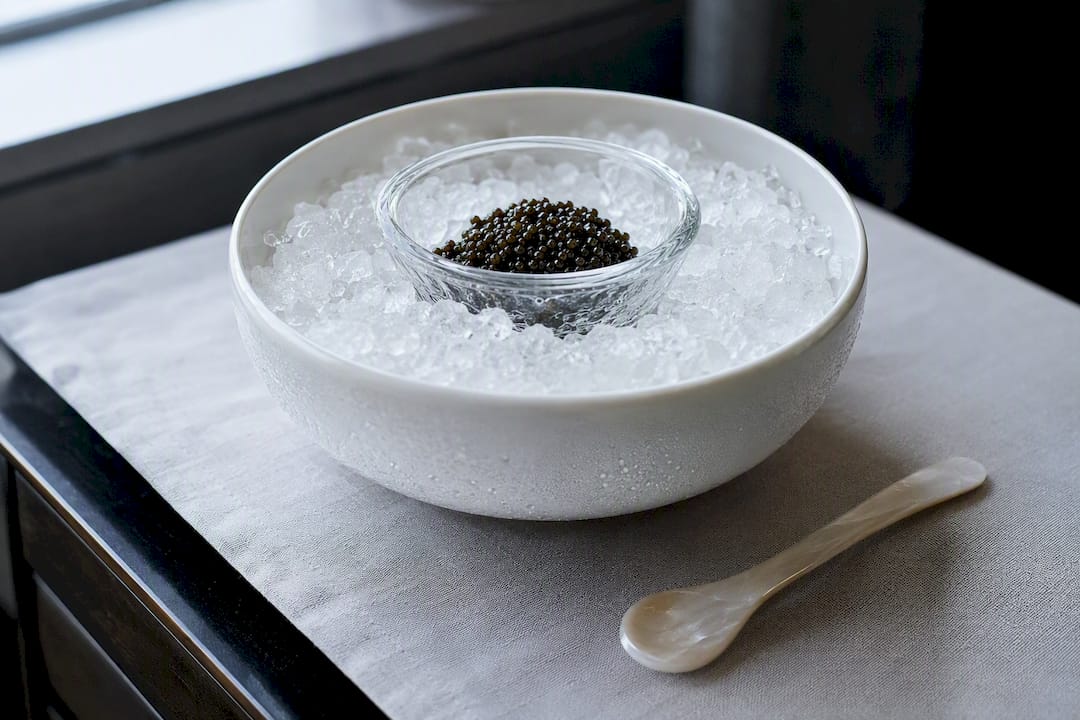
Utensils are not a minor detail. Metal spoons can impart a faint metallic taste to caviar, so mother-of-pearl, horn or high-quality food-grade plastic spoons are the standard choice among chefs and caviar houses alike. It is a small investment that protects the flavour you have paid a premium for.
Portioning follows the occasion:
- For a seated tasting where caviar is the focus, allow roughly one small spoon (about 15 to 20 grams) per guest.
- For canapé-style service across a longer event, a half-spoon per bite spread over several courses works better than one large serving.
- For a shared board at a cocktail party, plan on a similar total per guest, portioned across several small carriers rather than one large mound.
Statistic Callout: Tasting Table’s guide to caviar service notes that experts consistently recommend neutral starches as the backbone of any spread, precisely because they let portion sizes stay small without the plate feeling sparse.
Hygiene and timing matter as much as temperature. Caviar should stay on ice until the last reasonable moment, and any bowl that has been sitting at room temperature for more than 20 to 30 minutes should be refreshed rather than left to soften and warm.
What drinks pair best with caviar?
Dry Champagne or another quality sparkling wine remains the pairing chefs return to most often, and the logic is straightforward: acidity and fine bubbles cut through caviar’s saltiness and richness in a way that few other drinks manage. Look for a Brut or Extra Brut style with minimal residual sugar, since sweeter styles tend to clash rather than complement. Aptent’s guide to pairing caviar with Champagne goes deeper into specific styles and vintages if you want to plan a fuller menu.
Chilled vodka is the other traditional standby, particularly in Russian and Eastern European service. Served ice cold, ideally from the freezer, vodka acts as a palate cleanser between bites rather than a flavour pairing, which is exactly why it works alongside something as rich as caviar.
Beyond those two, a few other options hold their own:
- A crisp, unoaked dry white wine, such as a young Chablis or Sancerre
- A light, dry sherry (fino or manzanilla style), served chilled
- Sparkling mineral water, for guests who prefer a non-alcoholic match
If you’re planning a multi-course menu around caviar, Aptent’s Champagne food pairing chart is a useful reference for matching styles across an entire evening rather than a single course.
How do you assemble a caviar board at home?
A well-run caviar board comes down to preparation done well in advance and assembly done at the very last minute. Shop for the following:
- Your chosen caviar, plus a small non-metallic serving spoon
- Blinis or toast points, and a bowl of good kettle chips as backup
- Crème fraîche, unsalted butter, chopped hard-boiled egg (yolk and white separated)
- Finely chopped chives, minced shallot and capers
- Crushed ice, a small serving bowl and a larger bowl to nest it in
Assembly works best in stages:
- Chill the caviar tin and the serving bowls well ahead of time, ideally for several hours.
- Prepare and stage every condiment in its own small dish an hour or two before guests arrive.
- Portion the carriers (blinis warmed, toast points sliced, potatoes boiled and split) shortly before service.
- Decant the caviar into its bowl over crushed ice only in the final minutes, right before guests sit down.
Plan for a modest serving of caviar per guest if it is the centrepiece, prepared as described earlier, and treat everything else as make-ahead work. The condiments can sit prepped in the fridge for hours; only the caviar and its ice bed need last-minute attention. For styling, resist the urge to overcrowd the board. A few generous bowls, clean lines and one obvious point of focus (the caviar itself, sitting proud in its ice bath) reads as far more elegant than a table crowded with a dozen small dishes.
How does Aptent source and present its caviar?
Aptent curates its caviar selection from prestigious producers, with the Baeri Signature range offered in three sizes to suit everything from an intimate tasting to a full event. Each size serves a distinct purpose:
- The 30g Baeri Signature Caviar suits a first tasting or a small dinner for two
- The 50g Baeri Signature Caviar fits a canapé service for a modest gathering
- The 250g Baeri Signature Caviar covers a larger celebration or a multi-course menu
Beyond the caviar itself, Aptent’s boutique event service supports hosts who want a polished tasting without managing every element themselves, pairing wine and caviar for private gatherings and corporate functions alike.
How do you accommodate dietary needs at a caviar service?
Caviar itself is naturally gluten-free and, sourced correctly, free from common allergens beyond fish, which makes it a fairly accommodating centrepiece once you look past the traditional carriers. The accompaniments are where most dietary adjustments happen, not the roe.
For gluten-free guests, swap wheat toast points for boiled baby potatoes, gluten-free crackers or crisp cucumber rounds. All three carry a small spoonful of caviar just as well as bread does, without sacrificing the neutral flavour that makes a good carrier work.
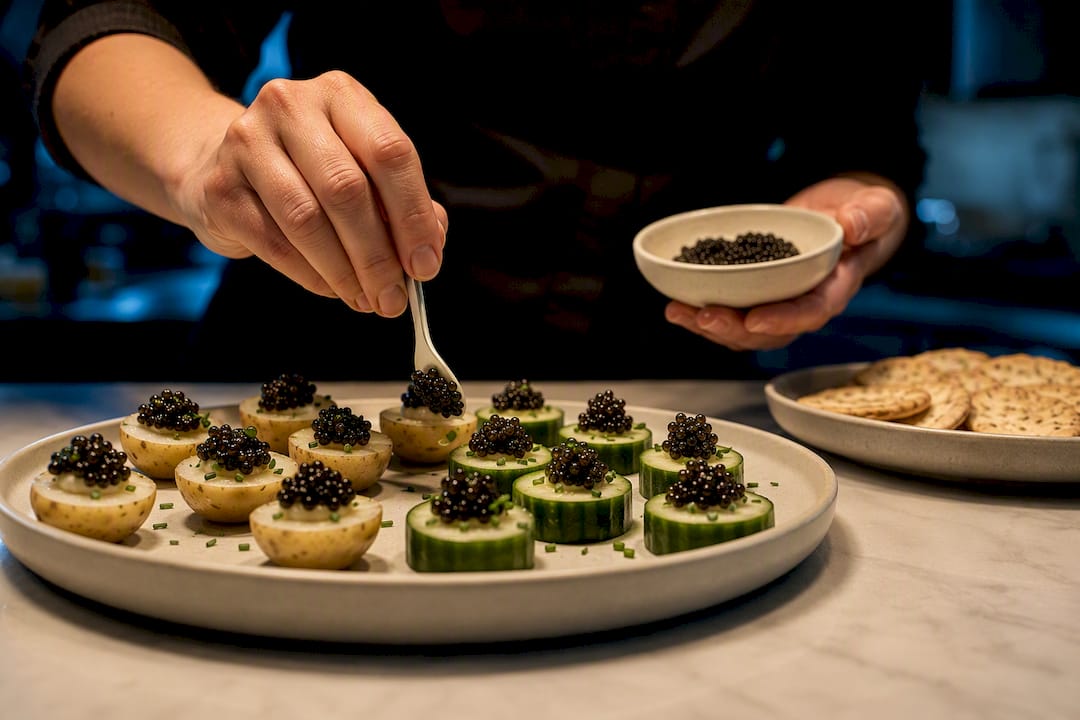
For dairy-free guests, crème fraîche and unsalted butter are easy to omit rather than substitute. Caviar on a plain blini, a potato, or a neutral cracker still reads as complete without the dairy element, and a squeeze of mild flavour like finely snipped chives fills the gap nicely.
Guests who avoid egg can simply skip the mimosa garnish. It’s decorative rather than essential, and removing it changes nothing about how the caviar itself tastes.
For alcohol-free service, chilled sparkling mineral water or a non-alcoholic sparkling wine mimics the acidity and effervescence that Champagne brings, keeping the palate-cleansing effect intact.
The safest approach for a mixed group is to serve every condiment separately, in its own small bowl, rather than pre-assembling the bites. That way, each guest builds a plate suited to their own needs without singling anyone out.

What’s the etiquette for serving and eating caviar?
Caviar etiquette exists mostly to protect flavour and texture, and once you understand the “why,” the rules stop feeling fussy. Serve caviar to guests rather than have them serve themselves from a communal tin, using the provided non-metallic spoon for each portion, then let guests use their own small spoon or spread it onto their chosen carrier by hand.
Purists eat a small amount of caviar plain, off the back of the hand or a spoon, before adding any garnish. This lets the taster register the producer’s specific character before condiments start altering it, and it’s a habit worth encouraging at a smaller tasting where guests are genuinely interested in the caviar itself.
At a larger or more casual gathering, self-assembly is entirely appropriate. Presenting caviar alongside small bowls of condiments so guests build their own bites is standard even at fine dining tables, and it keeps the service relaxed without sacrificing polish.
A few small courtesies round out good service: never let the caviar sit unrefrigerated for extended periods while guests mingle, offer a fresh spoon if the shared one touches a plate, and avoid stacking heavy or hot food directly against the caviar bowl, since warmth transfers faster than most hosts expect.
When should you keep it simple, and when should you experiment?
Match the approach to the occasion rather than to a fixed rule. For a purist tasting, taste each caviar plain first and keep garnishes minimal, especially with a top-tier grade where subtlety is the whole point. For a cocktail party or casual celebration, lean on approachable carriers, blinis, potatoes, toast, alongside a couple of creative pairings so every guest finds something they enjoy.
— APTENT
How Aptent can help you plan a caviar service
Sourcing caviar you can trust is the foundation of every pairing in this guide, and it’s where Aptent’s curated approach makes the difference between a good spread and a forgettable one. The Baeri Signature Caviar range, available in 30g, 50g and 250g sizes, is sourced from prestigious producers and scaled to fit anything from an intimate tasting to a full celebration.

Beyond the caviar itself, Aptent’s gourmet accessories collection covers the non-metallic spoons and serving bowls this guide recommends, so you’re not left improvising with whatever is in the kitchen drawer. If you’d rather leave the assembly to someone else entirely, Aptent’s Gourmet Events service pairs wine and caviar for private gatherings and corporate functions, handling the sourcing, presentation and pacing so you can focus on your guests. Browse the full caviar collection to choose a size and place an order ahead of your next occasion, or get in touch about event enquiries to book a tasting.
Sources
- What to serve with caviar - Great British Chefs
- How to eat caviar - Food & Wine
- 13 must-have accompaniments for caviar - Tasting Table
- How to serve caviar - D’Artagnan
FAQ
What do you serve with caviar?
The classics are blinis, lightly buttered toast points, crème fraîche, chopped hard-boiled egg and finely minced chives, with boiled baby potatoes or good kettle chips as a neutral alternative.
How do you traditionally serve caviar?
Caviar is traditionally decanted into a small bowl set inside a larger bowl of crushed ice, served with non-metallic spoons, and offered alongside blinis or toast with condiments in separate small dishes.
What should you not eat with caviar?
Avoid lemon juice, strong blue cheeses and raw pungent onion, since all three overpower the roe’s delicate flavour; lemon zest and chives are gentler substitutes.
What are some classic condiments for caviar?
Finely chopped chives, minced shallot, capers, crème fraîche and sieved hard-boiled egg yolk and white are the standard condiments, each served in its own small bowl so guests can portion to taste.
Is there a caviar option suited to a small first tasting?
Aptent’s 30g Baeri Signature Caviar is sized for exactly this, giving newcomers enough to taste plain and then try with a few classic accompaniments.


