
Champagne Dosage Decoded for Hosts: Why Extra Dry Is Sweeter Than Brut
Dosage is the liqueur d’expédition, a small addition of wine and sugar blended into each bottle after disgorgement, to soften Champagne’s natural acidity and set its final personality. It is the last decision a house makes before corking, and it determines whether a bottle lands as bracingly dry or luxuriously rounded. Label terms from Brut Nature to Doux exist purely to tell you how much sugar, per litre, that decision left behind.
TL;DR:
- Lower dosage Champagne, such as Brut Nature and Extra Brut, emphasizes acidity and minerality, making it suitable for seafood and briny dishes.
- The difference between dosage categories is subtle; shifting just a few grams of residual sugar per litre can change how wine tastes on the tongue.
- Producers typically add about 1 centilitre of liqueur per 75-centilitre bottle immediately after disgorgement, using reserve wines for texture and aromatics.
- Dosage levels influence wine style more than quality, with blind tastings guiding houses to their final formulation based on intended profile and pairing needs.
- Consumer preferences have shifted toward drier styles, with Extra Brut gaining popularity for its clean, minimalist expression.
Table of Contents
- What champagne dosage is and why producers add it
- The official dosage categories and their sugar ranges
- How dosage is prepared and added during production
- How dosage shapes style, texture and food pairing
- What people get wrong about Extra Dry and Brut
- Choosing dosage for events and tastings
- Why dosage matters to sommeliers and hosts
- Sources
- FAQ
What champagne dosage is and why producers add it
Champagne emerges from its second fermentation searingly acidic, almost austere. Dosage exists to civilise that acidity without erasing it, and the process happens at a precise moment: right after disgorgement, when the frozen plug of sediment is ejected and the bottle briefly stands open. Producers top up that small void with the liqueur d’expédition, roughly 1 cl for a 75 cl bottle, before corking for good.
The liqueur itself is rarely just sugar syrup. Many houses dissolve sugar into filtered reserve wines aged for at least two years, using that base to add texture and aromatic depth rather than simple sweetness, according to Champagne.fr. This is where a cellar master’s signature actually lives.
A few things dosage accomplishes at once:
- Balances the wine’s naturally high acidity so it feels harmonious rather than sharp
- Rounds out texture, adding a sense of weight or creaminess on the palate
- Layers in aromatic complexity when reserve wines form the liqueur base
- Defines the final house style, distinguishing one producer’s Brut from another’s
Two Bruts from neighbouring vineyards can taste entirely different because of what went into that final centilitre.
The official dosage categories and their sugar ranges
Champagne uses seven recognised sweetness categories, each defined by a residual sugar range measured in grams per litre. These bands underpin every label you will see on a shelf, and they follow regulatory thresholds set for Champagne AOC labelling.
These ranges come from the Maisons Champagne technical reference, and they are worth memorising because the jump between bands is smaller than it looks. A shift of just a few grams per litre changes how a wine reads on the tongue, especially near the Brut and Extra Dry boundary. Serving temperature and acidity levels also skew perception: a Brut served too warm can taste rounder than its dosage suggests, while a well-chilled Extra Brut can seem almost austere even with a touch of sugar present.
How dosage is prepared and added during production
Dosage enters the wine at a specific, almost surgical point in the winemaking calendar. The sequence runs like this:
- Bottles are riddled and disgorged, expelling the frozen sediment plug and leaving a small gap of missing liquid
- Cellar teams extract a matching volume of wine to make room for what comes next
- The liqueur d’expédition, sugar dissolved into filtered reserve wine, is measured and added to fill that gap
- The bottle is topped up to its final volume and immediately corked, caged and finished
At scale, high-speed doseuse machines handle the mechanical side of this, with the largest operations capable of dosing more than 18,000 bottles an hour. The machinery is impressive, but it is not where the craft sits. That lives in the liqueur recipe itself, and in the tasting panels that decide it. Houses commonly run blind tastings across several dosage levels before settling on a final figure, treating dosage as a deliberate stylistic call rather than a rounding error.
How dosage shapes style, texture and food pairing
Dosage is the single biggest lever a producer has over how a Champagne feels in the mouth, beyond grape variety and vintage. Lower dosage sharpens acidity and lets minerality lead, which is why Brut Nature and Extra Brut so often taste of chalk, citrus and salt. Higher dosage softens that edge and lets fruit and roundness take over, which is precisely why reserve wines built into the liqueur can add real aromatic character rather than just sweetness.
That spectrum maps neatly onto the table:
- Brut Nature and Extra Brut: oysters, raw seafood, anything briny and iodised
- Brut: the versatile middle ground, from canapés to roast chicken
- Extra Dry: brunch dishes, mild spice, fruit-forward starters
- Demi-Sec and Doux: fruit tarts, soft cheeses, dessert courses
This pairing logic comes from Canard-Duchêne’s dosage guide, and Aptent’s own Champagne pairing chart extends it across snacks, mains and dessert courses for anyone planning a full menu.
Pro Tip: Serve lower-dosage Champagnes colder, around 6 to 8 degrees Celsius, to sharpen their acidity, and let Demi-Sec or Doux sit slightly warmer, closer to 10 degrees, so their sweetness doesn’t feel flat or cloying.
What people get wrong about Extra Dry and Brut
The most persistent myth in Champagne sweetness levels is right there in the name. Extra Dry sits at 12 to 17 grams of sugar per litre, while Brut sits under 12, meaning Extra Dry is actually sweeter than Brut despite sounding drier. The naming dates back to an era when Brut was the newer, drier innovation and Extra Dry was the established norm, and the labels never caught up with the shift in taste.
The second myth is that zero dosage automatically equals better wine. It does not. Brut Nature demands flawless base wine with nowhere to hide, which makes it thrilling in the right vintage and thin in the wrong one. The honest test is a side-by-side tasting: pour a Brut Nature next to a Sec, note where acidity bites and where sweetness rounds it out, and you will taste the entire dosage scale in two glasses.
— APTENT
Choosing dosage for events and tastings
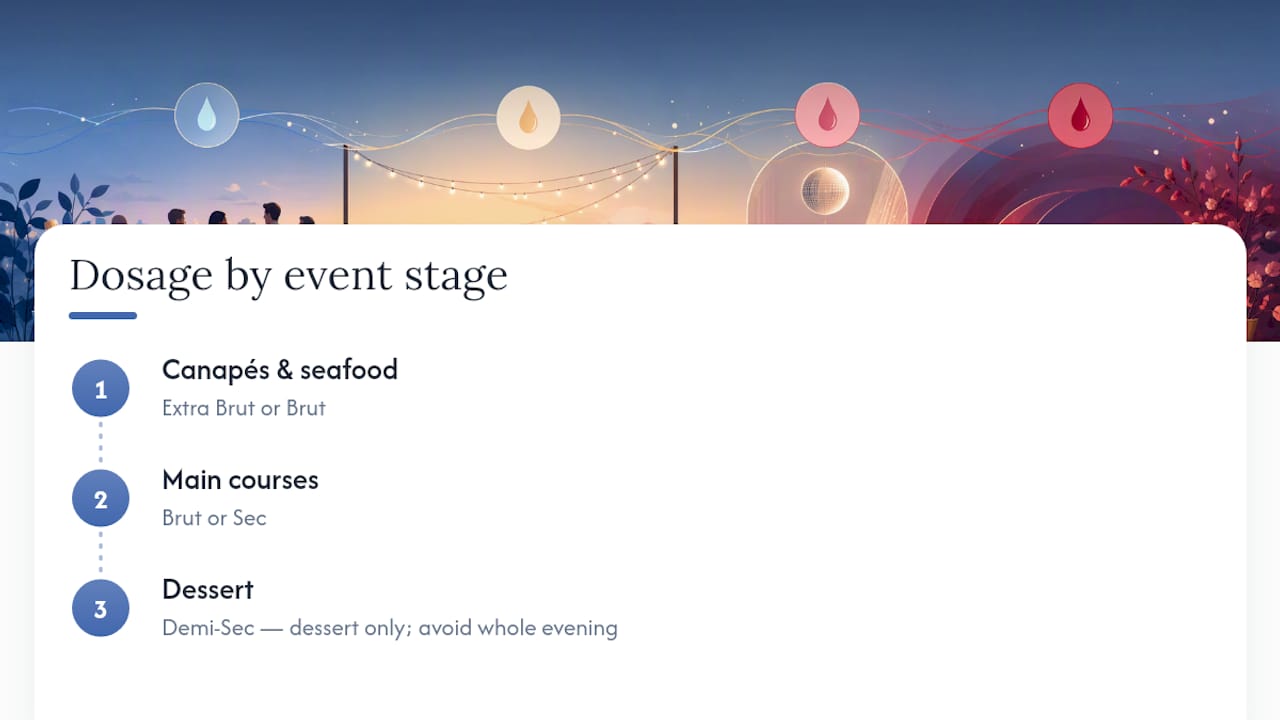
Matching dosage to a menu is less guesswork than most hosts assume. As a rule of thumb, open with Extra Brut or Brut for canapés and seafood, move to Brut or Sec through the main courses, and finish with Demi-Sec alongside dessert. For boutique events, Extra Brut is generally favoured when the emphasis is on precision and food, Brut for broader crowd appeal, and Demi-Sec sparingly, reserved for a dedicated dessert pour rather than an entire evening.
Why dosage matters to sommeliers and hosts
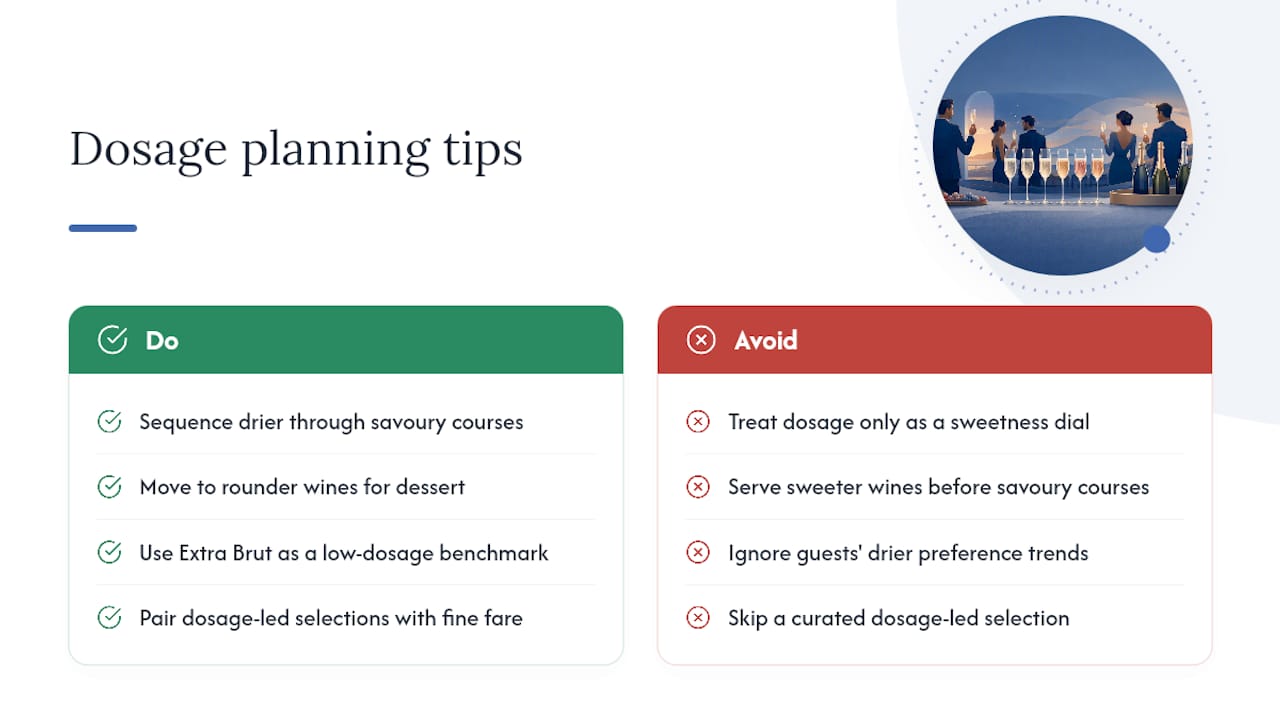
Professionals treat dosage as a tool for pacing a tasting, not just a sweetness dial. A well-chosen sequence, drier through savoury courses, rounder toward dessert, can make a single Champagne style feel like several different wines across an evening.
Consumer preference has also moved measurably drier over recent years, with Extra Brut and Brut Nature gaining ground against sweeter historical styles. Broader shifts in gastronomy and dining trends echo the same pattern: guests increasingly want wines that let the food lead.
Ready to put this scale into practice? Explore Aptent’s curated Champagne selection, built around exactly these dosage distinctions, or start with the Extra Brut Blanc de Blancs Grand Cru if you want a benchmark low-dosage bottle on your table. For anyone planning a tasting or private event, Aptent’s gourmet event services pair dosage-led Champagne selections with caviar and other fine fare, and the full range sits at Gourmet.
Sources
- Champagne
- Dosage (Maisons Champagne)
- Everything you need to know about Champagne dosage (Canard‑Duchêne)
- Brut, Extra Brut, Demi‑Sec: Understanding Champagne dosage (Champagne Education)
- Extra Dry vs Brut Champagne explained (Tasting Table)
FAQ
What Is Dosage in Champagne?
Dosage is the liqueur d’expédition, a mix of sugar and often reserve wine added to each bottle right after disgorgement, and it determines the wine’s final sweetness category.
Is Extra Dry Sweeter Than Brut?
Yes. Extra Dry contains 12 to 17 grams of sugar per litre, while Brut stays under 12 grams, making Extra Dry the sweeter of the two despite its name.
What Is Zero Dosage Champagne?
Zero dosage, usually labelled Brut Nature, contains 0 to 3 grams of sugar per litre and no added liqueur beyond what’s needed to fill the bottle, making it the driest style available.
How Much Liqueur Is Added During Dosage?
Producers typically add around 1 centilitre of liqueur d’expédition to a standard 75 centilitre bottle, filling the gap left after disgorgement.
Does Higher Dosage Mean Lower Quality?
No. Dosage is a stylistic choice rather than a quality marker, and houses select it through blind tastings to suit a particular cuvée, occasion or food pairing.


