
Premium truffle varieties explained: the chef's guide
The six premium truffle species that define haute cuisine are Tuber magnatum (Alba white), Tuber melanosporum (Périgord winter black), Tuber aestivum and Tuber uncinatum (summer and Burgundy), Tuber brumale (winter black variant), Tuber borchii (bianchetto) and Tuber mesentericum (bagnoli). Fewer than ten species carry real culinary market value despite over 140 described truffle species in existence, and the hierarchy among them is determined by aroma intensity, harvest rarity and how well each species holds up under kitchen heat.
The short version, before the detail:
- Tuber magnatum: wild-only, intensely garlicky and honeyed, harvested late autumn, the most expensive truffle in the world.
- Tuber melanosporum: the preeminent winter black, earthy and complex, widely cultivated, more stable in price and availability.
- Tuber aestivum / T. uncinatum: summer and Burgundy forms of the same species, milder and more heat-tolerant, excellent value.
- Tuber brumale: a secondary winter black with a sharper, more pungent character, often used as a melanosporum substitute.
- Tuber borchii: the bianchetto, garlicky and zesty, sometimes mis-sold as white Alba truffle at the lower end of the market.
- Tuber mesentericum: the bagnoli, bitter and phenolic, rarely seen outside specialist Italian markets.
Three principles govern every purchase: buy fresh, buy in season, and match the species to your technique.
Table of Contents
- What makes each premium truffle species distinct?
- How do you identify and grade premium truffles at purchase?
- Where and how do you buy premium truffles in Australia?
- How do you cook with premium truffles to get the most from them?
- Seasonality and price reference for premium truffle varieties
- Why truffle oil is not a substitute for fresh truffle
- Key takeaways
What makes each premium truffle species distinct?
No single truffle is universally “best” — the right choice depends entirely on season and culinary intention. The profiles below provide the identification cues, aromatic character, seasonal windows and kitchen guidance you need to work confidently with each species.
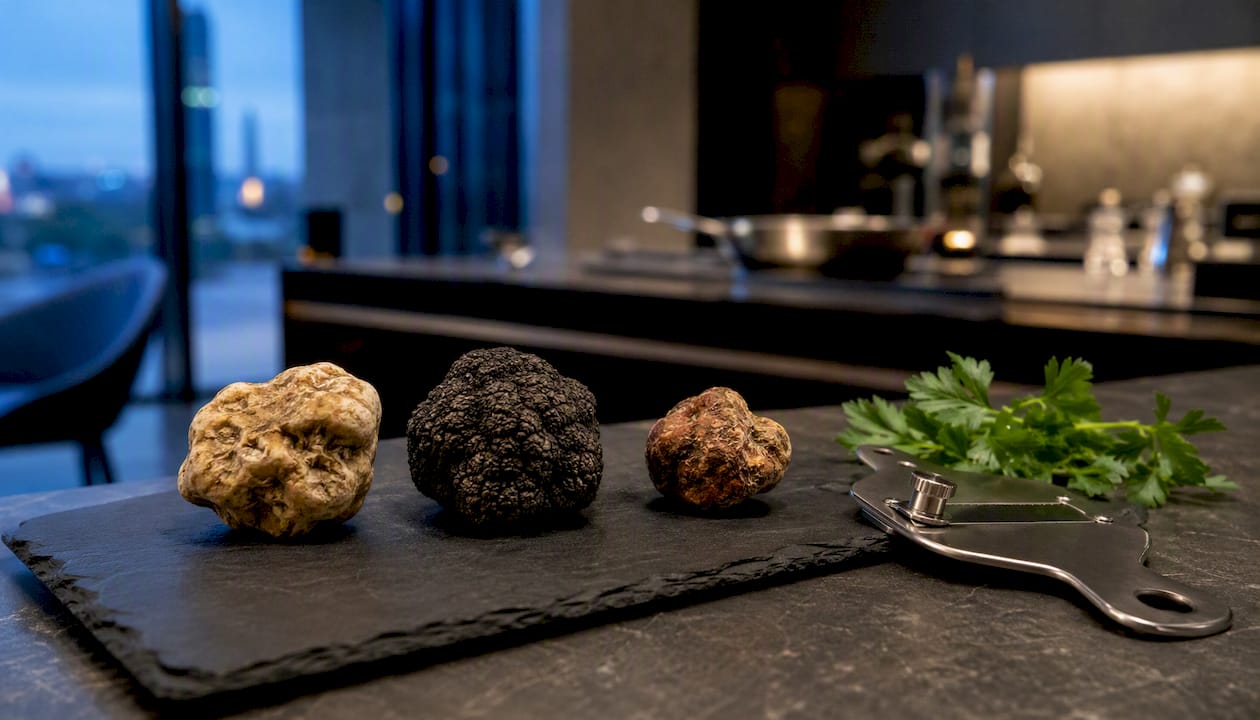
Tuber magnatum — the Alba white truffle
The outer skin (peridium) of Tuber magnatum is smooth, pale ochre to cream, and almost entirely without warts. The interior (gleba) is cream to light hazel, marbled with fine white veins that become more pronounced as the truffle matures. Size ranges from a walnut to a small apple, though specimens exceeding 100 grams are rare and command extraordinary premiums.
The aroma is the most complex of any truffle species: layered notes of fermented garlic, aged cheese, petrol, honey and white pepper, with an intensity that fills a room within minutes of slicing. This volatility is also its greatest vulnerability. Heat destroys the aromatics almost immediately, which means Tuber magnatum must always be used raw, shaved paper-thin over warm dishes at the very last moment. Classic applications include hand-rolled egg pasta, risotto, fonduta and fried eggs.
Seasonality runs from October through December in the Northern Hemisphere, with peak supply in November. White Alba truffle is wild-only, which means cultivation has never been reliably achieved at commercial scale, and price reflects that scarcity absolutely. Australian buyers should expect import windows in November and December, with retail prices at the very top of the market.
Pro Tip: Wrap the shaved truffle in a single layer of baking paper and rest it on top of the warm dish for thirty seconds before serving. The gentle radiant heat releases the aromatics without cooking them.
Tuber melanosporum — the Périgord winter black
The peridium of Tuber melanosporum is black, rough and warty, with a texture resembling cracked volcanic rock. The gleba is deep black to dark violet, threaded with fine white veins that turn reddish-brown when the truffle is cut. Specimens vary in weight within a typical range for this species.
Aromatically, the Périgord black is earthy, musky and complex, with notes of dark chocolate, damp forest floor, dried fruit and a subtle mineral finish. Unlike magnatum, it tolerates gentle heat well, which opens a far broader range of culinary applications: truffle butter, sauces, stuffed poultry, pâté, and dishes where a brief, low-temperature infusion is part of the technique. Shaving is still preferred for finishing, but brief cooking intensifies rather than destroys the aroma.
Harvest runs from November through March in France and Spain, with Australian domestic production from the Manjimup and Pemberton regions of Western Australia typically peaking in June and July. This makes melanosporum the most practically accessible premium truffle for Australian chefs, available both as a local product and as a Northern Hemisphere import. Cultivated specimens are widely available and generally more stable in price than wild-harvested ones.
Pro Tip: Infuse sliced melanosporum in softened unsalted butter overnight in the refrigerator. The fat captures the volatile compounds far more efficiently than any water-based medium, and the resulting truffle butter holds for up to five days.
Tuber aestivum and Tuber uncinatum — summer and Burgundy truffles
These two forms are genetically near-identical, distinguished primarily by the climate in which they mature. T. aestivum, harvested from May through August, has a pale, cream-coloured gleba with white veining and a mild, nutty, slightly mushroomy aroma. T. uncinatum, the Burgundy form harvested from September through November, develops a darker gleba and a noticeably more complex, hazelnut-forward aroma because cooler autumn temperatures slow maturation and concentrate the volatile compounds.
Both forms have a black, warty peridium similar to melanosporum, though slightly less pronounced. They are considerably more heat-stable than either white truffle species, making them well-suited to pasta fillings, risotto, omelettes and warm salads where the truffle is incorporated rather than merely finished. Price is substantially lower than either magnatum or melanosporum, which makes them the intelligent choice for high-volume menu applications or when budget is a genuine constraint.
Pro Tip: For T. uncinatum, grate rather than shave. The denser, darker gleba releases more aroma when broken on a microplane than when sliced thin on a mandoline-style slicer.
Tuber brumale — the winter musky truffle
Tuber brumale shares the same harvest window as melanosporum (November through March) and is frequently confused with it at the point of sale. The peridium is similarly black and warty, but the gleba is grey rather than black-violet, and the veining is coarser and more widely spaced. The aroma is sharper, more pungent and less nuanced than melanosporum, with a pronounced musk and a slightly medicinal edge.
In the kitchen, brumale performs adequately in cooked preparations where its assertive character is moderated by fat and heat, but it lacks the elegance of melanosporum in raw or lightly finished dishes. It is legitimately used as a more affordable winter black and is sometimes blended with melanosporum in commercial truffle products. Requesting the botanical name at purchase is the only reliable way to distinguish the two.
Tuber borchii — the bianchetto
The bianchetto is a small white truffle with a smooth, pale peridium ranging from cream to reddish-brown. The gleba is cream to light brown with fine white veining. Harvested from January through April, it fills the gap between the end of the white truffle season and the beginning of the summer season. The aroma is garlicky and zesty, with a sharper, more one-dimensional character than magnatum and none of the honeyed complexity.
Bianchetto is sometimes mis-sold as white Alba truffle at the lower end of the market, a substitution that represents both a quality and a price fraud. The two species are easily distinguished by aroma alone: magnatum is layered and honeyed; borchii is sharp and predominantly garlicky. Culinary use mirrors that of magnatum in technique (raw, shaved, finishing only) but the flavour profile suits more assertive dishes such as pasta with anchovy or aged pecorino.
Tuber mesentericum — the bagnoli truffle
The least celebrated of the premium group, T. mesentericum has a black, warty peridium and a grey-brown gleba with white veining. The aroma is distinctive and polarising: phenolic, slightly bitter and reminiscent of carbolic, with an earthy base note. Harvested from September through January, it is rarely exported in significant quantities and is largely confined to specialist Italian markets and a small number of dedicated importers.
Its culinary application is narrow. The phenolic character can overwhelm delicate preparations, so it is best reserved for robust dishes with strong competing flavours, such as braised meats or aged cheese boards. For most Australian chefs, mesentericum is a curiosity rather than a working ingredient, though it occasionally appears through specialist importers for those seeking the full spectrum of truffle character.
How do you identify and grade premium truffles at purchase?
Quality in a fresh truffle is not a matter of species alone. A two-day-old summer truffle can be culinarily superior to a week-old Périgord, because volatile aromatics degrade significantly within days of harvest. The following signs of freshness apply across all premium species.
Signs of a fresh, high-quality truffle:
- Firm to the touch with no soft spots, hollows or sponginess beneath the peridium.
- Aroma is immediate, vivid and species-appropriate when you hold the truffle close.
- The gleba, when visible on a cut surface, shows clean, defined veining without discolouration or browning at the edges.
- No excess surface moisture, which indicates improper storage or the beginning of decomposition.
- Weight feels dense relative to size; a truffle that feels light for its dimensions has likely lost moisture and aromatic compounds.
Merchant grading varies by supplier, but the most common framework distinguishes three tiers. Extra or Grade A truffles are whole, firm, aromatic, free of significant surface damage and above a minimum weight threshold (typically 20 grams for black varieties). Grade B specimens may be smaller, irregularly shaped or carry minor surface blemishes but retain full aroma and intact gleba. Grade C or “pieces” are broken, bruised or partially hollow truffles sold for processing into oils, butters and pastes, where visual presentation is irrelevant.
A truffle without a declared botanical name and harvest region is a truffle you cannot verify. Italian law (L.16 December 1985, n.752) formally distinguishes named varieties including Tuber magnatum and Tuber melanosporum by origin, providing a legal model for the provenance labelling that serious buyers should demand everywhere.
The most common fraud in the Australian market is the substitution of Tuber indicum (Chinese truffle) for Tuber melanosporum. The two species are visually similar, but indicum has almost no aroma and a significantly lower price. A reputable supplier will always provide the botanical name on the receipt or label. If they cannot or will not, that is a definitive red flag. Similarly, bianchetto (T. borchii) sold as white Alba truffle (T. magnatum) is a substitution that a single sniff should reveal, but only if you know what magnatum actually smells like.
Where and how do you buy premium truffles in Australia?
Australia receives premium truffles through two distinct channels: seasonal imports from Europe and a small but growing domestic cultivation sector. Each channel has its own rhythms, price dynamics and quality considerations.
Domestic production is concentrated in the cooler regions of Western Australia (Manjimup, Pemberton), Tasmania, Victoria and the ACT, with Tuber melanosporum as the primary cultivated species. The Australian season runs from June through August, which is the Southern Hemisphere winter, and aligns neatly with the Northern Hemisphere summer gap when European premium truffles are largely unavailable. Local growers sell directly at farmers’ markets, through specialist food retailers and via direct-to-chef relationships. Freshness from domestic sources is often exceptional because transit times are measured in hours rather than days.
Import windows for Tuber magnatum open in November and December; Tuber melanosporum imports from France and Spain arrive from November through March. Specialist importers and high-end food retailers in Sydney, Melbourne and Brisbane handle the majority of this volume. Buyers should always check the declared harvest region and import month before purchasing imported truffles, as the gap between harvest and arrival can be significant.
A practical buying checklist for Australian purchasers:
- Request the botanical name (Latin species) and harvest region in writing on the receipt or product label.
- Ask for the harvest date or at minimum the harvest week; anything older than seven days at point of sale warrants scrutiny.
- Confirm storage temperature at the retailer: fresh truffles should be held between 2°C and 4°C.
- Inspect the truffle yourself before purchase; a reputable supplier will always allow this.
- Buy the smallest quantity you can use within three to five days; stockpiling fresh truffle is rarely economical.
For storage at home or in a professional kitchen, wrap each truffle individually in dry paper towel, place in a sealed glass jar and refrigerate at 2°C–4°C. Change the paper daily to prevent moisture accumulation. Aromatic compounds transfer readily to porous foods, so storing truffles alongside eggs or Arborio rice for 24–48 hours before use is a practical technique for amplifying the truffle character of a dish without additional cost. Short-term freezing of melanosporum is possible but results in textural softening and some aroma loss; it is a last resort, not a strategy.
Typical retail price brackets in Australia reflect both species and source. Domestic melanosporum in season generally sits at a lower price point than European imports of the same species, while Tuber magnatum imports command the highest prices in the market. Summer and Burgundy truffles (T. aestivum / T. uncinatum) offer the most accessible entry point for chefs who want genuine truffle character without the premium price of the winter species. When budget is the primary constraint, T. aestivum in peak condition is a far more honest choice than a tired melanosporum purchased out of season.
You can browse Aptent’s seasonal truffle collection for curated options sourced with provenance in mind.
How do you cook with premium truffles to get the most from them?
The single most important principle in cooking with premium truffles is that heat is the enemy of the most volatile species and the ally of the more robust ones. Matching technique to species is not a stylistic preference; it is the difference between a dish that showcases the truffle and one that wastes it.
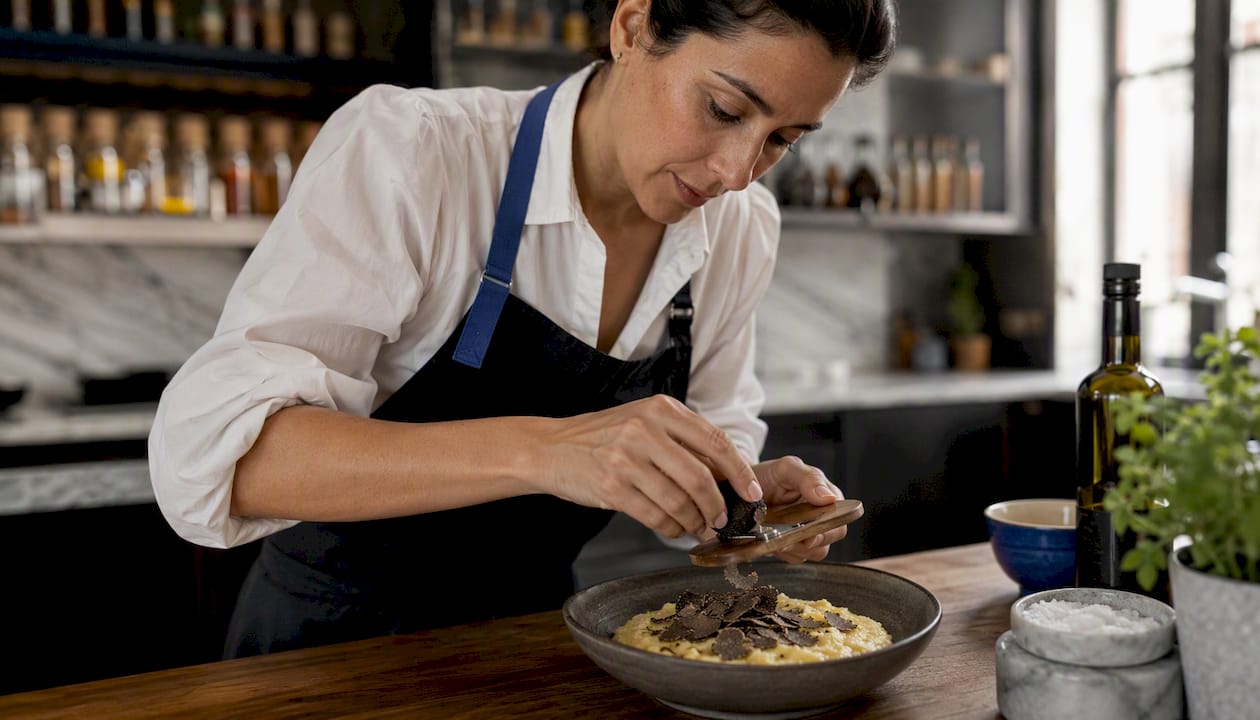
For Tuber magnatum and Tuber borchii, the technique is always the same: raw, shaved as thinly as possible, added at the very last moment over a warm surface. A truffle shaver with an adjustable blade is the correct tool, capable of producing translucent slices that release aroma on contact with the warmth of the dish without being cooked. For Tuber melanosporum and T. uncinatum, a microplane or fine grater works well for incorporation into sauces and butters, while a slicer is still preferred for finishing.
Pairing logic follows fat and starch. All premium truffle species pair most effectively with neutral, fat-rich carriers that amplify rather than compete with the aroma: unsalted butter, double cream, fresh egg pasta, risotto, polenta and mild fresh cheeses such as burrata or stracciatella. Proteins should be simple and unassertive: poached or fried eggs, roasted chicken breast, veal. Avoid acidic, spicy or heavily seasoned preparations, which suppress truffle volatiles.
Pro Tip: Add shaved or grated truffle to a dish no more than thirty seconds before it reaches the table. Truffle aroma is carried on volatile organic compounds that dissipate rapidly in open air; the longer the truffle sits exposed, the less the diner experiences.
A truffle knife and brush is the correct tool for cleaning fresh truffles before use. Never wash a truffle under running water; moisture accelerates decomposition and strips surface aromatics. Brush away soil gently, and clean only immediately before use, not in advance.
For those planning a luxury pairing experience, a glass of vintage champagne alongside a truffle course is one of the most refined combinations in the gourmet repertoire: the autolytic brioche notes of aged champagne harmonise with the earthy, honeyed complexity of melanosporum or magnatum in a way that few other beverages can match.
Pro Tip: Infuse truffle aroma into a dish without direct truffle contact by sealing the prepared plate in a cloche or cover with a few shavings for two minutes before service. Remove the shavings, plate them separately, and the base dish will carry a pronounced truffle perfume.
Seasonality and price reference for premium truffle varieties
The table below reflects Northern Hemisphere harvest windows alongside the Australian import calendar and domestic production season. Price brackets are indicative retail ranges for the Australian market and will vary by source, grade and seasonal supply.
| Species | Australian availability | Peak months | Wild or cultivated | Relative price |
|---|---|---|---|---|
| Tuber magnatum (white Alba) | Import only, Nov–Dec | November | Wild only | Highest |
| Tuber melanosporum (Périgord black) | Domestic Jun–Aug; import Nov–Mar | Jul (domestic), Dec (import) | Both | High |
| Tuber uncinatum (Burgundy) | Import only, Sep–Nov | October | Both | Moderate |
| Tuber aestivum (summer) | Import only, May–Aug | June–July | Both | Moderate–low |
| Tuber brumale (winter musky) | Import only, Nov–Mar | December | Wild-dominant | Moderate |
| Tuber borchii (bianchetto) | Import only, Jan–Apr | February–March | Both | Low–moderate |
| Tuber mesentericum (bagnoli) | Specialist import, Sep–Jan | October | Wild-dominant | Low |
Notes on price drivers:
- Wild-only status (magnatum) creates absolute supply constraints that no cultivation programme has yet resolved, keeping prices at a permanent premium regardless of demand.
- Domestic melanosporum from Western Australia and Tasmania has expanded supply during the Australian winter, moderating local prices for that species relative to European imports.
- Price spikes for any species occur when a poor harvest season reduces European supply, typically following drought or unusually warm autumn conditions in France, Italy or Spain.
- Cultivated specimens are generally more uniform in size and more stable in price than wild-harvested ones, though connoisseurs often argue that wild truffles carry greater aromatic complexity.
Why truffle oil is not a substitute for fresh truffle
The gap between fresh truffle and commercial truffle oil is not a matter of degree; it is a matter of chemistry. Most mass-produced truffle oils contain 2,4-dithiapentane, a single synthetic molecule that approximates one facet of truffle aroma. Fresh truffle aroma, by contrast, is the product of dozens of volatile organic compounds interacting simultaneously, including dimethyl sulphide, bis(methylthio)methane and a range of alcohols and aldehydes that vary by species, terroir and maturity.
A single synthetic molecule cannot replicate the aromatic architecture of a fresh truffle. What truffle oil delivers is a recognisable shorthand — a signal that reads as “truffle” to a diner who has never experienced the real thing. For a chef who has, it reads as a substitution.
This is not an argument against truffle oil in every context. A light rinse of quality truffle oil on a warm pizza base or a drizzle over a simple bruschetta can be a legitimate flavour choice when fresh truffle is unavailable or the dish does not warrant the cost. The error is presenting truffle oil as equivalent to fresh truffle, or using it in preparations where the complexity of the real ingredient would be transformative.
When purchasing truffle oil for legitimate use, look for products that declare a truffle percentage and carry a botanical name on the label. Products that list only “truffle flavour” or “natural truffle aroma” without a declared species are almost certainly synthetic. Some producers, such as those offering white truffle oil with declared ingredients, provide clearer labelling that allows you to assess what you are actually buying. The declared truffle percentage and the botanical name are the two non-negotiable markers of an authentic truffle-infused product.
Practical guidance for menu use:
- Never use truffle oil in a dish where fresh truffle is also present; the synthetic compound competes with and muddies the natural aroma.
- Truffle oil is most defensible in high-volume, casual applications where cost and availability make fresh truffle impractical.
- For any dish described on a menu as containing truffle, fresh truffle or a verified truffle-infused product with declared botanical content is the only honest choice.
Key takeaways
Freshness, seasonality and verified provenance are the three non-negotiable pillars of working with premium truffle varieties — species hierarchy matters far less than the condition of the truffle in your hand.
| Point | Details |
|---|---|
| Match species to season | Use T. aestivum in summer, T. uncinatum in autumn, magnatum in late autumn, melanosporum in winter. |
| Freshness overrides species rank | A fresh summer truffle outperforms a week-old Périgord; buy small quantities and use within three to five days. |
| Verify botanical name at purchase | Always request the Latin species name and harvest region in writing; this is the only reliable fraud protection. |
| Heat sensitivity varies by species | Magnatum and borchii must be used raw; melanosporum and aestivum tolerate gentle heat. |
| Aptent for curated sourcing | Aptent’s seasonal truffle range and accessories support provenance-verified purchasing in Australia. |
The case for provenance over prestige
There is a tendency in high-end dining to treat truffle species as a status hierarchy rather than a culinary toolkit, and it produces some of the most expensive mediocrity in the gourmet world. A Tuber magnatum that has spent ten days in transit and three more in a poorly managed cool room is not a luxury ingredient; it is an expensive disappointment. The species name on the label means nothing if the volatile aromatics have already dissipated.
Aptent’s position on this is straightforward: provenance and verified botanical labelling are not bureaucratic formalities. They are the practical mechanism by which a discerning buyer confirms that what they are paying for is what they are receiving. For high-net-worth clients hosting boutique events, or for chefs whose reputation rests on the integrity of every plate, that verification is the foundation of the entire experience. Truffle hunting with trained dogs rather than pigs, as is now standard practice in most reputable producing regions, reflects the same principle: sustainable, careful sourcing produces better truffles and preserves the grounds for future seasons. Provenance, in this sense, is not just an ethical preference. It is a quality signal.
Curated truffle accessories and gourmet experiences from Aptent
For those who take premium truffles seriously, the tools and the sourcing matter as much as the species itself.
Aptent offers a curated selection of specialist truffle accessories, including a precision truffle shaver and a truffle knife and brush set, chosen for the discerning cook who understands that the right instrument preserves aroma and presentation in equal measure. Every accessory is selected with the same attention to quality that Aptent applies to its broader gourmet range. For clients seeking a fully curated luxury experience, Aptent’s private gourmet events service brings together premium seasonal ingredients, expert curation and bespoke event design for individuals and corporate clients across Australia. Provenance and botanical verification are built into the sourcing process, not offered as an afterthought. Visit Aptent Gourmet to explore the current seasonal range or enquire about a private tasting event.
Authoritative sources and further reading
The following sources informed this guide and offer deeper technical detail for chefs and enthusiasts seeking primary-level reference material.
- Tasting Table — 8 Types of Truffles Explained: accessible overview including the chemistry of synthetic truffle oil compounds.
- PubMed — Volatile composition of Tuber magnatum: peer-reviewed research on the aromatic volatile compounds responsible for white truffle aroma.
- PubMed — Truffle aroma and volatile profiling: scientific analysis of aroma compound variation across truffle species and maturity stages.
- PMC — Truffle cultivation and ecology: research on cultivation methods, mycelium ecology and sustainable harvesting practices.
This article provides general culinary and sourcing information. For specific import regulations, food safety requirements or commercial purchasing decisions, confirm current rules with the relevant Australian authority or a qualified professional.


