
Champagne tower etiquette: your 2026 guide
Champagne tower etiquette is the set of refined practices governing the setup, pouring, and guest interaction with a champagne tower to create an elegant, safe, and memorable event focal point. Known formally as a champagne fountain in French service tradition, the tower is far more than a visual flourish. It demands precise glassware selection, controlled pouring technique, and attentive service management to succeed. For anyone planning a high-end wedding, gala, or corporate celebration, understanding what is a champagne tower etiquette means the difference between a breathtaking centrepiece and a costly, champagne-soaked mishap.
What is champagne tower etiquette and why does it matter?
Champagne tower etiquette is a framework of rules covering three distinct phases: construction, the ceremonial pour, and guest service. Each phase carries its own standards, and a failure in any one of them undermines the entire spectacle. The tower functions as both a service feature and a performance, so every decision from glass choice to attendant positioning shapes the guest experience.
The champagne fountain tradition originates in French fine dining service, where it was treated as a choreographed ritual rather than a casual party trick. That heritage informs every rule discussed here. Treating the tower with the same seriousness as a formal table service is the starting point for getting it right.
What are the essential rules for proper champagne tower setup?
The foundation of a flawless tower is the correct glassware. Coupe glasses are the accepted standard for champagne towers because their wide, shallow bowl and stable stem create the pyramid structure needed for the cascade effect. Flutes are structurally incompatible with tower construction. Their narrow base and tall profile make them prone to toppling, and the cascade cannot flow between them correctly.
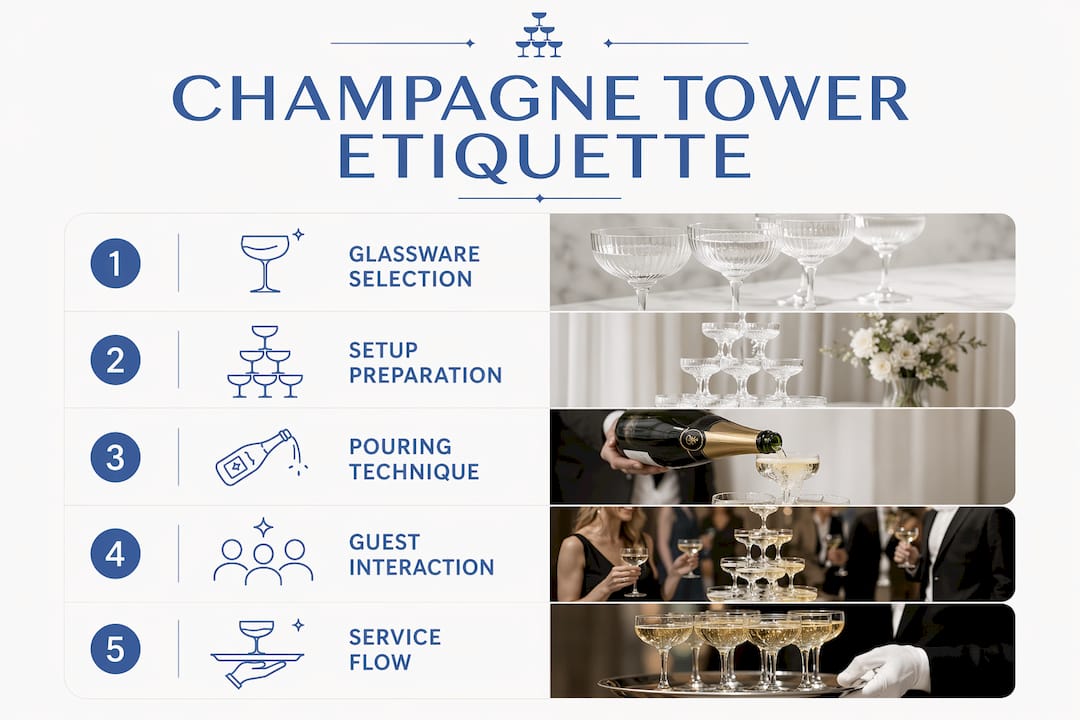
The surface beneath the tower is equally critical. The tower requires a perfectly level, non-carpeted, immovable surface positioned away from high-traffic areas. Card tables, bistro tables, and any surface with flex or give are unsuitable. A solid banquet table or a purpose-built plinth is the correct choice.
Key setup requirements include:
- Glass alignment: All glasses must touch their neighbours. Tightly aligned glass arrangement in a square formation ensures champagne flows down each tier without spillage and reinforces structural stability.
- Tray placement: Position a tray beneath the base tier to catch any overflow and protect the flooring or tablecloth.
- Traffic clearance: Mark a clear exclusion zone of at least one metre around the tower before guests arrive.
- Stability test: Gently press the base tier before pouring to confirm no movement. Never skip this step.
- Location selection: Avoid proximity to speakers, dance floors, or any area subject to vibration.
Pro Tip: Rehearse the full build at least 24 hours before the event. This reveals any surface irregularities and gives your team confidence with the glass arrangement before guests are present.
How should champagne be poured to maintain elegance?
The pour is the centrepiece of the entire ritual, and technique governs both the visual result and the taste of the champagne. A slow, steady rhythm is the governing principle. Pouring with a controlled rhythm preserves carbonation and minimises foam, which is critical for the cascade to flow cleanly rather than bubble over chaotically.
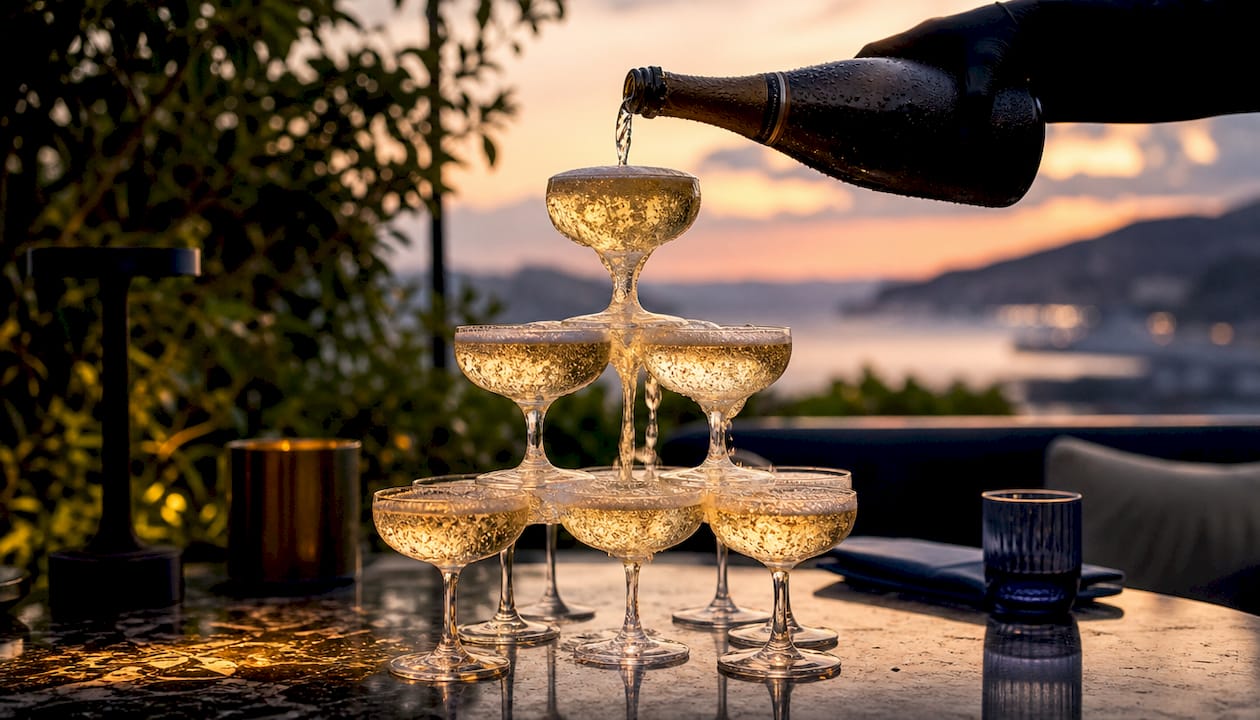
Temperature is the single most overlooked variable in champagne tower service. Champagne served between 6°C and 8°C produces the ideal carbonation level for a smooth cascade. Champagne that is too cold generates excessive foam that disrupts the visual effect. Champagne that is too warm loses carbonation too quickly and produces a flat, uninspiring flow. Understanding how champagne bubbles form helps you appreciate why temperature precision is non-negotiable.
The correct pouring sequence runs as follows:
- Chill the champagne to between 6°C and 8°C at least two hours before the event.
- Position the attendant at the apex of the tower, bottle held at a 45-degree angle to the top glass.
- Begin the pour slowly and steadily into the centre of the top glass, maintaining an even flow.
- Fill to two-thirds capacity in the top glass. This allows aromas to develop and prevents overflow before the cascade begins.
- Monitor the cascade as champagne flows to lower tiers. An attendant should observe each tier and manually top up any glass that does not fill from the cascade alone.
- Signal the photographer before the pour begins. The cascade lasts only seconds, and the visual peak is fleeting.
Pro Tip: Fill glasses to two-thirds, not to the brim. A full glass has no room for aroma and spills the moment a guest lifts it.
The traditional cascading pour often requires manual topping of lower tiers by attendants. This is not a failure of technique. It is standard practice, and guests expect to see an attendant moving gracefully around the tower during service.
What etiquette governs guest interaction and service flow?
Guest management is where many otherwise well-planned towers fall apart. The tower is a spectacle, not a self-service station, and the distinction matters enormously. A trained attendant is the single most important element of guest interaction etiquette. An attendant prevents crowding and ensures chilled glasses reach guests promptly, before the champagne warms and loses its appeal.
Stagnant, warm champagne is unappealing and reflects poorly on the host. Glasses should move from tower to guest within two to three minutes of the cascade completing. This requires the service team to be positioned and ready before the pour begins, not scrambling to find trays afterwards.
Guest interaction guidelines include:
- No unsupervised access: Guests must not reach into or lean against the tower at any point. The attendant controls all glass removal.
- Clear communication cues: The host or MC should signal when the cascade is complete and glasses are ready for collection. This prevents a rush.
- Staged service: Distribute glasses from the base tier outward. This maintains the tower’s visual integrity for photographs as long as possible.
- No toasting from the tower: Guests receive their glass, step back, and toast from a safe distance. Clinking glasses near the tower risks destabilising remaining tiers.
- Post-cascade transition: Once the tower is served, move guests away from the display area smoothly. A brief speech or musical cue works well as a transition device.
For broader event serving standards at high-end gatherings, the same principle applies: choreograph the service flow before guests arrive, not during.
How many glasses and bottles do you need for a champagne tower?
Quantity planning is a practical discipline that prevents two equally embarrassing outcomes: running out of champagne mid-cascade, or over-ordering and wasting a significant investment. A standard 750ml bottle fills approximately 6–8 coupe glasses. That ratio is the baseline for all planning calculations.
Common tower configurations and their requirements are as follows:
| Tower size (glasses) | Tiers | Bottles required | Standby bottles |
|---|---|---|---|
| 10 | 3 | 1–2 | 1 |
| 20 | 4 | 2–3 | 2 |
| 40 | 5 | 5–6 | 3 |
| 55 | 6 | 7–8 | 4 |
A 20-glass tower requires 2–3 bottles and a 40-glass tower needs approximately 5–6 bottles. These figures assume a clean cascade with no significant spillage. Always have standby bottles on ice, as the cascade rarely fills every glass to exactly two-thirds without some manual topping.
Glass uniformity is non-negotiable for structural reasons. Mixing coupe sizes, even slightly, creates uneven weight distribution across tiers and increases collapse risk. Source all glasses from a single batch and inspect each one for chips or cracks before building. For champagne selection guidance suited to tower volumes, the style of champagne matters as much as the quantity.
Pro Tip: Order 20% more glasses than your tower requires. Breakages during setup are common, and having spares on hand avoids last-minute reconfiguration.
Common champagne tower mistakes and how to avoid them
The most frequent errors in champagne tower service are predictable and entirely preventable. Common mistakes include using flute glasses, unstable surfaces, quick pouring, and neglecting an attendant, each of which leads to collapse, spillage, or a poor guest experience.
The errors that cause the most damage, and how to prevent them:
- Using flutes instead of coupes: Flutes cannot form a stable pyramid. The cascade has no surface to flow across. Replace them with coupes without exception.
- Building on an unstable surface: Carpet, grass, and folding tables all flex under the weight of a full tower. Test the surface before committing to a location.
- Pouring too quickly: A fast pour generates foam that overflows before the cascade can form. Slow down and maintain a steady, deliberate rhythm.
- No dedicated attendant: An unmanaged tower invites guests to help themselves, which destabilises the structure and results in warm, neglected champagne.
- Incorrect temperature: Champagne served outside the 6°C to 8°C window either foams excessively or falls flat. Use a calibrated wine cooler, not a standard ice bucket, for precise temperature control.
- Skipping the rehearsal: A tower built for the first time during an event is a tower built with unnecessary risk. Rehearse the full construction and pour at least once beforehand.
The champagne tower as a performance rewards preparation and punishes improvisation. Every mistake on this list is the result of skipping a step that takes minutes to address in advance.
Key takeaways
Champagne tower etiquette requires coupe glasses, a level surface, a trained attendant, and a controlled pour at 6°C to 8°C to deliver a safe and visually magnificent result.
| Point | Details |
|---|---|
| Coupe glasses are mandatory | Flutes cannot form a stable pyramid; coupes provide the wide rim and stem structure required. |
| Surface and location are critical | Use a solid, level, non-carpeted surface away from traffic and vibration at all times. |
| Temperature controls the cascade | Serve champagne at 6°C to 8°C to prevent excessive foam and ensure a clean, flowing cascade. |
| A trained attendant is non-negotiable | Attendants manage the pour, top lower tiers manually, and serve guests promptly after the cascade. |
| Plan quantities with standby bottles | A 20-glass tower needs 2–3 bottles; always keep extra bottles chilled and ready for service. |
What I have learned from years of champagne tower service
The most common misconception about champagne towers is that the pour is the hard part. It is not. The hard part is the 48 hours before the event, when every decision about surface, glassware, temperature, and staffing is made. By the time guests arrive, the outcome is largely determined.
What separates a tower that guests remember from one they merely witness is pacing. The cascade lasts perhaps 30 seconds. The build-up, the positioning of guests, the signal from the host, the silence before the pour: these are what create the moment. A tower poured without ceremony is just a wet table. Treat it as theatre, and it becomes the defining memory of the evening.
One insight that rarely appears in standard guides: brief your photographer separately from your service team. The photographer needs to know the exact moment the pour begins. The service team needs to know the exact moment it ends. These are two different cues, and conflating them results in either a missed photograph or a delay in serving warm champagne.
Aptent’s experience working with high-net-worth clients at boutique events has reinforced one truth consistently. The guests who appreciate a champagne tower most are not impressed by its size. They are impressed by the quality of the champagne, the precision of the service, and the confidence of the host. A modest four-tier tower poured with a grand cru vintage and served by a composed, well-briefed attendant outperforms a six-tier tower of indifferent sparkling wine every time.
— Aptent
Aptent’s champagne collection for your tower
Aptent curates a selection of premium French champagnes sourced from prestigious grower houses, each chosen for its character, provenance, and suitability for high-end event service. Whether you are planning an intimate wedding tower or a grand gala centrepiece, the right champagne transforms the ritual into something genuinely memorable.
The Aptent team provides personalised guidance on champagne selection for events, pairing the volume and style of your tower with the ideal cuvée. For those seeking the pinnacle of the tower experience, the Le Secret de Jules vintage offers the depth and effervescence that a ceremonial pour demands. Visit Aptent Gourmet to explore the full range and speak with a specialist about your event.
FAQ
What glasses are used for a champagne tower?
Coupe glasses are the only suitable choice for a champagne tower. Their wide, shallow bowl creates the stable pyramid structure and allows champagne to cascade between tiers.
How many bottles do I need for a champagne tower?
A 20-glass tower requires 2–3 bottles and a 40-glass tower needs approximately 5–6 bottles. Always keep additional bottles chilled on standby to top up glasses manually.
What temperature should champagne be for a tower?
Champagne should be served between 6°C and 8°C. This temperature range minimises excess foam and produces a smooth, visually clean cascade.
Do I need an attendant for a champagne tower?
Yes. A trained attendant manages the pour, manually tops lower tiers, prevents guest crowding, and ensures chilled glasses are served promptly after the cascade.
Can I use any sparkling wine in a champagne tower?
Any quality sparkling wine with consistent carbonation works structurally, but the visual and sensory result improves significantly with a well-chosen champagne. The carbonation level and temperature control remain the same regardless of the wine selected.


