
Why wine has tannins: the complete guide
Wine contains tannins because grapes produce them as natural plant metabolites, primarily concentrated in the skins, seeds, and stems of the berry. These polyphenolic compounds serve a protective function in nature, making unripe fruit bitter and unappealing to birds and insects until the seeds are ready for dispersal. In winemaking, particularly for red wines, tannins become the very architecture of the glass: they contribute bitterness, astringency, structural complexity, and the capacity to age with extraordinary grace. Without them, a fine Cabernet Sauvignon or Barossa Shiraz would be little more than coloured fruit juice.
Tannins are not a single compound but a broad class of polyphenols that bind readily to proteins, a property that defines both their sensory character and their preservative role in wine. They arrive in the wine primarily through maceration, the process by which fermenting juice spends time in contact with grape solids. Oak barrels contribute a secondary source of hydrolysable tannins during ageing. The result is a wine of depth, longevity, and the kind of textural refinement that distinguishes a cellar-worthy bottle from one meant for immediate consumption.
What do tannins actually taste like in wine?
Tannins produce two distinct sensations that are frequently conflated: bitterness and astringency. Bitterness is a true taste, perceived by receptors on the tongue and soft palate. Astringency is something altogether different, a tactile sensation rather than a flavour, caused by tannins binding salivary proteins and precipitating them out of solution, which reduces lubrication in the mouth and creates that characteristic drying, puckering feeling.
The sensation is not unlike drinking a very strong, stewed cup of tea. Run your tongue across your upper teeth after a sip of young Cabernet Sauvignon and you will feel the roughness and dryness that tannins leave behind. This is not unpleasant in a well-made wine; it is, in fact, a mark of structure and potential. The intensity varies considerably: seed tannins tend toward bitterness because of their smaller molecular size, while the longer polymer chains of skin tannins register more as astringency.
Tannin perception also shifts depending on what else is in the glass. High acidity amplifies the sensation of astringency, while residual sweetness can soften it. A wine with both firm tannins and vibrant acidity, such as a young Coonawarra Cabernet, can feel almost austere on its own, yet utterly composed alongside the right dish.
Pro Tip: Tannins interact with dietary fat and protein to soften their astringent impact, which is precisely why a well-marbled steak and a tannic red wine elevate each other so naturally. The fat restores mouth lubrication that tannins temporarily removes.
Where do tannins come from in the winemaking process?
The origins of tannins in wine are multiple, and understanding each source clarifies why red wines carry so much more tannic weight than whites.
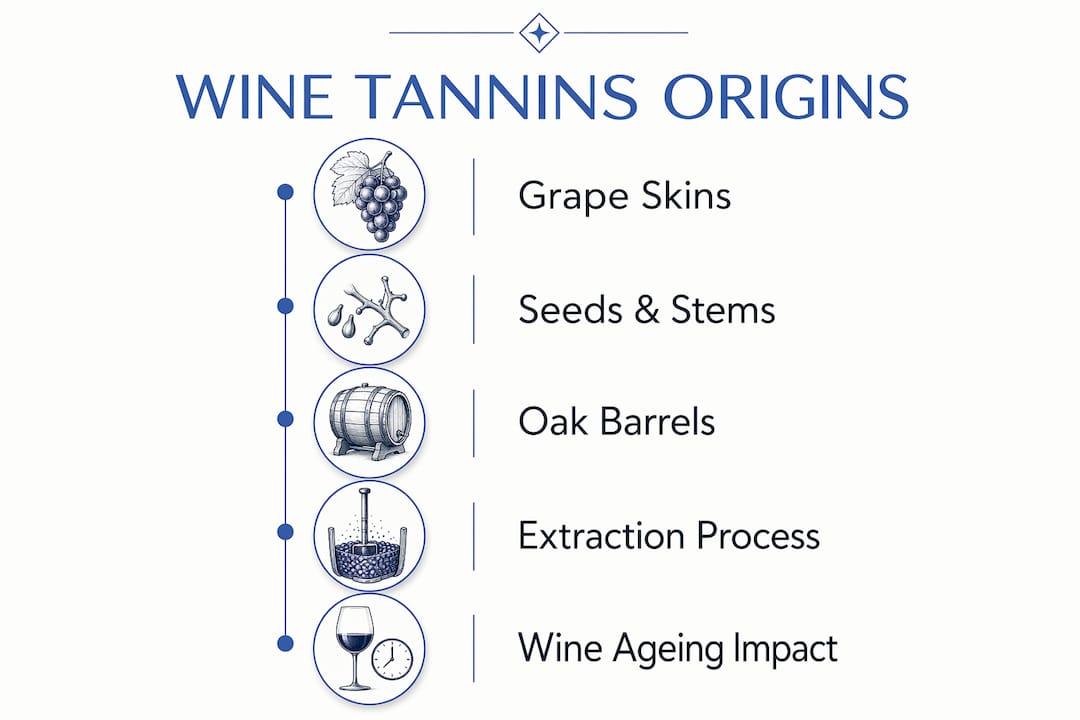
Grape skins are the most significant source of condensed tannins, also known as proanthocyanidins. Skin tannins are composed of long polymeric chains, ranging from 3 to 83 subunits in length, and they extract readily once alcohol forms during fermentation. Seeds contribute smaller, more bitter tannins with chains of just 2 to 16 subunits; their extraction is slower because the physical structure of the seed resists the process. Stems, when intentionally included by the winemaker, add a further layer of tannin, a technique occasionally used for varieties like Pinot Noir where the skins are thin and tannin levels naturally modest.
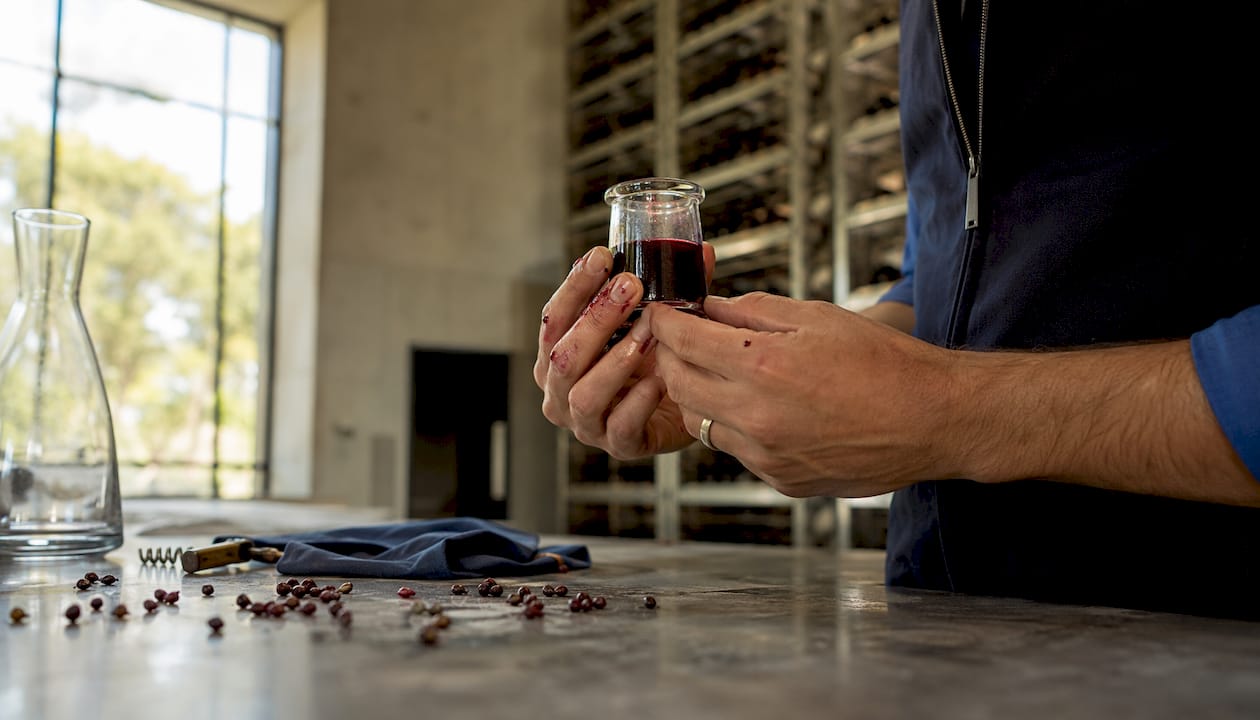
Maceration time is the primary lever a winemaker pulls to control tannin extraction. Longer skin contact yields higher tannin concentration; shorter contact produces a lighter, more approachable style. White wines typically undergo no maceration at all, which is why they carry negligible tannin. Some dry white wines do contain 100–300 mg/L of tannins due to juice settling processes, but this is the exception rather than the rule.
Oak barrels provide a secondary source of hydrolysable tannins, chemically distinct from the condensed tannins of the grape. Oak-derived tannins reach a maximum concentration of approximately 250 mg/L, far below the 2–4 g/L of condensed tannin that grape skins can contribute. New barrels impart more tannin than older ones; French oak tends to give finer, more integrated tannins than American oak, which can be more assertive.
How tannins shape wine structure, ageing, and complexity
Tannins are the structural backbone of a red wine, providing the framework that holds fruit, acidity, and alcohol in balance. Without sufficient tannin, a wine can feel flat and shapeless, lacking the tension that makes a great bottle compelling. With too much, particularly from unripe sources, it becomes harsh and unpleasant.
The relationship between tannins and ageing is one of the most fascinating aspects of fine wine. As a wine matures in bottle, tannin molecules undergo polymerisation, forming longer and longer chains that eventually exceed their solubility and precipitate as sediment. This process, which can be partially accelerated by micro-oxygenation or decanting, gradually transforms the aggressive astringency of a young wine into something softer, more complex, and profoundly satisfying. The Australian Wine Research Institute confirms that tannins act as natural preservatives, stabilising colour through reactions with oxygen and anthocyanins, and that managing them well is central to producing wines of genuine longevity.
Varieties with naturally high tannin levels, such as Tannat, Nebbiolo, and Sagrantino, are celebrated for their capacity to age for decades, their tannins resolving over time into what collectors describe as “bottle bouquet.” For those building a cellar, understanding tannins and wine ageing is as fundamental as understanding vintage variation. A tannic wine that seems forbidding at five years can be transcendent at fifteen.
Which wines have high or low tannins, and how does that affect food pairing?
Tannin levels vary enormously across red wine styles, and knowing where a wine sits on that spectrum shapes every pairing decision at the table.
Among red varieties, Cabernet Sauvignon, Nebbiolo, Syrah, and Tannat sit at the high-tannin end of the spectrum. These are wines built for the table and for the cellar. Pinot Noir and Gamay occupy the opposite pole, offering lighter, more silken tannins that make them far more versatile with food. Merlot and Sangiovese fall somewhere in between, with medium tannin levels that suit a broad range of dishes.
White wines, as noted, carry minimal tannin. Their structural element is acidity, not polyphenolic grip. Orange wines, made with extended skin contact on white grapes, are a notable exception and can carry tannin levels that rival a light red.
Food pairing with tannic wines follows a straightforward principle: fat and protein soften astringency. A richly marbled ribeye alongside a Barossa Shiraz, or a slow-braised lamb shoulder with a structured Clare Valley Cabernet, are pairings where both the wine and the food become more expressive together. Conversely, serving a highly tannic wine with delicate fish or leafy salads tends to amplify the wine’s astringency unpleasantly. For those exploring premium red wines with serious tannic structure, the pairing principle is simple: match the weight of the wine to the richness of the food.
What Australian wine research tells us about tannin quality
Australia’s contribution to the science of wine tannins is considerable, with the Australian Wine Research Institute (AWRI) at the forefront of understanding how tannin quality, not just quantity, determines the character of a finished wine.
Tannin concentrations in red wines vary from 50 mg/L in wines from certain hybrid grape species to 4,000 mg/L in wines from Vitis vinifera varieties. That range encompasses the full spectrum from a light, barely-there red to a wine of formidable structure. The AWRI’s research makes clear that ripeness at harvest is the single most influential factor in tannin quality. Grapes harvested before full phenolic maturity yield what winemakers call “green” tannins: aggressive, angular, and drying in a way that does not resolve gracefully with age. Grapes harvested at optimal ripeness produce tannins that are refined and less aggressive, with a texture that integrates beautifully over time.
The distinction between skin and seed tannins matters practically in the winery. Seed tannins extract more slowly than skin tannins and tend toward bitterness; winemakers who extend maceration to build colour and body must monitor seed extraction carefully to avoid an excess of harsh, bitter character. Skin tannins, by contrast, extract more readily with alcohol and contribute the broader, more astringent sensation associated with full-bodied reds. The AWRI’s position, grounded in decades of research, is that tannins are to be managed with precision, not eliminated. The goal is always balance: enough tannin to provide structure and longevity, refined enough to allow the wine’s fruit and complexity to speak clearly.
Key takeaways
Wine tannins are polyphenolic compounds derived primarily from grape skins, seeds, and stems that provide structure, astringency, and ageing potential, with red wine concentrations ranging from 50 mg/L to 4,000 mg/L depending on variety and winemaking technique.
| Point | Details |
|---|---|
| Tannin origins | Grape skins, seeds, and stems are the primary sources; oak barrels contribute up to approximately 250 mg/L of hydrolysable tannins. |
| Astringency vs bitterness | Astringency is a tactile sensation from protein binding, not a taste; seed tannins tend to be bitter, skin tannins more astringent. |
| Ageing potential | Polymerisation softens tannins over time; high-tannin varieties like Tannat and Nebbiolo are suited to long-term cellaring. |
| Ripeness at harvest | Under-ripe grapes yield harsh “green” tannins; optimal phenolic maturity produces refined, age-worthy tannins. |
| Food pairing | Fat and protein soften tannin astringency, making rich, protein-heavy dishes the natural companions for tannic red wines. |
Discover refined wines and gourmet pairings with Aptent

For those who appreciate wine at this level of depth, the experience of pairing a structured, tannic red with exceptional food is one of the great pleasures of the table. Aptent curates a selection of grand cru wines and rare cuvées sourced from prestigious producers, chosen precisely for the kind of complexity and ageing potential that tannins make possible. Whether you are building a cellar or planning a bespoke event, Aptent’s collection reflects the same commitment to refinement that the finest winemakers bring to tannin management itself.


