
What is a wine appellation? A clear guide for enthusiasts
A wine appellation is a legally protected geographic designation that identifies where wine grapes were grown and defines the production standards that apply to wines from that area. The term is the everyday English equivalent of the formal industry phrase “designation of origin,” and both terms appear on labels worldwide. Appellations act as a wine’s birth certificate, assuring you that the wine in your glass genuinely comes from the place named on the label. Regulatory bodies such as France’s INAO, the United States’ TTB, and the European Union enforce these rules, each with different levels of stringency. Understanding wine appellation meaning gives you a reliable starting point for decoding any bottle, whether it carries a French AOC, an Italian DOCG, or an Australian Geographical Indication.
What is a wine appellation and how does it work?
A wine appellation is a defined geographic zone whose name a producer may legally print on a label, provided the wine meets origin and production rules set by the relevant authority. The designation certifies grape origin, not a particular flavour or style. Appellations authenticate wine origin and protect both consumers and producers from fraud. Without this framework, a bottle labelled “Burgundy” could theoretically contain grapes grown anywhere on earth.
The rules governing how wine appellations work vary significantly by country. In France, the INAO administers the Appellation d’Origine Contrôlée system, which regulates permitted grape varieties, maximum yields, and winemaking methods. In the United States, the TTB oversees American Viticultural Areas, which define geographic boundaries but impose no restrictions on grape varieties or winemaking technique. Australia’s system of Geographical Indications, administered under the Australian Grape and Wine Authority framework, sits closer to the American model in its geographic focus.
The European Union consolidated its wine protection rules under EU Regulation No 1308/2013, creating two main categories: Protected Designation of Origin (PDO) and Protected Geographical Indication (PGI). These categories carry international legal standing under the WTO’s TRIPS agreement, Article 22, meaning member countries are obliged to prevent misuse of protected names. That legal reach is why you cannot legally sell a sparkling wine as “Champagne” unless it comes from the Champagne region of France.
How do different global appellation systems compare?
The world’s major appellation systems share a common purpose but differ sharply in what they regulate. The table below summarises the key features of the principal systems.
| System | Country | Governing body | Regulates winemaking? | Key focus |
|---|---|---|---|---|
| AOC | France | INAO | Yes, strictly | Grapes, yields, methods |
| DOC/DOCG | Italy | ICQRF | Yes, strictly | Grapes, yields, ageing |
| DO/DOCa | Spain | MAPA | Yes | Grapes, yields, methods |
| AVA | USA | TTB | No | Geographic boundary only |
| GI | Australia | AGWA | No | Geographic boundary only |
France’s AOC system, established in the 1930s, remains one of the most prescriptive in the world. A Châteauneuf-du-Pape producer, for example, must work within rules covering up to 18 permitted grape varieties, maximum alcohol levels, and vineyard management practices. Italy’s DOCG designation sits at the apex of its system, requiring additional tasting panel approval before wines can be bottled and sold.
Old World appellations emphasise terroir and traditional methods, while New World systems focus on vineyard location without regulating winemaking. This philosophical difference shapes what you can expect from a label. A Barossa Valley GI wine could be made from any grape variety using any technique the winemaker chooses, whereas a Barolo DOCG must be 100% Nebbiolo, aged for a minimum period, and produced within a tightly defined zone in Piedmont.
Pro Tip: When you see a PDO or DOP stamp on a European wine, you are looking at the EU’s formal equivalent of a national AOC or DOCG designation. The acronym changes by language, but the legal protection is identical. For a broader look at how geographic indications apply across food and beverage categories, the IGP quality framework used in artisan spirits offers a useful parallel.
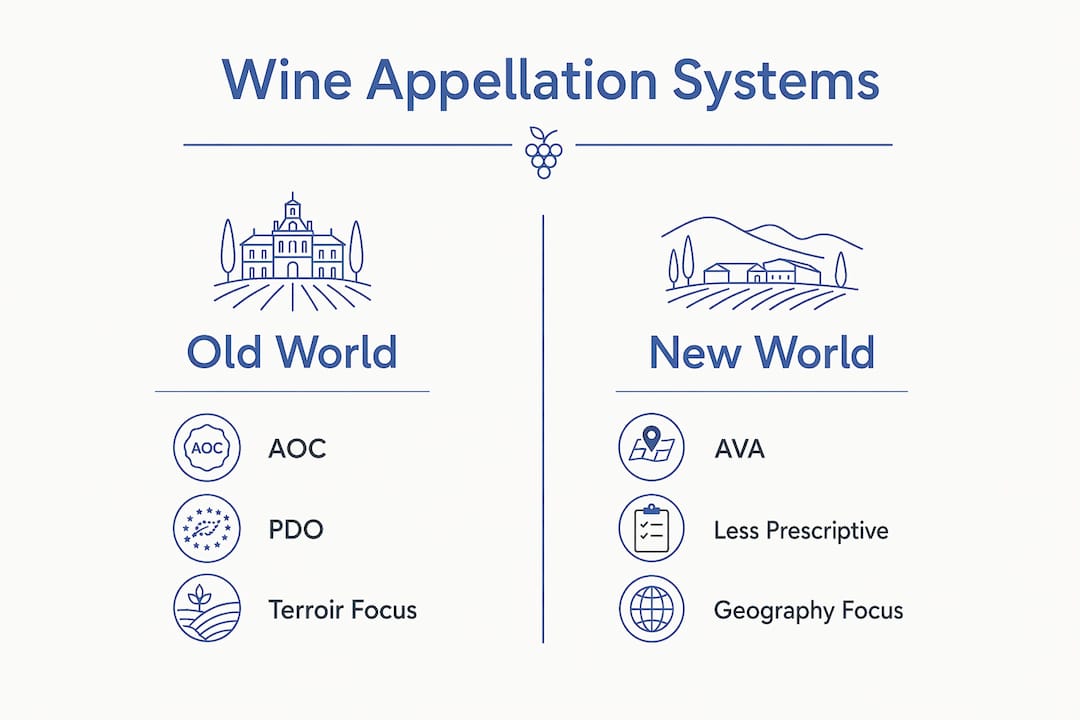
The over 270 AVAs that exist in the United States today range from enormous zones like California to tiny sub-appellations like Stags Leap District in Napa Valley. That number reflects how the AVA system rewards geographic specificity without imposing stylistic uniformity.
What does a wine appellation label tell you?
A wine label bearing an appellation name tells you where the grapes were grown and, in Old World systems, which varieties and methods were used. It does not tell you whether the wine is good. Reading the label well requires understanding both what the designation promises and what it leaves open.
In the US, at least 85% of grapes must originate from the named AVA for that name to appear on the label. That 15% margin allows blending flexibility without stripping the geographic claim. European rules are generally stricter, with many PDO wines requiring 100% origin from the named zone.
Label laws also prioritise specificity. A wine can only claim one, most specific geographic appellation based on where its grapes were grown. A producer whose vineyard sits within Pomerol cannot also claim the broader Bordeaux appellation on the same bottle. This rule protects the integrity of sub-regional designations and prevents producers from trading on a famous name when their fruit comes from a more modest location.
Practical things to look for on a label:
- AOC or AOP: French or EU Protected Designation of Origin. Expect strict grape and method rules.
- DOCG: Italy’s highest designation. Tasting panel approval required before release.
- AVA: American Viticultural Area. Geographic boundary only; style varies widely by producer.
- GI: Australian Geographical Indication. Origin certified; winemaking style unrestricted.
- DO/DOCa: Spanish designations, with DOCa reserved for the most prestigious regions such as Rioja and Priorat.
Pro Tip: If a label shows both a sub-regional and a regional appellation, the sub-regional name is the one that legally defines the wine’s origin. Use the sub-regional name when researching the wine’s expected style, not the broader regional label.
Appellations do not guarantee a particular flavour profile, ageing potential, or producer skill. Two bottles of Burgundy Premier Cru from the same vintage and vineyard can taste entirely different depending on who made them. The designation tells you the rules were followed; it does not tell you the rules produced something exceptional.
Why do appellations matter for wine character and enjoyment?
Appellations matter because geography shapes flavour. The concept of terroir, which encompasses soil composition, topography, macroclimate, and mesoclimate, creates conditions that no winemaker can fully replicate elsewhere. An appellation boundary, at its best, captures a coherent set of natural conditions that express themselves consistently across vintages.
Mesoclimate and producer skill greatly affect wine character beyond the region’s macroclimate. A vineyard on a north-facing slope within an appellation will produce grapes with different ripeness and acidity than one on a south-facing slope 500 metres away. Both wines may carry the same appellation name, yet taste markedly different. Understanding this helps you use appellations as a guide rather than a guarantee.
For wine enthusiasts, appellations help predict grape varieties and broad stylistic expectations. Knowing that Chablis is a PDO within Burgundy that permits only Chardonnay, grown on Kimmeridgian limestone soils, tells you to expect a lean, mineral white with high acidity. Knowing that a Barossa Valley GI Shiraz comes from a warm, continental climate tells you to expect ripe, full-bodied fruit. The vintage variation within those regions then layers additional nuance onto those baseline expectations.
Old World producers tend to see the appellation as the primary author of the wine’s character, with the winemaker’s role being to express that place faithfully. New World producers more often treat the appellation as a backdrop, with winemaking philosophy and brand identity taking centre stage. Neither approach is superior; they simply produce different kinds of wines and different kinds of label information.
Common misconceptions about wine appellations
The most persistent misconception is that a prestigious appellation guarantees a great wine. Appellations guarantee process compliance with geographic and production rules, not the hedonic quality of the wine. A Champagne AOC wine can be poorly made. A Napa Valley AVA wine can be extraordinary. The designation tells you the rules were followed, not that the result is worth drinking.
Several other myths deserve direct correction:
- Myth: Stricter rules mean better wine. Stricter rules mean more consistent style, not necessarily higher quality. Producer skill and vineyard management remain the decisive factors.
- Myth: A broader appellation means lower quality. A regional Burgundy from a gifted producer can outperform a Premier Cru from a careless one.
- Myth: New World wines lack the rigour of Old World appellations. New World systems prioritise geographic authenticity; they simply leave stylistic decisions to the producer.
- Myth: Appellations are permanent and unchanging. Climate change is already forcing regulatory bodies to reconsider permitted varieties and zone boundaries. Bordeaux, for example, approved new grape varieties in 2021 to help producers adapt to warming temperatures.
Strict appellation rules can limit producers’ flexibility to adapt to climate change or innovate with grape varieties, posing genuine challenges to traditional systems. The tension between preserving heritage and allowing adaptation is one of the defining debates in the wine world today.
Appellations also carry a marketing dimension that is easy to underestimate. A famous appellation name adds commercial value to a bottle regardless of what is inside it. That value can attract investment and elevate an entire region, but it can also sustain mediocre producers who trade on a prestigious postcode. The discerning wine enthusiast learns to look past the appellation name and investigate the producer.
Key takeaways
A wine appellation is a legally defined geographic designation that certifies grape origin and, in Old World systems, enforces production rules, but it does not guarantee the quality of what is in the bottle.
| Point | Details |
|---|---|
| Legal origin guarantee | An appellation certifies where grapes were grown, not how good the wine tastes. |
| Old World vs New World | Old World systems regulate grapes and methods; New World systems focus on geographic boundaries only. |
| Label specificity rule | A wine carries only its most specific qualifying appellation; broader regional names cannot override a sub-regional one. |
| 85% origin rule (AVA) | In the US, at least 85% of grapes must come from the named AVA for the name to appear on the label. |
| Producer skill matters | Within any appellation, quality varies widely based on vineyard management and winemaking decisions. |
Aptent’s perspective on reading appellations with confidence
Reading appellation labels well is a skill that takes time, and the learning curve is steeper than most wine guides admit. The names change by country, the acronyms multiply, and the rules shift depending on which regulatory body is in charge. What I have found, after years of curating wines from prestigious producers across France, Italy, and beyond, is that the appellation is best treated as a conversation starter rather than a verdict.
The most revealing thing an appellation tells you is not quality but context. When you see Rhône Valley wines labelled under the Châteauneuf-du-Pape AOC, you know you are dealing with a warm, southern French terroir, a blend likely dominated by Grenache, and a regulatory framework that has been refining its rules since the 1930s. That context shapes how you approach the wine before you even open the bottle.
Where I see novices go wrong most often is in treating the appellation as a quality score. A Grand Cru Burgundy label does not mean the wine is better than an unclassified bottle from a gifted producer in the same village. The appellation tells you the rules were followed. The producer’s name on the label tells you whether those rules were followed with care and ambition. Use both pieces of information together, and you will make far better choices than relying on either alone.
The wine and food pairing decisions that give the most pleasure are almost always grounded in a genuine understanding of where a wine comes from. Appellations, for all their complexity, are the most reliable map we have.
— Aptent
Aptent’s curated wines, chosen with appellation integrity in mind
Aptent sources wines with a clear understanding of what each appellation represents, so you receive bottles whose labels reflect genuine origin and production standards.
The Grand Cru collection at Aptent brings together wines from the most celebrated appellations in France and beyond, each selected for the integrity of its origin and the distinction of its producer. Whether you are building a cellar or choosing a bottle for a significant occasion, every wine in the collection carries an appellation that has been verified, not merely printed. For those who prefer to explore the full breadth of Aptent’s curated selection, the Aptent Gourmet store offers wines, caviar, and gourmet provisions chosen with the same rigour applied to every label.
FAQ
What is the simplest definition of a wine appellation?
A wine appellation is a legally protected geographic name that certifies where a wine’s grapes were grown and, in many systems, the production rules that apply. It is the formal equivalent of a wine’s birth certificate.
Does a prestigious appellation guarantee a high-quality wine?
No. Appellations guarantee compliance with geographic and production rules, not the taste or quality of the wine. Producer skill and vineyard management determine quality within any appellation.
How does an AVA differ from a French AOC?
An AVA defines a geographic boundary only, with no rules on grape varieties or winemaking. A French AOC regulates permitted grapes, maximum yields, and production methods within the same geographic framework.
What does the 85% rule mean on a US wine label?
At least 85% of the grapes in the wine must originate from the named AVA for that appellation to appear on the label. The remaining 15% may come from outside the designated area.
Can a wine carry more than one appellation on its label?
No. Label laws require a wine to display only its single most specific qualifying appellation. A wine from a sub-appellation cannot simultaneously claim a broader regional designation on the same label.


