
Artisan food production: a practical guide
Artisan food production is the making of food in small, limited batches by a skilled craftsperson using traditional, largely hand-driven methods rather than full automation. It is the deliberate opposite of the industrial production line, a smaller output, a named maker, and a process built around flavour and provenance rather than speed.
A handful of characteristics separate genuine artisan food from anything wearing the label as decoration:
- Limited scale — production runs in small batches, typically within a single micro-enterprise rather than a factory network.
- Skilled craft — a trained maker, not a machine, controls the critical steps: fermentation timing, curing, hand-shaping.
- Provenance focus — ingredients are traceable, frequently local, and the maker can usually name where they came from.
- Traditional method — techniques passed down or learned through apprenticeship, rather than optimised purely for throughput.
If you’re buying rather than making, the practical shortcut is this: look for traceability and small-batch cues on the label or from the seller directly, because those two signals do more to separate the genuine article from marketing gloss than any other detail on the packet.
Key takeaways
Artisan food production combines small-batch scale, skilled hand-craft and traceable provenance to create distinctive food that mass automation cannot replicate.
| Point | Details |
|---|---|
| Core definition | Artisan food production means small-batch, traditionally made food overseen by a skilled maker, not a factory line. |
| The defining quartet | Place, product, passion and personality shape every genuine artisan product, according to academic research on the topic. |
| Key techniques | Fermentation, curing, smoking, hand-processing and slow ageing build the flavour and texture mass production shortcuts. |
| Verify, don’t assume | Genuine provenance shows up as specific sourcing detail and direct producer engagement, not marketing adjectives. |
| Training pathways exist | Apprenticeships, TAFE-equivalent courses and dedicated degrees like NTU’s Artisan Food Production BSc build both craft and business skills. |
Table of Contents
- What is artisan food production, exactly?
- What kinds of foods count as artisan products?
- How is artisan food made? The core techniques
- What skills and training do artisan food makers need?
- How does artisan food production differ from mass production?
- What food-safety and labelling rules apply to artisan producers?
- How can you tell if a product is genuinely artisan?
- Why does provenance matter more than the label itself?
- Why provenance drives every sourcing decision Aptent makes
- Frequently asked questions
- Sources
What is artisan food production, exactly?
Academic work on the subject frames artisan food production around four elements often called the quartet: place, product, passion and personality. Each one shapes what ends up on the plate, and each one is missing, or diluted, in a factory setting.
Place refers to the geography and micro-climate behind an ingredient. Product means the physical characteristics that traditional methods produce, the open crumb in a slow-fermented loaf, the rind on a raw-milk cheese. Passion is the maker’s personal investment in getting the process right rather than just getting it done. Personality is the individual signature a specific artisan brings, which is why two makers using the same recipe still produce noticeably different results. Researchers who study this area note that the quartet ties tradition to both experiential knowledge and scientific understanding, rather than treating “artisan” as a purely nostalgic idea. Their work on what makes food artisan is the clearest academic account of the concept currently available.
Regulators have tried to turn that quartet into something measurable. Food safety authorities generally test artisan claims against a set of objective criteria, and while wording varies by jurisdiction, the pattern is consistent, reflecting the benefits and challenges of local sourcing.
| Criterion | What it usually means in practice |
|---|---|
| Limited quantities | Output stays well below industrial volumes, often capped by micro-enterprise rules |
| Skilled craftsperson | A trained individual directly performs or supervises the critical production steps |
| Non-fully mechanised methods | Machines may assist, but hands-on judgement still drives key stages |
| Single micro-enterprise | Production happens under one small business, not across a distributed factory network |
| Local characteristic ingredients | Inputs reflect a specific region or terroir rather than generic commodity supply |
This framework mirrors FSAI’s marketing terms guidance, and a similar structure appears in Decree 174/2019, which defines artisan food production as small-scale, environmentally considered, and personally overseen by the artisan rather than delegated to a production manager.
Applied to bread, the quartet looks like this: place supplies the grain and water, product is the open, chewy crumb that slow fermentation builds, passion is the baker’s early mornings tending a living starter, and personality shows up in the shape and scoring pattern unique to that baker’s hands. Applied to cheese, place is the pasture and the milk it produces, product is the rind and paste that ageing develops, passion is the daily attention a wheel demands over weeks or months, and personality is the flavour signature that no two cheesemakers, using the same recipe, quite replicate.
What kinds of foods count as artisan products?
The category is broader than most people assume, stretching well past bread and cheese into almost every food type where hand skill and time matter more than throughput. Wikipedia’s overview of artisanal food groups the common categories usefully:
- Bread — slow, often wild fermentation builds flavour and structure that commercial yeast shortcuts skip.
- Cheese — frequently made from single-origin or raw milk, with ageing times that can stretch from weeks to years.
- Preserves — small-batch jams, chutneys and pickles, usually tied to a specific season’s harvest.
- Cured meats — salumi, prosciutto and similar products that depend on precise humidity and time rather than speed.
- Chocolates — bean-to-bar makers who control roasting and conching by hand rather than by industrial formula.
- Oils and vinegars — cold-pressed or barrel-aged products where the source, the olive variety or the mother culture, drives the result.
- Beverages — small-batch wine, beer, cider and spirits made with distinct terroir or fermentation choices.
- Ice cream — churned in small batches, often made with seasonal or single-source ingredients rather than a fixed year-round formula.
What ties these categories together is variability. A factory batch of crackers tastes identical whether it’s the first pallet or the ten-thousandth. An artisan batch of cheese changes with the season the milk was drawn, the humidity in the ageing room that month, even the mood of the starter culture. That inconsistency isn’t a flaw. It’s the point, and it’s why no two jars from the same small producer are ever perfectly identical.
How is artisan food made? The core techniques
Artisan production leans on a handful of techniques that industrial processing tends to shortcut or skip entirely, because each one trades speed for flavour, texture or shelf stability.
Fermentation develops flavour compounds and acidity over days or weeks rather than hours, and it’s the backbone of sourdough bread, most cheeses, and a large share of fermented vegetables and beverages. Curing, using salt, time and controlled humidity, draws out moisture and builds the dense, concentrated flavour found in salumi and some preserved fish. Smoking adds both preservation and a distinct flavour layer, historically a practical necessity before refrigeration and now a deliberate stylistic choice. Hand-processing covers everything from hand-shaping loaves to hand-turning cheese wheels, steps where a trained eye and touch catch problems a sensor would miss. Slow ageing gives enzymes and cultures time to transform texture and flavour, whether that’s a six-week salami or a two-year cheddar. Small-batch blending lets a maker adjust a final product, a spice mix, a coffee roast, a spirit blend, by taste rather than by fixed formula.
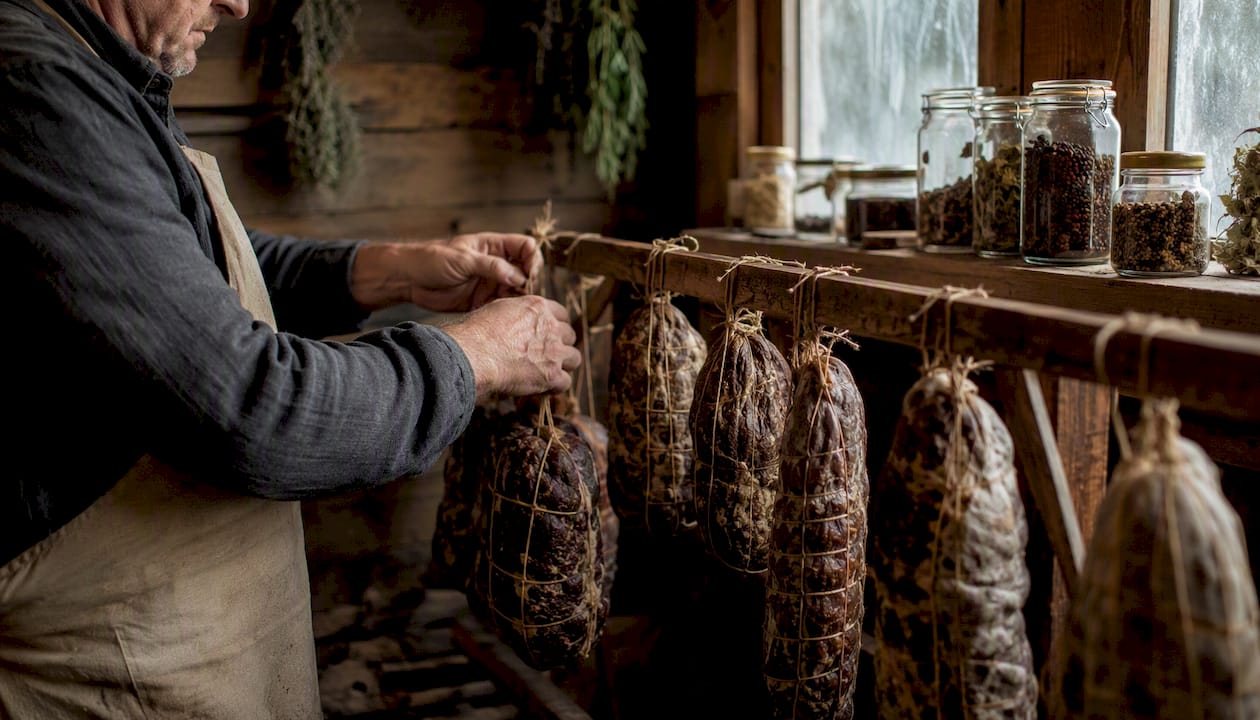
These methods survive because they solve real problems: flavour development that speed cannot replicate, preservation that doesn’t rely purely on additives, and texture control that a human hand still manages better than a machine tuned for consistency. Wild fermentation is the clearest example of batch variability in action; because the microbial culture is drawn from the environment rather than a lab-grown starter, no two batches behave identically, which is exactly why sourdough loaves from the same bakery still vary week to week.
Pro Tip: If you’re starting out, a digital thermometer and a basic humidity gauge are the two modest technical aids worth having early. They don’t replace judgement, but they narrow the guesswork while you build the sensory skill to trust your own senses later.
What skills and training do artisan food makers need?
Two skill sets matter equally here, and new makers often over-invest in one while neglecting the other.
The hands-on skills include dough handling and shaping, brining and curing timing, temperature and humidity control, and sensory evaluation, tasting and adjusting a product before it’s finished rather than after. The business skills include sourcing reliable, traceable ingredients, understanding labelling requirements, and costing small batches accurately enough to actually turn a profit rather than just break even.
Training pathways vary but tend to follow a few common routes: apprenticeships under an established maker, TAFE-equivalent vocational certificates, specialist food schools, and increasingly, undergraduate degrees built specifically around the craft. Nottingham Trent University’s Artisan Food Production BSc is a useful model of what a structured pathway looks like in practice, combining modules in breadmaking, patisserie, charcuterie and butchery with the practical, year-by-year structure that vocational and degree-level artisan programs increasingly share.
Pro Tip: Before committing to a course or a mentorship, ask three questions: how many practical hours are hands-on versus theoretical, is there any on-farm or on-site production experience built in, and does the curriculum cover business skills like costing and labelling, not just technique? A course strong on the first and weak on the third will leave you a skilled maker with a business you can’t run profitably.
How does artisan food production differ from mass production?
The two approaches aren’t just different in scale, they’re built around different goals entirely, and that distinction explains almost every practical difference a consumer will notice.
Mass production optimises for consistency, efficiency and low unit cost, using automated lines that turn out identical product at high volume with minimal per-unit labour. Artisan production optimises for quality, distinctiveness and provenance, accepting a lower output ceiling and higher per-unit cost as the trade-off for a result mass automation can’t replicate.
| Factor | Artisan production | Mass production |
|---|---|---|
| Primary goal | Quality, uniqueness, provenance | Efficiency, consistency, cost control |
| Scale | Micro-enterprise, small batch | High-volume industrial plants |
| Technology role | Supports the maker’s judgement | Drives and standardises the process |
| Product variability | Expected and often valued | Minimised as a design goal |
| Consumer outcome | Traceable, variable, often pricier | Predictable, low-cost, widely available |
For consumers, the practical outcomes flow directly from that table. Artisan products carry environmental and social value that’s easier to trace, a named maker, a specific farm, a documented method, but that traceability comes at a price premium and with less guaranteed consistency from batch to batch. Mass-produced food delivers reliability and affordability at scale, which matters enormously for feeding large populations, but it rarely offers the story or the sensory distinctiveness that drives someone to seek out a small producer in the first place.
What food-safety and labelling rules apply to artisan producers?
Small scale doesn’t mean small responsibility. Artisan producers still operate under the same food safety framework as any commercial food business, and the common artefacts of artisan regulation, micro-enterprise thresholds, traceability requirements, hygiene record-keeping, exist precisely because small batches still carry real risk if handled carelessly.
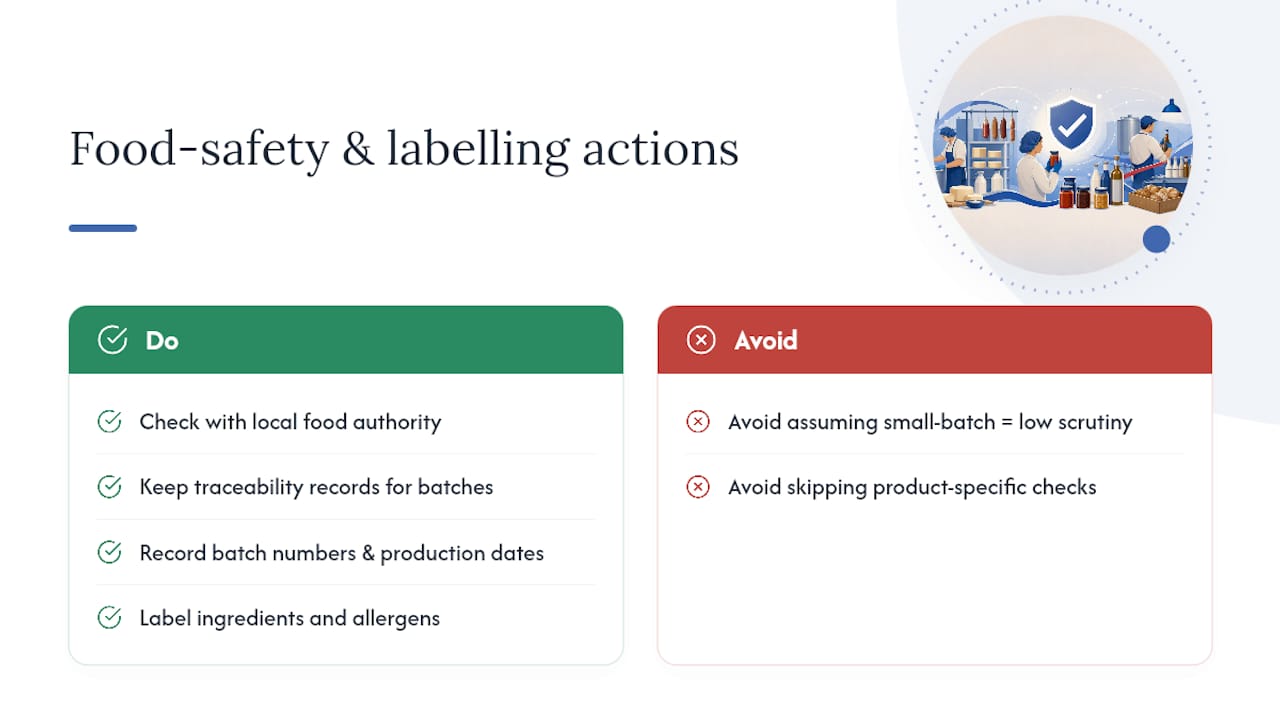
The practical starting point for any producer is checking with the relevant local food authority, Food Standards Australia New Zealand (FSANZ) or your state or territory regulator, before selling anything commercially. Requirements shift depending on the product category, particularly for anything involving raw milk, cured meat or fermentation, so this isn’t a step to skip on the assumption that “small batch” means “low scrutiny.”
Beyond checking the rules, a handful of practical habits matter every day: keep simple traceability records showing where each ingredient batch came from, maintain a cleaning log for equipment and surfaces, record batch numbers and production dates for every run, and label ingredients clearly and accurately, including allergens. FSAI’s own guidance on marketing terms notes that criteria like limited production quantities and local sourcing distances are exactly the kind of specifics regulators expect a genuine artisan producer to be able to document, not just claim.
Pro Tip: A printable, one-page traceability template covering ingredient source, batch number, production date and cleaning check does double duty: it satisfies basic food safety record-keeping and gives you ready-made proof behind any provenance claim you make on your label or to a curious customer.
This is general guidance, not a substitute for advice from your local food authority or a qualified food safety consultant, and current rules should always be confirmed directly with them before you begin selling.
How can you tell if a product is genuinely artisan?
Marketing language borrows the word “artisan” freely, so the real test is what a producer can show and explain, not what the label claims.
Run through this checklist before you buy:
- Visible provenance — can you see or find out exactly where the ingredients came from, down to a farm or region, not just a vague “locally sourced” line?
- Production scale signals — does the packaging or seller mention batch numbers, limited runs, or a specific production date?
- Method explanation — can the seller or label describe the actual technique used, fermentation time, curing method, ageing period, rather than generic buzzwords?
- Ingredient sourcing detail — are specific suppliers, farms or regions named, rather than “premium ingredients” left unspecified?
- Direct engagement options — does the producer offer tours, farmers’ market appearances, or a maker’s statement you can actually read?
Common red flags run the other way: vague claims like “handcrafted quality” with no supporting detail, stock photography of rustic scenes that doesn’t match the actual facility, and packaging so polished and industrial-looking it undercuts the small-batch story the label is trying to tell. Genuine artisan producers tend to welcome specific questions rather than deflect them, largely because engaging directly with the producer remains the most reliable way to verify what’s actually behind a claim.
When in doubt, ask the seller or curator directly: where the raw ingredient came from, how long the product took to make, and whether you can see or learn more about the production process itself. A seller who answers specifically is worth trusting more than one who answers with adjectives.
Why does provenance matter more than the label itself?
Academics who study this space are blunt about one thing: “artisan” is at least partly a socially constructed label, not a fixed, legally protected term the way some regional food names are. That doesn’t make it meaningless, but it does mean the label alone proves very little without the detail behind it.
Genuine artisan practice functions as a kind of social contract between producer and buyer, built on transparency, respect for raw materials, and traceable origin rather than on the word “artisan” printed on a jar.
That framing comes from researchers examining what actually makes food artisan, and it explains why curation matters as much as production. A retailer or curator who verifies sourcing, checks production methods, and communicates that detail clearly is doing real work on the buyer’s behalf, work that a bare “artisan” label on a supermarket shelf skips entirely.
It’s also worth noting that artisan craft isn’t inherently anti-technology. Researchers including Louise Manning point out that artisans regularly combine traditional method with scientific technique, a thermometer, a controlled fermentation chamber, precision scales, to refine quality rather than replace the human judgement driving the process.
A curator or retailer worth trusting should be able to answer three specific questions about any product they sell: where exactly did this ingredient come from, what production method was used and for how long, and can the buyer verify any of this independently, through a farm tour, a maker’s statement, or a third-party provenance check. If a retailer stumbles on all three, treat the artisan label with real scepticism regardless of how the packaging looks.
Why provenance drives every sourcing decision Aptent makes
We built Aptent’s curation around exactly this principle: that the word “artisan” only means something when the producer behind it can answer specific questions about origin and method. Every producer we work with, whether it’s a rare French vineyard or a caviar house with generations of technique behind it, has to earn a place in the collection through documented provenance, not just a compelling story.
If you want sourcing detail on a particular product, whether that’s our curated caviar range or a specific vintage, ask us directly. We’d rather answer a specific question about origin than let a label do the talking.
Frequently asked questions
What is artisan food production in simple terms? It’s food made in small, limited batches by a skilled maker using traditional, largely hand-driven methods, with a focus on flavour and traceable ingredients rather than volume or speed.
How is artisan food different from homemade food? Artisan food production is generally commercial, meaning it’s made to be sold and must meet food safety and labelling rules, whereas homemade food is typically made for personal or non-commercial use without those regulatory obligations.
Do artisan producers use any modern technology? Yes. Tools like precision thermometers, humidity-controlled ageing rooms and lab-tested starter cultures commonly support artisan work, refining consistency without replacing the maker’s hands-on judgement.
Is artisan food always more expensive than mass-produced food? Usually, yes, because smaller batches, slower methods and higher labour input all raise the per-unit cost compared with automated, high-volume production.
Where can someone train to become an artisan food maker? Common routes include apprenticeships with established producers, TAFE-equivalent vocational certificates, specialist food schools, and dedicated degrees such as Nottingham Trent University’s Artisan Food Production BSc.
Sources
- Artisan food production: What makes food ‘artisan’?
- The Use of Food Marketing Terms — FSAI guidance (section on artisan/artisanal)
- Artisan Food Production BSc (Hons) Undergraduate Course — NTU
- Artisanal food — Wikipedia


