
How wagyu is prepared professionally: a chef's guide
Treat Wagyu with minimal seasoning, precise temperature control, and a method matched to cut thickness. That is the professional standard, and every other decision flows from it. On receipt, verify the grade and certificate of authenticity, confirm cold chain integrity, pat the surface dry, and salt only moments before the meat meets heat. For thin A5-style slices graded at the upper end of the Beef Marbling Score (BMS) scale by the Japan Meat Grading Association (JMGA), a flash sear on a screaming-hot cast-iron or teppanyaki plate is the correct method. For thicker Australian Wagyu crossbreeds, reverse sear or sous-vide followed by a high-heat finish gives you the even fat rendering and doneness control the cut demands. Keep a digital instant-read thermometer in hand throughout, pull the meat a few degrees below your target to account for carryover, and rest briefly on a warm plate so the fat stays semi-liquid at service. Aptent’s approach to Wagyu service follows this same discipline: provenance first, technique second, restraint always.
Table of Contents
- Why Wagyu’s fat structure changes everything you know about steak
- Professional preparation and handling before heat
- What equipment does a professional Wagyu kitchen actually need?
- Chef-grade methods for cooking Wagyu steak: step by step
- Precise internal temperatures and resting times for Wagyu
- Cutting, portioning and plating for service
- Managing flare-ups and kitchen safety with high-fat beef
- What goes wrong in restaurants and how to fix it
- Field-tested notes from Australian professional kitchens
- Key takeaways
- Restraint is the technique
- Elevate your Wagyu service with Aptent
- Useful sources and further reading
Why Wagyu’s fat structure changes everything you know about steak
The defining characteristic of Wagyu is intramuscular fat so finely distributed that it alters the physics of cooking. A5 Wagyu fat begins to melt at around 25°C, compared with roughly 40°C for standard beef fat. That 15-degree gap is not a curiosity; it means the fat in a high-BMS steak is already beginning to soften before the pan is even close to searing temperature, and it will overcook and turn greasy far faster than a conventional ribeye.
The oleic acid profile of Wagyu fat is what drives that low melt point. Oleic acid, the same monounsaturated fatty acid that defines extra-virgin olive oil, gives Wagyu its characteristic buttery smoothness and nutty richness on the palate. Heavy marinades, aggressive rubs, and prolonged heat all work against this quality by either masking the fat’s delicate flavour or rendering it past the point of pleasure.
Grading under the JMGA system runs from BMS 1 (no marbling) to BMS 12 (extraordinary marbling), with A5 representing the highest yield and quality combination. The BMS and its sensory implications directly determine how a chef should portion and apply heat: a steak served as a larger slab may overwhelm the palate with rendered fat, which is why Japanese service tradition portions A5 more conservatively. Australian Wagyu crossbreeds, typically graded on the Meat Standards Australia (MSA) Marble Score or the AUS-MEAT marbling scale, tend to have more structural muscle fibre, making them better suited to thicker-cut preparations and longer cooking windows.
Wagyu.org notes that the breed’s genetic predisposition to intramuscular fat deposition is unique among cattle, and that this characteristic demands handling protocols quite distinct from commodity beef. The practical upshot for professional kitchens: treat grade and thickness as the two variables that determine every subsequent decision, from portioning through to method selection and plating.
Professional preparation and handling before heat
Consistency in a professional kitchen begins long before the pan heats up. How wagyu is prepared professionally depends as much on what happens at the cool room door as it does at the pass.
Receiving and cold chain
- Inspect the certificate of authenticity (COA) or traceability documentation on delivery; for Japanese A5, this includes the individual cattle identification number.
- Confirm the product arrived below 4°C; anything above that threshold warrants a supplier conversation and, if in doubt, rejection.
- Immediately vacuum-seal or tightly wrap any portion not going into service within 24 hours to limit oxidation and surface discolouration.
Thawing and portioning
- Thaw frozen Wagyu in the refrigerator over 24–48 hours; never use a water bath or microwave, both of which begin to melt the intramuscular fat unevenly.
- For clean portioning of high-BMS cuts, slice while the meat is still partially frozen (firm but not rock-hard). The fat holds its structure and the knife tracks cleanly against the grain.
- Portion individual steaks into vacuum bags immediately after cutting; this preserves surface integrity and prepares them for sous-vide if that is the chosen method. For a detailed reference on butchery technique and primal breakdown, Wine Drop Cookery’s full guide covers the structural anatomy that informs where to cut.
Seasoning timing
Salt applied immediately before cooking is the professional standard for thin A5 slices; the brief contact time prevents osmotic moisture draw that would steam rather than sear the surface. For thicker cuts (25mm and above), salting up to 12 hours ahead and resting uncovered in the refrigerator draws surface moisture out and then reabsorbs it, producing a drier exterior that crusts more effectively. Pepper is best applied after cooking on very high-BMS cuts; direct contact with a screaming-hot pan can turn pepper bitter before the meat is done. Avoid heavy marinades entirely on any grade above BMS 6; they mask the oleic fat profile that justifies the price.
Pro Tip: For tasting-menu portions of A5, cut against the grain into 10–15mm slices while the loin is still cold from the refrigerator. The fat stays firm enough to handle cleanly, and the slices cook in seconds rather than minutes.
What equipment does a professional Wagyu kitchen actually need?
The right gear is not about prestige; it is about heat control and repeatability. Each item below earns its place by solving a specific problem that Wagyu’s fat structure creates.
| Equipment | Specification | Why it matters for Wagyu |
|---|---|---|
| Cast-iron or carbon-steel pan | 25–30cm, minimum 3mm base thickness | Retains and radiates heat evenly; non-stick surfaces cannot reach Maillard temperatures |
| Digital instant-read thermometer | Response time under 3 seconds | Carryover on thin cuts is fast; a slow probe misses the window |
| Probe/oven thermometer | Dual-probe with alarm | Monitors ambient oven temp during reverse sear staging |
| Sous-vide immersion circulator | — | Holds bath within the narrow band needed for precise fat rendering |
| Vacuum sealer | Chamber or edge sealer with moist-food setting | Prevents bag failure during long sous-vide holds; preserves surface integrity |
| Flat-top teppanyaki plate or plancha | 6mm steel plate, minimum 280°C surface capacity | Provides even contact heat for thin slices without hot spots |
| Binchotan or quality lump charcoal | Binchotan preferred; dense hardwood lump as substitute | Binchotan burns steadily with minimal flare-ups, protecting high-fat cuts |
| Wire rack and warm plates | Plates held at 60–65°C | Prevents fat re-solidification during brief rests |
| Kitchen blowtorch | Butane or propane, adjustable flame | Finishing tool for sous-vide portions; adds crust without additional cook time |
| Microplane | Fine-grade | Finishing grated wasabi, truffle, or cured egg yolk without bruising |
Cast-iron and carbon-steel pans consistently outperform other surfaces for Wagyu searing because their thermal mass holds temperature when cold meat hits the surface, a moment when lesser pans drop below the Maillard threshold and begin to steam rather than sear.
Chef-grade methods for cooking Wagyu steak: step by step
The method you choose is determined first by thickness, then by grade. Thin A5 slices demand speed; thicker crossbreeds reward patience.
Pan-sear (best for cuts up to 25mm)
- Preheat a dry cast-iron pan over high heat until it reaches a temperature sufficient for searing; no oil is needed for high-BMS cuts because the fat renders immediately on contact.
- Pat the steak completely dry and salt just before it goes in.
- Sear for 45–90 seconds per side for a 15mm slice; 90–120 seconds per side for a 20–25mm cut. Flip once only for thicker pieces; for very thin A5 slices, a single 30-second sear per side is often sufficient.
- Baste with the rendered fat that pools in the pan during the final 20 seconds.
- Rest on a warm wire rack for 1–3 minutes before slicing.
Reverse sear (best for cuts 30mm and above)
- Season the steak and place on a wire rack in an oven set to a low temperature until the internal temperature approaches but remains below your target doneness.
- Remove and rest briefly while preheating a cast-iron pan to high heat.
- Sear for about a minute per side to build crust; the surface is already dry from the low oven, so the Maillard reaction begins almost instantly.
- Pull the steak shortly before the target internal temperature and rest briefly.
Sous-vide + sear (best for high-volume service or very thick cuts)
- Vacuum-seal individual portions with no added fat or liquid; the Wagyu’s own marbling provides all the basting it needs.
- Set the bath to around 52°C for medium-rare or slightly higher for medium. Hold for appropriate times for the cut thickness; avoid excessively long cooking periods that soften texture undesirably.
- Remove, pat completely dry, and chill the surface briefly with an ice bath for 60 seconds if the sear is not immediate; this prevents the interior from overcooking during the finishing sear.
- Sear in a screaming-hot cast-iron pan or with a blowtorch for 30–60 seconds per side, targeting crust only.
Pro Tip: After the ice bath, leave the bagged steak on a clean towel for 2 minutes before opening. The surface moisture redistributes inside the bag, and when you open it, the exterior is drier than if you had patted it immediately after the bath.
Teppanyaki and plancha
Teppanyaki service is built around speed and theatre. Thin A5 slices cook quickly per side on a plate held at appropriate high temperature. The key professional discipline is batch size: cook only what can be consumed in the next 60–90 seconds, slice on the griddle into strips or cubes, and plate directly onto warm service ware. Holding cooked Wagyu on the teppanyaki plate to wait for a diner is the fastest route to an overcooked, greasy result.
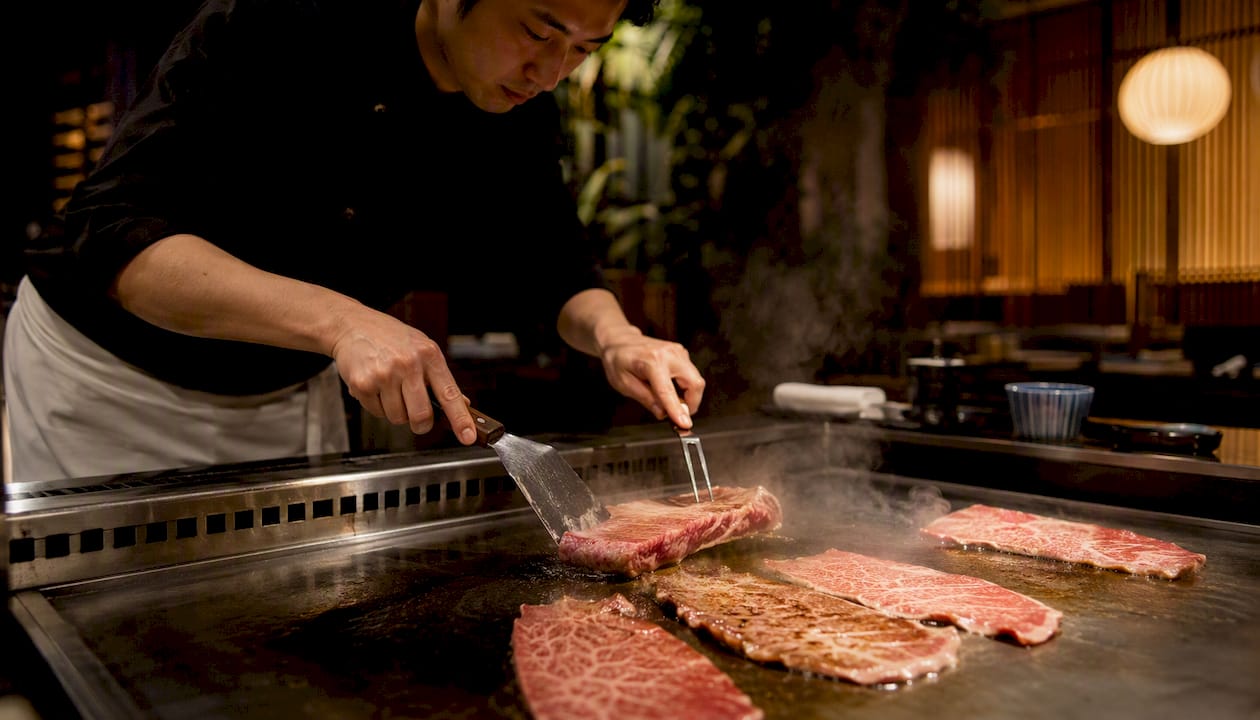
Planchas can run hotter than teppanyaki plates and are harder to regulate; practical tests show they can cause bitter over-char if the surface temperature is not carefully monitored. Many chefs prefer cast iron for its more forgiving heat curve.
Grilling over binchotan or lump charcoal
Set up a two-zone fire: a direct high-heat zone for searing and a cooler indirect zone for managing flare-ups and finishing. Binchotan charcoal is the professional preference because it burns at a steady, radiant heat with minimal smoke and far fewer flare-ups than standard lump charcoal. Where binchotan is unavailable, dense hardwood lump charcoal (jarrah or ironbark work well in Australian kitchens) is the closest substitute; avoid briquettes, which produce inconsistent heat and off-flavours.
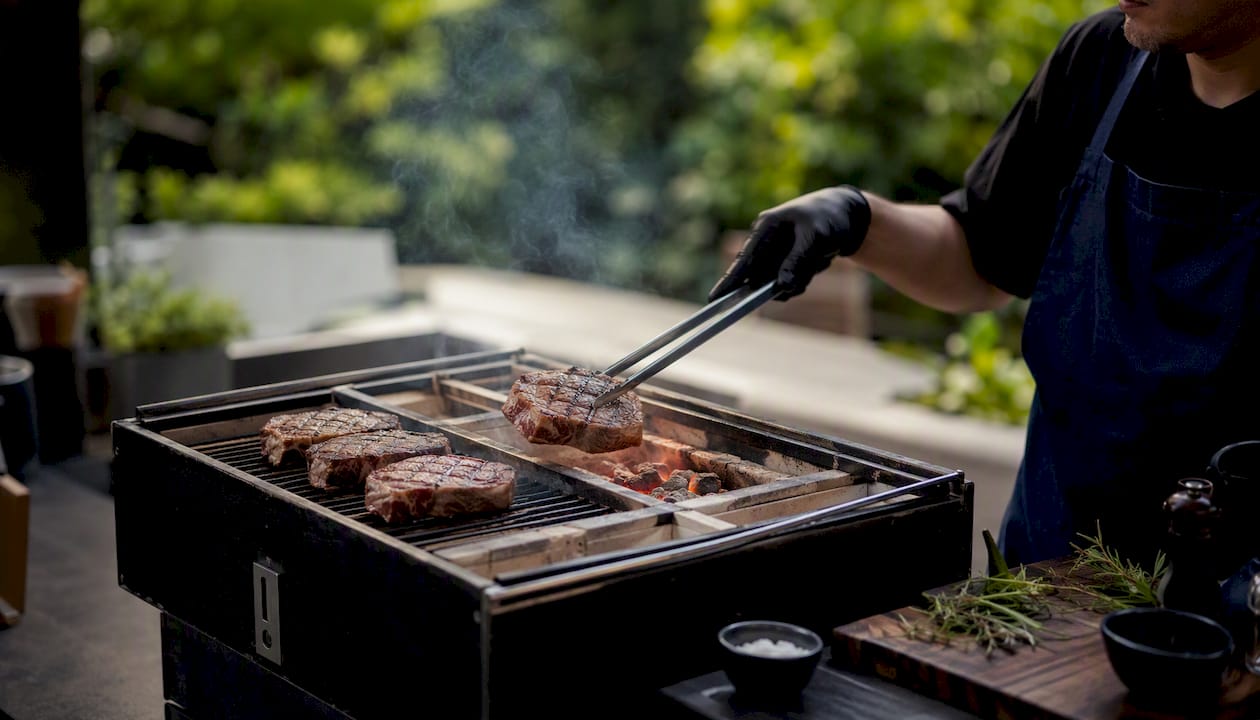
Sear thin cuts directly over the coals for 30–60 seconds per side, then move immediately to the cool zone to rest. For thicker cuts, reverse the sequence: bring to temperature in the cool zone first, then finish over direct heat for crust.
Precise internal temperatures and resting times for Wagyu
The temperature targets below apply to the geometric centre of the cut, measured with a digital instant-read thermometer. Carryover cooking continues after the meat leaves the heat source, and the rate depends on method: a pan-seared steak carries over 3–5°C; a sous-vide portion carries over only 1–2°C because the interior is already at equilibrium.
| Doneness | Pull temperature (°C) | Expected final temp (°C) | Rest time |
|---|---|---|---|
| Rare | 45°C | 48–50°C | 1–2 min |
| Medium-rare | 50°C | 50–55°C | 2–3 min |
| Medium | 55°C | — | 3–5 min |
| Well done | Not recommended for high-BMS Wagyu | — | — |
Medium-rare is the professional standard for Wagyu above BMS 6. At this temperature, the intramuscular fat is fully softened and semi-liquid, delivering the signature mouthfeel without the greasy, heavy quality that comes from fat rendered past 60°C. Rare is acceptable for very high-BMS A5 cuts served in thin slices, where the brief sear time means the interior barely rises above ambient.
Wagyu fat begins to melt at around 25°C (77°F) and reaches its optimal semi-liquid state between 50°C and 55°C internal temperature. Cooking beyond 60°C renders the fat fully liquid, which pools on the plate rather than coating the palate.
Resting is shorter for Wagyu than for conventional beef. Chef practitioners recommend 1–5 minutes depending on thickness to preserve the semi-liquid fat state. Thin A5 slices need only 60–90 seconds on a warm plate; a 40mm crossbreed steak benefits from 4–5 minutes on a wire rack above a warm surface. Never rest Wagyu on a cold board; the fat re-solidifies within minutes and the mouthfeel at service is waxy rather than buttery.
Pro Tip: Warm your plates to 60–65°C before service. A cold plate drops the surface temperature of a thin Wagyu slice by several degrees in under 30 seconds, which is enough to begin re-solidifying the fat before the diner’s first bite.
Cutting, portioning and plating for service
Portion size is the first decision, and it is determined by grade. A5 Japanese Wagyu is typically served in small portions in a tasting context; the richness of the fat means larger portions become fatiguing rather than indulgent. Australian Wagyu crossbreeds with moderate marbling can be served in portion sizes suitable for main courses without overwhelming the palate.
| Grade / style | Recommended portion | Slice thickness | Service style |
|---|---|---|---|
| A5 Japanese (BMS 10–12) | — | — | Tasting, teppanyaki, small plate |
| Australian Wagyu (BMS 6–9) | — | 15–20mm | Restaurant main, shared plate |
| Australian crossbreed (BMS 4–6) | 200–250g | 20–30mm | Classic steak service |
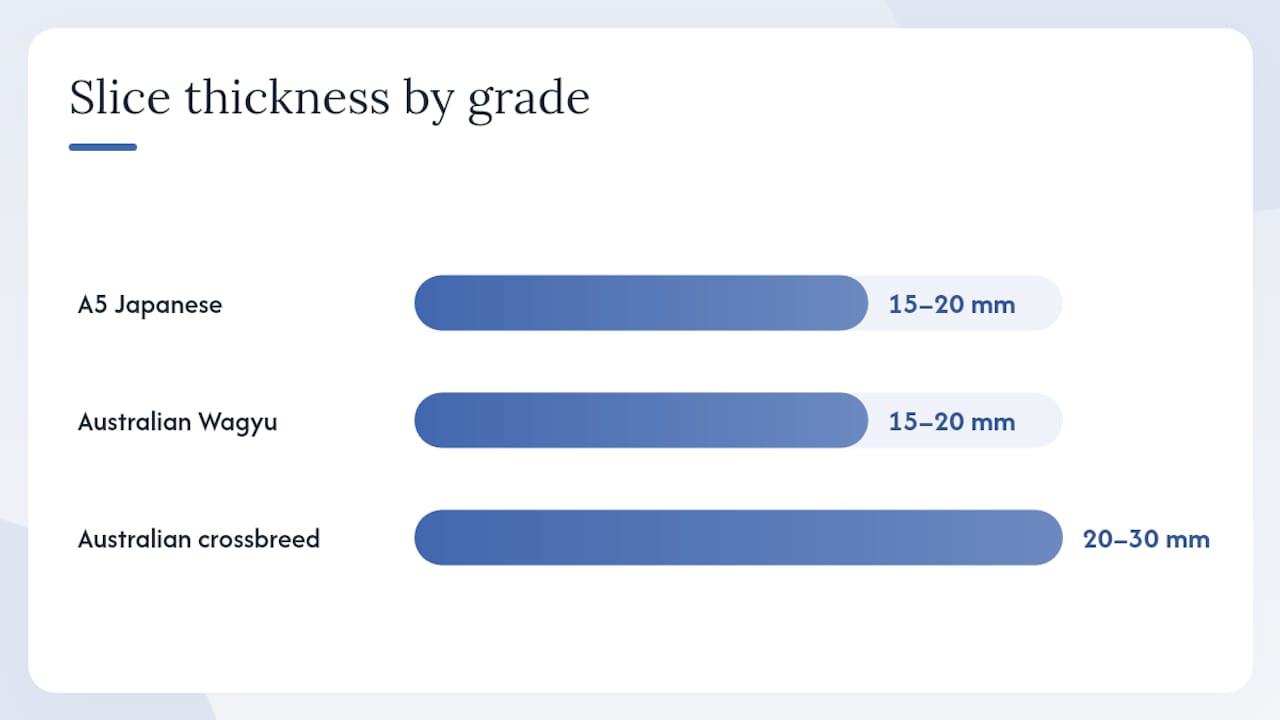
Slicing technique is non-negotiable: always cut against the grain. Identify the direction of the muscle fibres before cooking, mark the cut end if needed, and slice perpendicular to those fibres at service. Cutting with the grain leaves long, chewy strands that work against the tenderness the marbling promises. For teppanyaki service, slice on the griddle into 15–20mm strips, then cube if the format calls for it, and plate in a single layer so every piece retains its surface temperature.
Plating for high-end Wagyu dishes should be restrained. A warm plate, three to five slices fanned or stacked with deliberate spacing, and one or two accompaniments that complement rather than compete with the fat. Accompaniments that work: fine sea salt flakes (Murray River pink salt or Maldon), freshly grated wasabi, a small pool of ponzu, or a few drops of aged soy. Accompaniments that work against the fat: heavy cream sauces, strong blue cheese, or anything acidic enough to cut through the marbling entirely. For plating inspiration suited to fine-dining Wagyu presentations, Wild Foodz offers a useful visual reference.
Managing flare-ups and kitchen safety with high-fat beef
High-BMS Wagyu renders fat rapidly and in volume, and that fat is the primary flare-up risk on a grill. Understanding the cause is the first step to controlling it.
- Rendered fat dripping onto hot coals or a gas burner ignites immediately; the flame travels back up to the grate and chars the meat surface before the cook can react.
- Exterior fat caps, if left untrimmed, render faster than intramuscular fat and create concentrated drip points directly above the heat source.
- Thin cuts on a grill are particularly vulnerable because the cook time is so short that a single flare-up can char the exterior before the interior reaches temperature.
Preventive measures
- Trim exterior fat caps to no more than 3–4mm before grilling; this reduces drip volume without eliminating the flavour contribution.
- Render the fat cap first by holding the steak on its edge against the pan wall for 30–45 seconds before laying it flat; this pre-renders the exterior fat and reduces subsequent flare-up risk.
- Use a drip pan beneath grill grates for any Wagyu cut above BMS 6; the pan catches rendered fat before it reaches the coals.
- Keep a water spray bottle at the grill station for immediate flare-up suppression; a short burst directed at the coals (not the meat) knocks the flame back without cooling the cooking surface significantly.
- Maintain a cool zone on every grill setup so pieces can be moved off direct heat within seconds.
Staff safety
Hot rendered Wagyu fat behaves like any high-temperature cooking oil: it spatters, it ignites, and it causes serious burns. Chefs working the grill or teppanyaki station should wear heat-resistant gloves when handling grates, use long-handled tongs rated for high-temperature use, and keep the ventilation canopy at full extraction. Binchotan charcoal produces carbon monoxide during lighting and must be lit outdoors or under direct extraction; never light it in an enclosed kitchen space.
What goes wrong in restaurants and how to fix it
Even experienced cooks make predictable errors with Wagyu. The corrections below are specific and immediate.
Greasy mouthfeel / overcooked fat
The fat has been rendered past its optimal semi-liquid state, typically because the internal temperature exceeded 60°C or the rest was too long on a cold surface. The fix in service: lower the finish temperature by pulling 2–3°C earlier, shorten the sear time, and rest only on warm plates. For future service, recalibrate the thermometer and check the pan temperature with an infrared gun before the first steak goes in.
Poor crust / grey exterior
The surface was wet when it hit the pan, or the pan was not hot enough. Pat the steak completely dry with paper towel immediately before seasoning. Preheat the cast-iron pan for a minimum of 3–4 minutes over high heat before the first steak; the surface should be visibly smoking. If the pan drops temperature after the first steak, allow 60–90 seconds of recovery before the next one.
Charred exterior with raw interior
This is a thickness problem combined with excessive direct heat. The fix is to move the steak to the cool zone immediately, cover loosely with foil, and allow the interior to come up to temperature via residual heat. Prevention: for cuts above 25mm, always use reverse sear or sous-vide rather than direct high-heat searing from raw.
Underseasoning
Wagyu’s fat carries flavour, but the lean muscle still needs salt to taste complete. If the steak tastes flat despite correct doneness, the salt was applied too early (moisture drew out and evaporated, taking the seasoning with it) or not at all. Apply fine sea salt immediately before the steak hits the heat, and finish with a few flakes of coarse salt at service.
- Check surface dryness before every cook; moisture is the enemy of both crust and seasoning adhesion.
- Calibrate your thermometer weekly; a probe that reads 2°C high will consistently produce overcooked Wagyu.
- Never crowd the pan; two steaks in a 25cm cast-iron drop the surface temperature enough to stall the Maillard reaction.
- Rest on warm plates, not cold boards; fat re-solidification at service is irreversible.
Field-tested notes from Australian professional kitchens
Australian chefs working with both imported A5 and locally sourced crossbreeds have refined the methods above through service-floor experience. A few observations that do not always appear in technique guides:
- Australian gas ranges tend to run hotter at the burner ring than European induction; cast-iron pans on a high-output gas burner can reach 280°C surface temperature in under 4 minutes, which is faster than most guides assume. Preheat time should be calibrated with an infrared thermometer on your specific range, not estimated.
- Binchotan is available through Japanese food importers in Sydney and Melbourne, but lead times can be 2–3 weeks; most Australian chefs keep a supply of dense hardwood lump charcoal (jarrah is a reliable local option) as a standing substitute. The key is consistency of burn: light the charcoal fully before service so there are no cold spots on the grate.
- For very high BMS steaks (BMS 9 and above), some chefs reduce pan temperature slightly to 200–220°C rather than the standard 240–250°C. The lower temperature gives a 10–15 second longer window before the fat begins to over-render, which is enough margin to pull the steak at the right moment without rushing.
- In high-turnover teppanyaki service, the practical discipline is portion discipline: cook no more than two to three portions at a time, slice and plate immediately, and do not hold cooked Wagyu on the griddle. The teppanyaki slicing and batch-service approach is designed precisely to keep every mouthful at peak melt temperature.
- Cold-smoking prior to a high-heat sear is used in some Australian tasting menus to add subtle smoke character without cooking the meat; the smoke temperature must stay below 30°C to avoid altering the fat melt behaviour. It is an advanced technique, not a default one.
Pro Tip: If your kitchen runs multiple Wagyu covers in a single service, pre-portion and vacuum-seal individual steaks the morning of service. This keeps the surface pristine, speeds up the pass, and means every portion goes into the pan in identical condition.
Key takeaways
Professional Wagyu preparation requires minimal seasoning, tight temperature discipline, and a method matched to cut thickness, with resting on warm plates to preserve the fat’s semi-liquid state at service.
| Point | Details |
|---|---|
| Method by thickness | Flash-sear thin A5 slices (under 15mm); use reverse sear or sous-vide for cuts above 25mm. |
| Temperature targets | Pull at 50°C for medium-rare; expect 50–55°C final after carryover. Never exceed 60°C internal. |
| Seasoning rule | Salt immediately before cooking for thin cuts; up to 12 hours ahead for thick cuts rested uncovered in the fridge. |
| Portioning by grade | A5 Japanese Wagyu at — per person; Australian crossbreeds at 150–250g depending on BMS. |
| Aptent service context | Aptent pairs curated accompaniments and fine wines with Wagyu service for professional and private event settings. |
Restraint is the technique
The most common mistake in professional Wagyu service is not a technical one. It is the impulse to do more: more seasoning, more smoke, more sauce, more time on the heat. Every one of those additions is a vote of no confidence in the ingredient itself.
The chefs who consistently produce the finest Wagyu plates are the ones who have made peace with the fact that their job is largely to stay out of the way. Verify the grade, control the temperature, match the method to the thickness, and plate with economy. The provenance of the animal, the BMS, the oleic fat profile — these are the result of years of breeding and husbandry. A cook’s role is to deliver that work to the diner intact, not to reinterpret it.
There is a professional humility in that restraint that is worth naming. It takes more discipline to do less than to do more, particularly in a kitchen culture that rewards complexity. The best Wagyu service looks effortless because the technique is invisible. That invisibility is the craft.
Elevate your Wagyu service with Aptent

Wagyu at its finest deserves accompaniments of equal provenance. Aptent curates a selection of fine salts, rare champagnes, and premium caviar sourced from prestigious producers, each chosen to complement rather than compete with the refined fat profile of high-grade Wagyu. For professional kitchens and private dining events, Aptent’s gourmet event services deliver curated wine and caviar pairings designed for high-net-worth guests and discerning corporate clients across Australia. Whether you are building a tasting menu around A5 Japanese Wagyu or elevating a corporate dinner with matched champagne and Baeri Signature Caviar, Aptent’s team provides personalised guidance from selection through to service. Contact Aptent to discuss a curated pairing programme for your next event.
Useful sources and further reading
The following references informed the techniques, temperatures, and professional practices covered in this guide. Where possible, Australian and Japan-specific primary sources have been prioritised.
- Exploring Wagyū: A guide to buying and preparing this magnificent meat | Nippon.com
- What is Wagyu beef | Wagyu.org
- We ate super‑expensive steak so you don’t have to | SeriousEats
- How to cook Wagyu at home | Wagyu Handbook
- Wagyu teppanyaki guide | Wagyu Handbook
- How to Cook Authentic A5 Wagyu Beef: The Complete Guide to Japanese Wagyu Steak — Destination Wagyu
- Cooking A5 Wagyu steak with Japanese sauce | No Recipes


