
Champagne Stopper Types That Keep Fizz 1–3 Days in Australia
Clamp and lever-lock stoppers remain the most reliable choice for everyday households, holding sparkle for a short period when paired with prompt refrigeration. Valve and switch-style designs offer similar short-term protection, while pressurised CO2 systems justify their expense only for extended service or genuinely precious bottles. Vacuum stoppers, built for still wine, have no place on a Champagne bottle. The single rule that outperforms every stopper on the market is simple: reseal immediately and refrigerate upright.
TL;DR:
- Clamp and valve-style stoppers reliably preserve Champagne for one to three days when stored upright and resealed promptly with refrigeration.
- Silicone gaskets with mechanical locking mechanisms last longer and seal better, especially on standard 75cl bottles, than rubber or floppy designs.
- Pressurised CO2 systems outperform passive stoppers in extending freshness for high-value bottles or multi-day preservation, but cost significantly more.
- Fit compatibility on different bottle sizes and necks is crucial; testing the stopper on your actual bottle helps prevent sealing failures.
- Basic spring-loaded plugs are suitable only for same-evening resealing, whereas multi-day storage or special bottles justify investing in premium clamp or pressurised options.
Table of Contents
- Champagne stopper types and how each one works
- Materials and construction: why the small details matter
- How long does a champagne stopper actually keep wine fresh?
- How to choose the right champagne stopper
- APTENT’s perspective on practical stopper choices
- Price range and value comparison of champagne stopper types
- Trusted brands and manufacturers to look for
- Where to buy a champagne stopper in Australia
- When a simple stopper is enough
- A curated option when you would rather not manage it yourself
- Where these findings came from
- Sources
- FAQ
Champagne stopper types and how each one works
Walk into any bottleshop and you will find five broad families of stopper, each solving the same problem, retaining carbon dioxide, in a different way.
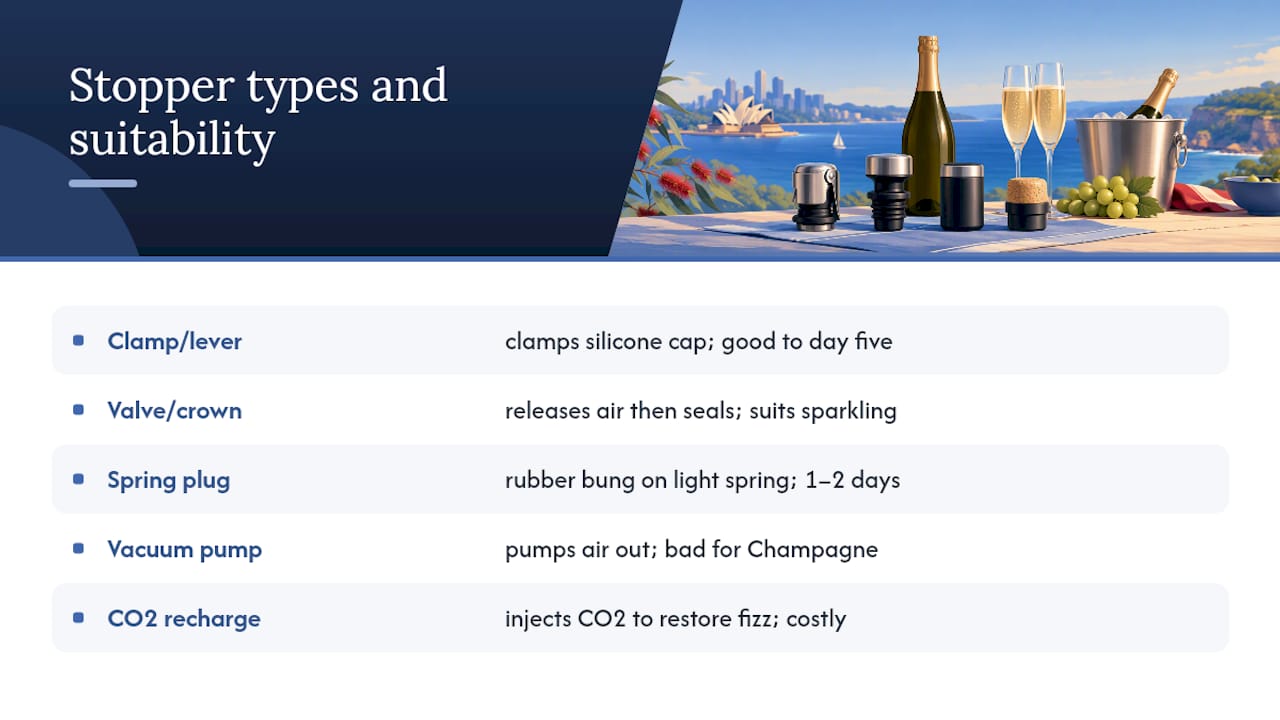
Clamp or lever-lock stoppers, sometimes called winged or WAF-style stoppers, use a hinged metal arm that clamps down over a silicone or rubber cap and locks beneath the bottle’s lip. They are the most common style sold in Australian kitchenware stores and, according to Decanter’s comparative testing, they consistently outperformed cheap alternatives through to day five of storage.
Valve or switch crown-style stoppers work differently again. A small lever or button releases trapped air before the cap seats, creating a genuinely airtight seal rather than relying on pressure alone. Food & Wine’s testing found this mechanism suits sparkling wine better than the vacuum-pump designs built for still bottles.
Spring-loaded plugs or snap-caps are the simplest and cheapest option, a rubber or silicone bung held in place by a light spring. They work adequately for a same-evening reseal but rarely hold pressure past a day or two.
Vacuum-style stoppers, the pump-and-seal kind popular with still wine drinkers, actively remove air from the bottle. That is precisely wrong for Champagne, where you want to retain carbonation, not extract it.
Pressurised CO2 recharge systems, such as the Coravin Sparkling, inject gas back into the bottle rather than passively sealing it. They cost considerably more but solve a problem passive stoppers cannot: restoring lost fizz after several pours have been taken.
Materials and construction: why the small details matter
The gasket touching the wine’s surface does most of the sealing work, but the mechanism holding it in place decides whether that seal survives fridge storage, side-lying, and the occasional bump from other bottles.
- Food-grade silicone gaskets resist compression fatigue better than rubber and rarely pick up odours over repeated use.
- Rubber gaskets seal well initially but tend to stiffen and crack faster with age, especially if washed in hot water.
- Stainless steel bodies hold their shape and clamp tension for years; stainless-steel stoppers are common in Australian kitchenware retail, typically listed as dishwasher-safe.
- Chrome-plated components look identical to solid steel on the shelf but can flake or corrode at the plating seams within a season or two of regular use.
Retention geometry matters as much as the gasket itself. A soft, well-made gasket without a firm mechanical catch will simply get pushed out from the inside as pressure builds. Decanter’s testing found clip and arm engagement, not gasket softness, decided which stoppers held their seal longest.
“Universal fit” claims deserve scepticism. Standard 75cl Champagne bottles have a fairly consistent neck diameter, but magnum and split formats vary enough that a stopper gripping perfectly on one bottle can gape on another.
Pro Tip: Before buying, press the stopper onto the bottle you actually own and try tilting it sideways in your hand. If the clamp arms flex or the cap shifts, it will fail in the fridge door too.
How long does a champagne stopper actually keep wine fresh?
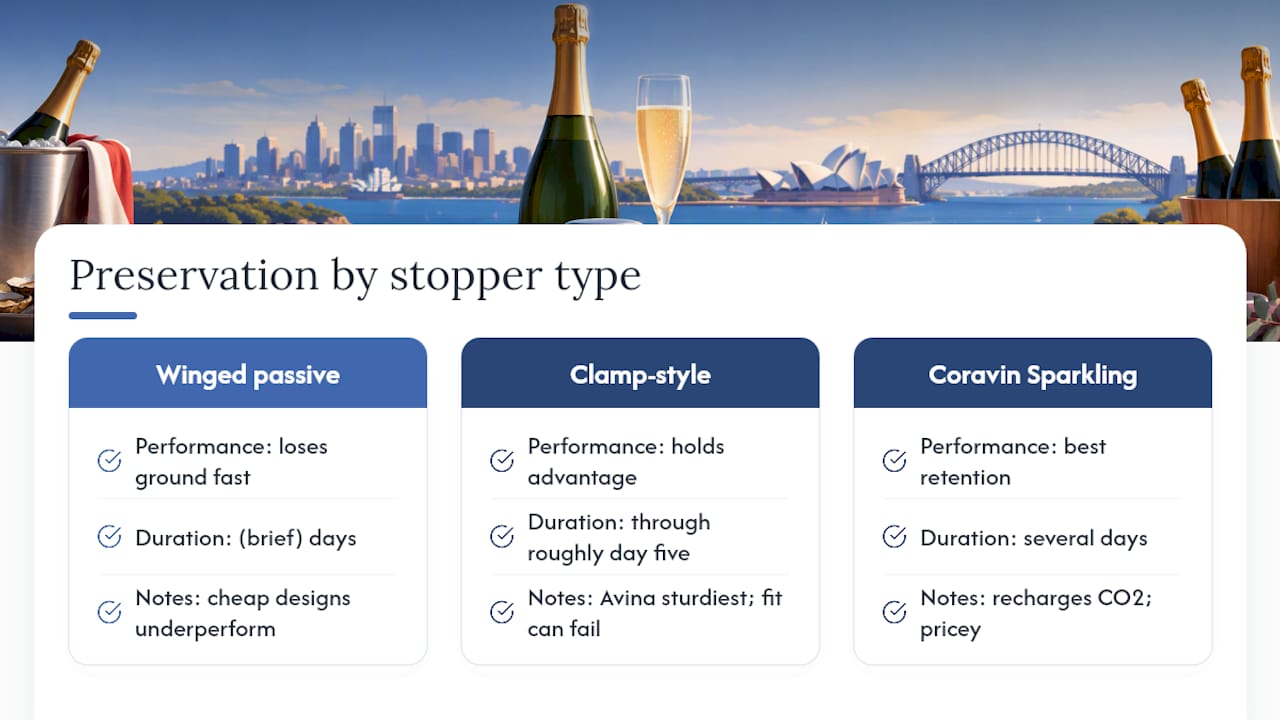
Expect a genuinely good clamp or valve stopper to hold acceptable fizz for a few days when the bottle is refrigerated upright and reopened gently. Beyond that window, most passive designs start losing ground fast.
Decanter’s side-by-side testing found clamp-style stoppers from brands including Avina, Finest Bubble and Kloveo held their advantage over cheap winged stoppers, staying comparable to premium passive designs through roughly day five. Avina rated sturdiest overall, though it struggled to seal on some thin-neck bottles, a reminder that fit compatibility can undo an otherwise well-built product.
Food & Wine’s parallel testing reinforced the same divide: vacuum pumps performed well on still wine but poorly on sparkling, while switch-style valves designed specifically for fizz did the job properly.
The clearest gap between passive and active preservation showed up in a Bon Appétit trial of the Coravin Sparkling system, which recharges CO2 rather than simply sealing what remains. Testers reported noticeably better mousse and flavour retention over several days compared with a basic stopper, though the system’s price puts it well beyond casual use. That advantage becomes most obvious once headspace grows large after several pours, exactly the scenario where a passive seal has the least gas left to protect.
For most evenings at home, the practical rule holds: pour modest amounts, reseal within a minute, and refrigerate immediately. A clip or valve stopper will comfortably manage one to three days under those conditions.
How to choose the right champagne stopper
Start by being honest about how you actually drink Champagne. Someone finishing a bottle over one dinner needs far less than someone keeping a bottle open across a three-day event.
- Match the stopper to the occasion. A spring-loaded plug is fine for same-evening resealing; multi-day storage calls for a clamp or valve design, and extended or high-value service justifies a pressurised system.
- Check the gasket material. Food-grade silicone tends to outlast rubber, particularly with frequent washing.
- Confirm the locking mechanism holds under pressure, not just how it feels in the shop, since retention geometry decides long-term seal integrity more than gasket softness alone.
- Ask whether the bottle can be stored on its side. Some clamps are only rated for upright storage.
- Verify neck compatibility, especially for magnums, splits, or older bottles with worn glass lips.
- For pressurised systems, check that gas cartridges are available locally before committing to the ongoing cost.
Red flags to avoid: vague “universal fit” language with no stated neck diameter, clips that feel loose out of the packet, missing material specifications, and no visible customer support or warranty information.
APTENT’s perspective on practical stopper choices
A quality clamp or valve stopper covers most occasions, and it is worth keeping on hand permanently rather than reaching for whatever plug happens to fit. Where APTENT sees a genuine case for pressurised systems is longer event service or bottles from the curated Champagne collection worth protecting beyond a single sitting.
Storage habits matter as much as the stopper itself. Understanding how bubbles form and dissipate explains why cold, upright storage slows carbonation loss regardless of which stopper you use. For hosts who would rather leave the logistics to someone else, Event services can manage sparkling-wine handling from pour to pour.
Price range and value comparison of champagne stopper types
Spring-loaded plugs sit at the entry level, typically the cheapest stopper style stocked in supermarkets and kitchenware stores. Clamp and lever-lock designs cost more, reflecting the stainless-steel or chrome-plated hardware and firmer locking arms, and they represent the better long-term value for anyone who opens sparkling wine regularly. Valve and switch-style stoppers sit in a similar mid-range bracket, priced for the more deliberate airtight mechanism rather than premium materials.
Pressurised CO2 systems occupy an entirely different bracket again. The upfront cost of the device is substantial, and ongoing gas cartridges add a per-use expense that a passive stopper never carries. That cost only pays off in specific circumstances: frequent multi-day service, high-value bottles, or hospitality settings pouring the same bottle across several sittings.
Judged purely on cost per use, a durable clamp stopper is hard to beat for the average household. It is bought once, lasts years with basic care, and handles the one to three day window that covers most real drinking occasions. The pressurised system earns its price only when the bottle being protected, or the length of service required, genuinely calls for it. Buying the expensive option for a Tuesday night spritz is money better spent on the wine itself.
Trusted brands and manufacturers to look for
Reliability in this category comes down to hardware quality more than brand recognition alone. Decanter’s testing singled out Avina, Finest Bubble and Kloveo as clamp-style stoppers that held their seal well past the point where cheaper winged stoppers began to fail, with Avina rated the sturdiest of the group despite some fit issues on thinner necks.
At the pressurised end of the market, Coravin’s Sparkling system is the name most closely associated with active CO2 preservation, and it is the model Bon Appétit’s trial used to demonstrate what active gas recharge can do that a passive seal cannot.
For everyday stainless-steel and chrome stoppers, mainstream kitchenware retailers stock reliable options; Kitchen Warehouse’s Barpro stopper is a fair example of the dishwasher-safe, spring-sealed hardware widely available across Australia. None of these brands need to be expensive to work well. The deciding factor, as the testing consistently shows, is whether the locking mechanism holds firm under real pressure, not how polished the packaging looks on the shelf.
Where to buy a champagne stopper in Australia
Kitchenware retailers and major supermarkets stock the bulk of entry-level and mid-range stoppers, letting you physically check the clamp mechanism before buying, a genuine advantage given how much fit and build quality vary between models. Bottleshops occasionally stock stoppers near the Champagne fridge, though range tends to be limited to one or two designs.
Online retail offers the widest selection, particularly for pressurised systems and premium clamp brands rarely stocked in physical stores. It also makes comparing gasket materials, locking mechanisms and stated neck compatibility far easier than reading a single product tag in an aisle. For gas cartridges supporting pressurised systems, confirm local stock and shipping before purchase, since replacement cartridges are the ongoing cost that makes or breaks the value of that category.
If you are buying Champagne itself alongside the hardware to protect it, sourcing both from a single curated collection saves a second shopping trip and ensures the bottle you are protecting is worth the effort in the first place.
When a simple stopper is enough
For casual entertaining, a clamp stopper handles everything most hosts need. Prolonged service or a genuinely special bottle is where pressurised gear earns its keep. Between pours, reseal fast, refrigerate immediately, and label any bottle left half full during an event.
— APTENT
A curated option when you would rather not manage it yourself
For hosts who want the wine looked after without adding another gadget to the kitchen drawer, APTENT’s event team can manage sparkling-wine service from the first pour to the last, so mousse and temperature stay exactly where they should across an entire evening. Beyond bottle-by-bottle stoppers, A curated selection means pairing the preservation method to a bottle chosen for quality.

Browse the Champagne collection to source bottles worth protecting properly, or look into APTENT Privé private events if you are planning a gathering where sparkling wine service needs to run smoothly for hours rather than minutes. Corporate hosts organising client gifting can also explore Corporate & VIP gifting for a fully managed alternative to sourcing bottles and hardware separately. Getting a quote for an upcoming event takes a few minutes through the events page.
Where these findings came from
- Decanter: How to keep sparkling wine fresh after opening
- Food & Wine: Best wine stoppers, tested
- Bon Appétit: Coravin Sparkling trial
- Food & Wine: Sommelier hacks for open Champagne
Sources
- How to keep sparkling wine fresh after opening | Decanter
- The 6 Best Wine Stoppers of 2026, According to Our Tests | Food & Wine
- Coravin Sparkling spritz experiment | Bon Appétit
- 4 Sommelier hacks to keep an open bottle of Champagne bubbly | Food & Wine
- Barpro Champagne Stopper Stainless Steel | Kitchen Warehouse
FAQ
What is the best champagne stopper available in Australia?
Clamp-style stoppers with stainless-steel hardware and silicone gaskets are the most reliable everyday choice, with Decanter’s testing rating designs like Avina and Kloveo above cheaper winged alternatives. For extended or high-value service, a pressurised system such as Coravin Sparkling performs noticeably better, at a higher cost.
What are the different types of bottle stoppers?
The main categories are clamp or lever-lock stoppers, valve or switch-style stoppers, spring-loaded plugs, vacuum pumps, and pressurised CO2 recharge systems. Vacuum pumps are built for still wine and are not suitable for Champagne, since they remove air rather than retain carbonation.
Which is the best champagne stopper for multi-day storage?
For most households, a well-built clamp or valve stopper holds acceptable fizz for one to three days when the bottle is refrigerated upright immediately after pouring. Beyond that window, or for particularly valuable bottles, a pressurised CO2 system such as Coravin Sparkling shows a clear advantage in preserved mousse and flavour.
What is a champagne stopper called?
It is most commonly called a Champagne stopper or sparkling wine stopper, though clamp designs are sometimes labelled winged or lever-lock stoppers. Retailers occasionally use “sparkling wine saver” for pressurised systems that actively recharge lost gas rather than just sealing the bottle.


