
How to tell if olive oil is good quality before you buy
A good olive oil is fresh, free of sensory defects, and backed by clear traceability or lab markers you can actually verify. The one-line verdict: buy if the bottle carries a harvest date within the last 12 to 18 months, sits in dark glass or tin, and smells fruity rather than flat; walk away if the label shows only a vague “best by” year, sits in clear plastic under bright lights, or costs suspiciously less than everything around it.
Run these checks before you commit to a bottle:
- Harvest date printed clearly, not just a “best before” stamp
- Dark packaging — tin, dark glass, or bag-in-box, never clear plastic
- Lot number and origin stated, ideally single-estate or PDO/PGI
- A quick sniff test for fruitiness rather than a flat, greasy smell
- Price sanity check — genuinely fresh extra virgin rarely comes cheap
Once you’ve run through those, the sensory and lab sections below will confirm what your instincts are already telling you.
Key Takeaways
Good olive oil is defined by recent harvest, zero sensory defects, and verifiable traceability, not by bitterness, colour, or price alone.
| Point | Details |
|---|---|
| Harvest date beats best-by | A date within 12 to 18 months signals genuinely fresh oil worth buying. |
| Trust your nose over your eyes | Fruity, clean aromas matter; colour and fridge tests prove nothing reliable. |
| Read the lab numbers when offered | Low FFA, low peroxide value, and solid polyphenols point to excellent quality. |
| Packaging protects flavour | Dark glass, tin, or bag-in-box beats clear bottles under bright light every time. |
| Match style to purpose | Mild oils suit delicate dishes; robust, high-polyphenol oils suit finishing and heat. |
For a curated pairing experience once you’ve settled on your everyday oil, Aptent’s gourmet collection and private tasting events bring the same attention to provenance and freshness to fine wine and caviar, sourced with the same traceability standards worth demanding from any pantry staple.
Table of Contents
- What does “good quality” olive oil actually mean?
- Check the harvest date and other label checks before you buy
- How to smell and taste olive oil like an expert at home
- Understanding FFA, peroxide value, and polyphenols on a technical sheet
- Does packaging and storage really affect how long olive oil stays good?
- Which home olive oil tests are actually reliable?
- Which quality olive oil suits cooking, roasting, or finishing?
- Frequently asked questions
- Sources
What does “good quality” olive oil actually mean?
“Extra virgin” is a legal classification, not a marketing flourish. To earn it, an oil must be extracted mechanically, without heat or chemical solvents, and pass a sensory panel test under International Olive Council rules that requires zero perceivable defects and a median fruitiness score above zero. Below that sits virgin oil, then lampante (technically inedible without refining), then the various refined and blended grades that dominate cheap supermarket shelves.
Quality within “extra virgin” still spans a wide range. The defining sensory traits, fruitiness, bitterness, and pungency, are positive attributes, not flaws to tolerate. A robust Tuscan oil that makes you cough is not automatically better than a buttery, mild Ligurian one; they simply reflect different olives and harvest timing.
- Fruitiness signals fresh olives, picked and pressed quickly
- Bitterness and pungency (that peppery throat catch) usually track with polyphenol content
- Harvest timing and handling speed matter more than the variety itself
Check the harvest date and other label checks before you buy
Skip the “best by” date if you can find a harvest date instead. Best-by dates are often set two years out regardless of how the oil has actually aged, while a harvest date tells you exactly how fresh the contents are. Freshness is the single biggest driver of perceived quality, and most tasters notice a real drop in aroma and flavour once oil passes 18 months from harvest.
Beyond the date, look for:
- Producer name and mill or lot number — vague brand names with no traceability are a red flag
- Single-origin or PDO/PGI labelling stating a specific region or estate, which signals traceability you can actually verify
- Dark glass, tin, or bag-in-box packaging rather than clear glass or plastic sitting under fluorescent lights, which is important for maintaining high-quality food service standards as detailed in this quick guide**
- A realistic price — genuine extra virgin has a real production cost, and a bottle priced well below the pack usually means blended or aged stock
- Independent quality seals or participation in random off-shelf testing schemes, which carry more weight than a producer’s own marketing claims
Pro Tip: If you’re buying online and the product page doesn’t list a harvest date, email the seller before ordering. A producer proud of a recent harvest will tell you within the hour; one that goes quiet is telling you something too.
How to smell and taste olive oil like an expert at home
Professional tasters use a simple, repeatable method, and you can copy it with nothing more than a small glass and a warm hand.
- Pour a small amount into a dark or opaque glass and cup it in your palm to warm it to around body temperature, which releases the aromatic compounds.
- Cover and swirl the glass, then remove your hand and inhale deeply through your nose.
- Take a small sip, drawing air across your tongue in short, noisy slurps to aerate the oil across your palate.
- Notice where the sensation lands: fruitiness up front, bitterness across the tongue, and pungency as a peppery catch at the back of the throat.
Good oil should smell green and vegetal, or ripe and fruity depending on the cultivar, with a clean bitterness and a peppery finish that makes you cough lightly. Defects are unmistakable once you know them: rancid (crayon-like, stale nuts), fusty (compost, fermented olives left too long before pressing), musty (damp basement), metallic, or vinegary. Any of these mean the oil has gone off, regardless of what the label promises.
Intensity is not the scoreboard here. A mild, buttery oil pressed from a delicate cultivar can be every bit as high-quality as an aggressive, throat-searing one, experts caution against treating pungency as a proxy for quality, particularly since comparing two oils side by side is the fastest way to train your palate.
Pro Tip: Keep a mild oil and a punchy one on hand and taste them back to back. The contrast teaches your palate faster than any single bottle ever could.
Never judge on colour alone, deep green tells you nothing reliable about quality. If a bottle tastes rancid or vinegary, don’t cook with it; the flavour won’t disappear with heat, and it’s worth returning to the retailer.
Understanding FFA, peroxide value, and polyphenols on a technical sheet
When a producer publishes lab results, three figures matter most.
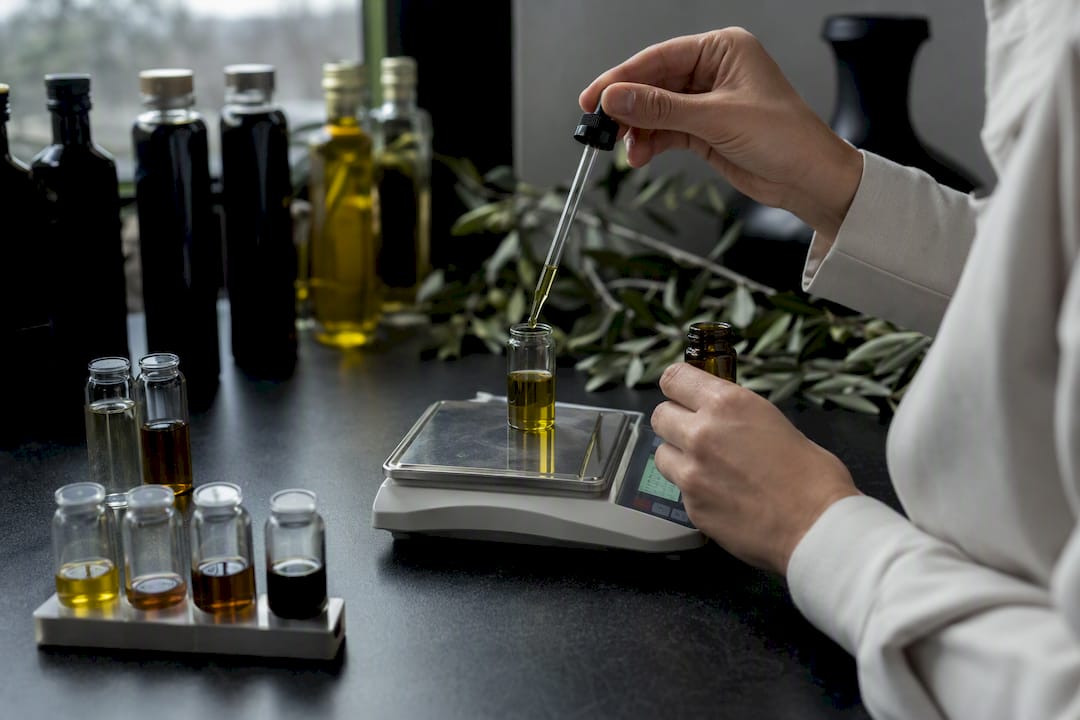
Free fatty acidity (FFA) measures how much the oil’s fat structure has broken down, usually from damaged or overripe olives, or slow processing. EU rules cap extra virgin at 0.8%, but serious producers routinely publish figures under 0.3%, which points to healthy fruit picked and pressed quickly.
Peroxide value (PV) tracks early oxidation. The International Olive Council caps extra virgin at 20 mEq O₂/kg, but genuinely fresh, well-stored oil often sits well under half that.
Polyphenol content isn’t legally regulated the same way, but higher levels generally correlate with more pronounced bitterness, pungency, and a longer shelf life, since polyphenols act as natural antioxidants.
| Marker | What it measures | Sign of quality |
|---|---|---|
| FFA | Fat breakdown from damaged/overripe fruit | Below 0.3% is excellent; up to 0.8% still legal EVOO |
| Peroxide value | Early-stage oxidation | Well under 20 mEq O₂/kg; lower is fresher |
| Polyphenols | Antioxidant compounds tied to flavour | Higher levels support bitterness, pungency, longer life |
If a technical sheet lists none of these, that’s not automatically disqualifying for a small producer, but a brand with nothing to hide will usually show its numbers.
Does packaging and storage really affect how long olive oil stays good?
Dark glass, tin, or bag-in-box packaging block the light and oxygen that degrade oil fastest, clear bottles sitting under bright shop lighting deteriorate noticeably quicker. At home, store your bottle in a cool, dark cupboard, well away from the stove.
- Buy a size you’ll finish within six to eight weeks of opening
- A tight pourer or one-way valve slows oxygen exposure between uses
- If you’ve bought oil in clear glass, decant into a dark cupboard immediately rather than leaving it on the counter
Which home olive oil tests are actually reliable?
The fridge test, chilling oil to see if it solidifies, proves nothing beyond how much saturated fat it contains; even adulterated oils can cloud on cue. Colour is equally unreliable, since it reflects chlorophyll from the olives, not freshness or purity. Skip DIY ignition or “lamp” tests entirely; they’re folklore, not chemistry.
Trust instead: harvest dates, sensory tasting for defects, and published lab figures. Ignore: colour, fridge solidification, and burn tests.
Which quality olive oil suits cooking, roasting, or finishing?
Match the oil to the job rather than assuming one bottle does everything. Milder, lower-polyphenol oils suit delicate dishes like fish or light vinaigrettes, where you don’t want pepperiness fighting the food. Robust, high-polyphenol oils hold their antioxidant protection better under heat and shine as a finishing drizzle over soups or grilled vegetables.
- Buy bag-in-box for everyday cooking to limit oxidation across a larger volume
- Keep a small, precious bottle of a punchy single-estate oil strictly for finishing
A cook’s honest take on picking olive oil
Chasing the “best” oil on paper misses the point; the right oil is the one whose balance suits how you actually cook and eat. Use the sensory test to trust your palate, then let the harvest date and lab figures, when available, confirm you’re not being sold tired stock at a premium price.
Frequently asked questions
How can I tell if olive oil is good quality without lab equipment? Check the harvest date, packaging, and price first, then run the warm-glass sniff and sip test described above. Fruitiness with a clean, peppery finish and no rancid or musty notes is your best at-home signal.
Is homemade olive oil better than store-bought? Small-batch, home-pressed oil can be excellent if the olives are pressed within hours of picking, since speed from harvest to press is what protects quality most. But without lab testing or panel tasting, you’re relying entirely on your own palate to catch defects.
Does a bitter taste mean olive oil has gone bad? No, bitterness is a genuine positive attribute in fresh extra virgin oil and often signals higher polyphenol content. Rancidity tastes stale and greasy, closer to old crayons or stale nuts, which is entirely different from a clean, sharp bitterness.
What’s the fastest way to spot fraudulent or mislabelled olive oil? Look for a harvest date, lot number, and single-origin or PDO/PGI claim together; oils missing all three are harder to trace back to a real estate. A price well below comparable bottles in the same category is often the clearest warning sign.
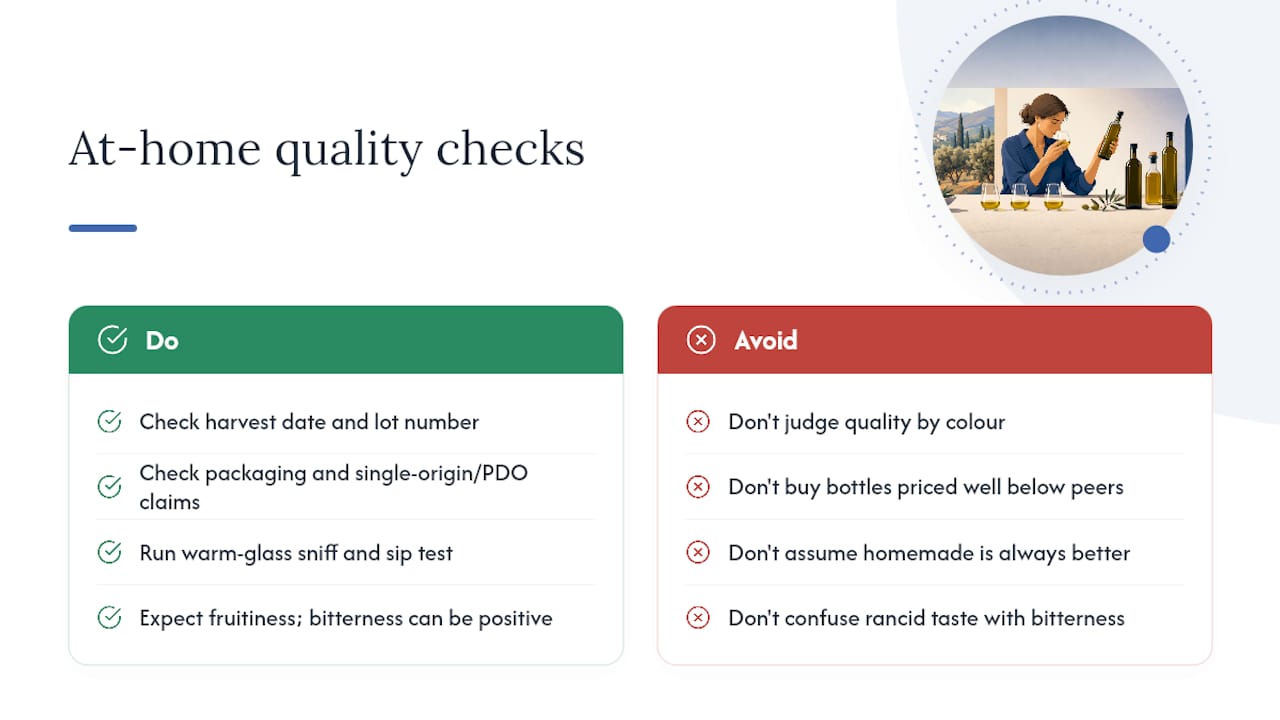
Why doesn’t colour tell me anything about quality? Colour comes from chlorophyll and carotenoid levels in the olives themselves, which vary by cultivar and ripeness, not by freshness or purity. Some of the finest oils are pale gold rather than deep green, so judge by aroma and taste instead.
Sources
- COI/T.20/Doc. No15/Rev. 11 (International Olive Council)
- How to tell good olive oil from mediocre (America’s Test Kitchen)
- 5 expert tips for buying olive oil (AboutOliveOil)
- How to test olive oil at home (LearnOliveOil)


