
What role does yeast play in the fermentation process?
Yeast performs a single, elegant biochemical transaction that underwrites bread, beer, wine and a substantial portion of industrial biotechnology: it converts sugar into ethanol and carbon dioxide, extracting just enough energy along the way to survive and multiply. The stoichiometry is precise. One molecule of glucose yields two molecules of ethanol and two of carbon dioxide(https://en.wikipedia.org/wiki/Ethanol_fermentation), with a net return of two ATP per glucose consumed, a modest energetic prize compared with aerobic respiration, but one that has shaped human cuisine for millennia.
The primary architects of this transaction are two closely related species: Saccharomyces cerevisiae, the workhorse behind bread, wine and ale, and Saccharomyces pastorianus, the cold-tolerant hybrid responsible for lager. Yet the ethanol and CO₂ reaction is only the headline act.
- Alongside the primary reaction, yeast generates hundreds of secondary metabolites, esters, higher alcohols, diacetyl and thiols among them, that determine whether a fermented product tastes clean and fruity or buttery and hot
- These secondary compounds are governed by process variables a producer can actually control: temperature, oxygen exposure, pitch rate and nutrient availability
- Understanding this chain, from stoichiometry to sensory outcome, is what separates a fermentation that is merely functional from one that is genuinely refined
Key Takeaways
Yeast drives fermentation by converting sugar into ethanol and CO₂ while simultaneously generating the secondary metabolites that determine a product’s final aroma and flavour.
| Point | Details |
|---|---|
| Core reaction | One glucose molecule yields two ethanol, two CO₂, and a net two ATP per molecule fermented. |
| Two dominant species | Saccharomyces cerevisiae and Saccharomyces pastorianus underpin most commercial alcohol fermentation. |
| Flavour comes from secondary metabolites | Esters, higher alcohols, diacetyl and thiols shape taste far more than the ethanol itself. |
| Process controls matter | Oxygen at pitching, pitch rate, temperature and nutrient levels (FAN) determine flavour and completeness. |
| Aptent connects science to tasting | Aptent curates wines and Champagnes and hosts private tastings that highlight yeast-driven flavour differences. |
Table of Contents
- The role of yeast in fermentation starts with cell biology
- How yeast converts sugar into alcohol: the metabolic pathway
- Secondary metabolites: how yeast shapes aroma and flavour
- Choosing a yeast strain: Saccharomyces versus non-Saccharomyces
- Yeast’s role across bread, beer, wine, cider and industrial fermentation
- Managing fermentation: oxygen, pitch rate, nutrients and temperature
- Yeast lifecycle, stress and what actually kills a fermentation
- Measuring yeast performance: what the numbers actually tell you
- Sources
The role of yeast in fermentation starts with cell biology
Before any sugar is touched, yeast’s cellular architecture dictates how efficiently that sugar gets processed. Saccharomyces species dominate commercial fermentation not by accident but because their metabolism, cell wall structure and tolerance profile suit high-sugar, alcohol-rich environments better than most other microorganisms.
The plasma membrane is the gatekeeper. Sugar transporters embedded in it determine how quickly glucose, fructose and maltose enter the cell, and membrane integrity itself depends heavily on sterols, particularly ergosterol, which yeast can only synthesise when oxygen is present. This is why brewers oxygenate wort at the start of fermentation rather than throughout it: yeast needs a short aerobic window to build membrane sterols before switching into anaerobic mode for the bulk of the ferment.
Growth follows a predictable arc, and each phase carries operational consequences:
- Lag phase: cells adjust to the new environment and begin synthesising the enzymes needed for uptake and metabolism, a period that can stall a fermentation if pitch rate is too low
- Exponential growth phase: population doubles rapidly, sugar consumption accelerates, and most of the heat and CO₂ output associated with “active” fermentation occurs here
- Stationary phase: nutrient depletion halts population growth, but residual sugar continues converting to ethanol at a slower rate
- Decline phase: viability drops, and cells that are not cropped or removed begin to autolyse, releasing compounds that can taste yeasty or sulphurous
Taxonomically, Saccharomyces belongs to the Saccharomycetaceae family, but the practical reason it dominates industrial fermentation over wild yeasts is tolerance: it handles high sugar concentrations, moderate ethanol accumulation and a wide temperature band better than most competing genera, which is precisely why it was domesticated first.
How yeast converts sugar into alcohol: the metabolic pathway
The conversion happens through glycolysis, a ten-enzyme pathway that splits each glucose molecule into two molecules of pyruvate while generating a small, usable pool of ATP and NADH. Under aerobic conditions with abundant oxygen, pyruvate would head into the mitochondria for complete oxidation. In fermentation, oxygen is scarce or actively excluded, so pyruvate instead gets decarboxylated to acetaldehyde and then reduced to ethanol, a step that regenerates the NAD+ yeast needs to keep glycolysis running.
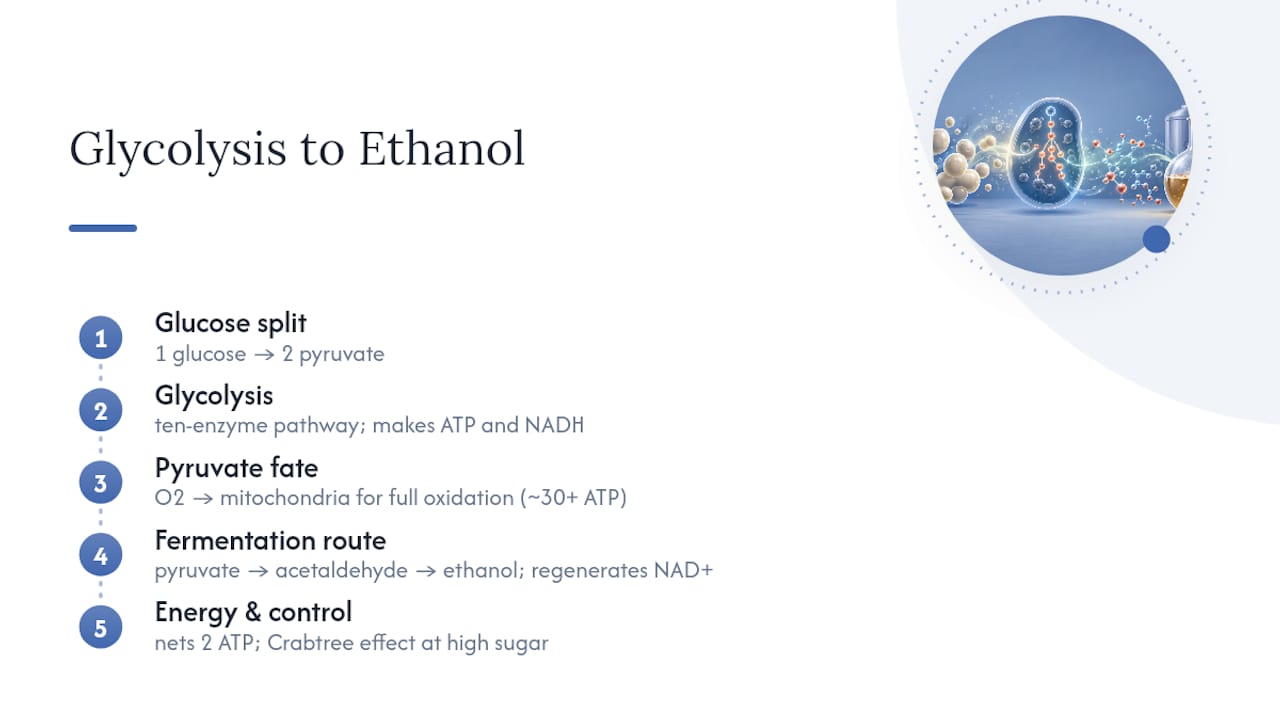
The full reaction nets just two ATP per glucose molecule, a fraction of the 30-plus ATP theoretically available from full aerobic respiration of the same sugar. Yeast trades energy efficiency for speed, and that trade is precisely what makes fermentation commercially useful: rapid sugar conversion over slow, energy-maximising respiration.
What makes this more interesting biochemically is that Saccharomyces cerevisiae often ferments even when oxygen is available, provided sugar concentrations are high. This is the Crabtree effect, and it explains why brewers and winemakers do not need to maintain a strictly anaerobic environment to get reliable alcohol yields. At sugar concentrations typical of wort or must, Saccharomyces prioritises fermentation over respiration by default, a regulatory quirk that has effectively been selected for across centuries of brewing and winemaking practice.
Secondary metabolites: how yeast shapes aroma and flavour
Ethanol and CO₂ indicate that fermentation has occurred. Secondary metabolites answer the far more interesting question of what it tastes like. The same biochemical machinery that produces ethanol also generates dozens of flavour-active compounds, and the balance between them is what separates a forgettable ferment from a genuinely distinctive one.
- Esters (ethyl acetate, isoamyl acetate) contribute fruity notes reminiscent of banana, pear or apple, and form via alcohol acetyltransferase enzymes, principally ATF1 and ATF2
- Higher alcohols (fusel alcohols like isoamyl and phenylethyl alcohol) add solvent-like or rose-like character depending on concentration
- Diacetyl produces a buttery, sometimes cloying note, generated as a byproduct of valine synthesis during active fermentation
- Thiols contribute tropical and passionfruit-like aromatics in certain wine and beer styles, often released from flavourless precursors by yeast enzymes such as β-lyase and glucosidases
Ester production is under genetic control but is also highly responsive to oxygen levels and nutrient availability, which means two batches fermented with the same strain can taste noticeably different if aeration or nitrogen levels shift. Non-Saccharomyces yeasts add a further layer, contributing β-glucosidase and β-lyase activity that liberates aroma precursors Saccharomyces alone cannot access, which is part of why mixed starter cultures have become more common in premium wine and craft beer production.
Producers have real levers here. Cooler fermentation temperatures generally suppress ester formation and favour a cleaner profile; warmer ferments push ester and higher alcohol output up. Oxygen at pitching supports healthy membrane synthesis without excessive stress-driven off-flavour production, while low pitch rates can force yeast to work harder per cell, often increasing ester and fusel output.
Pro Tip: Diacetyl is not eliminated by cooling fermentation down early. It is managed by holding the beer warm near the end of primary fermentation, a deliberate “diacetyl rest” that gives yeast time to reabsorb the compound before it locks into the final product.
Choosing a yeast strain: Saccharomyces versus non-Saccharomyces
Strain selection is where fermentation science meets product design. Saccharomyces strains remain the industry standard for good reason: they deliver reliable attenuation, tolerate ethanol concentrations well past 10% in many cases, and ferment predictably across a known temperature range. Non-Saccharomyces genera, including Brettanomyces, Torulaspora and Pichia, trade some of that reliability for biotransformation abilities that unlock aroma compounds Saccharomyces leaves untouched, which is why craft producers increasingly blend the two rather than treating strain choice as binary.
A practical selection process looks like this:
- Define the target sensory profile first, clean and neutral, fruity and estery, or complex and biotransformative, before touching a strain catalogue
- Check flocculation behaviour, since strongly flocculent strains clarify faster but can under-attenuate if they drop out before finishing available sugars
- Match attenuation range to the final gravity target, confirming the strain’s typical apparent attenuation against the recipe’s fermentable sugar profile
- Confirm ethanol tolerance against the anticipated final alcohol percentage, with a safety margin for stressed or underperforming batches
- Assess temperature range against available fermentation control, since a strain suited to 12°C lager conditions will behave very differently at 22°C
- Consider mixed or sequential inoculation with non-Saccharomyces strains if aroma complexity is the priority, sequencing them ahead of a Saccharomyces finisher
Flocculation, attenuation, sugar range and ethanol tolerance are not abstract lab metrics. Together they predict clarity, sweetness, alcohol strength and how forgiving the strain will be of an imperfect process, which is exactly the kind of detail that separates a technically correct ferment from a genuinely well-made one.
Yeast’s role across bread, beer, wine, cider and industrial fermentation
The underlying biochemistry stays constant, yet how it gets deployed varies enormously by application.
- Bread: yeast produces CO₂ that gets trapped in gluten strands, giving dough its rise over a relatively short one to three hour proof; commercial bakers typically use active dry, instant or fresh compressed yeast forms, chosen for speed and consistency rather than flavour complexity
- Beer: wort composition (extract density, nutrient load), pitch rate and fermentation temperature together determine flavour outcome; brewers routinely re-pitch yeast across successive batches, which demands careful cropping and viability checks to prevent flavour drift, unlike most other food fermentations that use yeast only once
- Wine and cider: fermentations run slower and cooler, often over one to three weeks, with careful nitrogen management since grape must and apple juice can be nutrient-limited compared with brewer’s wort; aroma compounds continue evolving through the ferment as esters and thiols develop
- Industrial applications: biofuel production favours high-tolerance, fast-fermenting Saccharomyces strains optimised purely for ethanol yield rather than flavour, while food processing uses such as leavening agents or flavour extracts select strains for specific enzymatic outputs rather than sensory balance
Scale changes the calculus too. A boutique winery might ferment in open-top vats measured in hundreds of litres with hands-on monitoring; an industrial ethanol plant runs continuous fermentation in vessels holding hundreds of thousands of litres, where strain robustness under stress matters more than nuance.
Managing fermentation: oxygen, pitch rate, nutrients and temperature
Every producer, regardless of scale, is managing the same four levers, just with different tolerances for error.
- Oxygenate at inoculation, not throughout: a short aerobic window supports sterol and unsaturated fatty acid synthesis for membrane integrity, after which the fermentation should run anaerobically to avoid unwanted oxidative stress on the yeast
- Calculate pitch rate deliberately: under-pitching stresses the population into producing excess esters and fusel alcohols, while over-pitching can suppress desirable ester formation and waste yeast biomass; viability checks before pitching catch a batch that looks adequate on paper but performs poorly in the tank
- Monitor free amino nitrogen (FAN): FAN levels directly affect yeast health and fermentation completeness, and a nutrient-poor must or wort risks a sluggish or incomplete ferment regardless of how healthy the yeast looked at pitching
- Hold temperature within the strain’s designed range, then track specific gravity and pH over time; a fermentation that stalls two or three points above expected final gravity usually points to insufficient nutrients, temperature too low for the strain, or a viability problem at pitch, not a fault in the recipe itself
Pro Tip: If a fermentation stalls, resist the urge to add more yeast immediately. Check temperature and gravity trend first. A stalled ferment is often a stressed population that needs gentle rousing or a slight temperature nudge, not fresh cells competing for depleted nutrients.
Fermentation kinetics tell their own story here. A fermentation curve that plateaus too early usually means nutrient exhaustion or a temperature drop below the strain’s active range, while one that never accelerates properly points back to an inadequate pitch rate or poor initial oxygenation.
Yeast lifecycle, stress and what actually kills a fermentation
Between batches, yeast has to survive storage, and how well it survives determines whether the next fermentation starts strong or struggles from day one. Cropping (harvesting yeast at the end of fermentation) needs to happen at the right point in the decline phase, since waiting too long risks autolysis, where dying cells rupture and release compounds that taste yeasty, sulphurous or simply off.
- Cold storage between 2°C and 4°C slows metabolic activity and extends viable storage life, though most brewers still recommend repitching within one to two weeks
- Ethanol accumulation itself is a stressor; yeast tolerance varies by strain, and pushing a low-tolerance strain past its comfortable range reduces viability for any subsequent generation
- Osmotic shock from high-sugar environments, particularly at the start of a high-gravity ferment, can stress cell membranes before fermentation even gets underway
- Heat stress above a strain’s tolerance ceiling denatures key enzymes and can trigger premature flocculation or cell death
Contamination is the other major threat, and it rarely announces itself politely. Wild yeasts and bacteria such as Lactobacillus or Pediococcus compete for sugar and can produce off-flavours ranging from sour to solvent-like. Sanitation protocols, no-rinse sanitisers, dedicated equipment for wild fermentation projects, and prompt cropping and cold storage between uses, remain the most reliable defence, alongside routine microscopic checks for unexpected cell morphology.
Measuring yeast performance: what the numbers actually tell you
Numbers matter more than instinct once a fermentation is underway, and the gap between apparent and real attenuation trips up more producers than any other single metric.
| Metric | What it measures | Typical use |
|---|---|---|
| Specific gravity | Sugar remaining in solution | Tracked daily to follow fermentation progress |
| Apparent attenuation | Gravity drop measured directly, ignoring alcohol’s effect on density | Quick daily check, slightly overstates true sugar conversion |
| Real attenuation | Corrected for alcohol’s density effect | More accurate final comparison against recipe target |
| Cell count / viability (methylene blue) | Live versus dead cells in a sample | Confirms pitch is healthy before inoculation |
A fermentation curve that tracks gravity loss against time reveals problems long before they show up in the glass. A curve that flattens well above target usually means nutrient depletion or a stressed pitch, prompting a nutrient check or gentle rousing rather than a fresh yeast addition. Sensory screening at key checkpoints, smelling for diacetyl, checking for excessive solvent notes, tasting for unexpected sourness, catches the kind of drift that gravity readings alone will miss.
What the industry already knows about managing yeast well
Oxygenating cooled wort at the start of fermentation, then holding the beer warm for a deliberate period near the end of primary fermentation, gives yeast time to reabsorb diacetyl before it becomes a permanent part of the flavour profile. Brewers who skip this step, or who crop and repitch without checking viability, tend to see flavour drift across successive batches rather than in any single ferment.
This is standard practice among brewers who manage yeast as an active, living input rather than a passive ingredient, and it is one reason repitched batches from careful producers stay consistent while careless ones drift. Aptent’s own writing on how champagne bubbles form touches on a related secondary fermentation principle worth exploring for readers curious about CO₂ dynamics beyond the still ferment.
What yeast science means for how we curate a tasting
Aptent’s curators treat yeast-driven flavour variation as a genuine point of distinction, not a footnote. A Champagne finished with prolonged lees contact tastes fundamentally different from a still white fermented cool and fast, and that difference traces directly back to which esters, thiols and autolytic compounds the yeast generated and how long they had to develop. Our wine colour and cheese ageing explainers cover adjacent biochemistry for readers who want the fuller picture. When we pair a rare vintage with caviar at a private tasting, that pairing decision often starts with understanding exactly what the yeast contributed to the glass, not just what the label says.
Bringing the science of fermentation to your table
Understanding the biochemistry behind a bottle changes how you drink it. Aptent exists precisely for readers who want that depth translated into an experience worth tasting, not just reading about.

Aptent’s curated collection favours producers whose fermentation practices show in the glass: wines with genuine aromatic complexity from careful yeast management, and Champagnes where lees-derived character is unmistakable rather than incidental. For a hands-on introduction to how yeast science shapes what you taste, Aptent’s private gourmet events pair fine wine with premium caviar under expert guidance, built for individuals and corporate groups who want a tasting experience grounded in real technical insight rather than a generic wine night. Browse the current collection or check available event dates on the Aptent Gourmet landing page, or if you are planning ahead, a gourmet gift card lets someone else choose their own moment to explore it.
Sources
- The role of yeasts in fermentation processes — Microorganisms (PMC)
- Professional yeast fermentation — Wyeast Lab


