
Event planners: 60–90 minute corporate wine tasting ideas for teams
A 60- to 90-minute blind tasting competition or a guided varietal flight delivers the strongest balance of engagement and approachability for most corporate groups. Both formats give people a shared task, a reason to talk to colleagues they rarely see, and a natural finish line. The details that make either one memorable, from pour sizes to reveal moments, are below.
TL;DR:
- Blind tastings work best for groups of 12 to 60 because structure and facilitation keep quieter colleagues engaged more than the number of wines.
- Activities like blind price-point challenges and blending competitions encourage genuine team-building by focusing on creativity and reasoning rather than correct answers.
- Maintaining consistent pour sizes of 30 mL and sharing a clear tasting theme improves fairness and enhances the tasting experience for all participants.
- Venue setup, including lighting, noise control, and table arrangements, significantly impacts taste perception and overall event quality.
- Featuring a memorable story or reason behind a rare bottle at the end of a tasting creates a lasting impression and enhances storytelling value.
Table of Contents
- Corporate wine tasting ideas for every group size and goal
- Team building wine tasting activities that actually get people talking
- Wine pairing corporate events: building a menu that supports conversation
- Corporate wine tasting events: budget, pours and venue essentials
- How to run a controlled blind tasting at a corporate event
- Curation and the small details that make a tasting memorable
- How Aptent turns these ideas into a done-for-you event
- Sources
- FAQ
Corporate wine tasting ideas for every group size and goal
Choosing the right format matters more than choosing the right bottle. A room of twelve executives needs a different structure to a client function for 120, and the tone you want (competitive fun versus refined hospitality) should shape the whole run sheet before a single wine is selected.
- Blind tasting competition: teams guess grape, region or price point from unlabelled pours. Works beautifully for groups of 12 to 60 and is the format most likely to get quiet colleagues talking, because structure and facilitation matter more than the size of the wine list for keeping a corporate crowd engaged.
- Guided varietal flight: a sommelier or host walks the room through four to six wines with a light narrative thread. Ideal for client entertainment where the aim is polish rather than competition.
- Blending lab: small teams create their own blend from base varietals, then pitch it. Excellent for genuine team-building because it rewards creativity over correct answers.
- Pairing dinner: wines matched course by course. Suits VIP hospitality and smaller executive groups where conversation, not scoring, is the point.
- Tasting stations: guests circulate between themed stations (region, producer, style). This scales well for 80 plus guests and mixed arrival times, similar to the flow used in wine pairing station events.
For mixed-drinking groups, run the same activity with an alcohol-free flight alongside the wine flight so nobody sits out the scoring sheet. At 12 guests, one host can run the whole room; at 120, split into stations or heats and use a single scorekeeper to keep results consistent.
Team building wine tasting activities that actually get people talking
A tasting only becomes team building wine tasting when there’s a task, not just a pour. These seven activities work across the formats above and need nothing more exotic than coded bottles, scorecards and a bit of nerve from the host.
- Blind price-point challenge — teams rank wines from cheapest to most expensive; biggest gap between guess and reality gets a prize for boldness, not accuracy.
- Terroir relay — each table gets one region’s wine and must present three facts about it before the reveal.
- Blending competition — small teams blend from base wines and name their creation.
- Label-and-story reveal — guests guess the producer’s story before labels come off.
- Vintage detective — identify the youngest and oldest wine in a flight using colour and structure cues.
- Pairing tournament — teams match wines to a surprise mystery food box.
- Producer story round — a short narrative on sourcing or sustainability read aloud between pours.
Keep scoring sheets simple: name of team, three or four guess fields, a space for one sentence of reasoning. That reasoning line is what makes scoring inclusive, since beginners can win points for a clever explanation even when the guess is wrong.
Pro Tip: Save the biggest reveal for last, and read out the reasoning behind the top-scoring team’s guesses before you reveal the correct answer. It builds suspense and rewards thinking, not just luck.
Wine pairing corporate events: building a menu that supports conversation
The wines should share one clear theme, whether that’s a single grape across three regions, an old world versus new world contrast, or a run of price tiers tasted blind. A themed comparison gives people a reference point, which is what actually sustains conversation once the novelty of the first pour wears off.
Food should support that conversation rather than compete with it. The Telegraph’s tasting guidance is blunt on this point: don’t hold all the food back for the end. Guests need something neutral in front of them from the first pour, both for palate management and simple comfort.
A sequence that works for most corporate flights:
- Neutral starters (plain crackers, bread) alongside the first, the lightest wine
- Light whites paired with delicate bites, such as Champagne matched to canapés
- Medium reds with charcuterie or hard cheese
- A restrained dessert or fortified pour to close, kept small so it doesn’t overpower the tasting notes before it
Single-serve bites beat shared platters for hygiene and pacing, and a QR-coded tasting sheet on each table saves a host from repeating tech specs six times a night. Leave three to four minutes of pure talking time between each pour before moving on.
Corporate wine tasting events: budget, pours and venue essentials
Pour size decides your bottle maths more than anything else. The Australian Wine Research Institute uses 30 mL as the benchmark for controlled sensory assessment, and it works just as well as a hospitality standard: a 750 mL bottle gives you roughly 25 tasting pours at that size, which is what makes a six-wine flight for 40 guests calculable in bottles rather than guesswork.
| Budget band | Per-guest cost focus | What it typically includes |
|---|---|---|
| Basic | Entry | House wine flight, simple scorecards, standard glassware |
| Mid | Balanced | Curated 4 to 6 wine flight, printed tasting notes, rented glassware |
| Premium | Full hospitality | Sommelier-led flight, plated pairings, premium and rare bottle inclusions, dedicated event staff |
Venue set-up affects taste perception more than most planners expect. AWRI’s own course notes flag light, noise and ambient scent as genuine variables in a tasting room, so cut scented candles, dim harsh overhead lighting slightly, and keep background music low during actual tasting rounds. Round tables of six to eight work better than long banquet seating for group scoring. Budget for rental glassware, spittoons or dump buckets at every second seat, and confirm ventilation if the space runs warm.
Check responsible-service obligations and any licensing conditions with the venue or your beverage provider before the date is locked in, particularly for events with external guests.
How to run a controlled blind tasting at a corporate event
A well-run blind tasting borrows its rigour from wine science and hides it behind good hosting. The AWRI’s sensory-evaluation approach recommends coded samples, a constant pour size and stable temperature, and that framework adapts cleanly to a corporate room without feeling like a laboratory.
- Source your wines and code each bottle with a letter or number, keeping the answer key with one organiser only.
- Number the glasses or tasting mats, not the bottles, and set up the pour station so every table gets an identical sequence.
- Chill or bring wines to serving temperature ahead of time, since temperature shifts change how a wine reads on the palate.
- Pour a consistent 30 mL per taste and randomise the order between tables.
- Allow talking within teams but hold all correct answers until every table has submitted a scorecard.
- Run the reveal as a moment, not a formality, reading scores from last place up.
A 30 mL pour, held constant across every glass, is the control that makes a blind tasting fair rather than random guesswork.
Confirm dietary needs and allergies before the night, offer an alcohol-free flight running in parallel, and make spitting into a bucket a normal, unremarked option rather than an awkward one.
Curation and the small details that make a tasting memorable
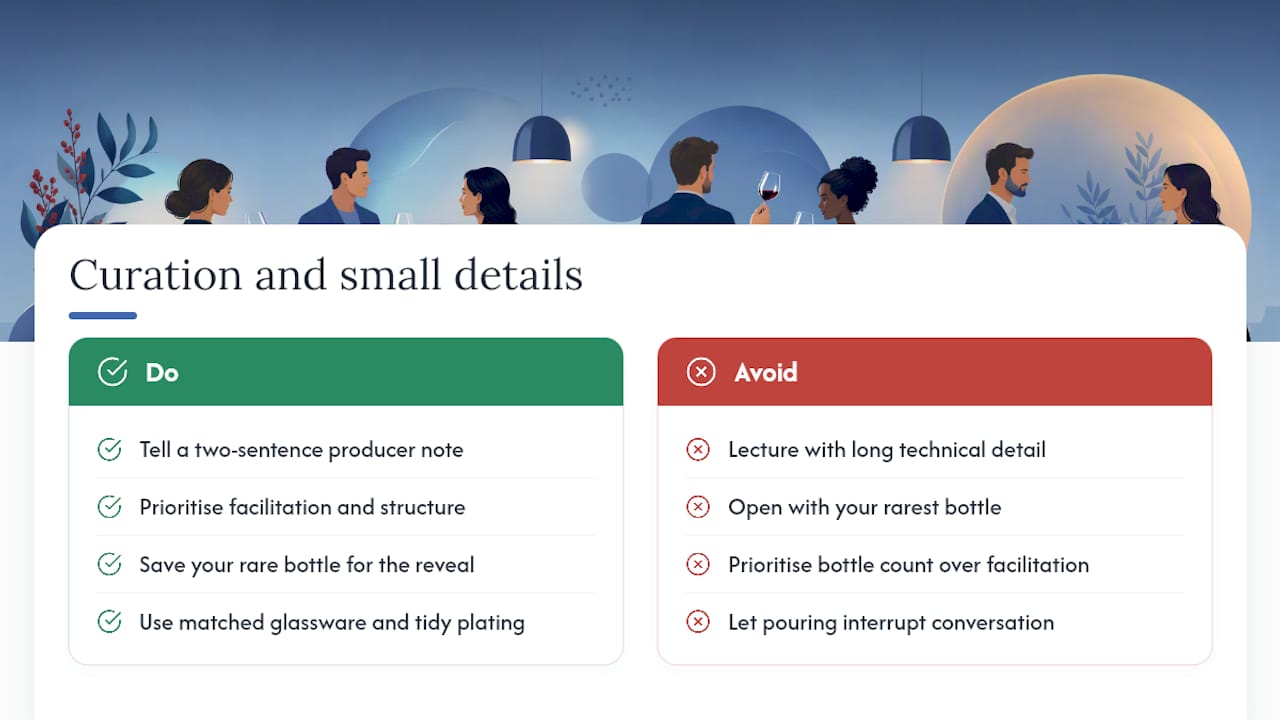
Storytelling beats lecturing every time. A concise producer note, two sentences on why a wine ended up in the flight, does more for a room than five minutes of technical detail nobody asked for. Facilitation and structure consistently outperform sheer bottle count when it comes to what guests actually remember.
Save your rarest bottle for the reveal moment, not the opening pour, so its story lands when the room is already paying attention. A crowd-pleaser up front settles nerves; a rare, well-told bottle at the close is what people mention in the follow-up email. Presentation choices, matched glassware, tidy plating, a staff member who pours without interrupting conversation, do more to signal quality than the price tag on any single label.
— APTENT
How Aptent turns these ideas into a done-for-you event
Specialist providers handle the parts of a corporate tasting that eat the most planning time: sourcing rare bottles, coordinating rental glassware, and briefing staff who know how to pour without breaking the room’s rhythm. For a boutique VIP tasting with a handful of executives or key clients, APTENT Privé is built for exactly that scale of curation and hospitality.
Running a larger client function instead, one with stations, a bigger guest list, or multiple wine and caviar pairings, sits better with Gourmet Events, which manages the logistics end to end rather than leaving an internal team to chase rentals and run sheets. Once the night wraps, Corporate & VIP gifting turns the standout bottle from the evening into a thank-you gift for clients or a wrap-up gesture for staff who ran the scoring sheets. If you’re at the stage of choosing bottles rather than booking a full service, browse the wine collection or champagne selection directly and build the flight yourself. Either way, the next step is the same: get in touch through the events page and describe your guest count and date.
Sources
For the sensory science behind blind tasting controls, the AWRI’s practical guidance is the primary reference. For pacing and wine counts, Wine Folly’s hosting guide is a solid practical companion, and Aptent’s blind tasting setup guide covers the on-the-night mechanics in more detail. For broader event and culinary framing, see this guide to culinary experiences.
- Practical sensory evaluation considerations - The Australian Wine Research Institute
- How to host a wine tasting at home — The Telegraph
- Corporate wine tasting event: complete planning guide — The Wine Voyage
FAQ
What Are the 5 S’s of Wine Tasting?
The 5 S’s are commonly taught as see, swirl, smell, sip and savour, a simple sequence for assessing a wine’s colour, aroma and structure before judging it. Building these five steps into your tasting sheet gives beginners a script to follow, which is exactly what keeps a corporate flight moving without confusion.
What Are Some Good Themes for a Corporate Wine Tasting?
Strong themes include a single grape variety compared across regions, old world versus new world styles, or a price-tier blind challenge where teams rank wines from cheapest to most expensive. A themed comparison gives guests a reference point that makes discussion far easier than an unthemed grab-bag of bottles.
What Is the 75 85 95 Rule for Wine?
This is a piece of tasting folklore rather than an established industry standard, and definitions of it vary depending on where you read it. Treat it as a talking point for your flight rather than a rule to build scoring around.
What Should Be on a Corporate Wine Tasting Menu?
A good menu runs neutral starters into light whites, then medium reds with charcuterie, finishing on a small dessert or fortified pour, with food served from the first glass rather than saved for the end. This sequencing keeps palates fresh and supports conversation through the whole event rather than just the finale.
How Many Wines Should a Corporate Tasting Include?
Most hosting guides land on three to six wines as the sweet spot, allowing 10 to 15 minutes per wine to keep a room engaged without fatigue. Beyond six wines, most groups lose the thread of comparison that made the tasting interesting in the first place.


